


In this article, we discuss the differences between Crimp and Solder connections. Crimping and soldering are the two most common ways to connect wires to terminals and connectors. While both methods are widely used, they are designed for different applications and working conditions. Understanding how each method works, along with its strengths and limitations, can help your business make better decisions and avoid costly connection failures.
Understanding Crimp Connections
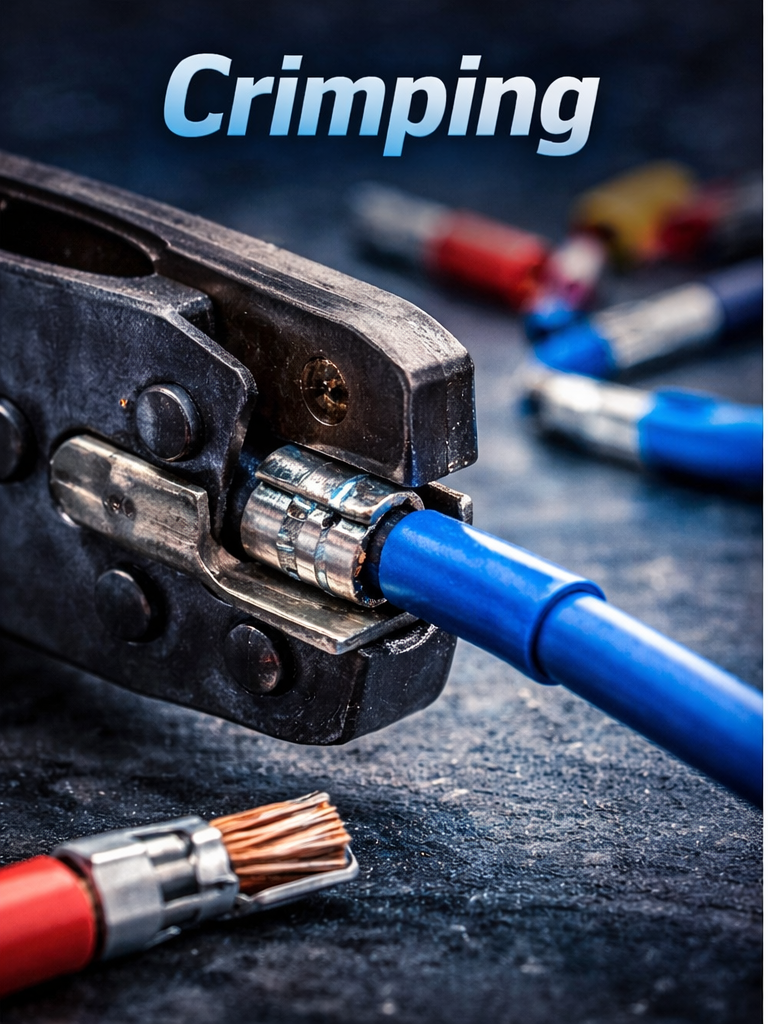
A crimp connection is formed by mechanically compressing a metal terminal around a stripped wire conductor using a dedicated crimping tool. When executed correctly, the terminal and wire strands are cold-welded together, creating a solid mechanical bond and a stable electrical interface.
Crimping is widely used across industries such as automotive manufacturing, automatización industrial, renewable energy systems, and heavy machinery. Its popularity is largely driven by its repeatability and suitability for large-scale production environments.
Advantages of Crimp Connections
High Consistency and Long-Term Reliability
A properly executed crimp forms a gas-tight connection, preventing oxygen and moisture from reaching the conductor. This significantly reduces the risk of corrosion, oxidation, and increased contact resistance over time.
Fast and Efficient Assembly
Crimping is a rapid process that supports high-throughput manufacturing. When combined with semi-automatic or fully automatic crimping machines, it enables consistent results with minimal cycle time, making it ideal for mass production.
Excellent Mechanical Strength
Crimped terminals offer superior resistance to vibration, shock, and mechanical stress. This makes them especially suitable for dynamic environments such as vehicles, equipos industriales, and power distribution systems.
Scalability and Automation Compatibility
Crimping processes can be easily standardized and automated. For businesses focused on scalability, crimp connections allow production capacity to increase without compromising quality.
Limitations of Crimp Connections
Despite their advantages, crimp connections require:
-
Properly matched terminals, wires, and tooling
-
Controlled crimp force and tooling calibration
Incorrect crimp height or unsuitable tools can lead to weak connections. Sin embargo, with proper process control and inspection, these risks are highly manageable in professional manufacturing environments.
Understanding Solder Connections
A solder connection is created by applying heat to melt a solder alloy, which flows between the wire and terminal to form an electrical joint. Once cooled, the solder solidifies, holding the connection in place.
Soldering is commonly used in electronics manufacturing, especially for printed circuit boards (PCBs), low-current signal connections, and compact assemblies where space is limited.
Advantages of Solder Connections
Excellent Electrical Conductivity
Soldered joints provide low contact resistance, which is beneficial for signal transmission in sensitive electronic circuits.
Compact and Precise Connections
Soldering allows for fine, detailed work, making it suitable for densely packed electronic components and intricate wiring layouts.
Low Initial Equipment Investment
Basic soldering requires relatively simple equipment, such as a soldering iron and solder wire, making it accessible for small-scale or low-volume applications.
Limitations of Solder Connections
Lower Mechanical Strength
Solder joints are inherently rigid. Under vibration or repeated mechanical stress, soldered connections are more prone to cracking or failure compared to crimped joints.
Slower Production Speed
Soldering is labor-intensive and time-consuming, which limits its efficiency in high-volume manufacturing.
Operator-Dependent Quality
The quality of a solder joint depends heavily on the skill of the operator. Variations in temperature control, solder quantity, and technique can lead to inconsistent results.
Safety and Environmental Concerns
Soldering involves high temperatures and fumes, requiring additional safety measures and workplace controls.

Crimp vs. Solder: A Practical Industry Comparison
Automotive and Manufacturing Applications
Crimping is the preferred method in automotive wiring harnesses and industrial manufacturing due to its vibration resistance, consistency, y cumplimiento de los estándares de la industria.
Aerospace and Heavy Industrial Equipment
In aerospace and mission-critical industrial systems, crimped connections are often mandatory. Standards such as MIL-ESPECIFICACIONES y IPC/WHMA-A-620 recognize crimping as a reliable method for long-term performance.
Electronics and PCB Assemblies
Soldering remains the dominant method for PCB assembly and low-current electronic circuits where compact size and precision are essential.
Low-Volume and Custom Wiring Projects
For prototypes, repairs, or small custom builds, soldering can be a practical solution due to its flexibility and low tooling requirements.
How to Choose the Right Connection Method for Your Business
When selecting between crimping and soldering, businesses should consider:
-
Production volume and scalability requirements
-
Environmental conditions such as vibration, temperatura, and moisture
-
Industry standards and compliance needs
-
Labor costs, automation potential, y confiabilidad a largo plazo
As a general guideline:
-
prensado is ideal for high-volume production, ambientes hostiles, and applications requiring long-term durability.
-
Soldering is best suited for precision electronics, low-current applications, and small-scale custom work.
Conclusión: Optimizing Electrical Connections for Reliability and Efficiency
Both crimping and soldering play essential roles in modern electrical systems, but they are not interchangeable solutions. For most industrial and automotive applications, crimped connections offer superior mechanical strength, consistency, and scalability. Soldering remains valuable in electronics and specialized applications where precision is paramount.
By understanding the strengths and limitations of each method, businesses can optimize their wiring processes, reduce failure rates, and improve overall system performance.
If you are looking to upgrade your wire terminals, conectores, or cable harness assemblies, working with an experienced manufacturer ensures that the right connection method is applied to meet your performance and compliance requirements.
Preguntas frecuentes
1. Is crimping better than soldering for electrical connections?
Crimping is generally better for industrial, automotor, and high-vibration environments. A properly crimped connection forms a gas-tight joint that resists corrosion and mechanical stress, making it more reliable over time than soldering in demanding applications.
2. Are crimped connections more reliable than soldered connections?
Sí, when done correctly, crimped connections are often more reliable. They provide stronger mechanical support and perform better under vibration, temperature changes, and repeated movement compared to soldered joints.
3. When should soldering be used instead of crimping?
Soldering is best suited for low-current electronics, PCB assemblies, and small-scale or custom wiring projects where space is limited and precision is required.
4. Can crimp connections replace soldering in most applications?
In many industrial and automotive applications, crimp connections can fully replace soldering. Sin embargo, soldering is still necessary for printed circuit boards and delicate electronic components.
5.Why do automotive and aerospace industries prefer crimping?
These industries require connections that can withstand vibration, thermal cycling, and long service life. Crimping meets strict standards such as MIL-SPEC and IPC/WHMA-A-620, making it the preferred method.
6. Does crimping require special tools?
Sí. Proper crimping requires matched terminals, wires, and calibrated crimping tools. Using the correct tooling ensures consistent crimp height, pull-out strength, and electrical performance.
7. Are soldered connections weaker mechanically?
Sí. Soldered joints are rigid and can crack under vibration or bending. This is why soldering is not recommended for environments with continuous movement or mechanical stress.
8. Which method is more cost-effective for mass production?
Crimping is more cost-effective for mass production due to faster assembly speed, automation compatibility, and lower long-term failure rates.
