

Introduction
Electric vehicles are no longer a future trend—they are already reshaping the global transportation industry. As EV adoption increases, so does the demand for reliable, efficace, and safe charging infrastructure.
Behind every EV charging station—whether it’s a home charger or a high-power DC fast charger—there are dozens of components working together. Among them, bornes électriques may seem small, but they play a fundamental role in the system’s performance.
So what exactly do terminals do?
In simple terms, terminals are responsible for:
-
Transferring electrical current between components
-
Maintaining stable and low-resistance connections
-
Preventing overheating, energy loss, and failure
In EV charging systems, where currents can reach several hundred amps, even a minor issue in a terminal can lead to serious consequences—ranging from efficiency loss to safety hazards.
This guide will walk you through everything you need to know:
-
The main types of terminals used in EV charging equipment
-
The materials that impact performance
-
How to choose the right terminal for your application
-
Common mistakes and how to avoid them
Whether you are an engineer, buyer, or manufacturer, this guide will help you make more informed decisions.
Why Electrical Terminals Matter More Than You Think
Many people underestimate the importance of terminals because they are relatively small compared to other components. Cependant, in EV charging systems, terminals operate under some of the most demanding conditions.
High Current Means High Sensitivity
EV charging systems deal with substantial electrical loads.
Par exemple:
-
AC chargers typically operate between 16A and 80A
-
DC fast chargers can exceed 200A, 300UN, or even 500A
At these current levels, electrical resistance becomes extremely important.
Even a slight increase in resistance at the terminal connection can result in:
-
Significant heat generation (I²R losses)
-
Voltage drops that reduce charging efficiency
-
Long-term degradation of materials
This means that the quality of the terminal directly affects how efficiently energy is delivered to the vehicle.
Heat: The Silent Failure Factor
Whenever current flows, heat is generated. This is unavoidable.
Cependant, poorly designed or low-quality terminals can make the situation worse.
Here’s what happens:
-
Poor contact → higher resistance
-
Higher resistance → more heat
-
More heat → material expansion
-
Expansion → loosened connection
-
Loose connection → even higher resistance
This creates a feedback loop that eventually leads to failure.
This is why thermal performance is one of the most critical considerations in EV charging terminals.
Mechanical Stress and Daily Use
Unlike static systems, EV chargers are used frequently.
Every time a user plugs in or removes a charging connector:
-
Mechanical force is applied
-
Internal terminals experience stress
-
Contact surfaces wear over time
Additionally, environmental factors such as vibration (especially in public or roadside chargers) can further weaken connections.
A well-designed terminal must be able to withstand:
-
Repeated mechanical cycles
-
Long-term fatigue
-
Environmental stress
Safety Cannot Be Compromised
Electrical failures in EV charging systems are not just inconvenient—they can be dangerous.
Poor terminal connections can cause:
-
Arcing (sparks between contacts)
-
Short circuits
-
Overheating and fire risks
This is why high-quality terminals are not just a performance choice—they are a safety requirement.
Types of Electrical Terminals Used in EV Charging Equipment
Understanding the different types of terminals helps you choose the right solution for each part of the system.
1. High-Current Ring Terminals (Battery Lugs)
Ring terminals are one of the most commonly used terminal types in EV charging equipment.
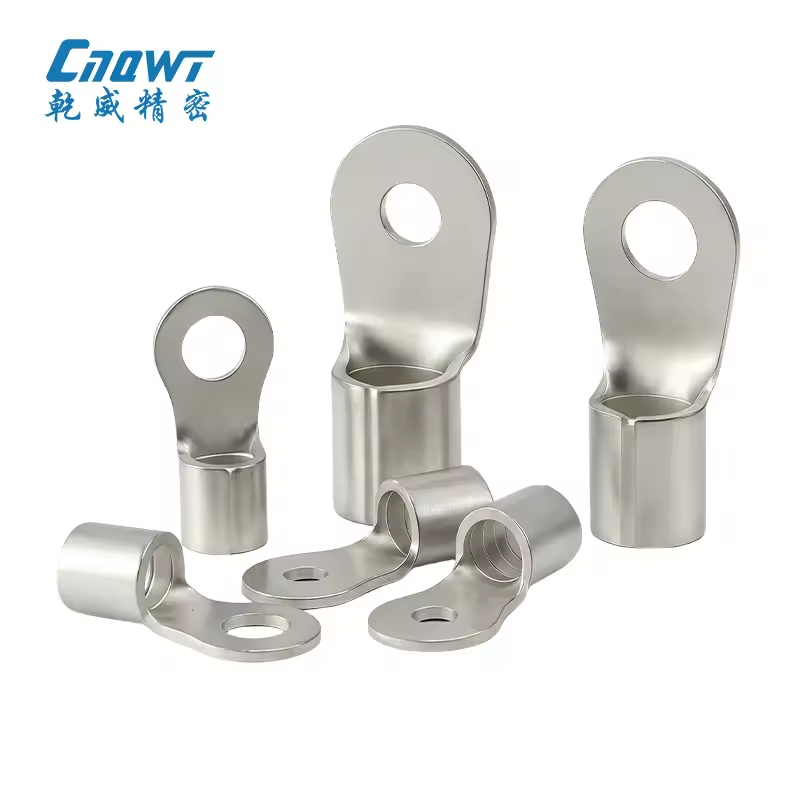
They are typically used in:
-
Power input connections
-
Battery connections
-
Internal wiring systems
The design is simple: a circular ring that is bolted onto a stud or busbar.
Why is this effective?
Because it provides:
-
A large contact surface area, which reduces resistance
-
A strong mechanical connection, which resists vibration
-
Reliable conductivity under high current loads
In high-power applications, these characteristics are essential.
2. Busbar Terminals
Busbars are used to distribute power within the charging system.
Think of them as the main “highways” for electrical current.
Busbar terminals connect cables to these conductive bars.
Their advantages include:
-
Very low resistance
-
Ability to handle extremely high current
-
Efficient heat distribution
They are commonly used in:
-
DC fast chargers
-
Industrial charging stations
3. Crimp Terminals
Crimping is the process of compressing a terminal onto a cable using a specialized tool.
This creates a tight, secure connection between the conductor and the terminal.
Why is crimping preferred over soldering?
Because a properly executed crimp:
-
Forms a gas-tight connection
-
Prevents oxidation
-
Maintains consistent electrical performance
-
Withstands vibration and mechanical stress
In contrast, soldered joints can become brittle and fail under thermal cycling.
4. Pin Terminals and Ferrules
These are typically used in lower-current applications such as:
-
Control circuits
-
Signal connections
-
Terminal blocks
Their main function is to:
-
Keep wire strands together
-
Improve insertion into connectors
-
Ensure consistent contact
While they don’t carry high current, they are still important for system reliability.

5. Connector Contact Terminals
These are precision components located inside EV charging connectors (such as Type 2 or CCS connectors).
They must meet strict requirements:
-
Low electrical resistance
-
High durability under repeated use
-
Strong and stable contact force
These terminals are often engineered with tight tolerances and advanced materials to ensure long-term performance.
Materials Used in EV Charging Terminals
Material selection is one of the most important factors affecting terminal performance.
Cuivre: The Foundation Material
Copper is widely used because of its:
-
Excellent electrical conductivity
-
High thermal conductivity
-
Good mechanical properties
It allows current to flow efficiently while minimizing heat generation.
Cuivre étamé: Practical and Durable
Tinned copper is copper coated with a thin layer of tin.
This provides:
-
Improved corrosion resistance
-
Better performance in humid or outdoor environments
-
Longer service life
For EV charging systems, especially outdoor installations, this is often the preferred option.
Silver-Plated Copper: High-End Performance
Silver has even better conductivity than copper.
Placage d'argent:
-
Reduces contact resistance further
-
Improves performance under extreme current
-
Enhances durability in demanding environments
Cependant, it is more expensive and typically used in high-performance applications.
Insulation Materials
Insulation plays a key role in safety.
High-quality terminals use materials such as:
-
PA66 (nylon)
-
PBT
-
Flame-retardant plastics
These materials must withstand:
-
High temperatures
-
Electrical stress
-
Environmental exposure
How to Choose the Right Terminal
Choosing the right terminal is not just about picking a product—it’s about ensuring system performance.
Note actuelle
The terminal must be rated for the system’s maximum current.
Underrated terminals can:
-
Overheat
-
Fail prematurely
-
Reduce efficiency
Thermal Performance
Good terminals are designed to manage heat effectively.
Cela comprend:
-
Low resistance
-
Good heat dissipation
-
Stable contact under temperature changes
Mechanical Strength
Terminals must remain secure over time.
This requires:
-
Strong materials
-
Good crimp design
-
Resistance to vibration
Corrosion Resistance
For outdoor applications, corrosion is a major concern.
Using tinned or plated terminals helps prevent:
-
Oxidation
-
Increased resistance
-
Connection failure
Standards and Certifications
Always ensure compliance with:
-
IEC standards
-
UL certifications
-
Automotive-grade requirements
This ensures safety and market acceptance.
Common Mistakes to Avoid
Many failures can be traced back to avoidable mistakes:
-
Using low-quality materials
-
Selecting the wrong size
-
Poor crimping techniques
-
Ignoring thermal effects
-
Using non-certified components
Avoiding these mistakes can significantly improve system reliability.
Best Practices for Installation
Proper installation is just as important as product selection.
Best practices include:
-
Using calibrated crimping tools
-
Applying correct torque
-
Using heat shrink tubing
-
Testing under real load conditions
-
Performing regular inspections
Future Trends in EV Charging Terminals
The industry is evolving rapidly.
Future trends include:
-
Higher current capacity for ultra-fast charging
-
More compact designs
-
Advanced surface treatments
-
Smart terminals with monitoring capabilities
Why Qianwei Precision Is a Reliable Partner
Choosing the right supplier is critical.
Précision Qianwei focuses on delivering high-quality terminal solutions for demanding applications.
Key strengths include:
-
High-purity copper materials
-
Precision manufacturing
-
Advanced plating technology
-
Strict quality control
-
Custom solutions for EV charging systems
Whether you need standard or customized terminals, Qianwei provides solutions designed for performance and reliability.

FAQ
1. What terminals are used in EV charging stations?
Common types include ring terminals, busbar terminals, crimp terminals, and connector contact terminals.
2. What is the best material for EV charging terminals?
Copper and tinned copper are the most widely used due to their conductivity and durability.
3. How do you prevent overheating in EV terminals?
By using properly rated terminals, ensuring good crimping, and minimizing contact resistance.
4. Are crimped terminals better than soldered ones?
Oui. Crimped terminals provide better mechanical strength and vibration resistance.
5. What standards apply to EV charging terminals?
IEC, UL, and automotive-grade standards depending on the application.
6. How long do EV charging terminals last?
With proper design and installation, they can last for many years under normal operating conditions.
7. What causes terminal failure in EV systems?
Poor materials, incorrect sizing, bad crimping, and environmental factors.
8. Can standard terminals be used in EV charging equipment?
Not recommended. EV systems require high-performance, certified terminals.
9. What is the role of busbars in EV chargers?
They distribute high current efficiently within the charging system.
10. How do I choose the right terminal for high-current applications?
Consider current rating, matériel, plating, and installation method.
