


In the electrical industry, accurate terminology is essential—not only for clear communication but also for safety, product selection, and long-term system reliability. Yet one of the most common sources of confusion among technicians, köpare, and even experienced engineers is the term “spade connector.”
Across different regions, industries, and even manufacturers, the term “spade” is used inconsistently. It may refer to a push-on terminal, a fork terminal, or any connector with a flat blade-like geometry. This inconsistency can cause miscommunication, delayed projects, or even the selection of incorrect components.
This article provides the most comprehensive explanation of these connector types, deras ansökningar, and the multiple names they go by—so you can confidently choose the right terminal for your electrical projects.
What Exactly Is a Spade Connector?
The word “spade” originally referred to connectors with a flat, spade-shaped metal end. Dock, over time, the definition has blurred. I dag, the term is widely used to refer to:
-
Push-on terminaler
-
Fork terminals
-
Blade-style connectors
-
Quick disconnects
This lack of consistency means that two people may say “spade connector” and be referring to completely different products.
Understanding the differences is critical, especially in environments requiring precision—such as control panels, fordonssystem, machinery wiring, apparater, and high-density electrical assemblies.
Push-On terminaler: The Most Common “Spade Connector”
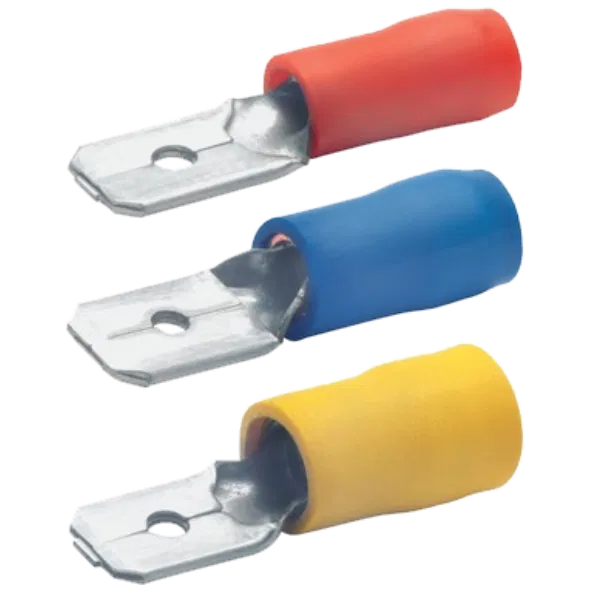
Push-on terminaler (also known as male and female disconnects) are often the first type people think of when they hear “spade connector.”
What They Are
Push-on terminals consist of two parts:
-
Male tab (blade)
-
Female receptacle (housing)
When mated, they create a secure yet easily removable electrical connection.
Key Advantages
-
Fast, tool-free connection
-
Ideal for repeated mating cycles
-
Stable and vibration-resistant when properly crimped
-
Widely used in appliances, fordonssystem, and control panels
Where They Are Used
-
Switch connections
-
Reläer
-
Kabeldragning för fordon
-
Hushållsapparater
-
HVAC systems
-
Power supplies
-
Industriella maskiner
Alternative Names
Push-on terminals can be referred to as:
-
Spade connectors
-
Quick disconnects
-
Disconnect terminals
-
Faston terminals
-
Lucar connectors
-
Bladterminaler
This is the primary source of the “spade terminology” confusion.
Fork Terminals: The Other “Spade Connector”
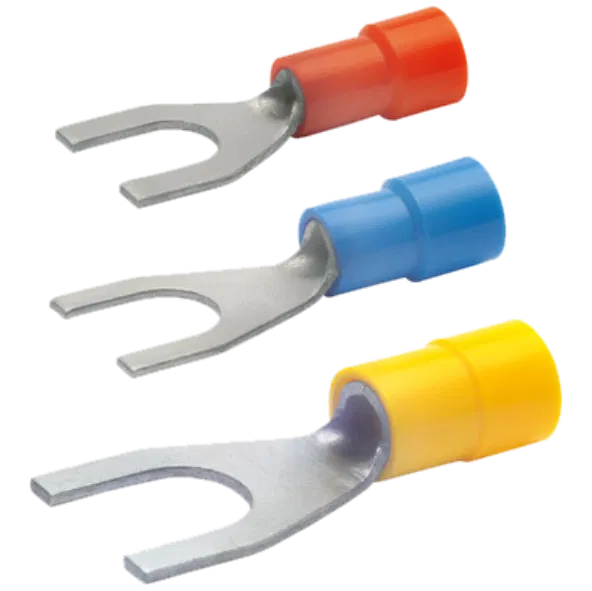
Fork terminals (also called U-type terminals) are another connector that frequently gets labeled as a “spade.”
What They Are
A fork terminal features a U-shaped opening that fits around a screw or stud.
Its design allows easy installation or removal without removing the screw completely.
Key Advantages
-
Saves installation time
-
Ideal for terminal blocks
-
Provides a secure hold under vibration
-
Reduces risk of wiring errors
Typiska applikationer
-
Control panel wiring
-
Terminal blocks
-
Industrial machines
-
Distribution boxes
-
Automotive systems
Alternative Names
Fork terminals are sometimes called:
-
Spadterminaler
-
Fork tongue terminals
-
Screw terminals
-
Horseshoe connectors
-
U connectors
The shared use of the word “spade” further contributes to confusion.
Why So Many Names for Simple Terminals?
The electrical industry lacks standard naming conventions across regions and manufacturers. This leads to:
Brand-Based Vocabulary Differences
Each major brand—Klauke, Cembre, TE-anslutning, Molex, Panduit—uses slightly different naming logic.
Industry-Specific Terminology
Automotive technicians may refer to connectors differently than electricians or appliance manufacturers.
Legacy Terminology
Older terms like Faston och Lucar are still widely used in some regions.
Shape-Based Descriptions
Many connectors resemble:
-
Spades
-
Forks
-
Blades
…and the names often overlap.
This is why “spade connector” has become a catch-all term, even though it technically describes only one shape.
Spade Connector Variants: A Comprehensive Breakdown
Spade-style connectors come in several forms, inklusive:
-
Male push-on tabs (flat blade)
-
Female push-on disconnects
-
Fully insulated push-on connectors
-
Gaffel (U-type) terminaler
-
Heat-shrink insulated versions
-
Non-insulated metal connectors
-
High-temperature spade terminals
-
Chain-type terminals for automated production
Each design exists to serve specific environments such as:
-
High vibration
-
Moisture exposure
-
High current
-
Automated assembly
Understanding these differences ensures proper connector selection and long-term reliability.
Brand Terminology Comparison: How Different Manufacturers Label “Spade” and “Fork” Terminals
Many brands refer to identical terminals using different names. For example:
| Brand | Push-On (Manlig) | Push-On (Female) | Fully Insulated | Gaffel |
|---|---|---|---|---|
| ExpressTERM | Push-on Tab | Push-on Female | Fully Insulated Female | Fork Pre-Insulated |
| Klauke | Push-on Tab | Push-on Female | Fully Insulated | Fork Pre-Insulated |
| Cembre PVC | N/A | N/A | N/A | Fork F-Range |
| Cembre Halogen-Free | Male Disconnect | Female Disconnect | Fully Insulated | Fork P-Range |
| Cembre Reinforced | Reinforced Male | Reinforced Female | Fully Insulated | Reinforced Fork |
| Cembre Chain | Male Chain | Female Chain | Fully Insulated Chain | Fork CP-Range Chain |
This comparison demonstrates how easily terms can vary between brands—even when referring to identical products.
How to Choose the Right Connector for Your Project
When selecting a connector, consider:
Electrical Requirements
-
Voltage and current
-
Insulation type
-
Temperaturklassificering
Mechanical Requirements
-
Vibration resistance
-
Parningsfrekvens
-
Wire size compatibility
Miljö
-
Indoor vs outdoor
-
Fukt, kemikalier, oil exposure
-
Heat and cold
Installationsmetod
-
Manual crimping
-
Automated chain feed
-
Quick replacement needs
If you select a connector only based on the word “spade,” you may end up with a product that does not meet these requirements.
Why Clear Terminology Matters
Accurate connector identification leads to:
-
Fewer wiring errors
-
Better installation efficiency
-
Improved safety
-
Longer product lifespan
-
Reduced cost due to fewer reworks
-
Easier communication between suppliers and engineers
This is why leading suppliers emphasize clarity and use standardized product naming.
Our Commitment: Helping You Make the Right Connection
At Express Electrical & Engineering Supplies Ltd, we prioritize precise terminology and customer education. Whether your project involves:
-
A simple home repair
-
A large-scale industrial panel
-
High-volume manufacturing
-
Elsystem för fordon
-
Appliance assembly
Our experts are always ready to help you decode the many names associated with push-on and fork terminals to avoid confusion and ensure optimal system performance.
Slutsats
The “Spade Debate” exists because the electrical industry has used overlapping terms for decades. Push-on terminaler, fork terminals, and spade-style connectors all serve specific purposes, but their names often get mixed together.
With growing demand for safer, more durable, and more efficient electrical systems, choosing the right connector has never been more important. By understanding the differences—and knowing the many names each connector can have—you can improve wiring reliability and reduce installation errors.
Whether you need push-on terminals, fork terminals, or specialized spade connectors, the key is simple: use clear terminology and choose components designed for your specific application.
