

How to Choose Reliable Connectors for Rugged Sensor Systems
Modern sensor technologies are rapidly evolving, enabling machines and systems to gather and process large amounts of environmental data. From industrial automation to autonomous vehicles, sensor systems are now responsible for monitoring temperature, motion, distance, pressure, and many other parameters in real time.
While much attention is typically given to the sensor devices themselves, the connectors that link sensors to system controllers are equally important. In many cases, connectors are the weakest point in a sensor system, particularly when deployed in zorlu ortamlar involving vibration, nem, extreme temperatures, or electromagnetic interference.
Selecting the right sensor connectors is essential to ensure reliable signal transmission, stable power delivery, and long-term system performance. This guide explores the key factors engineers should consider when choosing connectors for harsh environmental conditions.
Why Connectors Matter in Sensor Systems
Modern sensor systems often combine multiple sensing technologies such as:
-
Vision or imaging sensors
-
Thermal sensors
-
Electromechanical sensors
-
Ultrasonic sensors
-
Magnetic or inductive sensors
Many sensors now perform local signal processing before transmitting the processed data to a central controller or monitoring system. In many designs, sensors and controllers are located in separate modules, which means connectors must carry signals, data, and power between them.
Although connectors may appear to be simple components, they directly affect:
-
Signal integrity
-
Data transmission reliability
-
System safety
-
Maintenance requirements
A poorly selected connector can lead to intermittent connections, signal loss, or system failure, especially in demanding environments.
Electrical Requirements for Sensor Connectors
Sensor connectors must often support several electrical interfaces simultaneously. These may include:
High-Speed Digital Interfaces
Advanced sensors such as cameras or radar modules often require high-speed digital communication channels to transmit large volumes of data.
Analog Signal Connections
Many sensors still use analog outputs that require twisted pair or coaxial connections to maintain signal quality.
Power and Ground Connections
Sensors require stable power supply connections, which must remain reliable even under vibration or temperature changes.
Low-Speed Communication Buses
Industrial sensors often communicate through protocols such as I²C, SPI, CAN, or other low-speed communication buses.
Configuration and Control Signals
Sensor chipsets frequently require additional control or configuration lines that must be integrated within the connector interface.
Because these functions must be integrated into compact designs, connectors must deliver multiple electrical capabilities within a small footprint.
Typical Sensor Applications That Require Rugged Connectors
Sensor connectors are widely used in many industries where reliable data transmission is critical.
Common applications include:
Radar Sensors
Radar systems rely on connectors to transmit data between radar modules and processing systems.
Camera and Vision Systems
Vision sensors used in security systems, industrial inspection, and robotics require high-speed connectors to transmit large image datasets.
Ultrasonic Sensors
Ultrasonic sensors used for proximity detection or measurement must operate reliably in outdoor or industrial environments.
Inductive and Capacitive Sensors
These sensors are commonly used in automation equipment and require stable electrical connections.
Temperature Sensors
Temperature monitoring systems often operate in extreme environments, making connector reliability essential.
In some systems, multiple sensors are combined into arrays, increasing the number of signal channels and connector pin counts required.
Environmental Challenges in Harsh Sensor Applications
Sensors used in outdoor, endüstriyel, or mobile equipment often encounter harsh environmental conditions. Connectors must be designed to withstand these stresses without affecting system performance.
Common environmental challenges include:
Extreme Temperatures
Sensor connectors may be exposed to very high or very low temperatures, which can affect material stability and electrical performance.
Mechanical Vibration and Shock
Industrial machinery, vehicles, and heavy equipment generate constant vibration that can loosen or damage poorly designed connectors.
Moisture and Water Exposure
Outdoor equipment, marine systems, and industrial washdown environments expose connectors to water and humidity.
Chemical Exposure
Industrial environments may include oils, cleaning chemicals, or corrosive substances.
Electrostatic Discharge (ESD)
Sensitive sensor electronics can be damaged by electrostatic discharge if connectors are not properly designed.
Electromagnetic Interference (EMI)
Industrial equipment and high-power electrical systems may generate electromagnetic noise that interferes with sensor signals.
To ensure reliability, connectors must be engineered to protect electrical connections against all these potential threats.
Key Features of Rugged Sensor Connectors
Connectors designed for harsh environments include specialized features to ensure long-term performance.
IP Protection Ratings
Ingress Protection (IP) ratings indicate how well a connector can resist dust and water penetration.
Typical protection levels include:
-
IP66 – Protection against powerful water jets
-
IP67 – Protection against temporary water immersion
-
IP68 – Protection against prolonged immersion
High IP ratings are particularly important for endüstriyel otomasyon, marine systems, and outdoor installations.
Durable Housing Materials
Connector housing materials significantly influence durability.
Common materials include:
Stainless Steel
Provides excellent corrosion resistance and mechanical strength, making it suitable for marine or hygienic environments.
Nickel-Plated Brass
Offers a good balance between conductivity, dayanıklılık, and cost.
Engineering Plastics
Provide strong electrical insulation and lightweight design.
Shielding and Insulation
Sensor connectors often require shielding to protect signal integrity.
Shielding features help reduce:
-
Electromagnetic interference (EMI)
-
Radio frequency interference (RFI)
High-performance insulation materials also allow connectors to withstand high temperatures and voltage stress.
Keying and Retention Mechanisms
Keying and locking mechanisms help ensure connectors are properly mated and securely connected.
Benefits include:
-
Preventing incorrect connector insertion
-
Maintaining stable connections under vibration
-
Improving overall system reliability
Circular Connectors for Sensor Applications
Circular connectors are among the most widely used solutions for sensor systems operating in harsh environments.
Common circular connector types include:
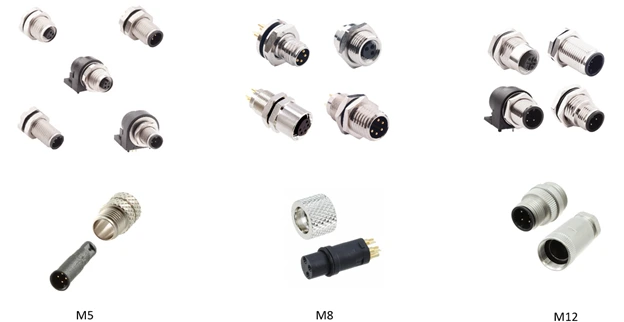
M5 Connectors
Compact connectors used for simple sensor interfaces with limited pin counts.
M8 Connectors
Small but robust connectors commonly used in automation equipment.
M12 Connectors
Larger connectors that support higher pin counts and increased power transmission.
Circular connectors provide several advantages:
-
Rugged construction
-
Compact design
-
Standardized interface formats
-
Reliable sealing against environmental contamination
These connectors are widely used in endüstriyel otomasyon, robotik, and machine vision systems.
Material Selection for Harsh Environments
Choosing the right connector material is critical for ensuring durability and performance.
Stainless Steel
Stainless steel connectors provide superior resistance to corrosion and mechanical damage, making them ideal for harsh environments.
Nickel-Plated Brass
Nickel-plated brass offers strong electrical conductivity and good corrosion resistance while remaining cost-effective.
Aluminum Alloy
Aluminum connectors provide lightweight structural strength for portable or mobile equipment.
High-Performance Plastics
Engineering plastics are commonly used for insulation and lightweight applications.
Each material offers specific benefits depending on the operating environment and application requirements.
Standard vs Custom Sensor Connectors
When designing sensor systems, engineers may choose between standard connectors and custom connector solutions.
Standard Connectors
Advantages include:
-
Established industry standards
-
Faster product development
-
Lower cost and easy availability
Standard connectors such as M8 or M12 connectors are widely used in industrial sensor systems.
Custom Connectors
Custom connectors may be required when systems have unique requirements, such as:
-
Multiple signal types in one connector
-
Special environmental protection levels
-
Unique mechanical constraints
Custom connector designs can integrate güç, sinyal, and communication interfaces into a single compact solution.
How to Choose the Right Sensor Connector
Selecting the right connector requires evaluating several key design factors.
Engineers should consider:
-
Environmental conditions where the sensor will operate
-
Electrical requirements including voltage, akım, and data rate
-
Connector pin count and interface compatibility
-
Available installation space
-
Required IP protection level
-
Long-term durability and maintenance needs
Careful evaluation of these factors ensures that the connector will support reliable sensor operation over the entire product lifecycle.
Çözüm
In modern sensor systems, connectors play a crucial role in ensuring reliable communication between sensors and control systems. In harsh environments, poorly designed connectors can quickly become the weakest point in the entire system.
Selecting connectors with:
-
Rugged construction
-
High-quality materials
-
Strong environmental protection
-
Reliable electrical performance
will significantly improve the stability, dayanıklılık, and safety of sensor systems.
For industries such as endüstriyel otomasyon, robotik, automotive electronics, and smart monitoring systems, investing in high-quality sensor connectors is essential to ensure long-term system reliability.
SSS
What connectors are commonly used for industrial sensors?
Circular connectors such as M8 and M12 connectors are widely used because they provide strong mechanical reliability and environmental protection.
What IP rating is recommended for harsh environments?
IP67 or higher is typically recommended for outdoor or industrial sensor systems.
Why is shielding important for sensor connectors?
Shielding helps protect signals from electromagnetic interference, ensuring accurate data transmission.
Can sensor connectors support both power and data?
Evet, many connectors are designed to transmit both power and signal data through multiple contact pins.
When should custom connectors be used?
Custom connectors are beneficial when standard connectors cannot meet unique system requirements.
