

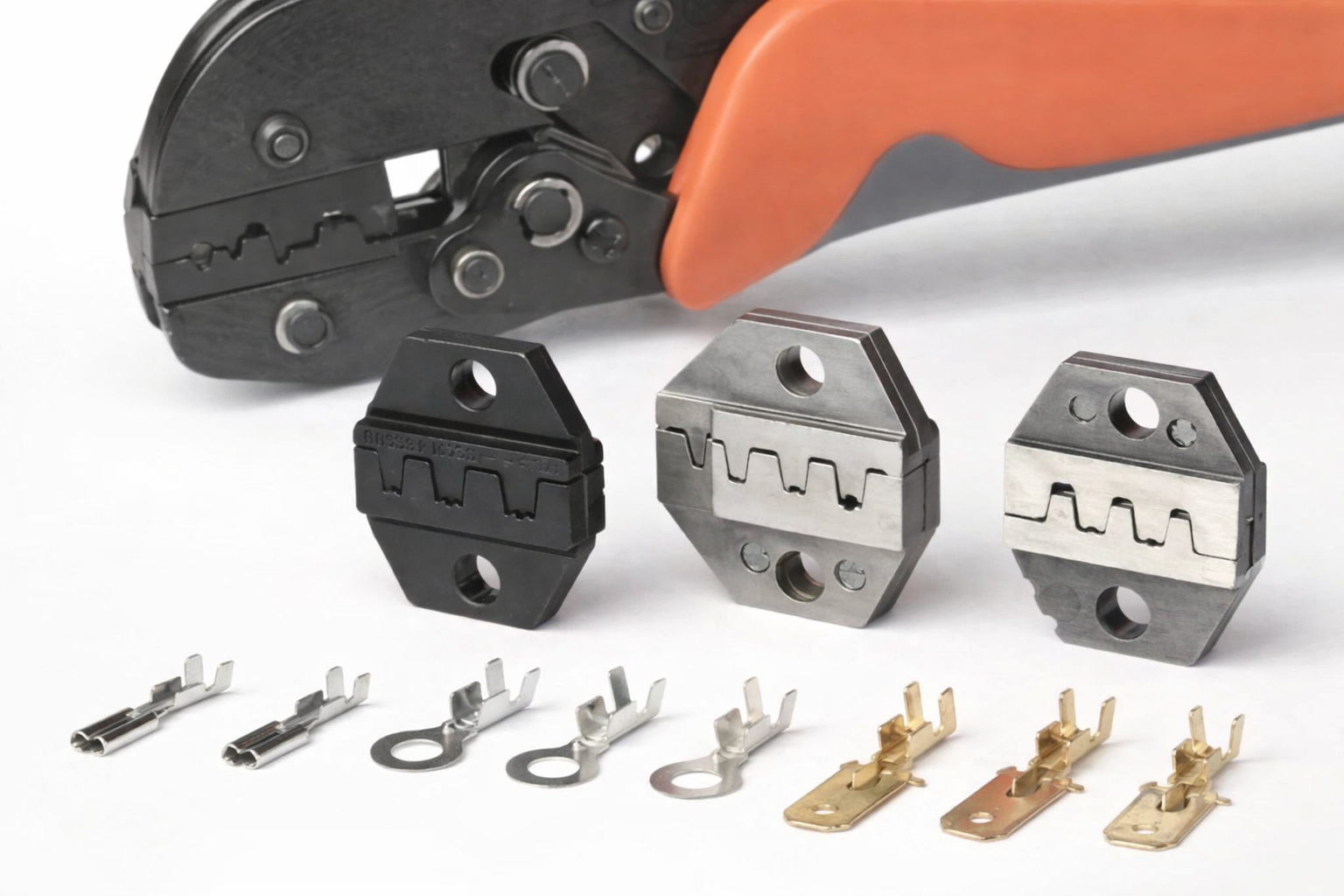
Crimping is the most reliable and widely used methods for creating electrical connections in wiring systems. From automotive wire harnesses to industrial control panels and aerospace electronics, properly crimped terminals ensure strong mechanical retention, stable electrical conductivity, and long-term reliability.
Among the many types of crimp terminals available, open barrel crimps Và closed barrel crimps are the two most common designs. While they serve the same fundamental purpose—terminating wires—their structures, crimping methods, tooling requirements, and ideal applications differ significantly.
This article provides a detailed comparison of open vs. closed barrel crimps, helping engineers, buyers, and manufacturers select the right solution for their specific electrical connection requirements.
1. Introduction to Crimping and Crimp Terminals
Crimping is a mechanical process that permanently joins a wire conductor to a metal terminal by deforming the terminal around the wire using a dedicated crimping tool. When done correctly, a crimped connection can be as reliable—or even more reliable—than soldering, especially in environments exposed to vibration, heat, or moisture.
Crimp terminals are metal components typically made from:
Copper
Tinned copper
Brass
Aluminum
Stainless steel (for specialized environments)
They are used to terminate stranded or solid wires and provide a standardized interface for electrical connections.
Choosing the correct crimp terminal type is critical. A mismatch between terminal design, wire gauge, and crimping tool can lead to:
High contact resistance
Intermittent connections
Wire pull-out
Premature system failure
2. What Are Open Barrel Crimps?

An open barrel crimp terminal features a barrel with open “wings” rather than a fully enclosed tube. The wire is placed into the open barrel, and the wings are folded inward during crimping to securely grip the conductor and, in many designs, the wire insulation.
Open barrel terminals are also commonly referred to as:
Stamped terminals
Stamped & formed contacts
Open-wing terminals
They are widely used in high-volume, precision wiring applications.
Features of Open Barrel Crimps
Key characteristics include:
Two-stage crimp design
One set of wings crimps the bare conductor
Another set crimps the insulation for strain relief
Excellent electrical performance
Gas-tight conductor crimp reduces oxidation
Consistent contact resistance
Compact size
Ideal for high-density connectors
Usually non-insulated
Insulation is often provided by connector housings rather than terminal sleeves
Open barrel terminals are manufactured in precise dimensions to match specific wire gauges, commonly ranging from AWG 28 to AWG 10, depending on the terminal type.
Crimping Tools for Open Barrel Terminals
Open barrel crimps require specialized crimping tools that form an F-crimp or B-crimp profile. These tools precisely fold the terminal wings around the conductor and insulation.
Key tooling considerations:
Correct die profile for terminal type
Accurate crimp height control
Consistent pressure for repeatability
Professional-grade tools are essential, especially in automotive, hàng không vũ trụ, and wire harness production, where crimp quality standards are strict.
Applications of Open Barrel Crimps
Open barrel crimps are commonly used in:
Automotive wiring harnesses
Aerospace and defense electronics
Industrial control systems
Consumer electronics
Home appliances
Connector systems (Deutsch, JST, Molex-style terminals)
They are particularly valued in environments where vibration resistance, compact design, Và high production efficiency are critical.
3. What Are Closed Barrel Crimps?

A closed barrel crimp terminal features a fully enclosed, cylindrical metal barrel with no open seam. The wire is inserted into one end of the barrel and compressed from the outside using a crimping tool.
Closed barrel terminals are also known as:
Closed contact terminals
Tubular terminals
They are the most commonly recognized crimp terminals in general electrical applications.
Features of Closed Barrel Crimps
Key characteristics include:
Fully enclosed barrel
Provides uniform compression around the conductor
High mechanical strength
Excellent pull-out resistance
Available with insulation
PVC, nylon, or heat-shrink sleeves for protection and strain relief
Wide variety of terminal styles
Ring terminals
Fork (spade) thiết bị đầu cuối
Blade terminals
Butt connectors
Pin terminals
Closed barrel crimps are available for wire sizes ranging from small signal wires to large-gauge power cables, making them extremely versatile.
Crimping Tools for Closed Barrel Terminals
Closed barrel terminals are crimped using tools that create:
Oval crimps
Hexagonal crimps
Indent crimps (for some heavy-duty applications)
Hex crimps are especially popular for power cables because they distribute pressure evenly around the conductor, ensuring a strong electrical and mechanical connection.
Tool selection depends on:
Wire gauge
Terminal material
Required crimp standard
Applications of Closed Barrel Crimps
Closed barrel crimps are widely used in:
Automotive electrical systems
Industrial machinery wiring
Power distribution panels
Marine and offshore environments
Renewable energy systems
Heavy-duty and high-current applications
Their enclosed design makes them ideal for harsh environments, where durability and reliability are essential.
4. Key Differences Between Open and Closed Barrel Crimps
| Aspect | Open Barrel Crimps | Closed Barrel Crimps |
| Barrel design | Open wings | Fully enclosed tube |
| Crimp style | F-crimp / B-crimp | Oval or hex crimp |
| Tooling | Precision terminal-specific tools | Standard or heavy-duty crimpers |
| Insulation | Typically non-insulated | Insulated or non-insulated |
| Size | Compact | Larger overall profile |
| Production | Ideal for automation | Manual and semi-automatic |
| Strength | Excellent vibration resistance | Superior pull-out strength |
5. How to Choose Between Open and Closed Barrel Crimps
When selecting the right crimp terminal, consider the following factors:
Wire and Conductor Type
Fine-stranded wires often benefit from open barrel crimps
Large-gauge or solid conductors favor closed barrel crimps
Environment
High vibration → open barrel
Moisture, corrosion, or outdoor use → closed barrel with insulation
Production Volume
Mass production and automation → open barrel
Low-volume or field installation → closed barrel
Industry Standards
Automotive and aerospace often specify open barrel terminals
Industrial and marine applications often require closed barrel designs
6. Common Use Cases and Industry Preferences
Open barrel crimps are preferred in OEM connector systems and wire harness assemblies.
Closed barrel crimps dominate maintenance, repair, and power applications.
In many systems, both types may be used in different sections of the same wiring harness.
7. Best Practices for Reliable Crimp Connections
To ensure high-quality crimp connections:
Match the terminal precisely to the wire gauge
Use manufacturer-recommended crimping tools
Verify correct crimp height and compression
Perform pull tests and visual inspections
Avoid over-crimping or under-crimping
Proper crimping is not just about the terminal—it is a complete system involving the wire, phần cuối, tool, and process.
8. Conclusion
Both open barrel Và closed barrel crimp terminals play essential roles in modern electrical systems. While they differ in structure, tooling, and ideal applications, neither is universally “better.” The correct choice depends on your electrical requirements, environment, production process, and industry standards.
For OEMs, engineers, and sourcing professionals, selecting the right crimp terminal—and pairing it with the correct crimping tool—is key to building reliable, long-lasting electrical connections.
If you are looking for custom crimp terminals, professional crimping tools, or engineering support for your specific application, working with Độ chính xác của Qianwei-an experienced terminal manufacturer can significantly improve product quality and reduce long-term costs.
Câu hỏi thường gặp
1. Which crimp type provides better electrical conductivity?
Both open and closed barrel crimps offer excellent conductivity when properly crimped. Open barrel crimps create a gas-tight connection ideal for signal and low-voltage applications, while closed barrel crimps are preferred for higher-current connections due to their uniform compression.
2. Are open barrel crimps suitable for outdoor or harsh environments?
Open barrel crimps are best used inside connector housings. For outdoor or exposed environments, closed barrel crimps with insulation or heat-shrink sleeves provide better protection against moisture and corrosion.
3. Can I use the same crimping tool for both open and closed barrel terminals?
No. Open barrel terminals require F-crimp or B-crimp tools, while closed barrel terminals require oval, hex, or indent crimping tools. Using the wrong tool can result in unreliable connections.
4. Which crimp type is better for high-vibration applications?
Open barrel crimps are commonly used in high-vibration environments such as automotive and aerospace wiring because they provide strong strain relief and consistent conductor retention when properly crimped.
5. Do closed barrel crimps work with fine-stranded wires?
Đúng, but the terminal must be correctly sized and crimped with the proper tool. For very fine-stranded wires, open barrel crimps often provide better control and conductor support.
6. Are insulated crimps always better than non-insulated crimps?
Not necessarily. Insulated crimps offer convenience and added protection, but non-insulated crimps are often required in connector systems where insulation is provided by the housing or overmolding.
7. How do I choose the correct crimp terminal size?
Always match the terminal to the wire gauge (AWG or mm²) specified by the manufacturer. An incorrect size can lead to high resistance, weak pull-out strength, or crimp failure.
8. Can open and closed barrel crimps be used in the same wiring harness?
Đúng. Many wiring systems use open barrel terminals inside connectors and closed barrel terminals for power or grounding connections within the same harness.
