

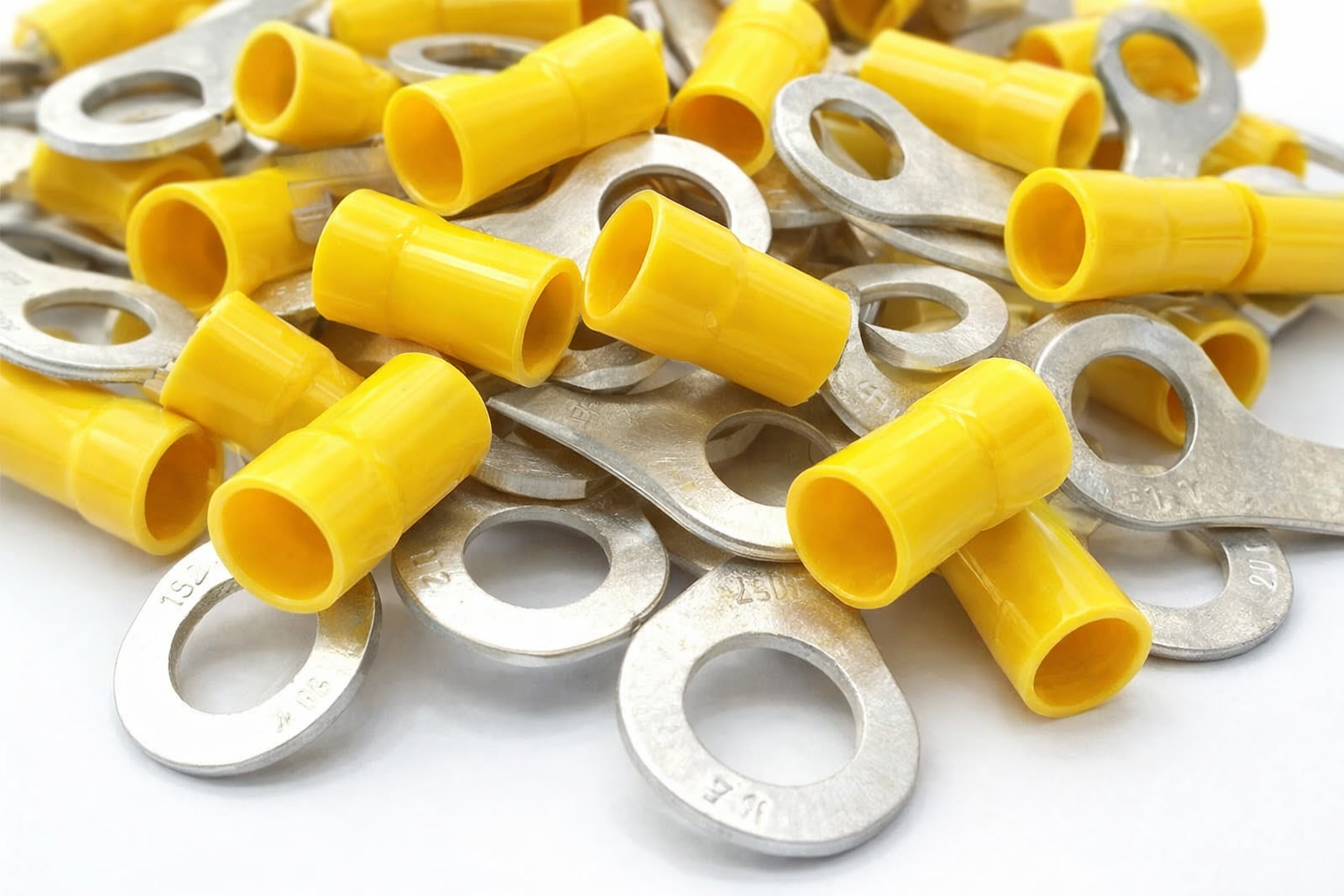
Ring terminals are among the most widely used electrical connectors in wiring systems. Known for their strength, stability, e confiabilidade a longo prazo, ring terminals play a critical role in applications where secure electrical connections are non-negotiable.
At Precisão Qianwei, we manufacture and supply high-quality ring terminals designed to meet the demands of automotive, marine, industrial, power, and OEM applications. This guide explains what ring terminals are, how to choose the right type, and why proper selection and installation directly impact electrical performance and safety.
What Are Ring Terminals?
Ring terminals are crimp-style electrical connectors designed to terminate a wire and fasten it securely to a stud, bolt, or screw. The terminal features a closed ring tongue, which fits completely around the stud, preventing accidental disconnection due to vibration, movement, or mechanical stress.
Compared to other terminal types, ring terminals provide:
Maximum mechanical retention
Consistent electrical contact area
Resistance to loosening in harsh environments
Because the connection is secured by a nut or screw, ring terminals are considered a semi-permanent solution—ideal for systems that must remain stable over long service cycles.
Why Ring Terminals Are Preferred in Critical Electrical Systems
Ring terminals are widely regarded as the most secure type of crimp connector. Once installed, they cannot slip off the connection point unless the fastener is completely removed. This makes them especially valuable in applications exposed to:
Continuous vibration
Thermal cycling
Moisture and corrosion
Mechanical shock
For these reasons, ring terminals are commonly used on barras de ônibus, grounding points, power distribution blocks, conexões de bateria, and control panels.
Ring Terminal Wire Gauge Options

Choosing the correct wire gauge is essential for both electrical performance and mechanical strength. Qianwei Precision offers ring terminals across a wide range of AWG sizes, incluindo:
22–18 AWG – Signal wiring, low-current circuits, sistemas de controle
16–14 AWG – Automotive wiring, eletrodomésticos, control panels
12–10 AWG – Power distribution, motors, marine systems
8 AWG and larger – High-current power and grounding applications (custom available)
Using an incorrectly sized terminal can lead to poor crimp quality, increased resistance, overheating, or premature failure. Precision sizing ensures optimal current flow and long-term reliability.
How to Use Ring Terminals Correctly
Proper installation is just as important as selecting the right terminal.
Step-by-Step Installation Process

Strip the wire correctly
Remove only enough insulation to match the barrel length. Avoid nicking conductor strands.
Insert the wire fully into the barrel
The insulation should butt against the barrel opening.
Select the correct crimp nest
Always match the crimp tool to the wire gauge and terminal type.
Crimp the terminal
Apply even pressure until the crimp cycle is complete. The barrel should deform uniformly around the conductor.
Inspect the crimp
Look for clean indentations with no cracks or deformation.
Heat shrink (if applicable)
For heat shrink ring terminals, apply controlled heat until the tubing shrinks and adhesive flows.
Perform a pull (tug) test
A properly crimped terminal will not loosen under moderate force.
Correct tooling and controlled crimping are critical to achieving a gas-tight, vibration-resistant connection.
Common Applications of Ring Terminals
Ring terminals are used across a wide range of industries and systems, incluindo:
Automotive and EV wiring harnesses
Marine and offshore electrical systems
Industrial machinery and automation panels
Power distribution and grounding systems
Transportation and infrastructure equipment
OEM assemblies and replacement components
Their durability and reliability make them the preferred choice where downtime or electrical failure is not acceptable.
Key Advantages of Ring Terminals
Ring terminals offer several advantages over other terminal types:
Superior vibration resistance
Secure, closed-loop attachment
Consistent electrical contact
Long service life
Easy inspection and maintenance
They are particularly well-suited for stud-mounted equipment and high-current connections where stability is critical.
How to Choose the Correct Stud Size
Stud size refers to the diameter of the bolt or screw that the ring terminal will be mounted on. Common sizes include:
#6, #8, #10
1/4″, 5/16″, 3/8″, 1/2″
To determine the correct size:
Measure the stud diameter with a caliper or ruler
Match the measurement exactly to the terminal ring size
Using the correct stud size ensures full contact, prevents movement, and reduces the risk of loosening or arcing.
Ring Terminals vs. Garfo (Spade) Terminais
While both ring and fork terminals are used for stud connections, they serve different purposes.
Terminais de anel
Fully enclosed connection
Highest mechanical strength
Best for vibration-prone or permanent installations
Fork Terminals
Open-ended design
Faster installation without removing the fastener
Easier servicing, but lower retention strength
For safety-critical and long-term applications, ring terminals are generally the preferred solution.
Tools Required for Crimping Ring Terminals
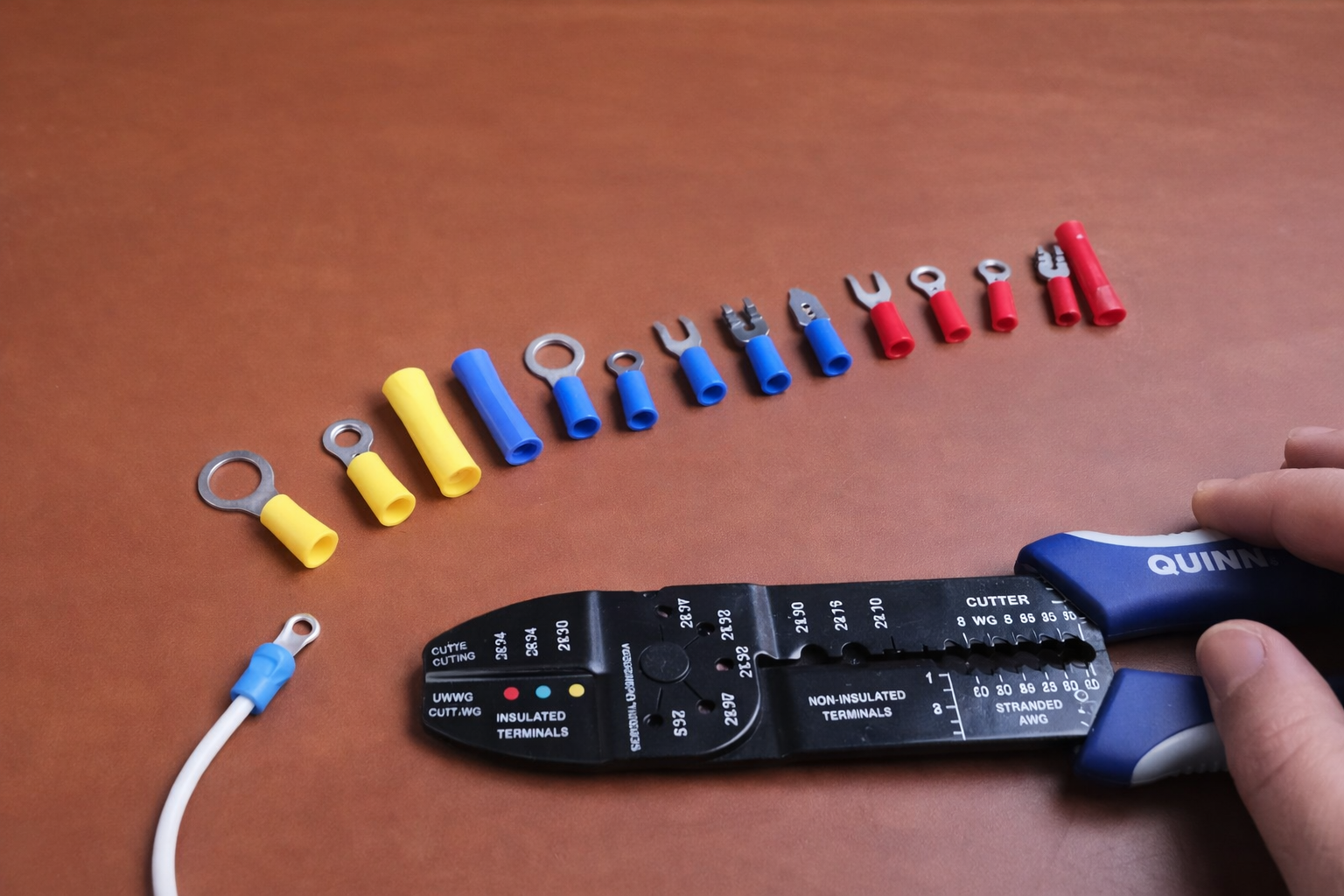
Using the correct crimping tool is essential. Improper tools can lead to loose connections, high resistance, and premature failure.
Insulated terminals require matched ratcheting crimpers
Non-insulated terminals require die-style or hex crimpers
Na precisão Qianwei, we emphasize process repeatability and crimp consistency, which are essential for OEM and high-volume production environments.
Types of Ring Terminals Offered by Qianwei Precision
We offer a complete range of ring terminals, categorized by insulation type:
Heat Shrink Ring Terminals
Nylon Insulated Ring Terminals
Vinyl Insulated Ring Terminals
Non-Insulated (Bare) Terminais de anel
Customization options include:
Latão, cobre, or tinned copper materials
Custom plating and surface treatments
Special dimensions, barrel lengths, and tolerances
Does Insulation Type Really Matter?
Yes—insulation directly affects durability, segurança, and environmental resistance.
Heat Shrink: Provides the highest level of protection, including moisture sealing
Nylon: Durable and flexible, suitable for industrial environments
Vinyl: Cost-effective for general-purpose use
Non-Insulated: Compact and economical for controlled environments
Selecting the right insulation ensures the terminal performs reliably under real operating conditions.
Environmentally Sealed Ring Terminals
For harsh or outdoor environments, adhesive-lined heat shrink ring terminals offer superior protection. As heat is applied, the adhesive melts and flows, creating a moisture-resistant seal that protects against corrosion and contamination.
These terminals are ideal for:
Marine and offshore systems
Outdoor power equipment
High-humidity or corrosive environments
Industries Served by Qianwei Precision
Qianwei Precision supplies ring terminals to a wide range of industries, incluindo:
Automotive and electric vehicles
Marine and offshore equipment
Industrial automation
Power and energy systems
Transportation and infrastructure
OEM and custom wiring assemblies
Why Choose Qianwei Precision?
Over 10 anos de experiência in terminals and connectors
Engineering-driven customization capabilities
Stable production and consistent quality control
Fast response and technical support
OEM / ODM manufacturing services
Commitment to long-term reliability and international standards
When you choose Qianwei Precision, you gain a manufacturing partner focused on performance, precision, e confiabilidade.
Conclusão: Selecting the Right Ring Terminal
Choosing the correct ring terminal requires careful consideration of:
Calibre do fio
Stud size
Insulation type
Application environment
With the right selection and proper installation, ring terminals provide one of the most reliable electrical connections available.
Contact Qianwei Precision today to discuss standard or custom ring terminal solutions tailored to your application requirements.
Perguntas frequentes
1. How do I choose the right ring terminal for my application?
To select the correct ring terminal, you need to match four key factors: bitola do fio, stud size, insulation type, and operating environment. Using the wrong size or insulation can lead to poor electrical contact, overheating, or premature failure. If you are unsure, Qianwei Precision’s engineering team can assist with selection based on your application details.
2. Are heat shrink ring terminals worth the higher cost?
Sim. Heat shrink ring terminals provide superior moisture resistance, corrosion protection, and strain relief due to their adhesive-lined insulation. They are strongly recommended for marine, outdoor, automotivo, and industrial environments where reliability and longevity are critical.
3. Can Qianwei Precision supply custom or OEM ring terminals?
Absolutamente. Qianwei Precision offers OEM and ODM ring terminal solutions, including custom wire gauges, tamanhos de pinos, barrel lengths, materials, chapeamento, and insulation types. We support both prototype development and high-volume production with consistent quality control.
4. What happens if I use the wrong crimping tool?
Using an incorrect crimping tool can result in loose connections, high electrical resistance, conductor damage, or terminal failure. Proper crimp tools ensure a gas-tight connection that meets electrical and mechanical performance requirements. We recommend using application-matched crimpers for best results.
5. Are non-insulated ring terminals safe to use?
Non-insulated (bare) ring terminals are safe only in controlled environments where additional insulation, heat shrink, or protective housings are used. They are commonly selected for compact designs or cost-sensitive applications but require proper secondary insulation to prevent short circuits.
6. What materials are commonly used for ring terminals?
Most high-quality ring terminals are manufactured from copper or brass, often with tin plating to improve corrosion resistance and conductivity. Material selection directly impacts electrical performance and durability, especially in harsh environments.
7. Do ring terminals meet international electrical standards?
Qianwei Precision manufactures ring terminals designed to comply with industry-recognized electrical and mechanical standards. Material traceability, dimensional control, and crimp performance consistency are all part of our quality assurance process. Certification support is available upon request for OEM projects.
8. How can I request a quote or technical support from Qianwei Precision?
You can contact Qianwei Precision directly through our inquiry form or sales team. Providing details such as bitola do fio, stud size, insulation type, quantidade, and application environment will allow us to respond quickly with accurate recommendations and pricing.
