

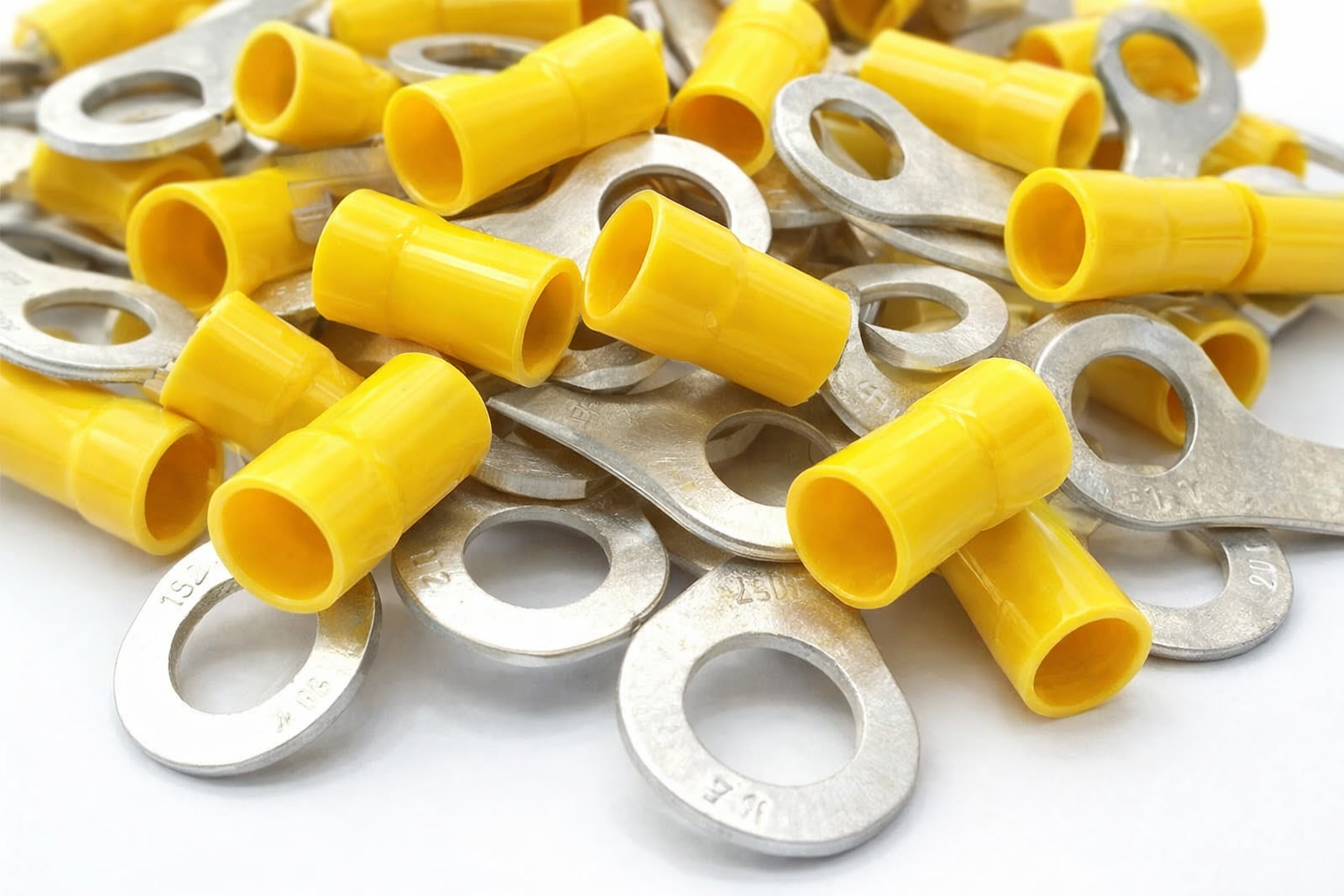
Choosing the right ring terminal is not simply a matter of finding one that fits over a bolt. The wire size, stud diameter, terminal material, plating, current requirement, and crimping method all affect the reliability of the final electrical connection.
A ring terminal that is too small may not accept the conductor correctly. A terminal with the wrong stud hole can create installation problems, while an unsuitable material or poor crimp can increase contact resistance and reduce connection reliability.
This guide explains ring terminal sizes, wire gauges, stud sizes, dimensions, materials, current considerations, and crimping methods. Whether you are selecting terminals for automotive wiring, industrial equipment, control panels, appliances, or power connections, these factors can help you choose the right ring terminal for your application.
What Is a Ring Terminal?
A ring terminal is an electrical connector designed to attach a wire to a threaded stud, screw, or bolt. Unlike a fork or spade terminal, the ring-shaped tongue completely surrounds the mounting stud, providing a secure mechanical connection.
A typical ring terminal consists of four main areas:
- Ring or tongue: The flat section with the mounting hole.
- Stud hole: The opening that fits over a bolt or threaded stud.
- Crimp barrel: The section where the wire conductor is inserted and crimped.
- Wire entry: The opening through which the stripped conductor enters the barrel.
Ring terminals are commonly used in automotive wiring, industrial control systems, electrical equipment, battery connections, household appliances, power distribution, and grounding applications.
Their popularity comes from a simple advantage: once properly installed, the ring remains mechanically secured around the stud rather than relying only on friction.
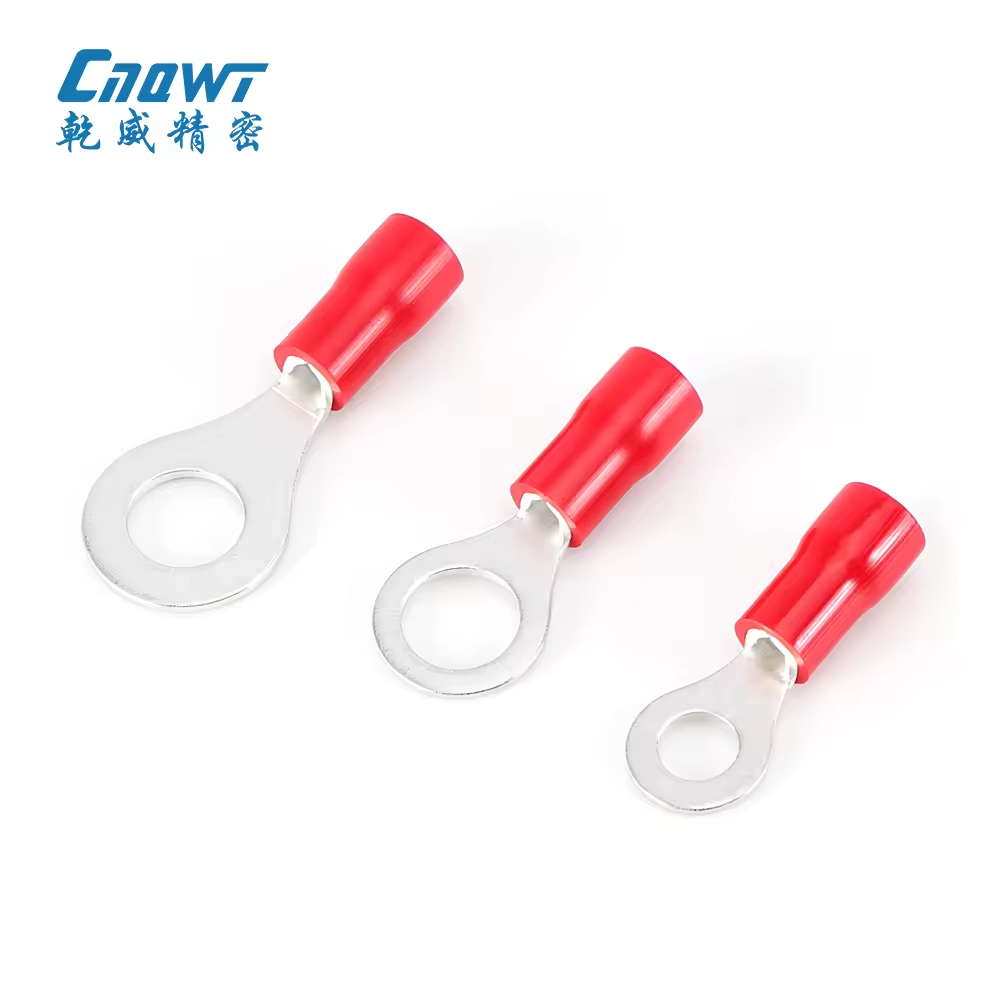
Ring Terminal Sizes: The 4 Measurements You Need to Know
When selecting a ring terminal, four dimensions are particularly important: wire size, stud hole size, barrel size, and overall terminal dimensions.
Wire Gauge and Cable Size
The first step is to determine the conductor size. Ring terminals are manufactured for specific wire ranges, commonly specified in AWG or mm².
For example, a terminal designed for 12 AWG wire should not automatically be used with 16 AWG or 8 AWG wire simply because the wire can physically enter the barrel.
The barrel must be designed for the conductor size and the selected crimping method.
Common wire sizes used with ring terminals include:
- 22 AWG
- 20 AWG
- 18 AWG
- 16 AWG
- 14 AWG
- 12 AWG
- 10 AWG
- 8 AWG
- 6 AWG
- 4 AWG
- 2 AWG
- 1/0 AWG and larger
For metric applications, terminals may instead be specified for conductor areas such as 0.5 mm², 1.0 mm², 1.5 mm², 2.5 mm², 4 mm², 6 mm², 10 mm², and larger.
Always check the manufacturer’s specified wire range rather than selecting a terminal based only on approximate wire diameter.
Stud Hole Size
The second critical measurement is the stud hole.
The ring hole must match the bolt, screw, or threaded stud used in the application. Common sizes include:
- M3
- M4
- M5
- M6
- M8
- M10
- M12
Imperial sizes such as 1/4 inch, 5/16 inch, and 3/8 inch are also common in some markets.
It is important to distinguish between metric and imperial dimensions. For example, an M6 stud and a 1/4-inch stud are close in diameter, but they are not identical. The correct terminal should be selected according to the actual fastening hardware and application specification.
A hole that is too small will not fit the stud. A hole that is excessively large may reduce positioning accuracy and affect the mechanical connection.
Barrel Size
The crimp barrel must match the conductor size.
A properly matched barrel allows the conductor to enter fully and provides sufficient material around the conductor for a reliable crimp.
Barrel design varies depending on the terminal type. Some terminals use closed barrels, while others use open-barrel designs.
Closed-barrel ring terminals are common for many general electrical applications, while open-barrel terminals may be used in specific automated or high-volume wire harness assembly processes.
Overall Ring Terminal Dimensions
The mounting hole is only one part of the terminal’s physical dimensions.
Depending on the application, you may also need to check:
- Ring outside diameter
- Tongue width
- Terminal length
- Material thickness
- Barrel length
- Barrel diameter
- Overall height after crimping
These dimensions become particularly important when terminals are installed in compact electrical assemblies where adjacent components or terminals have limited clearance.
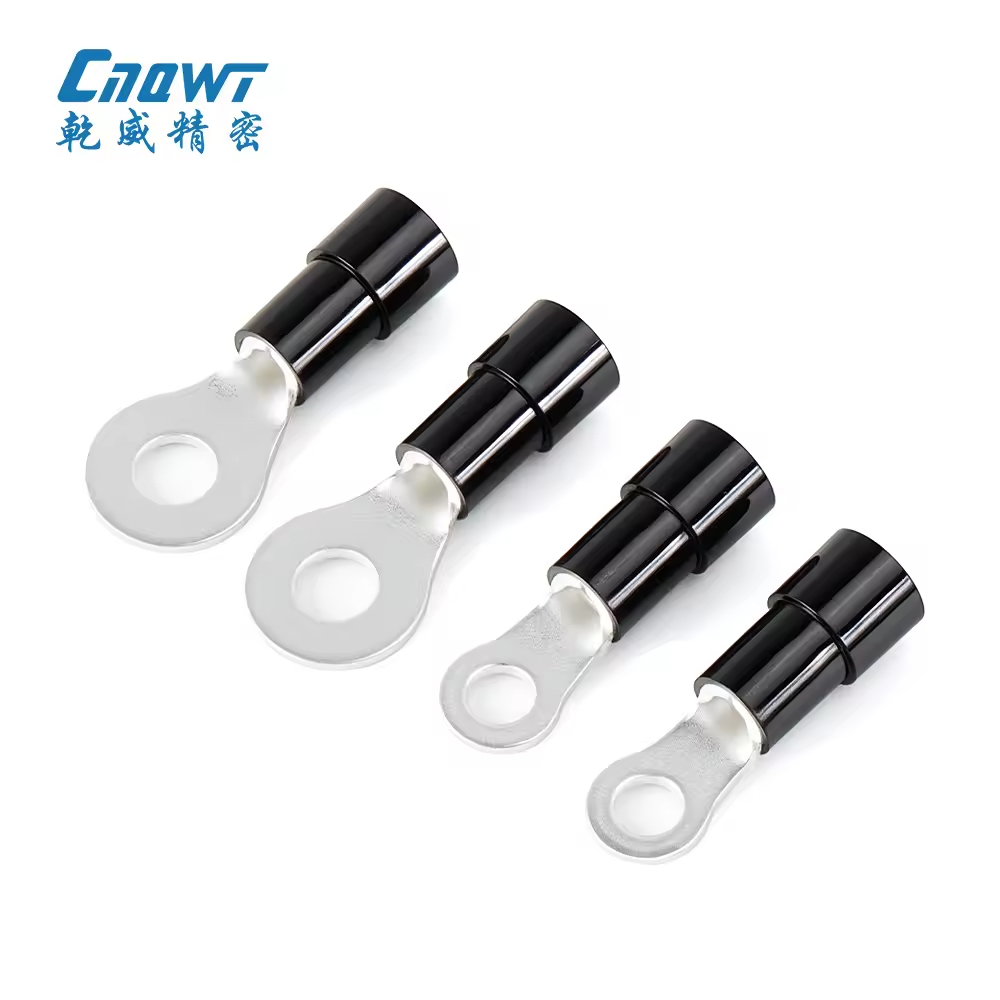
Ring Terminal Size Chart
A ring terminal size chart is useful for narrowing down the correct terminal, but it should be treated as a selection reference rather than a universal specification.
| Wire Size | Typical Conductor Area | Common Application |
|---|---|---|
| 22–20 AWG | Small signal wiring | Electronics and control circuits |
| 18–16 AWG | Small electrical wiring | Appliances and control systems |
| 14–12 AWG | General power wiring | Automotive and industrial equipment |
| 10–8 AWG | Higher-current wiring | Automotive and power applications |
| 6–4 AWG | Heavy-duty wiring | Batteries and power distribution |
| 2–1/0 AWG | High-current connections | Battery and power systems |
| 2/0 AWG+ | Heavy power connections | Specialized high-current systems |
The exact terminal range depends on the product design. Two ring terminals with the same stud size may support completely different conductor sizes.
Ring Terminal AWG to mm²
AWG and mm² are different wire-sizing systems, so conversions should be treated as approximate when selecting terminals.
For example:
| AWG | Approx. Cross-Sectional Area |
|---|---|
| 18 AWG | 0.82 mm² |
| 16 AWG | 1.31 mm² |
| 14 AWG | 2.08 mm² |
| 12 AWG | 3.31 mm² |
| 10 AWG | 5.26 mm² |
| 8 AWG | 8.37 mm² |
| 6 AWG | 13.3 mm² |
| 4 AWG | 21.2 mm² |
| 2 AWG | 33.6 mm² |
| 1/0 AWG | 53.5 mm² |
Actual terminal selection should always follow the wire range specified for the terminal rather than relying solely on this conversion.
How to Choose the Right Ring Terminal
A reliable selection process can be reduced to seven steps.
Step 1: Check the Wire Size
Identify the conductor’s AWG or cross-sectional area in mm².
Do not select a terminal only because the wire fits inside the barrel. The terminal must be rated and designed for that conductor range.
Step 2: Check the Stud Size
Measure or confirm the diameter of the screw, bolt, or stud.
Select the appropriate ring hole size, such as M4, M5, M6, M8, or M10.
Step 3: Determine the Current Requirement
The terminal must be suitable for the expected electrical load.
Current capacity is affected by conductor size, terminal material, contact resistance, temperature, terminal geometry, and installation quality.
For higher-current applications, a larger conductor and appropriately designed copper terminal may be required.
Step 4: Select the Terminal Material
Copper, brass, and other conductive alloys can be used depending on the electrical and mechanical requirements.
For many electrical applications, copper is preferred because of its high electrical conductivity and good crimping characteristics.
Step 5: Choose the Plating
Plating protects the base metal and can improve corrosion resistance.
Tin plating is widely used for copper terminals because it provides additional protection against oxidation and environmental exposure.
Step 6: Check the Operating Environment
Consider:
- Temperature
- Humidity
- Corrosion
- Vibration
- Chemical exposure
- Installation space
Automotive and outdoor applications may require different terminal specifications than a protected indoor control cabinet.
Step 7: Confirm the Crimping Method
The terminal must be compatible with the selected crimp tool and crimping process.
A correctly sized terminal can still fail if the conductor is improperly crimped.
Ring Terminal Materials: Copper, Brass, and Other Options
Copper Ring Terminals
Copper is widely used for electrical terminals because of its excellent electrical conductivity and good workability.
Copper ring terminals are suitable for applications where electrical performance and reliable crimping are important.
They are commonly found in automotive, industrial, appliance, battery, and power connection applications.
Brass Ring Terminals
Brass provides a useful combination of electrical conductivity, mechanical strength, and manufacturability.
Depending on the application, brass terminals can be a practical choice where mechanical properties and cost need to be balanced.
Tinned Copper Ring Terminals
Tinned copper combines the electrical performance of copper with improved surface protection.
The tin coating helps reduce oxidation and improves resistance to environmental exposure, making tinned copper terminals particularly useful in applications where moisture or corrosion may be a concern.
For customized electrical terminals, material and plating should be selected according to the actual application rather than simply choosing the lowest-cost option.
Ring Terminal Plating Options
Tin-Plated Ring Terminals
Tin plating is one of the most common choices for copper electrical terminals.
It provides improved corrosion resistance and protects the copper surface during storage and operation.
Nickel-Plated Ring Terminals
Nickel plating can provide stronger resistance to elevated temperatures and demanding environments.
It may be considered for applications where thermal or environmental performance is more demanding.
Bare Copper Ring Terminals
Bare copper provides excellent conductivity but does not have the same surface protection as a plated terminal.
For applications exposed to moisture, humidity, or corrosive environments, a suitable plating may be preferable.

Ring Terminal Current Rating: How Much Current Can It Handle?
There is no single current rating that applies to every ring terminal.
A terminal’s current-carrying capability depends on several factors, including:
- Conductor size
- Terminal material
- Terminal thickness
- Contact area
- Crimp quality
- Contact resistance
- Operating temperature
- Installation conditions
The terminal should not become the weakest point in the electrical connection.
For high-current applications, the terminal, wire, fastening system, and crimp connection should be evaluated as one complete electrical system.
This is especially important for battery connections, power distribution systems, electric equipment, and other applications where large conductors carry substantial current.
How to Crimp a Ring Terminal Correctly
A good ring terminal connection depends heavily on the crimp.
Strip the Wire
Remove the insulation carefully without cutting or damaging the conductor strands.
The stripped length should correspond to the terminal barrel and the crimping specification.
Insert the Wire
Insert the conductor fully into the barrel.
The conductor should reach the intended position without excessive exposed wire.
Position the Terminal
Place the terminal correctly in the crimp tool according to the terminal and tooling specifications.
Perform the Crimp
Apply the appropriate crimping force.
Avoid using unsuitable pliers or improvised tools for applications where a controlled crimp is required.
Inspect the Crimp
Check that:
- The conductor is properly retained.
- The barrel is not excessively deformed.
- There is no significant conductor damage.
- The terminal is not cracked.
- The wire cannot be pulled out under normal handling conditions.
For production applications, crimp quality should be controlled according to the relevant terminal and wire specifications.
Common Ring Terminal Crimping Problems
Wrong Wire Size
Using a terminal outside its specified wire range can result in insufficient mechanical retention or excessive deformation.
Incorrect Crimp Tool
A terminal may look correctly installed but still have an unreliable electrical connection if the crimping tool is not suitable.
Over-Crimping
Excessive crimping force can damage the barrel or conductor.
Under-Crimping
An under-crimped terminal may have poor mechanical retention and increased electrical resistance.
Loose Wire
The conductor should be properly positioned inside the barrel before crimping. A partially inserted wire can create an unreliable connection.
Wrong Stud Size
Even a correctly crimped terminal is not suitable if the ring hole does not match the mounting hardware.
Ring Terminal vs Other Terminal Types
Ring vs Fork Terminals
A ring terminal surrounds the stud, while a fork terminal has an opening that allows it to be installed from the side.
Ring terminals are generally preferred when stronger mechanical retention is required.
Ring vs Spade Terminals
Ring terminals are a type of spade-family connection with a fully enclosed mounting hole. Spade or fork terminals can be more convenient when frequent installation or removal is required.
Ring vs Butt Connectors
A butt connector joins two wires end-to-end. A ring terminal connects a wire to a stud or threaded fastening point. They perform completely different functions.
Ring Terminal Applications
Ring terminals are used across a wide range of industries.
Automotive Wiring
Automotive applications often require resistance to vibration, temperature changes, corrosion, and mechanical stress.
Industrial Equipment
Ring terminals are commonly used for internal wiring, grounding, power distribution, and control equipment.
Control Panels
They can be used to connect wires to terminal blocks, grounding points, circuit components, and other fastening points.
Battery and Power Connections
Larger ring terminals are widely used for battery cables and high-current connections.
Household Appliances
Ring terminals can be found in wiring systems for appliances and electrical equipment where secure screw or stud connections are required.
New Energy Equipment
Energy storage systems, charging equipment, and related electrical systems may require larger copper terminals designed for higher current and mechanical loads.
How to Select Ring Terminals for Automotive Wiring
Automotive environments can be demanding because electrical connections may experience vibration, temperature cycling, humidity, and corrosion.
When selecting an automotive ring terminal, consider:
- Wire size
- Stud size
- Current requirement
- Copper or alloy material
- Plating
- Crimp reliability
- Vibration resistance
- Operating temperature
- Available installation space
For automotive wire harness applications, terminal dimensions and crimp performance should be evaluated together with the wire and connector system.
How to Select Ring Terminals for High-Current Applications
High-current applications require more than simply choosing a larger ring hole.
The terminal should be selected according to the conductor cross-section, current requirement, material, thickness, contact area, and operating temperature.
Copper terminals are often used for high-current connections because of their high electrical conductivity.
For applications involving large cables or battery connections, heavy-duty copper ring terminals can provide a practical connection solution when properly designed and crimped.
Ring Terminal Installation Checklist
Before installing a ring terminal, check:
- Wire gauge or cross-sectional area
- Stud or bolt diameter
- Terminal wire range
- Terminal material
- Plating
- Current requirement
- Operating environment
- Crimping tool
- Crimp quality
- Mechanical retention
- Clearance around the terminal
This simple checklist can prevent many common selection and installation problems.
How to Order Custom Ring Terminals
Standard ring terminals may not always meet the dimensional, electrical, or mechanical requirements of a specific application.
For a custom ring terminal, manufacturers typically need information such as:
- Wire size
- Stud hole diameter
- Material
- Plating
- Terminal thickness
- Barrel dimensions
- Overall terminal dimensions
- Current requirement
- Application environment
- Crimping method
- Required production volume
At Qianwei Precision, custom electrical terminals can be developed according to customer drawings, samples, wire specifications, and application requirements.
Our manufacturing capabilities include precision metal stamping, mold development, plating, injection molding, and terminal assembly. This integrated production capability allows different parts of the terminal manufacturing process to be coordinated under one manufacturing system.
For automotive, industrial, appliance, power, and other electrical applications, customized copper terminals can be developed according to the required dimensions, material, plating, and production requirements.
Need a Custom Ring Terminal?
The right ring terminal is determined by more than its appearance. Wire size, stud size, material, plating, current, dimensions, and crimping method all need to work together.
If you are looking for a standard ring terminal or a custom electrical terminal, Qianwei Precision can support the development and production process from tooling and precision stamping to plating and assembly.
Send us your drawing, sample, wire size, stud size, or application requirements, and our engineering team can help you identify the appropriate ring terminal design for your project.
FAQs
What size ring terminal do I need?
You need to match the terminal to both the wire size and stud size. Check the manufacturer’s specified wire range and select a ring hole that matches the mounting stud.
How do I know what size ring terminal to use?
Start with the wire gauge or mm² size, then check the stud diameter, current requirement, material, plating, and operating environment.
What wire size fits a ring terminal?
It depends on the specific terminal. Ring terminals are manufactured for defined wire ranges, such as 22–20 AWG, 16–14 AWG, 12–10 AWG, or larger conductors.
What is the most common ring terminal size?
There is no single universal size. Common choices vary by industry and application. M4, M5, M6, and M8 stud sizes are frequently encountered, but the correct size depends on the equipment design.
What size ring terminal should I use for 12 AWG wire?
Select a ring terminal specifically rated for 12 AWG wire and then choose the appropriate stud hole size for the mounting hardware.
What is the difference between M6 and 1/4-inch ring terminals?
M6 and 1/4-inch are different dimensional standards. Although their nominal diameters are close, they are not identical. The terminal should match the actual fastening hardware.
Are copper ring terminals better than brass?
Copper generally offers higher electrical conductivity, while brass can provide a useful balance of mechanical properties and cost. The better choice depends on the application requirements.
How do I crimp a ring terminal?
Strip the wire to the specified length, insert the conductor fully into the terminal barrel, use the correct crimping tool, apply the specified crimp, and inspect the finished connection.
Can ring terminals be used for high-current applications?
Yes. Large ring terminals are commonly used for high-current connections, including battery and power applications. However, current capability depends on the complete terminal, conductor, crimp, contact, and operating conditions.


3 thoughts on “Ring Terminal Sizes Explained: How to Choose the Right Ring Terminal”