

Giới thiệu
Renewable energy systems are rapidly transforming the global power landscape. From solar farms and wind turbines to battery storage and EV infrastructure, these systems demand highly reliable electrical connections to operate efficiently over decades.
At the heart of these systems are thiết bị đầu cuối điện—small components that play a critical role in ensuring safe, ổn định, and efficient power transmission.
A poorly selected or improperly installed terminal can lead to:
- Mất điện
- Quá nóng
- Thời gian ngừng hoạt động của hệ thống
- Even safety hazards
Trong hướng dẫn này, we’ll break down everything you need to know about electrical terminals used in renewable energy systems, and how to choose the right solution for long-term performance.
Why Electrical Terminals Matter in Renewable Energy
In renewable energy systems, electrical terminals are not just passive connectors—they are critical performance determinants that directly impact efficiency, sự an toàn, và độ tin cậy lâu dài của hệ thống.
Unlike conventional indoor electrical setups, renewable installations such as solar farms, tua bin gió, and battery storage systems operate in highly demanding environments and are expected to perform continuously for 20–30 years with minimal maintenance. Under these conditions, even a minor weakness in a terminal connection can lead to significant operational issues.
1. Minimizing Energy Loss
Electrical terminals must provide điện trở tiếp xúc thấp to ensure efficient current flow. Poor-quality or improperly installed terminals can create resistance points, resulting in:
- Giảm điện áp
- Heat generation
- Reduced system efficiency
In large-scale solar or energy storage systems, even small inefficiencies can translate into substantial energy losses over time, directly affecting ROI.
2. Preventing Overheating and Fire Risks
Loose or degraded connections are one of the most common causes of overheating in electrical systems. In renewable energy applications where high currents are common, this risk is amplified.
Thiết bị đầu cuối chất lượng cao:
- Maintain stable contact pressure
- Resist loosening under vibration or thermal cycling
- Prevent arc formation and hotspots
This is especially critical in battery systems and EV charging infrastructure, where safety is non-negotiable.
3. Ensuring Mechanical Reliability
Renewable energy systems are often exposed to:
- Wind-induced vibration (tua bin gió)
- Sự giãn nở và co lại nhiệt
- Mechanical stress during installation and operation
Electrical terminals must deliver khả năng giữ cơ học mạnh mẽ to prevent loosening or disconnection over time. Crimped or bolted connections are typically preferred because they offer long-term mechanical stability.
4. Withstanding Harsh Environmental Conditions
Outdoor renewable systems face constant exposure to:
- UV radiation
- Moisture and rain
- Salt spray (coastal installations)
- Dust and contaminants
Terminals must be designed with:
- Corrosion-resistant materials (ví dụ., đồng đóng hộp)
- Protective plating
- Sealing solutions (IP-rated connectors)
Failure to address these factors can lead to quá trình oxy hóa, tăng sức đề kháng, and eventual connection failure.
5. Supporting Long Service Life
Renewable energy assets are long-term investments. Replacing failed components in large installations is both costly and logistically challenging.
Reliable terminals contribute to:
- Reduced maintenance frequency
- Lower operational costs
- Extended system lifespan
In this context, terminals are not just components—they are key contributors to lifecycle cost optimization.
Types of Electrical Terminals Used in Renewable Energy
Renewable energy systems require a wide range of electrical terminals, each designed for specific functions, current levels, và điều kiện môi trường. Selecting the appropriate type is essential for achieving optimal electrical and mechanical performance.
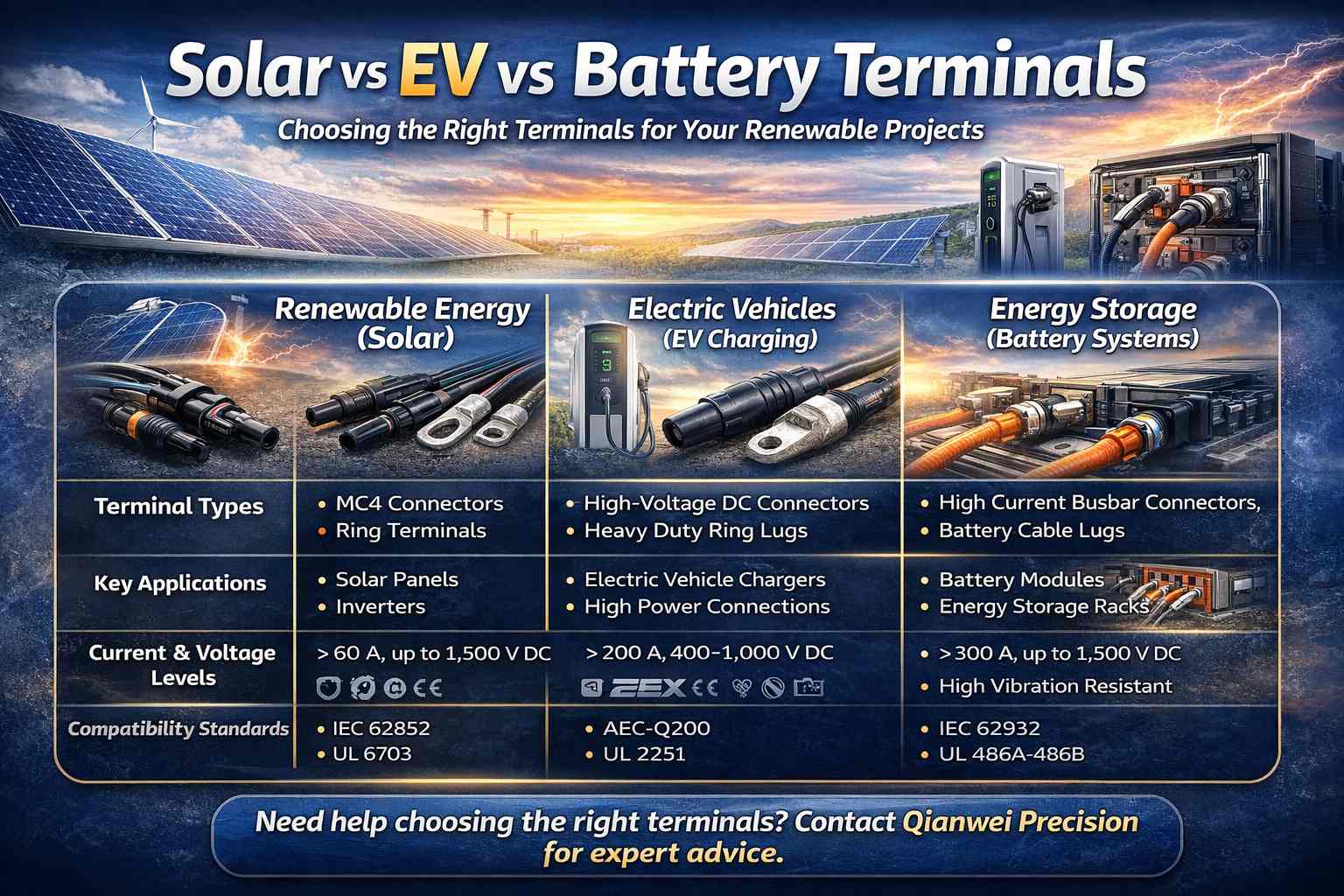
Figure: Comparison of Electrical Terminals Used in Solar, EV Charging, and Battery Storage Systems
1. Solar (PV) Đầu nối
Photovoltaic systems rely heavily on standardized connectors such as MC4-type connectors for fast and secure installation.
Đặc điểm chính:
- IP67/IP68 waterproof protection
- UV-resistant insulation materials
- Snap-lock mechanisms for secure mating
Ứng dụng điển hình:
- Panel-to-panel connections
- String connections to inverters
These connectors are designed for tool-free installation and long-term outdoor durability, making them indispensable in solar deployments.
2. Thiết bị đầu cuối vòng Và Cable Lugs
Ring terminals and cable lugs are widely used in high-current and grounding applications.
Thuận lợi:
- Secure bolted connections
- Độ dẫn tuyệt vời
- Khả năng chống rung cao
Common use cases:
- Inverter terminals
- Battery banks
- Hệ thống nối đất
Their closed-ring design ensures that the connection remains secure even under mechanical stress, making them ideal for critical power connections.
3. Thiết bị đầu cuối uốn
Crimp terminals are the preferred choice for creating kết nối điện kín khí without soldering.
Types include:
- Thiết bị đầu cuối thùng mở (for automated production)
- Thiết bị đầu cuối thùng kín (for heavy-duty applications)
Những lợi ích:
- Low and stable contact resistance
- High vibration resistance
- Consistent connection quality
When properly crimped using professional tools, these terminals provide long-term reliability in demanding environments.
4. Cách nhiệt vs. Thiết bị đầu cuối không cách điện
The choice between insulated and non-insulated terminals depends on the application environment and safety requirements.
- Provide additional protection against short circuits
- Cải thiện sự an toàn của người vận hành
- Suitable for general wiring applications
Thiết bị đầu cuối không cách điện:
- Offer better heat resistance
- Allow for compact installations
- Preferred in high-temperature or space-constrained environments
In renewable systems, both types are often used depending on the specific installation scenario.
5. Busbar Connections
Busbars are essential in systems that require high-current distribution, such as energy storage and power conversion units.
Key benefits:
- Khả năng mang dòng điện cao
- Giảm độ phức tạp của hệ thống dây điện
- Improved heat dissipation
Chúng thường được sử dụng trong:
- Battery modules
- Tủ phân phối điện
- Inverter systems
Busbars enable efficient and compact power routing, which is critical in modern energy systems.
6. Ferrules (Bootlace Terminals)
Ferrules are used to terminate stranded wires, especially in control panels and inverter connections.
Thuận lợi:
- Prevent strand fraying
- Ensure uniform contact
- Improve connection reliability
They are particularly important in low-voltage control circuits, where stable and clean connections are required.
7. High-Voltage and High-Current Specialized Terminals
With the growth of EV charging and large-scale energy storage, there is increasing demand for specialized terminals capable of handling extreme electrical loads.
Các tính năng bao gồm:
- Enhanced insulation systems
- High-temperature resistance
- Advanced plating for conductivity and durability
These terminals are designed for next-generation renewable infrastructure, where performance and safety requirements are significantly higher.
Materials Used in Renewable Energy Terminals
Material selection directly impacts performance.
đồng
- Độ dẫn tuyệt vời
- Ideal for most applications
đồng đóng hộp
- Enhanced corrosion resistance
- Common in outdoor environments
Nhôm
- Nhẹ và tiết kiệm chi phí
- Used in large-scale installations
Tùy chọn mạ bề mặt
- Mạ thiếc → chống ăn mòn
- Nickel plating → high-temperature performance
- Silver plating → superior conductivity
Environmental Challenges
Renewable energy terminals must withstand extreme conditions:
UV Exposure
Degrades plastic and insulation materials over time
Độ ẩm & Water Ingress
Can cause corrosion and short circuits
Temperature Extremes
From freezing winters to high heat
Corrosive Environments
Salt spray (coastal), độ ẩm, và hóa chất
👉 This is why IP-rated connectors and sealed terminals are essential.
Performance Requirements
To ensure long-term reliability, terminals must meet:
- Dòng điện cao & voltage ratings
- Điện trở tiếp xúc thấp
- Tuổi thọ dài (20+ năm)
- Resistance to thermal cycling
- Khả năng giữ cơ học mạnh mẽ
Thực hành tốt nhất về cài đặt
Even the best terminal will fail if installed incorrectly.
Proper Crimping
- Sử dụng các công cụ uốn đã được hiệu chỉnh
- Đảm bảo chiều dài tước dây chính xác
Professional Tools
- Avoid manual or inconsistent crimping
Cable Management
- Prevent tension and bending stress
Waterproof Protection
- Use heat shrink tubing or seals
Common Failure Modes (And How to Avoid Them)
| Failure Issue | Gây ra | Giải pháp |
|---|---|---|
| Quá nóng | Kết nối lỏng lẻo | Proper torque/crimping |
| Ăn mòn | Tiếp xúc với độ ẩm | Use plated terminals |
| Sức đề kháng cao | Uốn kém | Use correct tools |
| Đoản mạch | Hư hỏng cách nhiệt | Use insulated terminals |
Applications in Renewable Energy Systems
Hệ thống năng lượng mặt trời
- PV module connections
- Inverter wiring
Wind Energy Systems
- Internal turbine wiring
- Môi trường rung động cao
Hệ thống lưu trữ năng lượng
- Battery module connections
- Thiết bị đầu cuối hiện tại cao
EV Charging Infrastructure
- High-voltage connections
- Safety-critical terminals
Cách chọn thiết bị đầu cuối phù hợp
When selecting terminals, coi như:
- Yêu cầu hiện tại và điện áp
- Điều kiện môi trường
- Chất liệu và mạ
- Phương pháp cài đặt
- Tiêu chuẩn chứng nhận
Always prioritize long-term reliability over initial cost.
Tiêu chuẩn và chứng nhận
To ensure safety and compliance:
- tiêu chuẩn IEC
- Chứng nhận UL
- TÜV approval
These certifications guarantee performance in demanding applications.
Xu hướng tương lai
The renewable energy sector is evolving rapidly.
Emerging trends include:
- High-voltage DC terminals
- Smart connectors with monitoring
- Advanced corrosion-resistant materials
- Plug-and-play modular systems
Tại sao chọn độ chính xác của Qianwei?
Tại Độ chính xác của Qianwei, we specialize in high-performance electrical terminals designed for demanding environments.
Chúng tôi cung cấp:
- High-current and high-voltage terminals
- Custom solutions for solar, xe điện, and energy storage
- Strict quality control and global standards compliance
- Fast production and reliable delivery
Looking for the right terminals for your renewable energy project?
👉 Liên hệ với Qianwei Precision ngay hôm nay to get expert support and customized solutions.
Phần kết luận
Electrical terminals may seem like small components, but they are critical to the performance, sự an toàn, và tuổi thọ of renewable energy systems.
Choosing the right terminal ensures:
- Truyền tải điện hiệu quả
- Reduced maintenance
- Long-term system reliability
Câu hỏi thường gặp
1. What are electrical terminals in renewable energy systems?
Electrical terminals are conductive components used to connect wires and cables in renewable energy systems such as solar panels, tua bin gió, and battery storage. They ensure chắc chắn, low-resistance electrical connections for efficient power transmission.
2. Why are electrical terminals important in solar and energy systems?
Electrical terminals are critical because they:
- Reduce energy loss
- Prevent overheating
- Ensure long-term system reliability
Poor-quality terminals can lead to power inefficiency, system failure, and safety risks.
3. What types of terminals are used in solar power systems?
Common solar terminals include:
- Đầu nối MC4
- Thiết bị đầu cuối vòng
- Vấu cáp
- Thiết bị đầu cuối uốn
These are designed for outdoor durability, waterproofing, và tuổi thọ dài.
4. What is the difference between EV terminals and battery terminals?
EV terminals are designed for high-voltage and high-current applications, while battery terminals focus on stable energy storage connections. EV systems require stricter insulation and thermal management due to higher power demands.
5. Which material is best for electrical terminals in renewable energy?
Copper is the most commonly used material due to its excellent conductivity.
Tinned copper is preferred in outdoor environments because it offers better corrosion resistance and durability.
6. How do I choose the right terminal for my application?
To select the right terminal, coi như:
- Yêu cầu hiện tại và điện áp
- Điều kiện môi trường
- Phương pháp cài đặt
- Required certifications
Choosing the correct terminal ensures long-term performance and safety.
7. What causes electrical terminal failure in renewable systems?
The most common causes include:
- Kết nối lỏng lẻo
- Corrosion and oxidation
- Uốn kém
- Moisture ingress
These issues increase resistance and can lead to overheating or system failure.
8. Are crimped or soldered connections better for renewable energy systems?
Crimped connections are generally preferred because they provide:
- Gas-tight contact
- Chống rung tốt hơn
- Hiệu suất nhất quán
Soldered connections may fail under vibration and thermal stress.
9. What certifications should electrical terminals have?
Reliable terminals should meet standards such as:
- tiêu chuẩn IEC
- Chứng nhận UL
- TÜV approval
These certifications ensure sự an toàn, hiệu suất, and compliance in global markets.
10. How can I improve the reliability of electrical connections?
You can improve reliability by:
- Using high-quality terminals
- Applying proper crimping techniques
- Protecting connections from moisture and corrosion
- Performing regular inspection and testing
11. What is the most reliable electrical connection method?
Crimping is considered the most reliable method because it creates a gas-tight, low-resistance connection that performs well under vibration and harsh environments.
12. What is the lifespan of electrical terminals in solar systems?
High-quality terminals can last 20–30 years, matching the lifespan of solar installations when properly installed and protected.

