

Introduction
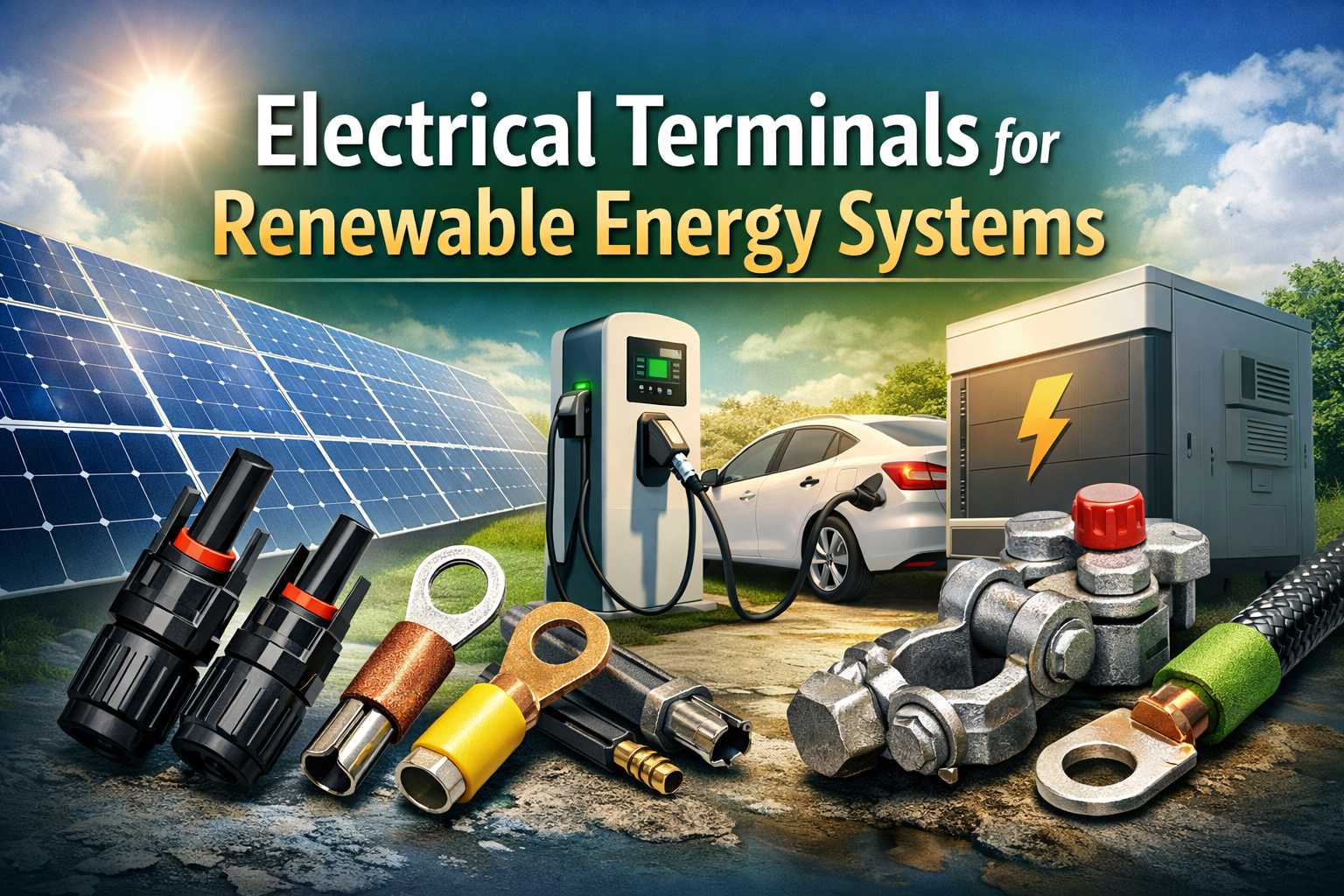
Renewable energy systems are rapidly transforming the global power landscape. From solar farms and wind turbines to battery storage and EV infrastructure, these systems demand highly reliable electrical connections to operate efficiently over decades.
At the heart of these systems are electrical terminals—small components that play a critical role in ensuring safe, stable, and efficient power transmission.
A poorly selected or improperly installed terminal can lead to:
- Power loss
- Overheating
- System downtime
- Even safety hazards
In this guide, we’ll break down everything you need to know about electrical terminals used in renewable energy systems, and how to choose the right solution for long-term performance.
Why Electrical Terminals Matter in Renewable Energy
In renewable energy systems, electrical terminals are not just passive connectors—they are critical performance determinants that directly impact efficiency, safety, and long-term system reliability.
Unlike conventional indoor electrical setups, renewable installations such as solar farms, wind turbines, and battery storage systems operate in highly demanding environments and are expected to perform continuously for 20–30 years with minimal maintenance. Under these conditions, even a minor weakness in a terminal connection can lead to significant operational issues.
1. Minimizing Energy Loss
Electrical terminals must provide low contact resistance to ensure efficient current flow. Poor-quality or improperly installed terminals can create resistance points, resulting in:
- Voltage drops
- Heat generation
- Reduced system efficiency
In large-scale solar or energy storage systems, even small inefficiencies can translate into substantial energy losses over time, directly affecting ROI.
2. Preventing Overheating and Fire Risks
Loose or degraded connections are one of the most common causes of overheating in electrical systems. In renewable energy applications where high currents are common, this risk is amplified.
High-quality terminals:
- Maintain stable contact pressure
- Resist loosening under vibration or thermal cycling
- Prevent arc formation and hotspots
This is especially critical in battery systems and EV charging infrastructure, where safety is non-negotiable.
3. Ensuring Mechanical Reliability
Renewable energy systems are often exposed to:
- Wind-induced vibration (wind turbines)
- Thermal expansion and contraction
- Mechanical stress during installation and operation
Electrical terminals must deliver strong mechanical retention to prevent loosening or disconnection over time. Crimped or bolted connections are typically preferred because they offer long-term mechanical stability.
4. Withstanding Harsh Environmental Conditions
Outdoor renewable systems face constant exposure to:
- UV radiation
- Moisture and rain
- Salt spray (coastal installations)
- Dust and contaminants
Terminals must be designed with:
- Corrosion-resistant materials (e.g., tinned copper)
- Protective plating
- Sealing solutions (IP-rated connectors)
Failure to address these factors can lead to oxidation, increased resistance, and eventual connection failure.
5. Supporting Long Service Life
Renewable energy assets are long-term investments. Replacing failed components in large installations is both costly and logistically challenging.
Reliable terminals contribute to:
- Reduced maintenance frequency
- Lower operational costs
- Extended system lifespan
In this context, terminals are not just components—they are key contributors to lifecycle cost optimization.
Types of Electrical Terminals Used in Renewable Energy
Renewable energy systems require a wide range of electrical terminals, each designed for specific functions, current levels, and environmental conditions. Selecting the appropriate type is essential for achieving optimal electrical and mechanical performance.
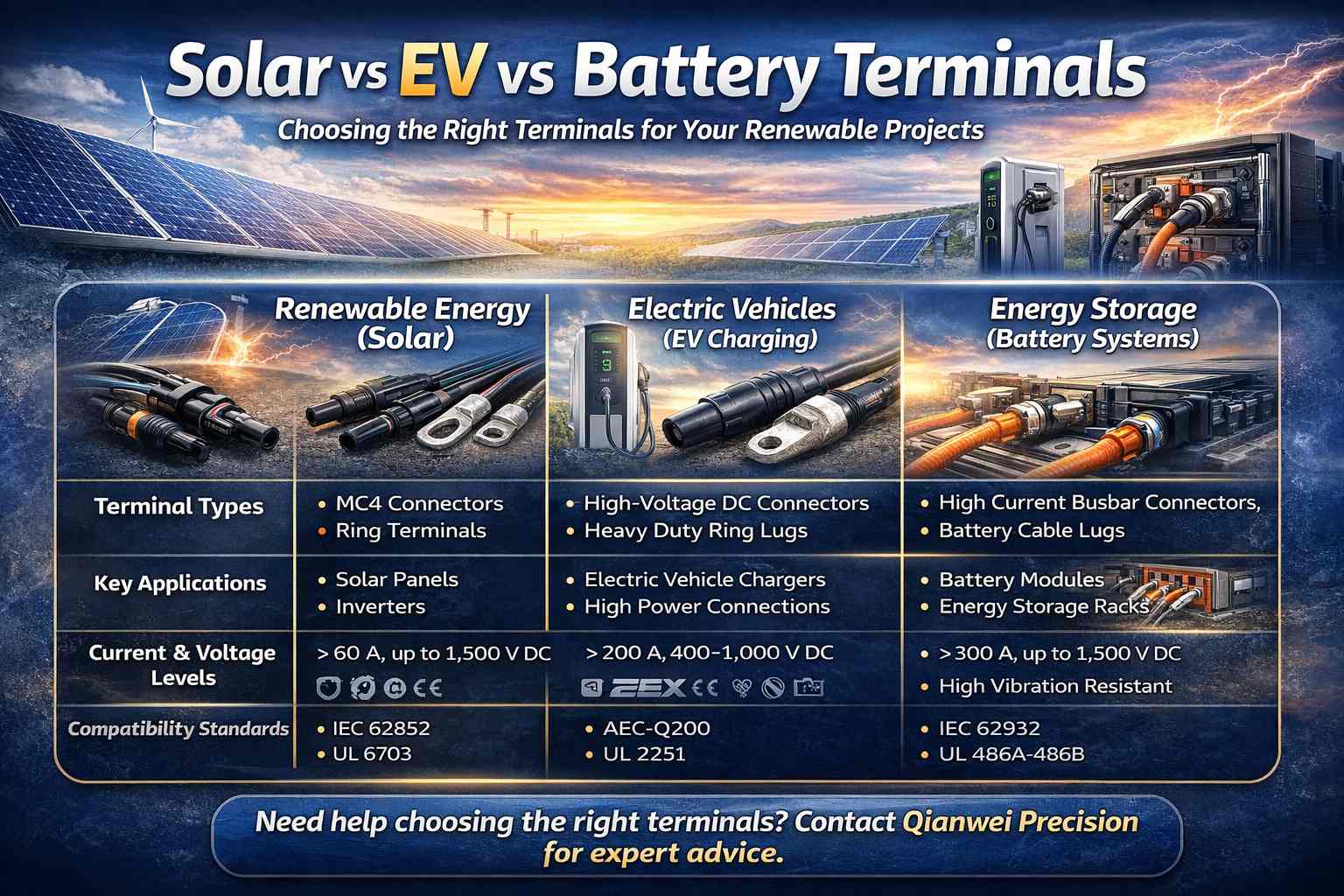
Figure: Comparison of Electrical Terminals Used in Solar, EV Charging, and Battery Storage Systems
1. Solar (PV) Connectors
Photovoltaic systems rely heavily on standardized connectors such as MC4-type connectors for fast and secure installation.
Key characteristics:
- IP67/IP68 waterproof protection
- UV-resistant insulation materials
- Snap-lock mechanisms for secure mating
Typical applications:
- Panel-to-panel connections
- String connections to inverters
These connectors are designed for tool-free installation and long-term outdoor durability, making them indispensable in solar deployments.
2. Ring Terminals and Cable Lugs
Ring terminals and cable lugs are widely used in high-current and grounding applications.
Advantages:
- Secure bolted connections
- Excellent conductivity
- High resistance to vibration
Common use cases:
- Inverter terminals
- Battery banks
- Grounding systems
Their closed-ring design ensures that the connection remains secure even under mechanical stress, making them ideal for critical power connections.
3. Crimp Terminals
Crimp terminals are the preferred choice for creating gas-tight electrical connections without soldering.
Types include:
- Open barrel terminals (for automated production)
- Closed barrel terminals (for heavy-duty applications)
Benefits:
- Low and stable contact resistance
- High vibration resistance
- Consistent connection quality
When properly crimped using professional tools, these terminals provide long-term reliability in demanding environments.
4. Insulated vs. Non-Insulated Terminals
The choice between insulated and non-insulated terminals depends on the application environment and safety requirements.
- Provide additional protection against short circuits
- Improve operator safety
- Suitable for general wiring applications
- Offer better heat resistance
- Allow for compact installations
- Preferred in high-temperature or space-constrained environments
In renewable systems, both types are often used depending on the specific installation scenario.
5. Busbar Connections
Busbars are essential in systems that require high-current distribution, such as energy storage and power conversion units.
Key benefits:
- High current-carrying capacity
- Reduced wiring complexity
- Improved heat dissipation
They are commonly used in:
- Battery modules
- Power distribution cabinets
- Inverter systems
Busbars enable efficient and compact power routing, which is critical in modern energy systems.
6. Ferrules (Bootlace Terminals)
Ferrules are used to terminate stranded wires, especially in control panels and inverter connections.
Advantages:
- Prevent strand fraying
- Ensure uniform contact
- Improve connection reliability
They are particularly important in low-voltage control circuits, where stable and clean connections are required.
7. High-Voltage and High-Current Specialized Terminals
With the growth of EV charging and large-scale energy storage, there is increasing demand for specialized terminals capable of handling extreme electrical loads.
Features include:
- Enhanced insulation systems
- High-temperature resistance
- Advanced plating for conductivity and durability
These terminals are designed for next-generation renewable infrastructure, where performance and safety requirements are significantly higher.
Materials Used in Renewable Energy Terminals
Material selection directly impacts performance.
Copper
- Excellent conductivity
- Ideal for most applications
Tinned Copper
- Enhanced corrosion resistance
- Common in outdoor environments
Aluminum
- Lightweight and cost-effective
- Used in large-scale installations
Surface Plating Options
- Tin plating → corrosion resistance
- Nickel plating → high-temperature performance
- Silver plating → superior conductivity
Environmental Challenges
Renewable energy terminals must withstand extreme conditions:
UV Exposure
Degrades plastic and insulation materials over time
Moisture & Water Ingress
Can cause corrosion and short circuits
Temperature Extremes
From freezing winters to high heat
Corrosive Environments
Salt spray (coastal), humidity, and chemicals
👉 This is why IP-rated connectors and sealed terminals are essential.
Performance Requirements
To ensure long-term reliability, terminals must meet:
- High current & voltage ratings
- Low contact resistance
- Long service life (20+ years)
- Resistance to thermal cycling
- Strong mechanical retention
Installation Best Practices
Even the best terminal will fail if installed incorrectly.
Proper Crimping
- Use calibrated crimping tools
- Ensure correct wire stripping length
Professional Tools
- Avoid manual or inconsistent crimping
Cable Management
- Prevent tension and bending stress
Waterproof Protection
- Use heat shrink tubing or seals
Common Failure Modes (And How to Avoid Them)
| Failure Issue | Cause | Solution |
|---|---|---|
| Overheating | Loose connection | Proper torque/crimping |
| Corrosion | Moisture exposure | Use plated terminals |
| High resistance | Poor crimp | Use correct tools |
| Short circuits | Insulation damage | Use insulated terminals |
Applications in Renewable Energy Systems
Solar Power Systems
- PV module connections
- Inverter wiring
Wind Energy Systems
- Internal turbine wiring
- High-vibration environments
Energy Storage Systems
- Battery module connections
- High-current terminals
EV Charging Infrastructure
- High-voltage connections
- Safety-critical terminals
How to Choose the Right Terminal
When selecting terminals, consider:
- Current and voltage requirements
- Environmental conditions
- Material and plating
- Installation method
- Certification standards
Always prioritize long-term reliability over initial cost.
Standards and Certifications
To ensure safety and compliance:
- IEC standards
- UL certification
- TÜV approval
These certifications guarantee performance in demanding applications.
Future Trends
The renewable energy sector is evolving rapidly.
Emerging trends include:
- High-voltage DC terminals
- Smart connectors with monitoring
- Advanced corrosion-resistant materials
- Plug-and-play modular systems
Why Choose Qianwei Precision?
At Qianwei Precision, we specialize in high-performance electrical terminals designed for demanding environments.
We offer:
- High-current and high-voltage terminals
- Custom solutions for solar, EV, and energy storage
- Strict quality control and global standards compliance
- Fast production and reliable delivery
Looking for the right terminals for your renewable energy project?
👉 Contact Qianwei Precision today to get expert support and customized solutions.
Conclusion
Electrical terminals may seem like small components, but they are critical to the performance, safety, and longevity of renewable energy systems.
Choosing the right terminal ensures:
- Efficient power transmission
- Reduced maintenance
- Long-term system reliability
FAQs
1. What are electrical terminals in renewable energy systems?
Electrical terminals are conductive components used to connect wires and cables in renewable energy systems such as solar panels, wind turbines, and battery storage. They ensure secure, low-resistance electrical connections for efficient power transmission.
2. Why are electrical terminals important in solar and energy systems?
Electrical terminals are critical because they:
- Reduce energy loss
- Prevent overheating
- Ensure long-term system reliability
Poor-quality terminals can lead to power inefficiency, system failure, and safety risks.
3. What types of terminals are used in solar power systems?
Common solar terminals include:
- MC4 connectors
- Ring terminals
- Cable lugs
- Crimp terminals
These are designed for outdoor durability, waterproofing, and long service life.
4. What is the difference between EV terminals and battery terminals?
EV terminals are designed for high-voltage and high-current applications, while battery terminals focus on stable energy storage connections. EV systems require stricter insulation and thermal management due to higher power demands.
5. Which material is best for electrical terminals in renewable energy?
Copper is the most commonly used material due to its excellent conductivity.
Tinned copper is preferred in outdoor environments because it offers better corrosion resistance and durability.
6. How do I choose the right terminal for my application?
To select the right terminal, consider:
- Current and voltage requirements
- Environmental conditions
- Installation method
- Required certifications
Choosing the correct terminal ensures long-term performance and safety.
7. What causes electrical terminal failure in renewable systems?
The most common causes include:
- Loose connections
- Corrosion and oxidation
- Poor crimping
- Moisture ingress
These issues increase resistance and can lead to overheating or system failure.
8. Are crimped or soldered connections better for renewable energy systems?
Crimped connections are generally preferred because they provide:
- Gas-tight contact
- Better vibration resistance
- Consistent performance
Soldered connections may fail under vibration and thermal stress.
9. What certifications should electrical terminals have?
Reliable terminals should meet standards such as:
- IEC standards
- UL certification
- TÜV approval
These certifications ensure safety, performance, and compliance in global markets.
10. How can I improve the reliability of electrical connections?
You can improve reliability by:
- Using high-quality terminals
- Applying proper crimping techniques
- Protecting connections from moisture and corrosion
- Performing regular inspection and testing
11. What is the most reliable electrical connection method?
Crimping is considered the most reliable method because it creates a gas-tight, low-resistance connection that performs well under vibration and harsh environments.
12. What is the lifespan of electrical terminals in solar systems?
High-quality terminals can last 20–30 years, matching the lifespan of solar installations when properly installed and protected.


One thought on “Electrical Terminals for Renewable Energy Systems – A Complete Guide to Reliable Power Connections”