

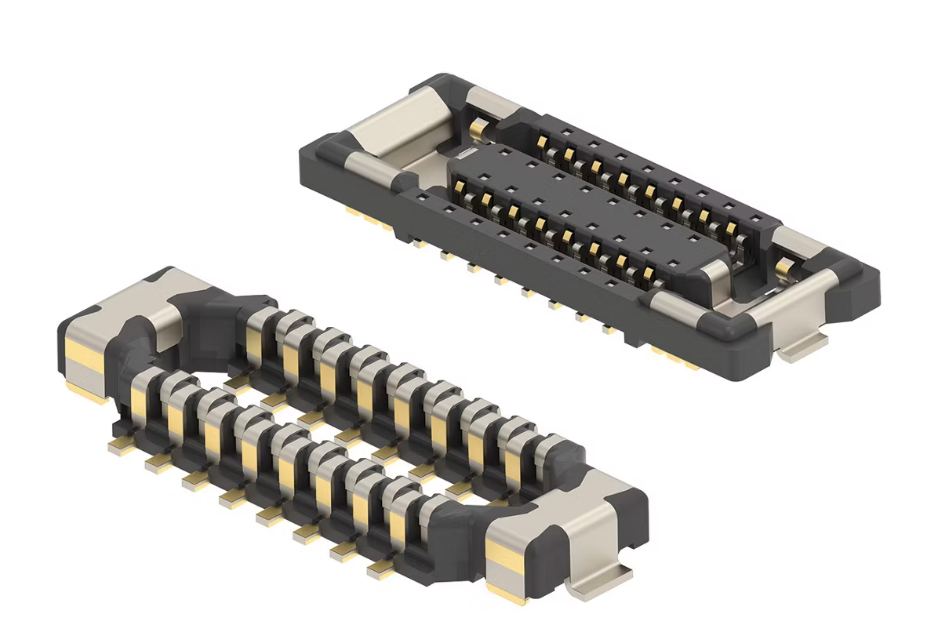
Board-to-board connectors are precision-engineered interconnections that create secure electrical connections between two printed circuit boards (PCBs) without requiring separate wiring. Due to the ongoing trend toward shrinking, increasing power, and the multifunctionality of electronic devices, high-density, space-saving interconnection solutions have become highly in demand. Board-to-board connectors are important for stable signal transmission, effective power delivery, and mechanical positioning in complicated electronic mechanisms.
Qianwei Precision is a manufacturer of high-performance connectors between boards with a design based on the stability of the board, electrical stability, and data integrity at speed. We offer standardized and custom board-level interconnect solutions in automotive electronics, industrial automation, telecommunications infrastructure, medical, and consumer electronics applications around the world through advanced stamping technology and the development of precision molds, as well as automated assembly systems.
What are Board-to-Board Connectors?
Board-to-board connectors are electromechanical pieces of equipment that join two PCBs together either in a parallel, perpendicular, or coplanar manner. In contrast to a wire-to-board connection, which uses cable harnesses, a board-to-board connection connects two circuit boards and simplifies wiring; furthermore, structural integration is enhanced.
These connectors are made of mating plug and receptacle parts with accurate contacts that fit well when assembling them. When connected, they supply a defined spacing between boards as well as a steady electric continuity. They consume less space, have a high density of pins, and a stable contact system that makes them suitable in a contemporary electronic system that requires miniaturization and high performance.
They are becoming a common application in multilayer electronic modules where vertical stacking or right-angle format is necessary. They allow a modular design architecture, streamline assembly, and allow scalable product development.
Engineering Design Principles
Optimization of electrical and mechanical designs is of importance to the performance of board-to-board connectors. When developing an engineering design, several aspects are taken into account to provide stable operation under different environmental and load conditions.
1. Electrical Signal Integrity and Performance
Digital systems run at high-speed connectors that transmit signals without distortion and interference. The geometry of contacts, the thickness of plating, and the conductor material are optimized to ensure minimal contact resistance and constant impedance behavior. In high-frequency design, controlled impedance design minimizes signal reflection and crosstalk between neighboring contacts.
At low insertion loss, continuity of the signal path is vital in ensuring the integrity of the data flow. Adequate shielding and separation of contacts reduce electromagnetic interference (EMI) to provide a consistent communication performance in high-density PCB designs.
2. Mechanical alignment and Accuracy
Pay close attention to alignment because it is necessary to eliminate pin damage and create secure bi-directional engagement. Board-to-board connectors are made in the form of guideposts, alignment pins, and polarization so as to avoid false mating. The force of insertion is carefully regulated to provide assurance of proper contact and eliminate overloading of PCB solder joints.
The mechanical robustness is of particular interest in applications where vibration or shock is involved, e.g., in automotive control modules or in industrial equipment.
3. Contact Force and Durability
The design of the contact assures constant pressure of contact during the service life of the connector. Optimal normal force reduces the resistance and avoids too much wearout caused by mating with other individuals in a repetitive cycle of mating. Durability testing confirms that connectors can be inserted and removed numerous times without losing their performance.
4. Thermal Stability and Current Carrying Capacity
Electrical current is heating contact interfaces. The board-to-board connector is designed to carry desired current ratings without compromising safe temperature rise levels. Excessive conducting copper alloy and thermoplastic housing materials deter excessive heating and structural distortion.
Materials We Use for Board-to-Board Connector
Such connectors are sensitive to material selection that directly influences the electrical performance, mechanical performance, and environmental sensitivity. The table below provides an overview of the commonly used materials together with their important properties:
| Material | Key Property | Typical Use |
| Phosphor Bronze / Brass | High conductivity, strong, fatigue-resistant | Contact terminals |
| PA / PBT / LCP / PPS | Heat-resistant, stable, insulating | Connector housings |
| Tin / Nickel / Gold Plating | Corrosion-resistant, improves conductivity | Contact surfaces |
Manufacturing Processes
Board-to-board connector manufacturing is a process that demands strict control measures to ensure that dimensional and electrical consistency is attained.
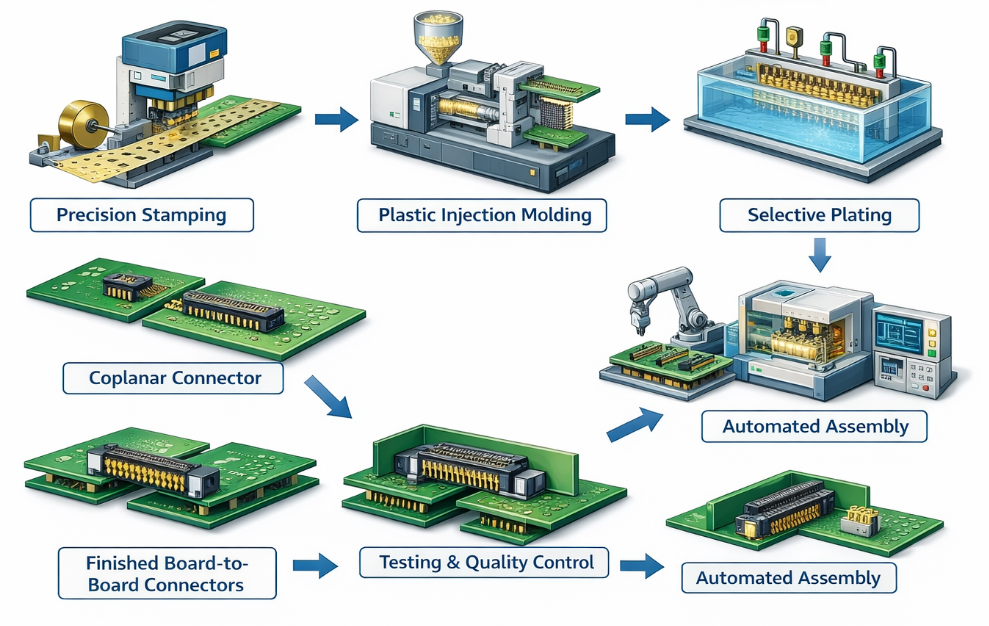
Stamping of Contacts with Accuracy
In high-speed stamping machines, contact terminals are made with micron-tolerance. Progressive dies make the shape, edges, and spring characteristics consistently shaped. Close dimensional control ensures correct mating and stability of insertion forces.
Plastic Injection Molding
The connector housings are produced on high-precision injection molding systems. Hi-tech design of the mold is used to guarantee proper alignment of the pin pitch and integrity of the structure. Control Process control reduces warpage and produces dependable locations of solder tails.
Selective Surface Treatment and Plating.
Electroplating operations provide layers of conductive and protective materials on the contact surfaces, which are controlled. Selective gold plating is frequently applied in signal hotspots to ensure high-performance and cost-effective plating. The quality can be checked and the surface prepared to guarantee a uniform thickness and high adhesion.
Automated Assembly
Automated apparatus blows stamped contacts into high positional accuracy molded housings. The position and orientation are checked by vision systems. Labor productivity is improved, and the decrease in human error is achieved through automation.
Testing and Quality Control
Every production batch is tested electrically, investigated in terms of its dimensions, and its mechanical performance is checked. To ensure that the technical standards are met, parameters like contact resistance, insulation resistance, and dielectric strength are measured.
Standard Specifications for Board-to-Board Connectors
They are made with different configurations, pitches, and stacking heights. So, they can be suitable for special electrical and mechanical needs. A table of typical specifications is shown below:
| Specification | Typical Range | Notes |
| Pitch | 0.4 – 2.54 mm | Contact spacing |
| Stacking Height | 1 – 30 mm | Vertical board spacing |
| Current Rating | 0.3 – 5 A | Per contact |
| Voltage Rating | 50 – 250 V | Operating voltage |
| Temperature | −40°C to +105°C | Operating environment |
| Mating Cycles | 30 – 500+ | Insertion/removal durability |
Different Types of Board-to-Board Connectors
Board-to-board connectors are classified according to orientation, structure, and mechanical configuration. All types are specific to satisfy electrical, mechanical, and space considerations of electronic assemblies.
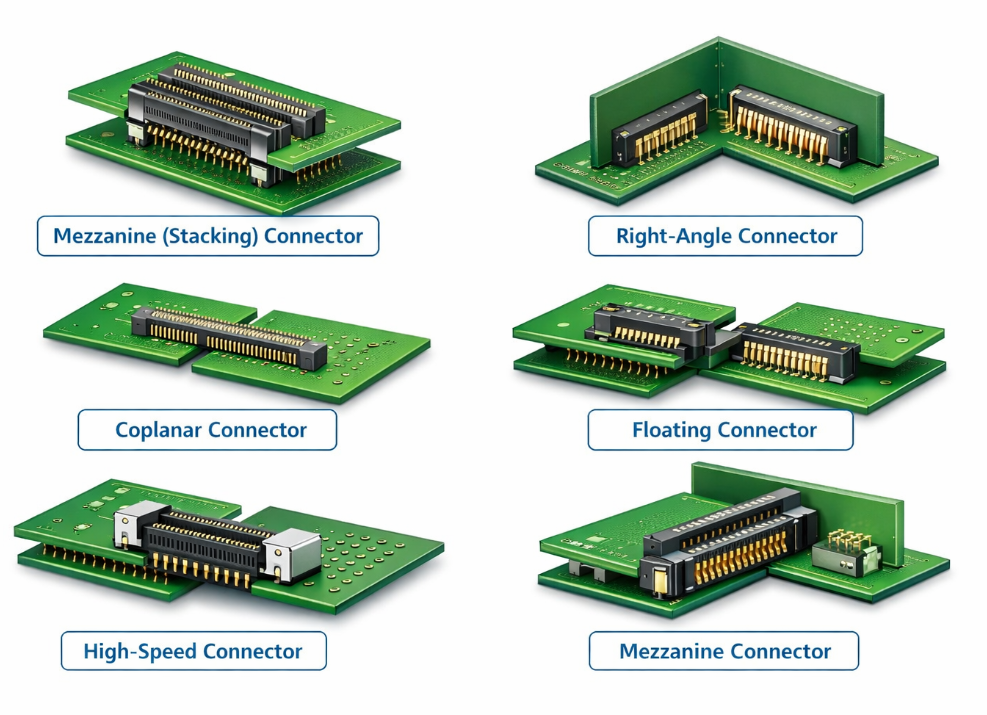
1. Mezzanine (Stacking) Connectors
Parallel stacking of PCBs is possible with mezzanine connectors. They usually find application in small gadgets like communication modules and embedded systems. The high pin density allows them to implement complex signal routing in smaller spaces, and is also reliable to make contact with each other across many mating cycles. These connectors are suited to designs where there is no availability of vertical space, but high connectivity is needed.
2. Right-Angle Connectors
Right-angle plugs attach PCBs in 90° modes. They are perfect for use in which the vertical and horizontal boards are in contact with each other in enclosures. The layout minimizes the footprint on the board and enables the routing of the cables and components easily. They are also very stable and can be used in vibration-prone settings due to their strong mechanical design.
3. Coplanar Connectors
Coplanar connectors are used to connect boards that are side-by-side. They make industrial control systems modularly expandable. These connectors enable consistent electrical performance and enable easy replacement or upgrading of single boards without interfering with the rest of the assembly. They are commonly found in telecom and networking devices when it is needed to be layout-flexible.
4. Floating Connectors
Floating connectors allow the boards to be slightly misaligned, which lowers mechanical stress during assembly. They can be used in automotive and industrial environments that have vibrations. The floating design provides consistent contact integrity when small shifts occur to avoid premature wear or loss of signal. The application is especially beneficial for challenging situations to have the precision of alignment.
5. High-Speed Connectors
Data-intensive connectors are high-speed board-to-board connectors. At high transmission rates, controlled impedance and enhanced shielding can minimize signal distortion. These are essential in high-frequency data lines, computing devices, and telecommunication equipment, with respect to signal integrity. The design reduces crosstalk and has high-speed long-term reliability.
Industrial Uses of Broad-to-Broad Connector
Board-to-board connectors are all-purpose elements applied in various industries:
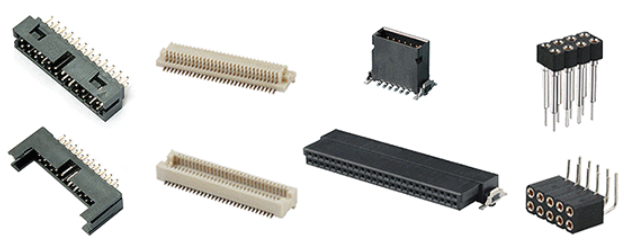
- Consumer Electronics: Small connectors combine displays, batteries, and communication devices on smartphones, tablets, and laptops.
- Automotive Electronics:ECUs, infotainment systems, and ADAS are based on the use of vibration-resistant connectors to achieve a manufactured, reliable performance.
- Industrial Automation:Modular connectors are used to design flexible system architecture by industrial PLCs, robotic controllers, and sensors.
- Telecommunications & Networking: Fast connectors are used to deliver stable signals in network equipment and data centers.
- Medical Equipment: Trustworthy connectors. Due to the accurate signal integrity demanded, small diagnostic and monitoring electronics depend on reliable connectors.
OEM Solutions and Designing
Qianwei Precision provides all-around customization services according to OEM requirements.
- Custom Pin Configuration: The number of connector pins and circuit board layout can be tailored to the requirements of a particular circuit.
- Tailored Stacking Heights: Special mechanical integration requirements are for custom stacking heights.
- Especially Designed Railroad Plating: Choices of plating thickness and a set of materials are offered to ensure the best performance.
- Branding and Packaging: The global OEM supply chains are supported by laser marking, labeling, and export-grade packaging solutions.
Quality and Compliance
Reliability of connectors is guaranteed by quality control. The manufacturing processes meet the quality management systems in the world, e.g, ISO 9001, and IATF 16949. The products comply with environmental standards such as RoHS and REACH compliance. Extensive electrical and mechanical testing ensures stability, conductivity, and safety behavior in the given conditions.
Conclusion
Board-to-board connectors are essential elements of contemporary electronic systems that provide compact design, stable electrical transmission, and modular architecture. Qianwei Precision provides durable and high-performance, high-quality board-to-board connectors in a wide range of industries through precision engineering and the use of superior materials and enhanced production technologies. We will stay innovative, assure quality, and customer-oriented solutions to keep providing reliable connectivity to the next generation of electronic devices.
FAQs
What is a board-to-board connector?
A board-to-board connector is an electrical connector between two printed circuit boards (PCBs), with reliable conduction of signals and power conduction within small electronic assemblies.
What are the materials of board-to-board connectors?
Copper alloys such as phosphor bronze or brass are usually used as contacts, with high-performance plastics such as PA, PBT, LCP, or PPS used as housings. Conductivity and corrosion resistance are enhanced by plating such as tin, nickel, or gold.
What are the typical uses of board-to-board connectors?
They find application in consumer electronics, automotive, and industrial automation, telecommunications, and medical applications where small PCB interconnections are needed and reliability is important.
What are the pitch sizes and heights of stacking?
The standard pitches are between 0.4 mm and 2.54 mm, and stacking heights stand between 1 mm and 30 mm, determined by the board layout and need of the application.
What is the maximum number of mating cycles of these connectors?
Board-to-board connectors are specified to have 30 to over 500 mating cycles, and this varies with the material, plating, and mechanical configuration.
Do board-to-board connectors survivea harsh environment?
Yes, vibration-resistant connector design, plastics with high operating temperatures, and plated connectors can be utilized successfully at the mechanical, thermal, and environmental levels.
