

Introducción
Renewable energy systems are rapidly transforming the global power landscape. From solar farms and wind turbines to battery storage and EV infrastructure, these systems demand highly reliable electrical connections to operate efficiently over decades.
At the heart of these systems are terminales electricos—small components that play a critical role in ensuring safe, estable, and efficient power transmission.
A poorly selected or improperly installed terminal can lead to:
- Pérdida de energía
- Calentamiento excesivo
- Tiempo de inactividad del sistema
- Even safety hazards
En esta guía, we’ll break down everything you need to know about electrical terminals used in renewable energy systems, and how to choose the right solution for long-term performance.
Why Electrical Terminals Matter in Renewable Energy
In renewable energy systems, electrical terminals are not just passive connectors—they are critical performance determinants that directly impact efficiency, seguridad, y confiabilidad del sistema a largo plazo.
Unlike conventional indoor electrical setups, renewable installations such as solar farms, turbinas eólicas, and battery storage systems operate in highly demanding environments and are expected to perform continuously for 20–30 years with minimal maintenance. Under these conditions, even a minor weakness in a terminal connection can lead to significant operational issues.
1. Minimizing Energy Loss
Electrical terminals must provide baja resistencia de contacto to ensure efficient current flow. Poor-quality or improperly installed terminals can create resistance points, resulting in:
- Caídas de voltaje
- Heat generation
- Reduced system efficiency
In large-scale solar or energy storage systems, even small inefficiencies can translate into substantial energy losses over time, directly affecting ROI.
2. Preventing Overheating and Fire Risks
Loose or degraded connections are one of the most common causes of overheating in electrical systems. In renewable energy applications where high currents are common, this risk is amplified.
Terminales de alta calidad:
- Maintain stable contact pressure
- Resist loosening under vibration or thermal cycling
- Prevent arc formation and hotspots
This is especially critical in battery systems and EV charging infrastructure, where safety is non-negotiable.
3. Ensuring Mechanical Reliability
Renewable energy systems are often exposed to:
- Wind-induced vibration (turbinas eólicas)
- Expansión y contracción térmica.
- Mechanical stress during installation and operation
Electrical terminals must deliver fuerte retención mecánica to prevent loosening or disconnection over time. Crimped or bolted connections are typically preferred because they offer long-term mechanical stability.
4. Withstanding Harsh Environmental Conditions
Outdoor renewable systems face constant exposure to:
- UV radiation
- Moisture and rain
- Salt spray (instalaciones costeras)
- Dust and contaminants
Terminals must be designed with:
- Corrosion-resistant materials (p.ej., cobre estañado)
- Protective plating
- Sealing solutions (IP-rated connectors)
Failure to address these factors can lead to oxidación, mayor resistencia, and eventual connection failure.
5. Supporting Long Service Life
Renewable energy assets are long-term investments. Replacing failed components in large installations is both costly and logistically challenging.
Reliable terminals contribute to:
- Reduced maintenance frequency
- Lower operational costs
- Extended system lifespan
In this context, terminals are not just components—they are key contributors to lifecycle cost optimization.
Types of Electrical Terminals Used in Renewable Energy
Renewable energy systems require a wide range of electrical terminals, each designed for specific functions, current levels, y condiciones ambientales. Selecting the appropriate type is essential for achieving optimal electrical and mechanical performance.
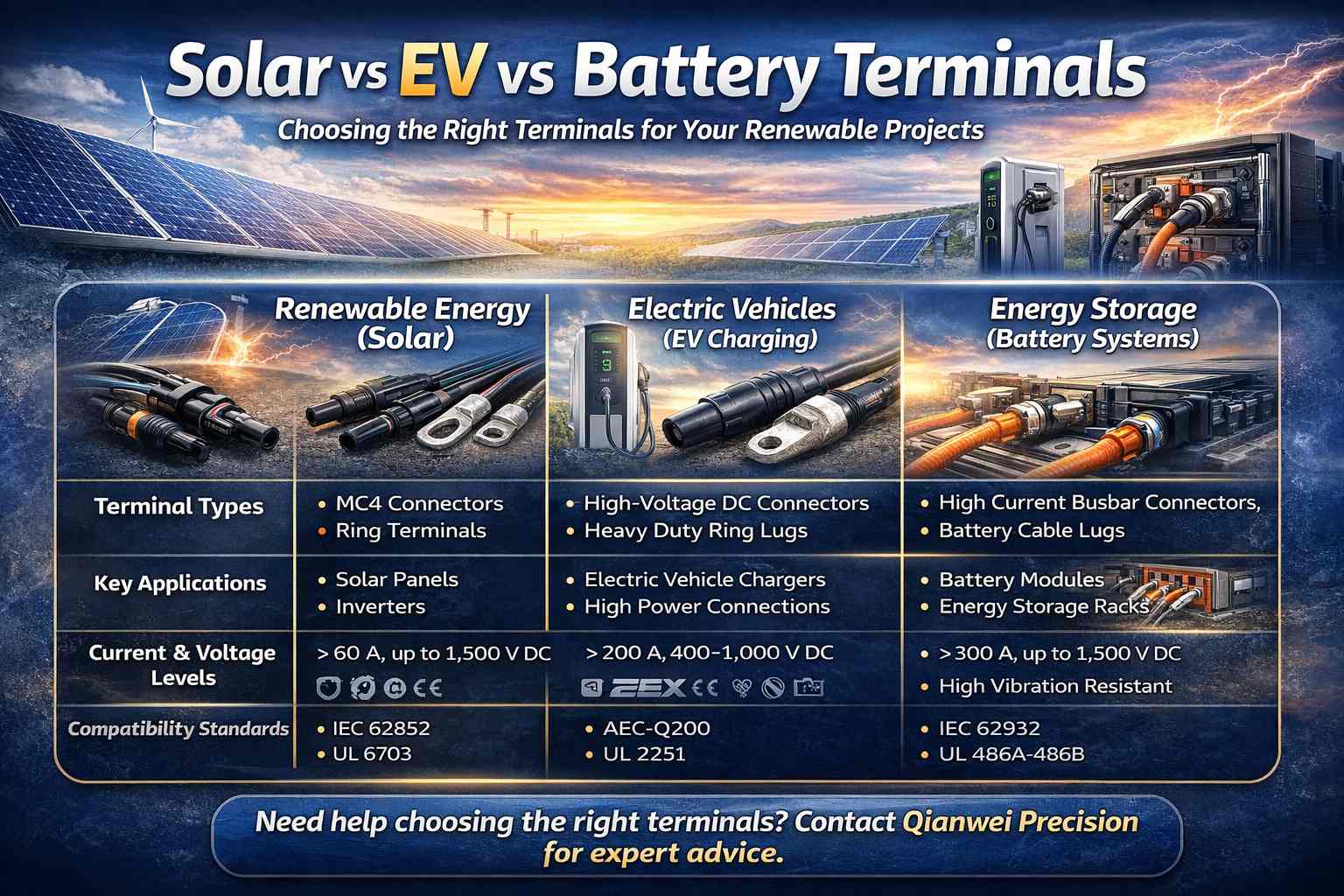
Figure: Comparison of Electrical Terminals Used in Solar, EV Charging, and Battery Storage Systems
1. Solar (fotovoltaica) Conectores
Photovoltaic systems rely heavily on standardized connectors such as MC4-type connectors for fast and secure installation.
Características clave:
- IP67/IP68 waterproof protection
- UV-resistant insulation materials
- Snap-lock mechanisms for secure mating
Aplicaciones típicas:
- Panel-to-panel connections
- String connections to inverters
These connectors are designed for tool-free installation and long-term outdoor durability, making them indispensable in solar deployments.
2. Terminales de anillo y Cable Lugs
Ring terminals and cable lugs are widely used in high-current and grounding applications.
Ventajas:
- Secure bolted connections
- Excelente conductividad
- Alta resistencia a las vibraciones
Common use cases:
- Inverter terminals
- Battery banks
- Sistemas de puesta a tierra
Their closed-ring design ensures that the connection remains secure even under mechanical stress, making them ideal for critical power connections.
3. Terminales de crimpado
Crimp terminals are the preferred choice for creating conexiones eléctricas estancas al gas without soldering.
Types include:
- Terminales de barril abierto (for automated production)
- Terminales de barril cerrado (for heavy-duty applications)
Beneficios:
- Low and stable contact resistance
- High vibration resistance
- Consistent connection quality
When properly crimped using professional tools, these terminals provide long-term reliability in demanding environments.
4. Aislado vs.. Terminales no aislados
The choice between insulated and non-insulated terminals depends on the application environment and safety requirements.
- Provide additional protection against short circuits
- Mejorar la seguridad del operador
- Suitable for general wiring applications
- Offer better heat resistance
- Allow for compact installations
- Preferred in high-temperature or space-constrained environments
In renewable systems, both types are often used depending on the specific installation scenario.
5. Busbar Connections
Busbars are essential in systems that require high-current distribution, such as energy storage and power conversion units.
Key benefits:
- Alta capacidad de transporte de corriente
- Complejidad de cableado reducida
- Improved heat dissipation
Se utilizan comúnmente en:
- Battery modules
- Gabinetes de distribución de energía
- Inverter systems
Busbars enable efficient and compact power routing, which is critical in modern energy systems.
6. Férulas (Bootlace Terminals)
Ferrules are used to terminate stranded wires, especially in control panels and inverter connections.
Ventajas:
- Prevent strand fraying
- Ensure uniform contact
- Improve connection reliability
They are particularly important in low-voltage control circuits, where stable and clean connections are required.
7. High-Voltage and High-Current Specialized Terminals
With the growth of EV charging and large-scale energy storage, there is increasing demand for specialized terminals capable of handling extreme electrical loads.
Las características incluyen:
- Enhanced insulation systems
- High-temperature resistance
- Advanced plating for conductivity and durability
These terminals are designed for next-generation renewable infrastructure, where performance and safety requirements are significantly higher.
Materials Used in Renewable Energy Terminals
Material selection directly impacts performance.
Cobre
- Excelente conductividad
- Ideal for most applications
Cobre estañado
- Enhanced corrosion resistance
- Common in outdoor environments
Aluminio
- Ligero y rentable
- Used in large-scale installations
Opciones de revestimiento de superficies
- Estañado → resistencia a la corrosión
- Nickel plating → high-temperature performance
- Silver plating → superior conductivity
Environmental Challenges
Renewable energy terminals must withstand extreme conditions:
UV Exposure
Degrades plastic and insulation materials over time
Humedad & Water Ingress
Can cause corrosion and short circuits
Temperature Extremes
From freezing winters to high heat
Ambientes corrosivos
Salt spray (coastal), humedad, y quimicos
👉 This is why IP-rated connectors and sealed terminals are essential.
Performance Requirements
To ensure long-term reliability, terminals must meet:
- Alta corriente & voltage ratings
- Baja resistencia de contacto
- Larga vida útil (20+ años)
- Resistance to thermal cycling
- Fuerte retención mecánica
Mejores prácticas de instalación
Even the best terminal will fail if installed incorrectly.
Proper Crimping
- Utilice herramientas de engarce calibradas
- Asegúrese de que la longitud de pelado de cables sea correcta
Professional Tools
- Avoid manual or inconsistent crimping
Cable Management
- Prevent tension and bending stress
Waterproof Protection
- Use heat shrink tubing or seals
Common Failure Modes (And How to Avoid Them)
| Failure Issue | Causa | Solución |
|---|---|---|
| Calentamiento excesivo | Conexión floja | Proper torque/crimping |
| Corrosión | Exposición a la humedad | Use plated terminals |
| Alta resistencia | Mal engarzado | Use correct tools |
| Cortocircuitos | Daños en el aislamiento | Use insulated terminals |
Applications in Renewable Energy Systems
Sistemas de energía solar
- PV module connections
- Inverter wiring
Wind Energy Systems
- Internal turbine wiring
- Ambientes de alta vibración
Sistemas de almacenamiento de energía
- Battery module connections
- Terminales de alta corriente
EV Charging Infrastructure
- High-voltage connections
- Safety-critical terminals
Cómo elegir la terminal adecuada
When selecting terminals, considerar:
- Requisitos de corriente y voltaje.
- Condiciones ambientales
- Material y revestimiento
- Método de instalación
- Estándares de certificación
Always prioritize long-term reliability over initial cost.
Estándares y Certificaciones
To ensure safety and compliance:
- Normas IEC
- Certificación UL
- TÜV approval
These certifications guarantee performance in demanding applications.
Tendencias futuras
The renewable energy sector is evolving rapidly.
Emerging trends include:
- High-voltage DC terminals
- Smart connectors with monitoring
- Advanced corrosion-resistant materials
- Plug-and-play modular systems
¿Por qué elegir la precisión Qianwei??
En Precisión de Qianwei, we specialize in high-performance electrical terminals designed for demanding environments.
Ofrecemos:
- High-current and high-voltage terminals
- Custom solutions for solar, vehículo eléctrico, and energy storage
- Strict quality control and global standards compliance
- Fast production and reliable delivery
Looking for the right terminals for your renewable energy project?
👉 Póngase en contacto con Qianwei Precision hoy to get expert support and customized solutions.
Conclusión
Electrical terminals may seem like small components, but they are critical to the performance, seguridad, y longevidad of renewable energy systems.
Choosing the right terminal ensures:
- Transmisión de potencia eficiente
- Reduced maintenance
- Long-term system reliability
Preguntas frecuentes
1. What are electrical terminals in renewable energy systems?
Electrical terminals are conductive components used to connect wires and cables in renewable energy systems such as solar panels, turbinas eólicas, and battery storage. They ensure seguro, low-resistance electrical connections for efficient power transmission.
2. Why are electrical terminals important in solar and energy systems?
Electrical terminals are critical because they:
- Reduce energy loss
- Prevent overheating
- Ensure long-term system reliability
Poor-quality terminals can lead to power inefficiency, falla del sistema, and safety risks.
3. What types of terminals are used in solar power systems?
Common solar terminals include:
- Conectores MC4
- Terminales de anillo
- Terminales de cable
- Terminales de engarce
These are designed for outdoor durability, waterproofing, y larga vida útil.
4. What is the difference between EV terminals and battery terminals?
EV terminals are designed for high-voltage and high-current applications, while battery terminals focus on stable energy storage connections. EV systems require stricter insulation and thermal management due to higher power demands.
5. Which material is best for electrical terminals in renewable energy?
Copper is the most commonly used material due to its excellent conductivity.
Tinned copper is preferred in outdoor environments because it offers better corrosion resistance and durability.
6. How do I choose the right terminal for my application?
To select the right terminal, considerar:
- Requisitos de corriente y voltaje.
- Condiciones ambientales
- Método de instalación
- Required certifications
Choosing the correct terminal ensures long-term performance and safety.
7. What causes electrical terminal failure in renewable systems?
The most common causes include:
- Conexiones sueltas
- Corrosion and oxidation
- Mal prensado
- Moisture ingress
These issues increase resistance and can lead to overheating or system failure.
8. Are crimped or soldered connections better for renewable energy systems?
Crimped connections are generally preferred because they provide:
- Gas-tight contact
- Mejor resistencia a las vibraciones
- Rendimiento consistente
Soldered connections may fail under vibration and thermal stress.
9. What certifications should electrical terminals have?
Reliable terminals should meet standards such as:
- Normas IEC
- Certificación UL
- TÜV approval
These certifications ensure seguridad, actuación, and compliance in global markets.
10. How can I improve the reliability of electrical connections?
You can improve reliability by:
- Using high-quality terminals
- Applying proper crimping techniques
- Protecting connections from moisture and corrosion
- Performing regular inspection and testing
11. What is the most reliable electrical connection method?
Crimping is considered the most reliable method because it creates a gas-tight, low-resistance connection that performs well under vibration and harsh environments.
12. What is the lifespan of electrical terminals in solar systems?
High-quality terminals can last 20–30 years, matching the lifespan of solar installations when properly installed and protected.

