

Introducción
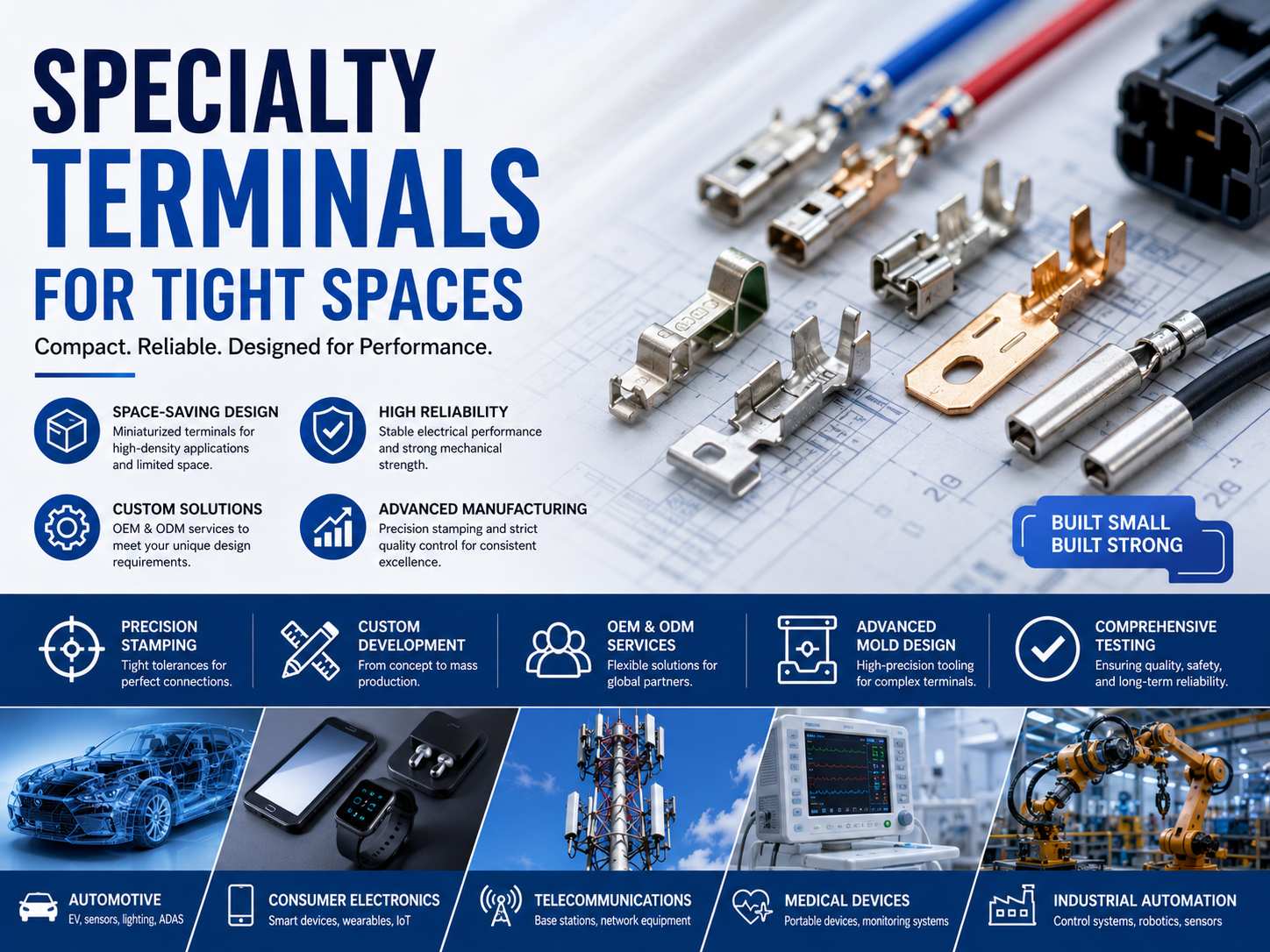
Como dispositivos electrónicos, sistemas automotrices, y los equipos industriales son cada vez más pequeños y sofisticados, Los ingenieros enfrentan un desafío creciente.: cómo crear conexiones eléctricas fiables en espacios cada vez más limitados.
Los terminales tradicionales suelen requerir más espacio de instalación del que pueden permitirse los productos modernos. Ya sea un sistema de gestión de baterías de vehículos eléctricos, un dispositivo médico compacto, un producto electrónico portátil, o un módulo de control densamente poblado, cada milímetro importa.
Esta demanda ha llevado al desarrollo de terminales especiales para espacios reducidos: soluciones de conexión eléctrica compactas diseñadas específicamente para ofrecer un rendimiento confiable y al mismo tiempo minimizar los requisitos de espacio..
Estos terminales especializados permiten a los fabricantes optimizar los diseños, aumentar la densidad del componente, mejorar la eficiencia del ensamblaje, y respaldar la miniaturización del producto sin sacrificar la confiabilidad eléctrica.
En este artículo, exploraremos los tipos, consideraciones de diseño, materiales, requisitos de desempeño, y aplicaciones de terminales especiales diseñados para entornos con limitaciones de espacio.
¿Qué son las terminales especiales??
Los terminales especiales son componentes de conexión eléctrica personalizados o compactos diseñados para aplicaciones donde los terminales convencionales son demasiado grandes o poco prácticos..
A diferencia de los terminales estándar, estas soluciones están diseñadas para:
- Reducir el espacio de instalación
- Maximizar la densidad del cableado
- Simplifique el montaje
- Mantenga un rendimiento eléctrico confiable
- Encajar en carcasas compactas
Se utilizan ampliamente en industrias donde el tamaño del equipo, peso, y el rendimiento son críticos.
Por qué las aplicaciones en espacios reducidos necesitan soluciones especializadas
Los productos modernos son cada vez más pequeños e integran más funciones..
Los ejemplos incluyen:
- Vehículos eléctricos
- Dispositivos domésticos inteligentes
- Electrónica portátil
- Instrumentos medicos
- Sensores industriales
- Equipos de telecomunicaciones
- Ruedas giratorias motorizadas
A medida que el espacio disponible disminuye, Las conexiones eléctricas deben ser más compactas manteniendo el mismo nivel de seguridad y confiabilidad..
Desafíos comunes en diseños eléctricos para espacios reducidos
El diseño de sistemas eléctricos para espacios limitados presenta varios desafíos.
Área de instalación limitada
Los productos compactos dejan muy poco espacio para cableado y terminales..
Los ingenieros a menudo necesitan instalar múltiples circuitos en una carcasa confinada sin comprometer la accesibilidad..
Mayor densidad de componentes
A medida que los sistemas electrónicos se vuelven más avanzados, más componentes deben caber en el mismo espacio.
Esto aumenta la demanda de soluciones de conexión en miniatura..
Restricciones de enrutamiento de cables
Los espacios reducidos a menudo requieren que los cables se doblen bruscamente o sigan rutas de enrutamiento complejas..
La selección inadecuada de terminales puede provocar tensiones en los cables y fallos prematuros..
Gestión del calor
Una mayor densidad de componentes a menudo resulta en una mayor concentración de calor..
Los terminales deben mantener un rendimiento estable incluso en temperaturas elevadas.
Tipos de terminales especiales para espacios reducidos
Se han desarrollado varios diseños de terminales para abordar diferentes limitaciones de espacio..
Microterminales
Los microterminales se encuentran entre los terminales eléctricos más pequeños disponibles..
Están diseñados para:
- Tamaños de alambre pequeños
- Conectores compactos
- Montajes de alta densidad
Las aplicaciones comunes incluyen:
- Sensores automotrices
- Electrónica de consumo
- Dispositivos portátiles
Su pequeño tamaño permite a los ingenieros reducir significativamente el tamaño del conector..
Terminales de bajo perfil
Los terminales de bajo perfil minimizan la altura vertical.
Los beneficios incluyen:
- Grosor del conector reducido
- Diseños de productos delgados
- Flexibilidad de embalaje mejorada
Estos terminales se utilizan comúnmente en:
- Módulos de visualización
- Unidades de control compactas
- Dispositivos electrónicos portátiles
Terminales en ángulo recto
Los terminales en ángulo recto redirigen la orientación del cable 90 grados.
Las ventajas incluyen:
- Mejor enrutamiento de cables
- Profundidad de instalación reducida
- Mejor uso del espacio disponible
Estos terminales se encuentran frecuentemente en aplicaciones montadas en PCB..
Terminales de bandera
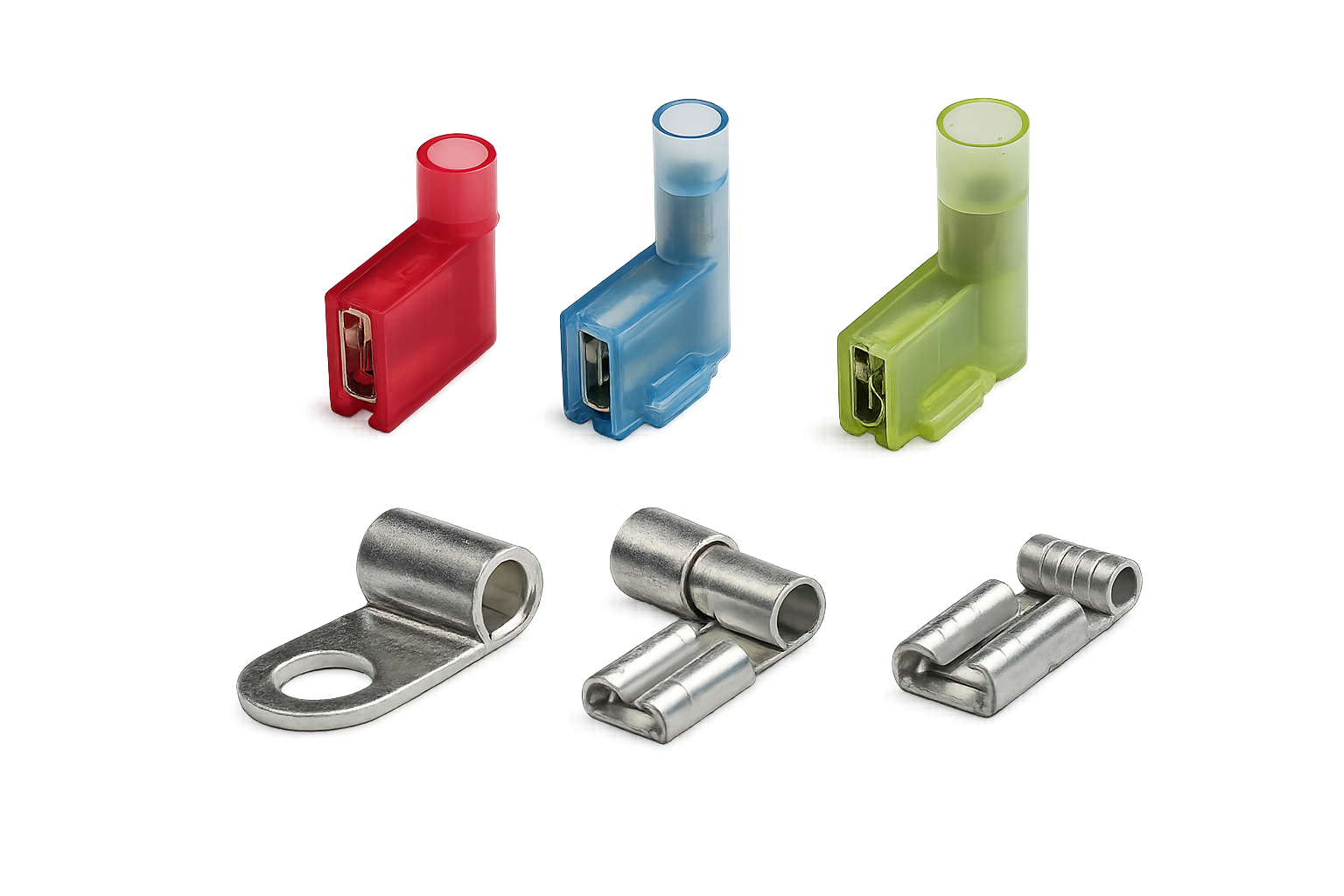
Los terminales de bandera son una solución popular cuando los cables deben salir de lado en lugar de rectos..
Los beneficios incluyen:
- Instalación que ahorra espacio
- Gestión de cables mejorada
- Esfuerzo de flexión reducido
Las industrias comunes incluyen:
- Automotor
- Accesorios
- controles industriales
Terminales de crimpado en miniatura
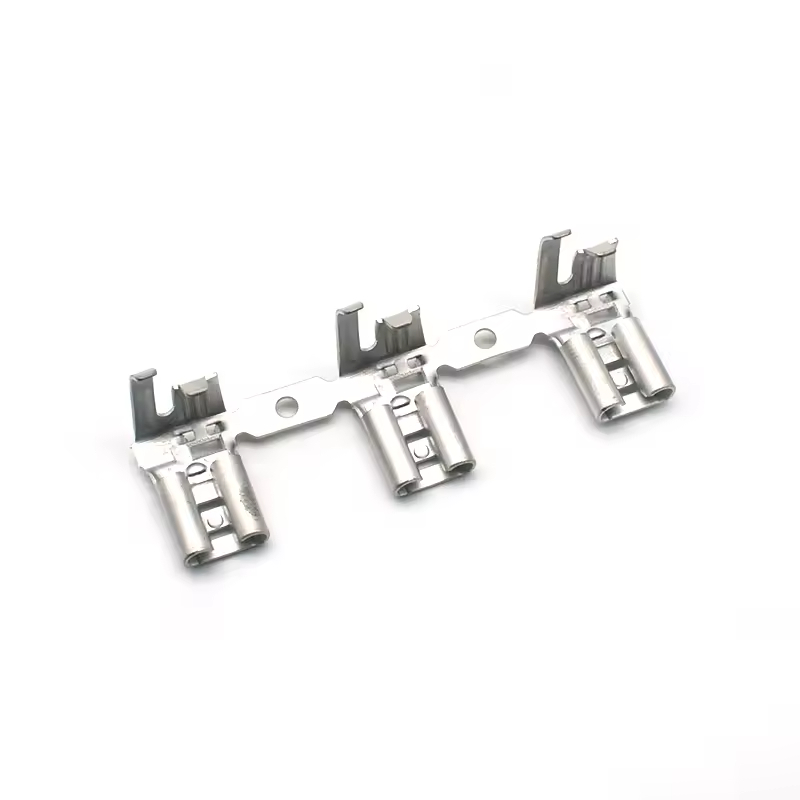
Los terminales de engarzado en miniatura están diseñados específicamente para cables de pequeño calibre..
ellos ofrecen:
- Engarzado confiable
- Dimensiones compactas
- Compatibilidad con conectores de alta densidad
Las aplicaciones incluyen:
- Módulos de control electrónico
- Sistemas de transmisión de señales.
- Dispositivos de precisión
Terminales especiales personalizadas
Muchas aplicaciones requieren soluciones diseñadas a medida.
Los terminales personalizados se pueden optimizar para:
- Dimensiones de vivienda únicas
- Requisitos actuales especiales
- Métodos de montaje específicos
- Certificaciones de la industria
Para fabricantes OEM, Los terminales personalizados a menudo proporcionan el mejor equilibrio entre rendimiento y utilización del espacio..
Consideraciones clave de diseño
El diseño de terminales compactos requiere una ingeniería cuidadosa.
Optimización de tamaño
La reducción del tamaño del terminal no debe comprometer el rendimiento.
Los fabricantes se centran en:
- Reducción de huella
- Reducción de altura
- Reducción de peso
Las tecnologías de estampado avanzadas permiten que los terminales se vuelvan más pequeños manteniendo la integridad estructural.
Rendimiento eléctrico
Incluso los terminales en miniatura deben mantener una excelente conductividad..
Los factores importantes incluyen:
Resistencia de contacto
La baja resistencia de contacto minimiza la pérdida de energía y la generación de calor..
Capacidad de carga actual
A pesar de su tamaño, Los terminales especiales deben manejar las cargas actuales requeridas de forma segura..
Integridad de la señal
La transmisión de señal debe permanecer estable., especialmente en comunicaciones y aplicaciones electrónicas.
Fiabilidad mecánica
Los terminales compactos a menudo experimentan una gran tensión durante el montaje y el funcionamiento..
Los indicadores críticos de desempeño incluyen:
- Fuerza de extracción
- Fuerza de retención
- Durabilidad del acoplamiento
- Resistencia a las vibraciones
La selección adecuada del material es esencial para garantizar la confiabilidad a largo plazo..
Gestión Térmica
Los sistemas miniaturizados suelen tener un flujo de aire limitado.
Los terminales especiales deben:
- Resiste la acumulación de calor
- Mantener la conductividad a temperaturas elevadas.
- Prevenir la deformación térmica
El rendimiento térmico se vuelve cada vez más importante en aplicaciones industriales y de vehículos eléctricos.
Materiales utilizados en terminales especiales
La selección de materiales juega un papel importante en el rendimiento del terminal..
Cobre
El cobre sigue siendo el material preferido para muchas aplicaciones..
Las ventajas incluyen:
- Excelente conductividad
- Alta capacidad de corriente
- Baja resistencia eléctrica
Los terminales de cobre se utilizan comúnmente en sistemas de distribución de energía..
Latón
El latón ofrece un equilibrio entre conductividad y resistencia..
Los beneficios incluyen:
- Eficiencia de costes
- Buena maquinabilidad
- Propiedades mecánicas confiables
El latón se utiliza ampliamente en terminales industriales y de automoción..
Bronce fosforado
El bronce fosforado proporciona una elasticidad superior..
Las ventajas incluyen:
- Excelentes características de primavera.
- Alta resistencia a la fatiga
- Presión de contacto estable
Estas propiedades lo hacen ideal para contactos de conector..
Aleaciones de cobre avanzadas
Algunas aplicaciones de alto rendimiento requieren aleaciones de cobre especializadas.
Estos materiales proporcionan:
- Mayor fuerza
- Resistencia al desgaste mejorada
- Durabilidad mejorada
Se encuentran comúnmente en sistemas automotrices y aeroespaciales..
Opciones de revestimiento de superficies
El revestimiento de la superficie mejora el rendimiento y la longevidad del terminal.
Estañado
El estañado es la solución más común.
Los beneficios incluyen:
- Resistencia a la corrosión
- Buena soldabilidad
- Rentabilidad
Niquelado
El niquelado mejora:
- Resistencia al desgaste
- Rendimiento a alta temperatura
- Protección contra la corrosión
Chapado en plata
La plata ofrece una conductividad excepcional.
Las aplicaciones incluyen:
- Terminales de alta corriente
- Sistemas de energía renovable
- Conexiones de alimentación de vehículos eléctricos
Chapado en oro
El baño de oro se utiliza cuando la confiabilidad de la señal es crítica.
Las ventajas incluyen:
- Resistencia superior a la corrosión
- Excelente conductividad
- Rendimiento estable de baja corriente
Tecnologías de fabricación detrás de terminales compactos
La producción de terminales en miniatura requiere capacidades de fabricación avanzadas.
Estampado de precisión
La tecnología de estampado moderna puede lograr tolerancias extremadamente estrictas.
Los beneficios incluyen:
- Calidad constante
- Producción de alto volumen
- Eficiencia de costes
Fabricación de troqueles progresivos
Las matrices progresivas permiten producir geometrías terminales complejas en un solo proceso.
Las ventajas incluyen:
- Consistencia mejorada
- Producción más rápida
- Costos de fabricación reducidos
Tecnología de microestampado
El microestampado apoya la producción de componentes ultrapequeños.
Esta tecnología es esencial para:
- Electrónica
- Dispositivos médicos
- Sistemas de comunicación
Montaje automatizado
La automatización garantiza:
- Calidad constante
- Error humano reducido
- Eficiencia de producción mejorada
La automatización es cada vez más importante para la fabricación de terminales de gran volumen.
Pruebas y control de calidad
La verificación de la calidad es fundamental para las terminales especializadas.
Inspección dimensional
Los sistemas avanzados de medición óptica verifican:
- Dimensiones críticas
- Tolerancias
- Compatibilidad de montaje
Pruebas eléctricas
Las pruebas eléctricas incluyen:
- Medición de resistencia de contacto
- Evaluación de capacidad de carga actual
- Verificación de conductividad
Pruebas mecánicas
Las pruebas mecánicas evalúan:
- Fuerza de extracción
- Fuerza de retención
- Durabilidad del acoplamiento
Pruebas ambientales
Las terminales especializadas suelen sufrir:
- Pruebas de niebla salina
- Pruebas de ciclos térmicos
- Pruebas de vibración
- Prueba de humedad
Estas pruebas garantizan la confiabilidad en condiciones del mundo real..
Industrias que dependen de terminales especiales
Industria automotriz
Los vehículos modernos contienen cientos de conexiones eléctricas..
Las aplicaciones incluyen:
- Sensores
- sistemas ADAS
- Módulos de iluminación
- Sistemas de gestión de baterías para vehículos eléctricos
Las terminales compactas ayudan a reducir el peso del vehículo al tiempo que mejoran la eficiencia del embalaje.
Electrónica de Consumo
La miniaturización es esencial en los productos de consumo..
Los ejemplos incluyen:
- Teléfonos inteligentes
- tabletas
- Wearables
- Dispositivos domésticos inteligentes
Telecomunicaciones
Los equipos de telecomunicaciones requieren conexiones eléctricas de alta densidad.
Las aplicaciones incluyen:
- Equipo de red
- Módulos de comunicación
- Estaciones base
Dispositivos médicos
Los equipos médicos a menudo combinan un diseño compacto con estrictos requisitos de confiabilidad..
Las aplicaciones incluyen:
- Equipo de monitoreo
- Dispositivos de diagnóstico portátiles
- Dispositivos de salud portátiles
Automatización Industrial
Las fábricas modernas dependen cada vez más de sistemas de automatización compactos.
Las aplicaciones incluyen:
- módulos PLC
- Robótica
- Sensores industriales
- Sistemas de control inteligentes
Beneficios de los terminales especiales para espacios reducidos
Los terminales especiales ofrecen numerosas ventajas:
Utilización mejorada del espacio
Más funciones pueden caber en productos más pequeños.
Mayor densidad de conexión
Los ingenieros pueden aumentar la densidad del circuito sin sacrificar la confiabilidad.
Mejor gestión de cables
Los diseños compactos permiten un enrutamiento de cables más eficiente.
Peso reducido del producto
Terminales más pequeñas contribuyen a productos más ligeros.
Flexibilidad de diseño mejorada
Los fabricantes obtienen mayor libertad en el desarrollo de productos.
Apoyo a las tendencias de miniaturización
Los terminales especiales permiten diseños de productos de próxima generación.
Cómo elegir la terminal especializada adecuada
Al seleccionar un terminal para una aplicación compacta, considerar:
Espacio de instalación disponible
Medida:
- Ancho
- Altura
- Profundidad
- Área de enrutamiento de cables
Requisitos eléctricos
Evaluar:
- Calificación actual
- Clasificación de voltaje
- Requisitos de señal
Condiciones ambientales
Considerar:
- Temperatura
- Humedad
- Vibración
- Exposición a la corrosión
Selección de materiales
Elija materiales que equilibren:
- Conductividad
- Fortaleza
- Durabilidad
- Costo
Requisitos de personalización
Si los productos estándar no cumplen con los objetivos de diseño, Los terminales personalizados pueden proporcionar la solución óptima..
¿Por qué elegir? Precisión de Qianwei para fabricación de terminales especiales
Encontrar el proveedor de terminales adecuado es tan importante como seleccionar el diseño de terminal adecuado. Con años de experiencia en estampado de metales de precisión y fabricación de terminales personalizados., Qianwei ofrece soluciones confiables de conexión eléctrica para clientes de todo el mundo.
Si necesita terminales en miniatura para electrónica de consumo, Conectores compactos para sistemas automotrices., o soluciones personalizadas para aplicaciones especializadas, Nuestro equipo de ingeniería puede respaldar su proyecto desde el concepto hasta la producción en masa..
Experiencia en estampado de precisión
La precisión es fundamental al fabricar terminales especiales para espacios reducidos. Incluso pequeñas desviaciones dimensionales pueden afectar el montaje., rendimiento eléctrico, y confiabilidad del producto.
Qianwei utiliza equipos avanzados de estampado de alta velocidad y herramientas de precisión para producir terminales con tolerancias estrictas y calidad constante..
Nuestras capacidades incluyen:
- Microestampación para terminales miniatura
- Producción de alto volumen
- Control dimensional estricto
- Rendimiento constante del producto
- Geometrías terminales complejas
Esto garantiza que cada terminal cumpla con los exigentes requisitos de la industria..
Desarrollo de terminales personalizados
No todas las aplicaciones se pueden resolver con diseños de terminales estándar.
Nuestro equipo de ingeniería trabaja en estrecha colaboración con los clientes para desarrollar soluciones de terminales personalizadas basadas en:
- Limitaciones de espacio de instalación
- Requisitos eléctricos
- Capacidad de carga actual
- Especificaciones del cable
- Compatibilidad del conector
- Condiciones ambientales
Del desarrollo de prototipos a la producción en masa, Qianwei ayuda a los clientes a optimizar tanto el rendimiento como la capacidad de fabricación.
OEM & Servicios ODM
Qianwei ofrece servicios integrales de fabricación OEM y ODM.
Servicios OEM
Para clientes con diseños existentes, ofrecemos:
- producción de herramientas
- Estampado de precisión
- Revestimiento de superficie
- Pruebas de calidad
- Fabricación de alto volumen
Servicios ODM
Para clientes que buscan soporte completo para el desarrollo de productos, nuestro equipo puede ayudar con:
- Optimización del diseño
- Selección de materiales
- Creación de prototipos
- Desarrollo de herramientas
- Soluciones de fabricación
Este enfoque flexible ayuda a los clientes a reducir el tiempo de desarrollo y acelerar el lanzamiento de productos..
Capacidades avanzadas de diseño de moldes
La calidad de un terminal empieza por la calidad de su utillaje.
Qianwei diseña y fabrica matrices progresivas de precisión capaces de producir estructuras terminales complejas con una consistencia excepcional..
Nuestras ventajas en el desarrollo de moldes incluyen:
- Herramientas de alta precisión
- Larga vida útil del molde
- Calidad de producción estable
- Costos de fabricación reducidos
- Ciclos de producción más rápidos
El diseño avanzado del molde es particularmente importante para terminales en miniatura donde las tolerancias son extremadamente estrictas..
Servicios de pruebas integrales
Cada terminal especializada debe funcionar de manera confiable en condiciones operativas del mundo real..
Qianwei realiza pruebas rigurosas durante todo el proceso de fabricación para garantizar la calidad y consistencia del producto..
Inspección dimensional
Uso de equipos de medición de precisión y sistemas de inspección óptica., verificamos:
- Dimensiones críticas
- Tolerancias
- Geometría terminal
- Compatibilidad del conector
Esto garantiza que cada componente cumpla con las especificaciones de diseño..
Prueba de fuerza de extracción
La prueba de fuerza de extracción evalúa la resistencia mecánica de las conexiones engarzadas.
La prueba verifica:
- Calidad de engarzado
- Fuerza de retención del cable
- Fiabilidad de montaje
Un buen rendimiento de extracción es esencial para evitar fallos de conexión durante el funcionamiento.
Pruebas de vibración
Muchos terminales operan en entornos expuestos a vibraciones constantes..
Nuestras pruebas de vibración simulan las condiciones que se encuentran en:
- Sistemas automotrices
- Maquinaria industrial
- Equipo de transporte
- Instalaciones de energías renovables
Esto ayuda a verificar la estabilidad de la conexión a largo plazo..
Pruebas de ciclos térmicos
Las fluctuaciones de temperatura pueden afectar tanto a los materiales de los terminales como al rendimiento de la conexión..
Las pruebas de ciclos térmicos exponen los terminales a cambios repetidos de temperatura para evaluar:
- Estabilidad del material
- Fiabilidad de contacto
- Durabilidad del revestimiento
- Rendimiento a largo plazo
Esta prueba ayuda a garantizar un funcionamiento confiable en entornos exigentes..
Su socio de confianza para soluciones de terminales compactas
Desde microterminales y terminales de bajo perfil hasta soluciones de conexión totalmente personalizadas, Qianwei combina experiencia en ingeniería, tecnología de fabricación avanzada, y un estricto control de calidad para ofrecer terminales especializados confiables para aplicaciones con espacio limitado.
Si su proyecto requiere una mayor densidad de conexión, eficiencia de montaje mejorada, o desarrollo de terminal personalizado, Nuestro equipo está listo para apoyar su próximo desafío de diseño..
Póngase en contacto con Qianwei hoy para analizar los requisitos de su terminal especializado y descubrir la solución de conexión compacta adecuada para su aplicación..
Conclusión
A medida que los productos se vuelven más pequeños, más inteligente, y más complejo, Los terminales especiales se han convertido en componentes esenciales en el diseño eléctrico moderno.. Estas soluciones de conexión compactas permiten a los fabricantes maximizar la utilización del espacio mientras mantienen el rendimiento eléctrico., confiabilidad mecánica, y durabilidad a largo plazo.
Ya sea utilizado en vehículos eléctricos., electrónica de consumo, dispositivos médicos, equipo de telecomunicaciones, o sistemas de automatización industrial, Los terminales especiales ayudan a los ingenieros a superar las limitaciones de espacio sin comprometer la calidad..
Seleccionando el diseño de terminal correcto, material, enchapado, y socio fabricante, las empresas pueden crear más eficientes, confiable, y productos innovadores para el futuro.

