

Introduction
As electronic devices, automotive systems, and industrial equipment continue to become smaller and more sophisticated, engineers face a growing challenge: how to create reliable electrical connections in increasingly limited spaces.
Traditional terminals often require more installation room than modern products can afford. Whether it’s an electric vehicle battery management system, a compact medical device, a wearable electronic product, or a densely populated control module, every millimeter matters.
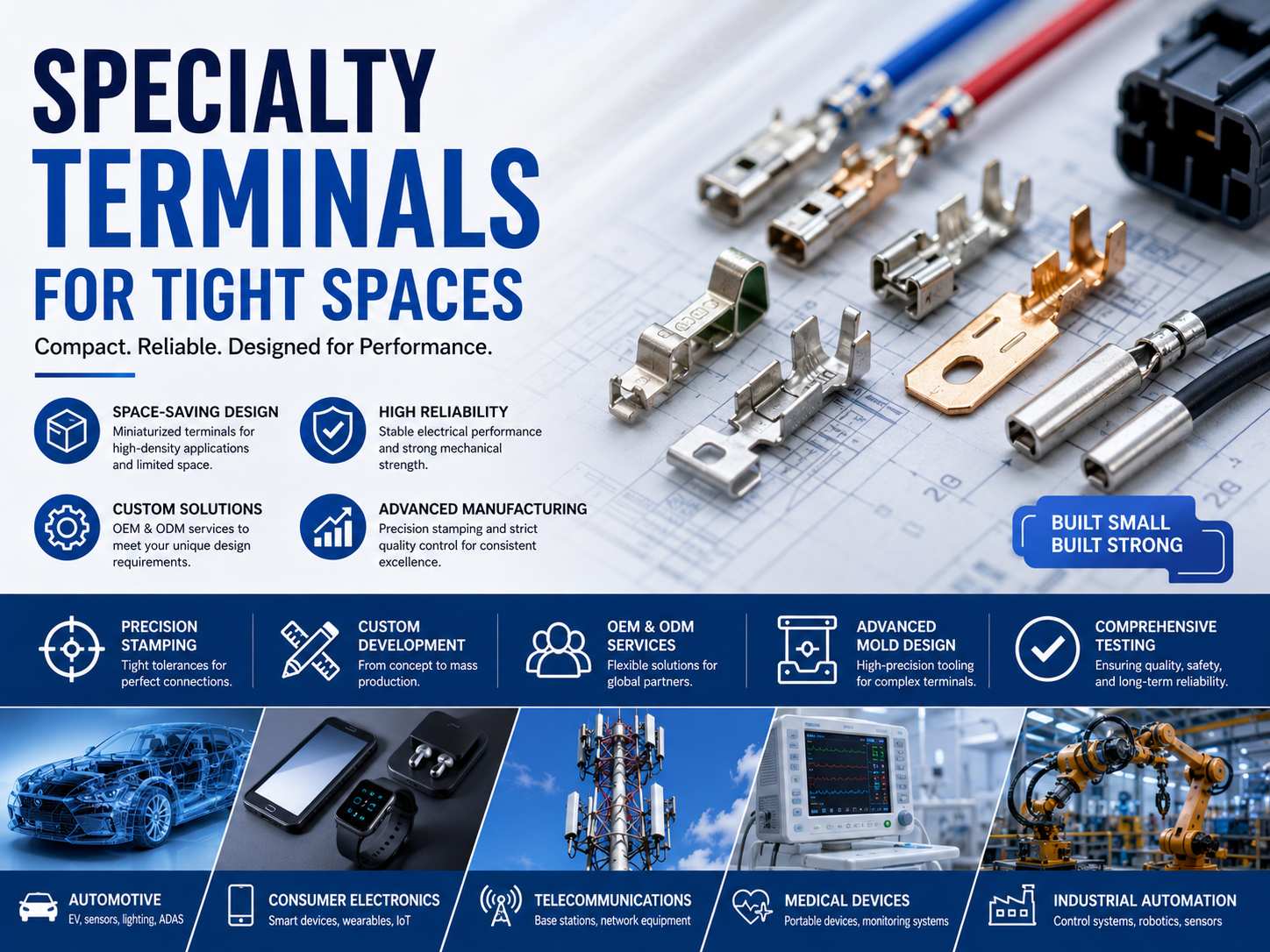
This demand has led to the development of specialty terminals for tight spaces—compact electrical connection solutions specifically engineered to deliver reliable performance while minimizing space requirements.
These specialized terminals enable manufacturers to optimize layouts, increase component density, improve assembly efficiency, and support product miniaturization without sacrificing electrical reliability.
In this article, we’ll explore the types, design considerations, materials, performance requirements, and applications of specialty terminals designed for space-constrained environments.
What Are Specialty Terminals?
Specialty terminals are customized or compact electrical connection components designed for applications where conventional terminals are too large or impractical.
Unlike standard terminals, these solutions are engineered to:
- Reduce installation footprint
- Maximize wiring density
- Simplify assembly
- Maintain reliable electrical performance
- Fit into compact housings
They are widely used in industries where equipment size, weight, and performance are critical.
Why Tight-Space Applications Need Specialized Solutions
Modern products are becoming smaller while integrating more functions.
Examples include:
- Electric vehicles
- Smart home devices
- Wearable electronics
- Medical instruments
- Industrial sensors
- Telecommunications equipment
- Motorized caster wheels
As available space decreases, electrical connections must become more compact while maintaining the same level of safety and reliability.
Common Challenges in Tight-Space Electrical Designs
Designing electrical systems for limited spaces introduces several challenges.
Limited Installation Area
Compact products leave very little room for wiring and terminals.
Engineers often need to fit multiple circuits into a confined housing without compromising accessibility.
Higher Component Density
As electronic systems become more advanced, more components must fit into the same space.
This increases the demand for miniature connection solutions.
Cable Routing Restrictions
Tight spaces often require wires to bend sharply or follow complex routing paths.
Improper terminal selection can lead to wire stress and premature failure.
Heat Management
Higher component density often results in greater heat concentration.
Terminals must maintain stable performance even in elevated temperatures.
Types of Specialty Terminals for Tight Spaces
Several terminal designs have been developed to address different space constraints.
Micro Terminals
Micro terminals are among the smallest electrical terminals available.
They are designed for:
- Small wire sizes
- Compact connectors
- High-density assemblies
Common applications include:
- Automotive sensors
- Consumer electronics
- Portable devices
Their small footprint enables engineers to significantly reduce connector size.
Low-Profile Terminals
Low-profile terminals minimize vertical height.
Benefits include:
- Reduced connector thickness
- Slim product designs
- Improved packaging flexibility
These terminals are commonly used in:
- Display modules
- Compact control units
- Portable electronic devices
Right-Angle Terminals
Right-angle terminals redirect wire orientation by 90 degrees.
Advantages include:
- Better cable routing
- Reduced installation depth
- Improved use of available space
These terminals are frequently found in PCB-mounted applications.
Flag Terminals
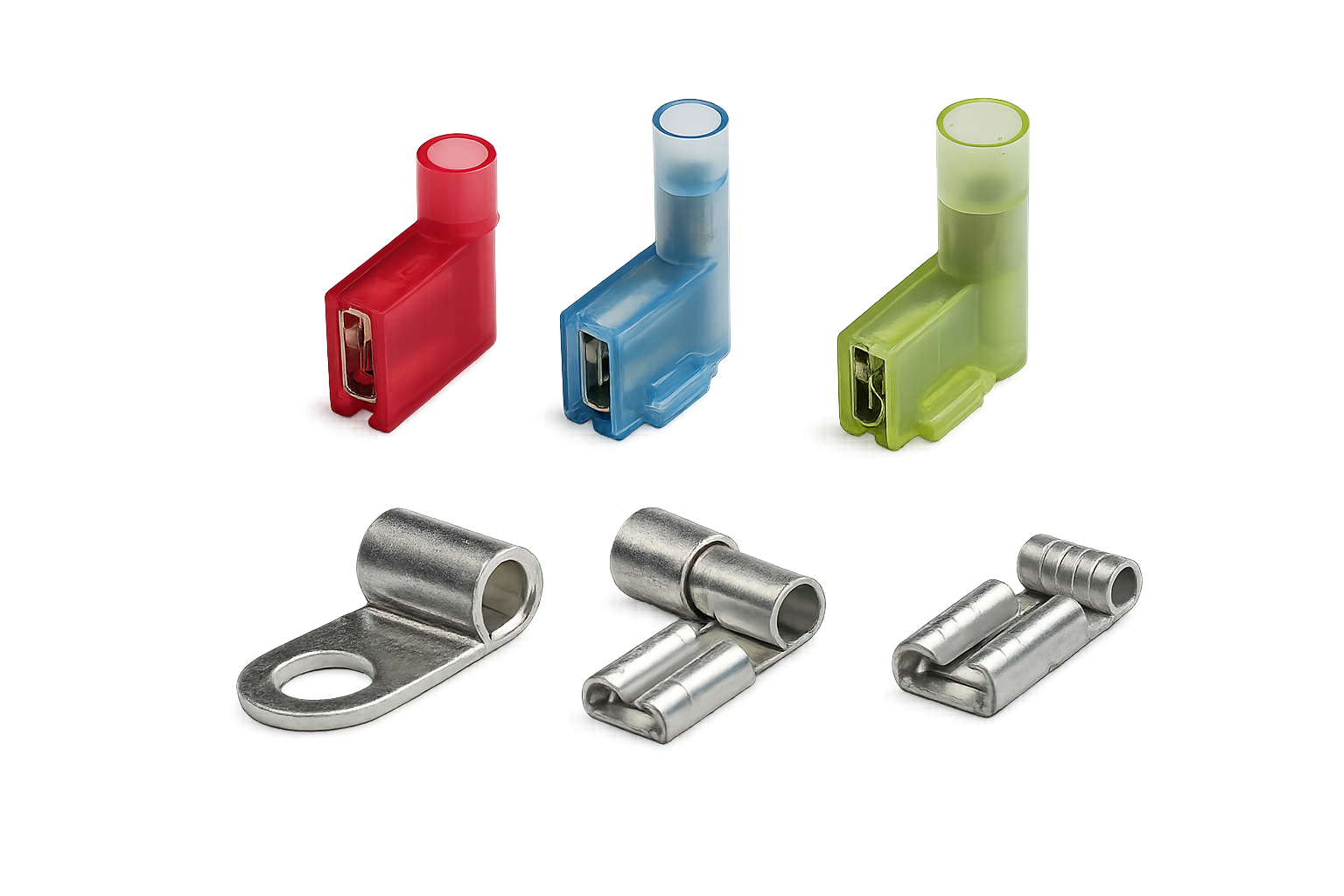
Flag terminals are a popular solution when wires must exit sideways rather than straight.
Benefits include:
- Space-saving installation
- Improved cable management
- Reduced bending stress
Common industries include:
- Automotive
- Appliances
- Industrial controls
Miniature Crimp Terminals
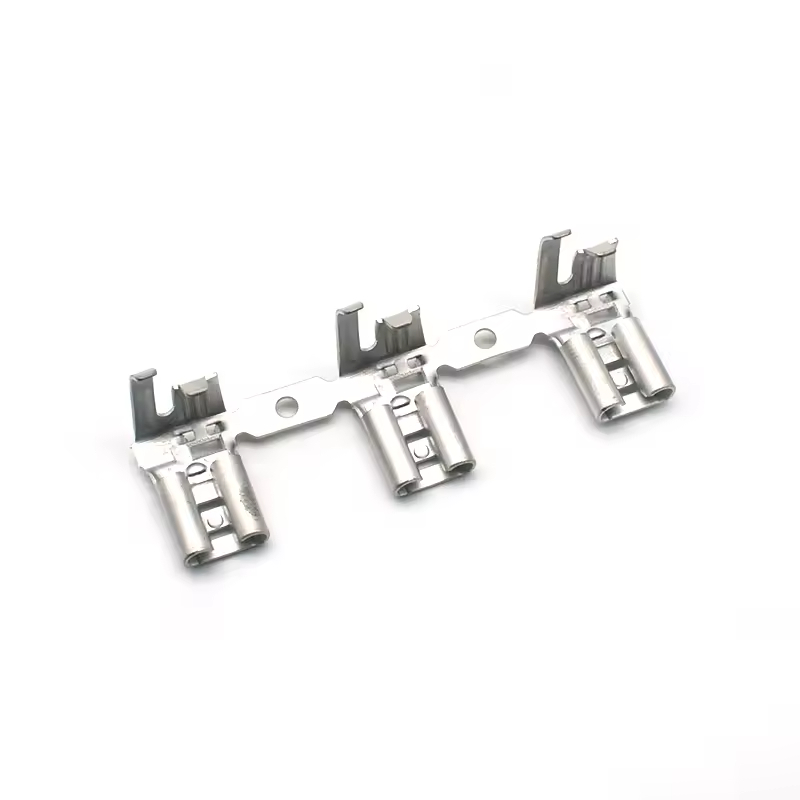
Miniature crimp terminals are specifically designed for small-gauge wires.
They offer:
- Reliable crimping
- Compact dimensions
- High-density connector compatibility
Applications include:
- Electronic control modules
- Signal transmission systems
- Precision devices
Custom Specialty Terminals
Many applications require custom-engineered solutions.
Custom terminals can be optimized for:
- Unique housing dimensions
- Special current requirements
- Specific assembly methods
- Industry certifications
For OEM manufacturers, custom terminals often provide the best balance between performance and space utilization.
Key Design Considerations
Designing compact terminals requires careful engineering.
Size Optimization
Reducing terminal size must not compromise performance.
Manufacturers focus on:
- Footprint reduction
- Height reduction
- Weight reduction
Advanced stamping technologies allow terminals to become smaller while maintaining structural integrity.
Electrical Performance
Even miniature terminals must maintain excellent conductivity.
Important factors include:
Contact Resistance
Low contact resistance minimizes energy loss and heat generation.
Current Carrying Capacity
Despite their size, specialty terminals must handle required current loads safely.
Signal Integrity
Signal transmission must remain stable, especially in communication and electronic applications.
Mechanical Reliability
Compact terminals often experience high stress during assembly and operation.
Critical performance indicators include:
- Pull-out strength
- Retention force
- Mating durability
- Vibration resistance
Proper material selection is essential to ensure long-term reliability.
Thermal Management
Miniaturized systems often have limited airflow.
Specialty terminals must:
- Resist heat buildup
- Maintain conductivity at elevated temperatures
- Prevent thermal deformation
Thermal performance becomes increasingly important in EV and industrial applications.
Materials Used in Specialty Terminals
Material selection plays a significant role in terminal performance.
Copper
Copper remains the preferred material for many applications.
Advantages include:
- Excellent conductivity
- High current capacity
- Low electrical resistance
Copper terminals are commonly used in power distribution systems.
Brass
Brass offers a balance between conductivity and strength.
Benefits include:
- Cost efficiency
- Good machinability
- Reliable mechanical properties
Brass is widely used in automotive and industrial terminals.
Phosphor Bronze
Phosphor bronze provides superior elasticity.
Advantages include:
- Excellent spring characteristics
- High fatigue resistance
- Stable contact pressure
These properties make it ideal for connector contacts.
Advanced Copper Alloys
Some high-performance applications require specialized copper alloys.
These materials provide:
- Increased strength
- Improved wear resistance
- Enhanced durability
They are commonly found in automotive and aerospace systems.
Surface Plating Options
Surface plating enhances terminal performance and longevity.
Tin Plating
Tin plating is the most common solution.
Benefits include:
- Corrosion resistance
- Good solderability
- Cost effectiveness
Nickel Plating
Nickel plating improves:
- Wear resistance
- High-temperature performance
- Corrosion protection
Silver Plating
Silver offers exceptional conductivity.
Applications include:
- High-current terminals
- Renewable energy systems
- EV power connections
Gold Plating
Gold plating is used where signal reliability is critical.
Advantages include:
- Superior corrosion resistance
- Excellent conductivity
- Stable low-current performance
Manufacturing Technologies Behind Compact Terminals
Producing miniature terminals requires advanced manufacturing capabilities.
Precision Stamping
Modern stamping technology can achieve extremely tight tolerances.
Benefits include:
- Consistent quality
- High-volume production
- Cost efficiency
Progressive Die Manufacturing
Progressive dies enable complex terminal geometries to be produced in a single process.
Advantages include:
- Improved consistency
- Faster production
- Reduced manufacturing costs
Micro Stamping Technology
Micro stamping supports the production of ultra-small components.
This technology is essential for:
- Electronics
- Medical devices
- Communication systems
Automated Assembly
Automation ensures:
- Consistent quality
- Reduced human error
- Improved production efficiency
Automation is increasingly important for high-volume terminal manufacturing.
Testing and Quality Control
Quality verification is critical for specialty terminals.
Dimensional Inspection
Advanced optical measurement systems verify:
- Critical dimensions
- Tolerances
- Assembly compatibility
Electrical Testing
Electrical tests include:
- Contact resistance measurement
- Current carrying capacity evaluation
- Conductivity verification
Mechanical Testing
Mechanical testing evaluates:
- Pull-out force
- Retention force
- Mating durability
Environmental Testing
Specialty terminals often undergo:
- Salt spray testing
- Thermal cycling testing
- Vibration testing
- Humidity testing
These tests ensure reliability in real-world conditions.
Industries That Rely on Specialty Terminals
Automotive Industry
Modern vehicles contain hundreds of electrical connections.
Applications include:
- Sensors
- ADAS systems
- Lighting modules
- EV battery management systems
Compact terminals help reduce vehicle weight while improving packaging efficiency.
Consumer Electronics
Miniaturization is essential in consumer products.
Examples include:
- Smartphones
- Tablets
- Wearables
- Smart home devices
Telecommunications
Telecommunications equipment requires high-density electrical connections.
Applications include:
- Network equipment
- Communication modules
- Base stations
Medical Devices
Medical equipment often combines compact design with strict reliability requirements.
Applications include:
- Monitoring equipment
- Portable diagnostic devices
- Wearable health devices
Industrial Automation
Modern factories increasingly rely on compact automation systems.
Applications include:
- PLC modules
- Robotics
- Industrial sensors
- Smart control systems
Benefits of Specialty Terminals for Tight Spaces
Specialty terminals provide numerous advantages:
Improved Space Utilization
More functions can fit within smaller products.
Higher Connection Density
Engineers can increase circuit density without sacrificing reliability.
Better Cable Management
Compact designs allow more efficient wire routing.
Reduced Product Weight
Smaller terminals contribute to lighter products.
Enhanced Design Flexibility
Manufacturers gain greater freedom in product development.
Support for Miniaturization Trends
Specialty terminals enable next-generation product designs.
How to Choose the Right Specialty Terminal
When selecting a terminal for a compact application, consider:
Available Installation Space
Measure:
- Width
- Height
- Depth
- Cable routing area
Electrical Requirements
Evaluate:
- Current rating
- Voltage rating
- Signal requirements
Environmental Conditions
Consider:
- Temperature
- Humidity
- Vibration
- Corrosion exposure
Material Selection
Choose materials that balance:
- Conductivity
- Strength
- Durability
- Cost
Customization Requirements
If standard products do not meet design goals, custom terminals may provide the optimal solution.
Why Choose Qianwei Precision for Specialty Terminal Manufacturing
Finding the right terminal supplier is just as important as selecting the right terminal design. With years of experience in precision metal stamping and custom terminal manufacturing, Qianwei provides reliable electrical connection solutions for customers worldwide.
Whether you need miniature terminals for consumer electronics, compact connectors for automotive systems, or custom solutions for specialized applications, our engineering team can support your project from concept to mass production.
Precision Stamping Expertise
Precision is critical when manufacturing specialty terminals for tight spaces. Even minor dimensional deviations can affect assembly, electrical performance, and product reliability.
Qianwei utilizes advanced high-speed stamping equipment and precision tooling to produce terminals with tight tolerances and consistent quality.
Our capabilities include:
- Micro stamping for miniature terminals
- High-volume production
- Tight dimensional control
- Consistent product performance
- Complex terminal geometries
This ensures every terminal meets demanding industry requirements.
Custom Terminal Development
Not every application can be solved with standard terminal designs.
Our engineering team works closely with customers to develop customized terminal solutions based on:
- Installation space limitations
- Electrical requirements
- Current carrying capacity
- Wire specifications
- Connector compatibility
- Environmental conditions
From prototype development to mass production, Qianwei helps customers optimize both performance and manufacturability.
OEM & ODM Services
Qianwei provides comprehensive OEM and ODM manufacturing services.
OEM Services
For customers with existing designs, we offer:
- Tooling production
- Precision stamping
- Surface plating
- Quality testing
- High-volume manufacturing
ODM Services
For customers seeking complete product development support, our team can assist with:
- Design optimization
- Material selection
- Prototype creation
- Tooling development
- Manufacturing solutions
This flexible approach helps customers reduce development time and accelerate product launches.
Advanced Mold Design Capabilities
The quality of a terminal begins with the quality of its tooling.
Qianwei designs and manufactures precision progressive dies capable of producing complex terminal structures with exceptional consistency.
Our mold development advantages include:
- High-precision tooling
- Long mold lifespan
- Stable production quality
- Reduced manufacturing costs
- Faster production cycles
Advanced mold design is particularly important for miniature terminals where tolerances are extremely tight.
Comprehensive Testing Services
Every specialty terminal must perform reliably under real-world operating conditions.
Qianwei conducts rigorous testing throughout the manufacturing process to ensure product quality and consistency.
Dimensional Inspection
Using precision measuring equipment and optical inspection systems, we verify:
- Critical dimensions
- Tolerances
- Terminal geometry
- Connector compatibility
This ensures every component meets design specifications.
Pull-Out Force Testing
Pull-out force testing evaluates the mechanical strength of crimped connections.
The test verifies:
- Crimp quality
- Wire retention strength
- Assembly reliability
Strong pull-out performance is essential for preventing connection failures during operation.
Vibration Testing
Many terminals operate in environments exposed to constant vibration.
Our vibration testing simulates conditions found in:
- Automotive systems
- Industrial machinery
- Transportation equipment
- Renewable energy installations
This helps verify long-term connection stability.
Thermal Cycling Testing
Temperature fluctuations can affect both terminal materials and connection performance.
Thermal cycling tests expose terminals to repeated temperature changes to evaluate:
- Material stability
- Contact reliability
- Plating durability
- Long-term performance
This testing helps ensure dependable operation in demanding environments.
Your Trusted Partner for Compact Terminal Solutions
From micro terminals and low-profile terminals to fully customized connection solutions, Qianwei combines engineering expertise, advanced manufacturing technology, and strict quality control to deliver reliable specialty terminals for space-constrained applications.
Whether your project requires higher connection density, improved assembly efficiency, or custom terminal development, our team is ready to support your next design challenge.
Contact Qianwei today to discuss your specialty terminal requirements and discover the right compact connection solution for your application.
Conclusion
As products become smaller, smarter, and more complex, specialty terminals have become essential components in modern electrical design. These compact connection solutions enable manufacturers to maximize space utilization while maintaining electrical performance, mechanical reliability, and long-term durability.
Whether used in electric vehicles, consumer electronics, medical devices, telecommunications equipment, or industrial automation systems, specialty terminals help engineers overcome space constraints without compromising quality.
By selecting the right terminal design, material, plating, and manufacturing partner, companies can create more efficient, reliable, and innovative products for the future.

