

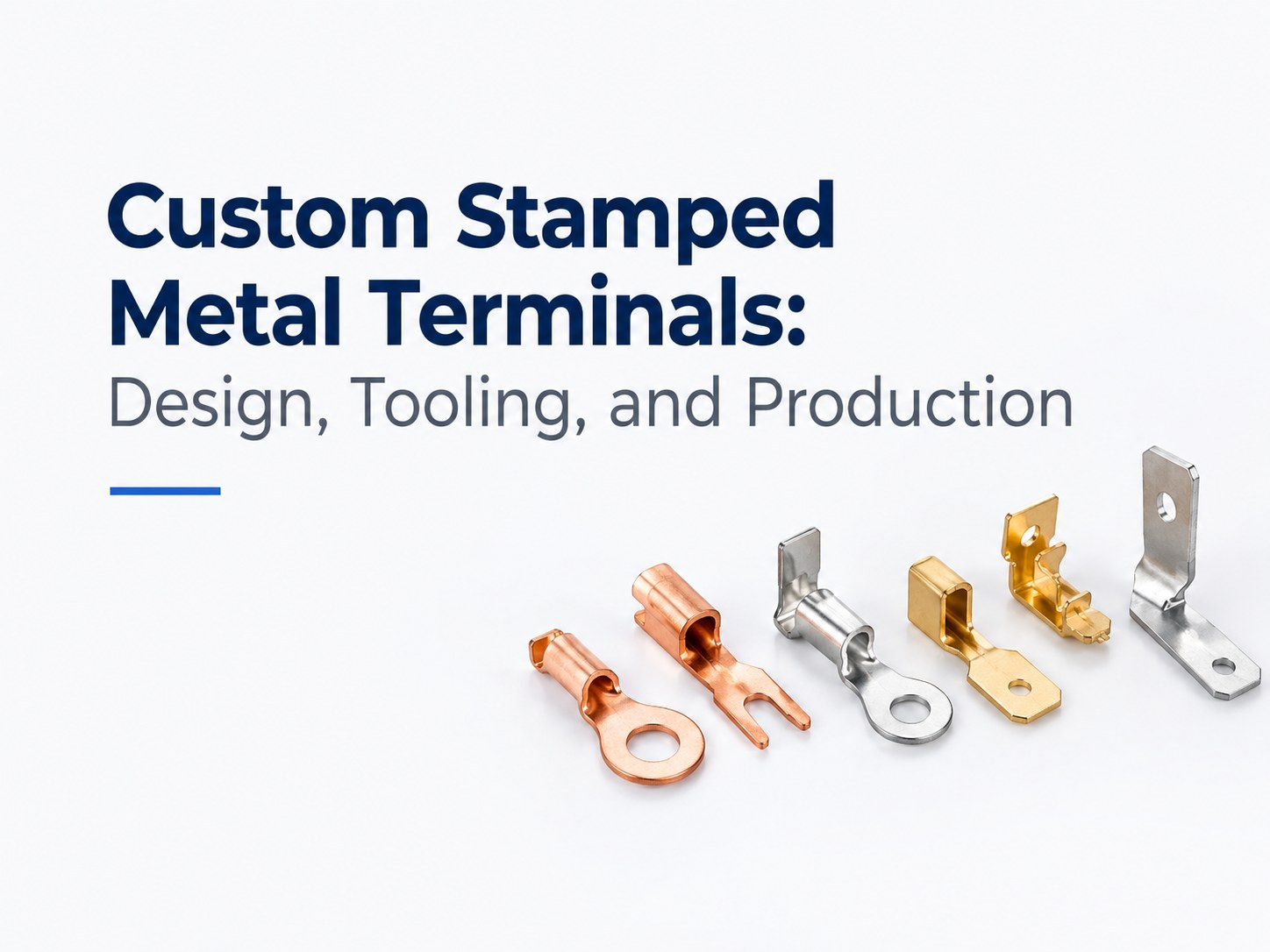
맞춤형 스탬프 금속 단자는 자동차 배선 하니스에 널리 사용됩니다., 산업용 전기 장비, 가전제품, 및 배전 시스템. These components may look simple, but their performance depends on several important factors, 재료 선택을 포함하여, 치수 정확도, tooling design, 제조 일관성.
OEM 제조업체의 경우, choosing the right custom stamped metal terminal is not just about finding a component that fits. It is about ensuring reliable electrical contact, stable mechanical performance, and consistent quality throughout mass production.
Unlike standard terminals with fixed specifications, custom stamped terminals are developed around specific application requirements. From the initial drawing and material selection to mold development and final production, each stage plays an important role in the performance of the finished product.
This guide explains how custom stamped metal terminals are designed, tooled, and manufactured, and what buyers should consider when selecting a reliable manufacturing partner.
1. What Are Custom Stamped Metal Terminals?
Custom stamped metal terminals are electrical connection components manufactured by cutting, punching, 굽힘, and forming metal sheets or strips into specific shapes.
They are designed to connect wires, transfer electrical current, and provide stable contact between electrical components. 응용 프로그램에 따라, terminals may require particular dimensions, contact structures, retention forces, 도금 마감, or mounting configurations.
Metal stamping is widely used in terminal manufacturing because it supports high production efficiency, consistent dimensions, and cost-effective mass production.
Common Types of Stamped Metal Terminals
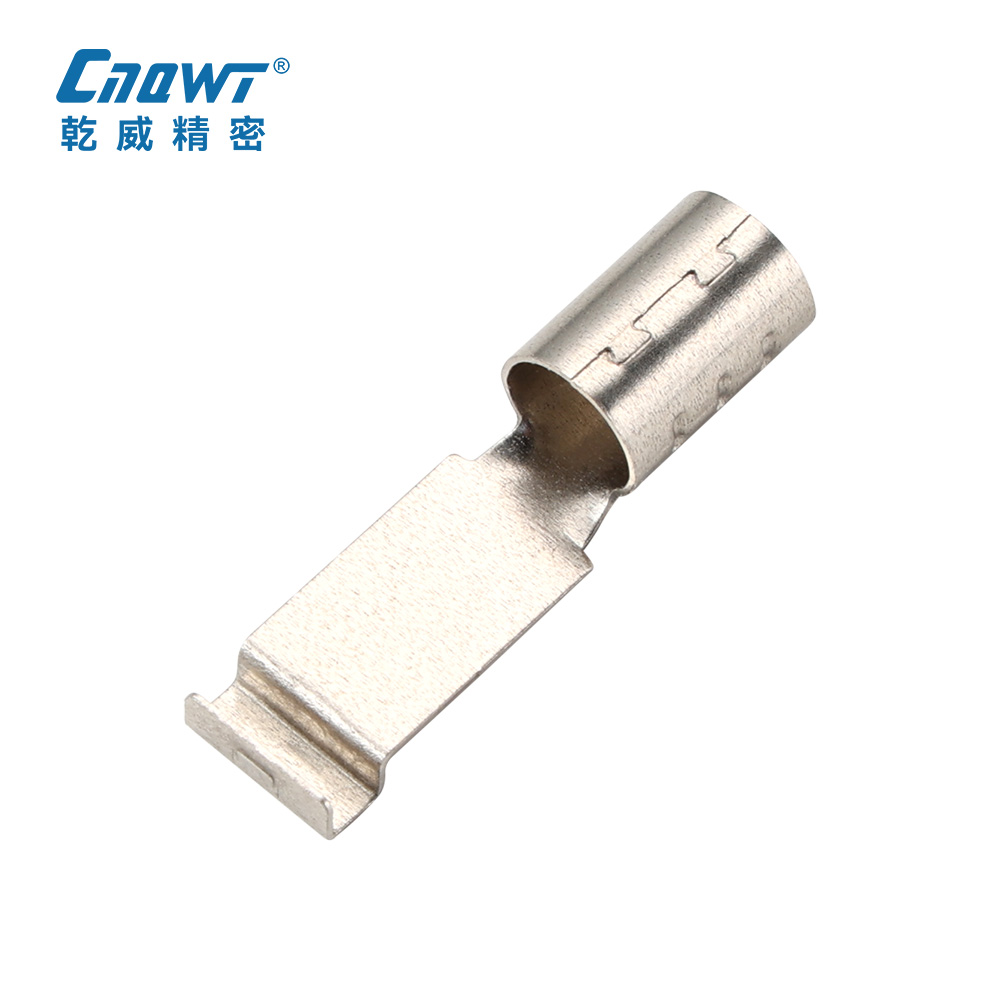
Different electrical applications require different terminal structures. 일반적인 유형은 다음과 같습니다.:
- 링 터미널: Designed with a circular connection hole for secure screw or bolt connections.
- 스페이드 터미널: Feature an open-ended connection design for convenient installation and removal.
- 포크 터미널: Similar to ring terminals but with an open fork-shaped connection end.
- 플래그 터미널: Feature a 90-degree connection design for applications with limited installation space.
- Tab and Blade Terminals: Commonly used in electrical contact and wire connection systems.
Each design serves a different purpose. The right terminal depends on the wire size, 설치 방법, 부하, 사용 가능한 공간, 및 운영 환경.
How Stamped Terminals Work in Electrical Connections
A stamped metal terminal provides an electrical and mechanical connection between conductors or electrical components.
In wire termination applications, the terminal is typically crimped onto a wire using specialized crimping equipment. The crimping process creates a mechanical connection between the terminal barrel and the conductor.
A properly designed terminal should provide:
- 안정적인 전기 전도성
- Sufficient mechanical retention
- Consistent crimping performance
- Reliable contact under operating conditions
- Resistance to vibration and environmental exposure
이러한 이유로, terminal geometry and manufacturing accuracy are important from the beginning of the design process.
2. Materials Used in Custom Metal Terminal Manufacturing
Material selection directly affects the electrical, 기계적인, and manufacturing performance of stamped metal terminals.
The most suitable material depends on conductivity requirements, 힘, 성형성, 내식성, 그리고 의도한 애플리케이션.
구리
Copper is widely used in electrical terminal manufacturing because of its excellent electrical conductivity.
It is particularly suitable for applications where efficient current transmission is important, including power connections, 배터리 시스템, 그리고 전기 배선.
주요 이점은 다음과 같습니다.:
- 높은 전기 전도성
- 좋은 열 전도성
- 좋은 성형성
- Compatibility with various plating treatments
Copper terminals are commonly used in applications requiring reliable electrical performance.
놋쇠
Brass is another common material for stamped electrical terminals. It offers a useful balance of electrical conductivity, 기계적 강도, 및 성형성.
순수 구리와 비교, brass generally provides greater hardness and can be suitable for terminal designs requiring additional mechanical stability.
Typical applications include electrical connection components, 와이어 터미널, and various industrial electrical products.
인청동
Phosphor bronze is valued for its elasticity, 힘, 및 피로 저항.
It is particularly useful for electrical contacts that require stable spring properties and repeated connection performance.
Its mechanical characteristics make it suitable for certain contact terminals and components where contact pressure is an important consideration.
Choosing the Right Plating for Metal Terminals
Surface treatment is another important consideration in terminal manufacturing.
일반적인 도금 옵션은 다음과 같습니다.:
- 주석 도금: Provides good corrosion protection and is widely used for electrical terminals.
- Bright Tin Plating: Offers a smooth, bright surface finish and good solderability.
- 니켈 도금: Provides wear resistance and corrosion protection, making it suitable for applications with more demanding environmental requirements.
The appropriate plating depends on the application, 작동 온도, contact conditions, 환경 노출.
Buyers should also specify plating thickness and relevant performance requirements when requesting a quotation.
3. 맞춤형 터미널 설계: From Drawings to Manufacturing
A successful custom stamped metal terminal project starts with a clear understanding of the customer’s application and technical requirements.
일반 제품과 다르게, custom terminals must be designed around specific dimensions, 설치 조건, 그리고 실적 기대.
Understanding Customer Requirements
Before starting the design process, manufacturers need to understand how the terminal will be used.
Important information includes:
- Wire gauge and conductor specifications
- Required terminal dimensions
- Electrical current requirements
- Connection and installation methods
- 작동 온도
- Mechanical retention requirements
- Surface treatment and corrosion resistance
- Production volume and packaging requirements
Providing accurate application information helps engineers select appropriate materials and develop a practical terminal structure.
2D Drawings and 3D Design
Technical drawings provide the foundation for custom terminal development.
A typical drawing should include:
- 전체 치수
- Material type and thickness
- Hole diameter and position
- Bending angles
- 중요한 공차
- 도금 요구 사항
- Crimping or contact specifications
더 복잡한 디자인의 경우, 3D CAD models can help engineers evaluate the terminal structure and identify potential manufacturing issues before tooling begins.
This step is particularly important for terminals with multiple bending features, complex contact structures, or tight dimensional requirements.
제조 가능성을 고려한 설계 (DFM)
A terminal design may look suitable on paper but still present challenges during mass production.
제조 가능성을 고려한 설계 (DFM) helps identify these issues before the tooling stage.
Engineers typically evaluate:
- Material utilization and strip layout
- Punching and forming feasibility
- Bending sequence
- 재료 변형
- 버 제어
- 치수 안정성
- 생산 효율성
A well-designed terminal should not only meet functional requirements but also be suitable for stable and repeatable manufacturing.
Prototyping and Design Validation
양산 전, sample development allows customers and manufacturers to verify the design.
프로젝트에 따라, validation may include:
- 치수검사
- Assembly and fit testing
- Crimping performance evaluation
- 접촉력 테스트
- Mechanical retention testing
- 표면 마무리 검사
If adjustments are needed, the design can be refined before final tooling approval.
This helps reduce unnecessary tooling modifications and production risks.
4. Tooling Development for Custom Stamped Metal Terminals
Tooling is one of the most important parts of custom metal terminal manufacturing.
The quality of the stamping die directly affects product dimensions, forming consistency, 생산 효율성, and long-term manufacturing costs.
OEM 고객의 경우, working with a manufacturer that has in-house tooling capabilities can make communication, design modifications, and production management more efficient.
Why Tooling Matters in Terminal Manufacturing
A precision stamping die determines how the metal strip is punched, 형성된, bent, and separated during production.
Proper tooling design helps achieve:
- Consistent product dimensions
- Accurate hole positions and bending angles
- Controlled burr formation
- Stable production performance
- 재료 낭비 감소
- Higher manufacturing efficiency
For complex terminal structures, even small tooling errors can affect assembly compatibility and electrical contact performance.
Progressive Die vs. Single-Operation Tooling
Two common approaches in metal stamping are progressive die stamping and single-operation stamping.
Progressive Die Stamping
A progressive die performs multiple operations as the metal strip moves through a series of stations. These operations may include piercing, blanking, 굽힘, 그리고 형성.
It is particularly suitable for terminals manufactured in medium to high volumes.
장점은 다음과 같습니다:
- Continuous production
- High manufacturing efficiency
- 일관된 제품 품질
- Reduced manual handling
- Compatibility with automated feeding systems
Single-Operation Tooling
Single-operation tooling performs one specific stamping operation at a time.
It may be suitable for simple components, lower-volume production, or applications where separate processing steps are more practical.
| Comparison | Progressive Die | Single-Operation Tooling |
|---|---|---|
| Production method | Multiple operations in sequence | Individual operations |
| 능률 | 높은 | 일반적으로 낮음 |
| 생산량 | 중간에서 높음 | 낮음 ~ 중간 |
| 오토메이션 | 매우 적합함 | Depends on the process |
| Initial tooling investment | Generally higher | 일반적으로 낮음 |
| 일반적인 응용 | Mass-produced terminals | Simple or specialized parts |
The right tooling solution depends on product complexity, 생산량, dimensional requirements, and overall project cost.
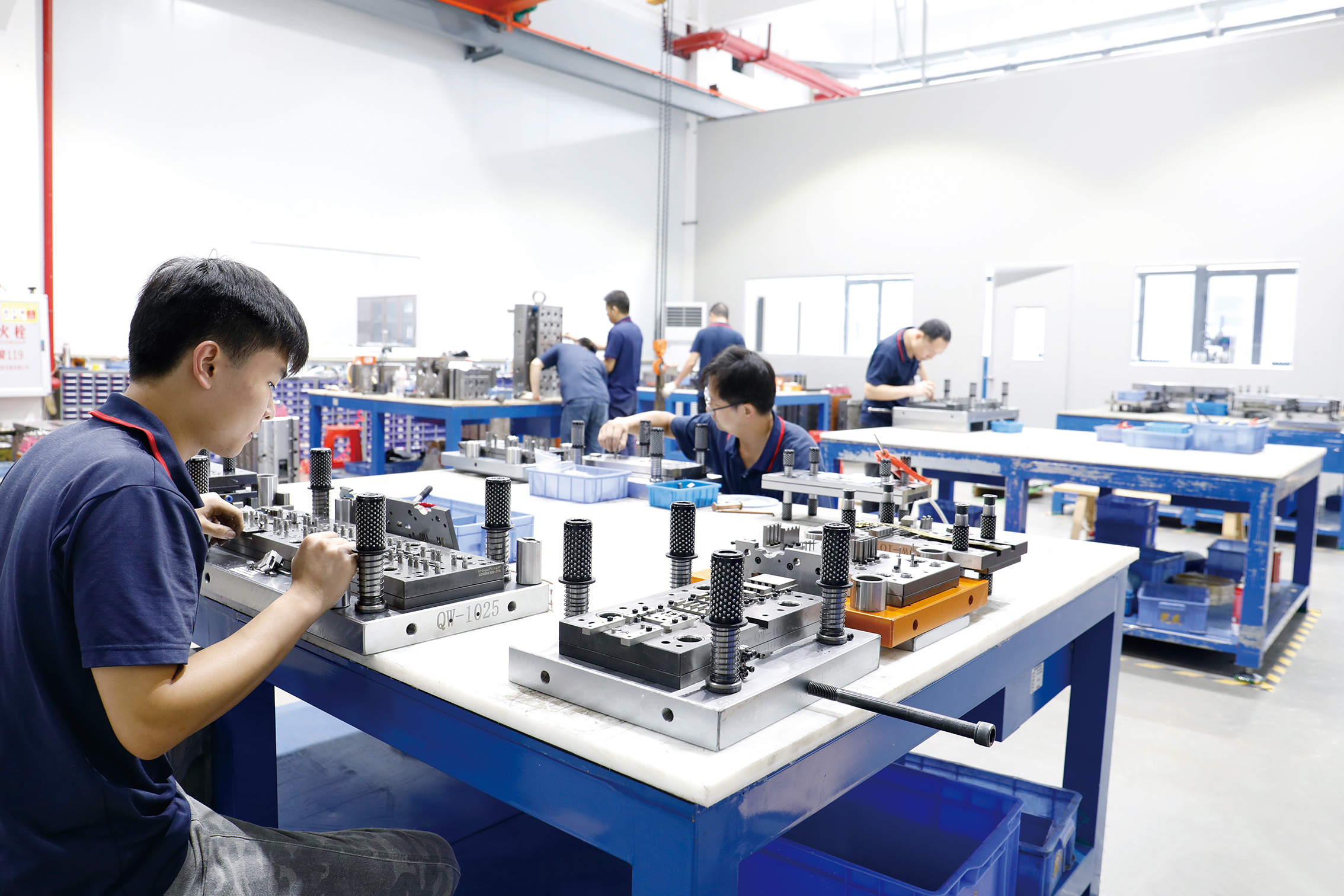
Custom Die Design and Manufacturing
Custom terminal tooling typically involves several stages:
- Die Design: Engineers develop the tooling structure based on product drawings and manufacturing requirements.
- Precision Machining: Key mold components are manufactured through precision machining processes.
- Die Assembly: 펀치, dies, guide components, and other tooling elements are assembled.
- Trial Stamping: Initial samples are produced to evaluate forming accuracy and product dimensions.
- Tooling Adjustment: Necessary modifications are made to improve production stability.
- Mass Production Preparation: The die is validated before regular production begins.
In-house tooling development allows manufacturers to coordinate engineering and production more closely, especially when customers need design changes or new product variations.
How Tooling Affects Production Cost
Tooling investment is an important part of the total cost of a custom stamped terminal project.
하지만, the lowest initial tooling cost does not always result in the lowest overall manufacturing cost.
Several factors should be considered:
- Initial mold design and manufacturing costs
- Expected production volume
- Material utilization
- Stamping cycle efficiency
- Tooling lifespan
- 유지 보수 요구 사항
- Product consistency and rejection rates
For high-volume projects, progressive tooling may provide better long-term cost efficiency even if the initial investment is higher.
5. The Metal Stamping Process for 전기 터미널
Once the design and tooling have been approved, the terminal enters the manufacturing stage.
A typical precision metal stamping process includes the following steps.
단계 1 – Raw Material Preparation
The process begins with selecting suitable metal coils or strips according to the approved material specifications.
재료 두께, 너비, 기계적 성질, and surface condition should be checked before production.
Consistent raw material quality is essential for maintaining stable stamping performance.
단계 2 – Coil Feeding and Strip Stamping
The metal strip is fed into the stamping machine through an automatic feeding system.
The stamping press then drives the material through the die according to the designed process sequence.
For progressive stamping, the strip moves continuously through multiple stations, with each station performing a specific operation.
This process is widely used for high-volume electrical terminal manufacturing.
단계 3 – Piercing, Blanking, and Forming
스탬핑 중, several operations may be performed:
- 꿰뚫는: Creates holes and openings in the metal strip.
- Blanking: Cuts the required product profile from the material.
- 벤딩: Forms the metal into the required angles and shapes.
- 형성: Creates more complex geometries and functional structures.
- 절단: Separates finished components from the carrier strip when required.
The exact sequence depends on the terminal design and tooling structure.
단계 4 – Plating and Surface Treatment
스탬핑 후, terminals may undergo plating or other surface treatments.
The selected treatment should meet the product’s electrical, 기계적인, 및 환경 요구 사항.
Plating quality should be controlled to ensure consistent surface coverage and appropriate coating thickness.
단계 5 – Inspection and Packaging
Finished terminals are inspected according to the product specifications and quality requirements.
Inspection may cover dimensions, 모습, burr conditions, plating quality, and functional performance.
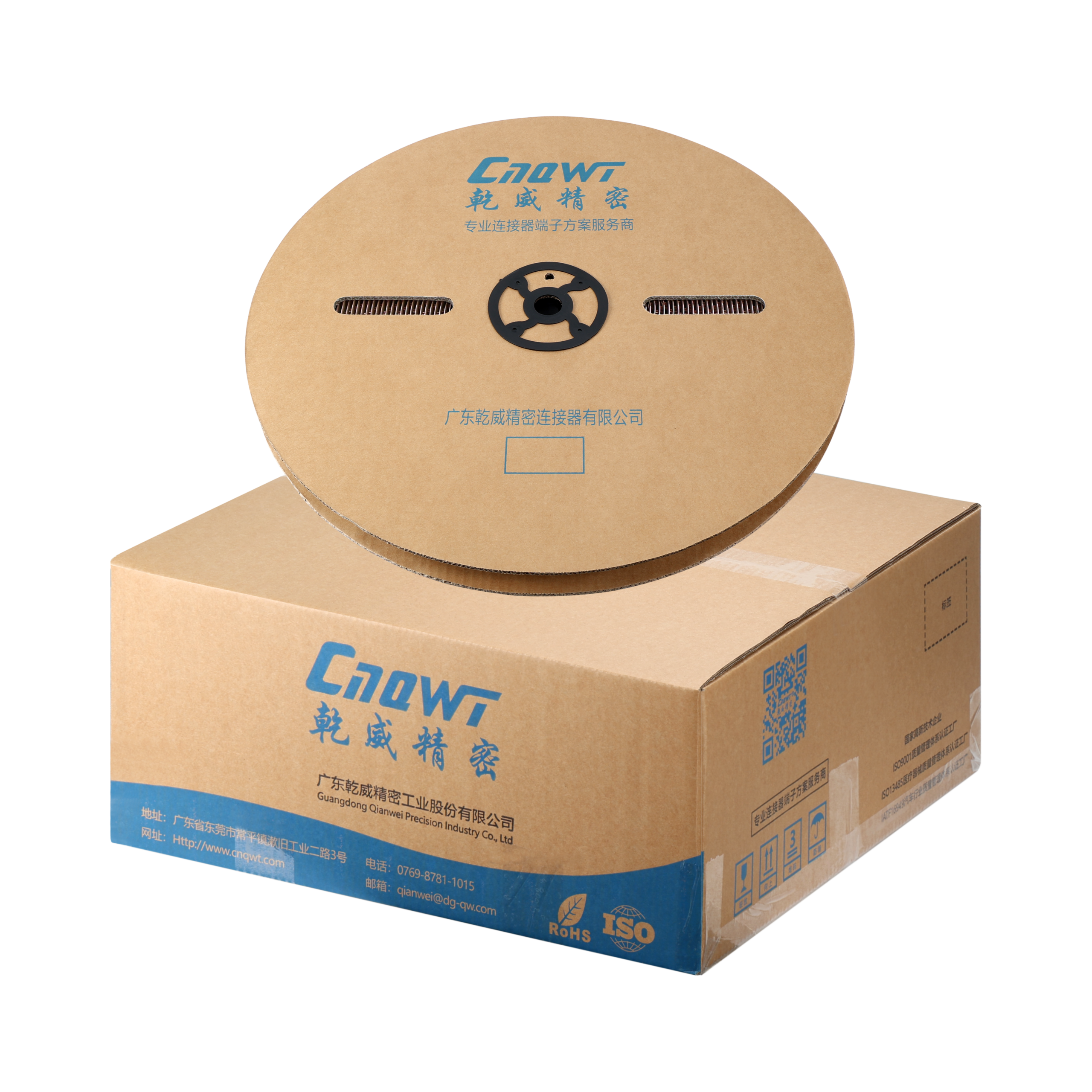
Depending on the terminal design and customer requirements, products can be packaged in bulk, trays, or continuous reels.
For automated production lines, terminals on reel are particularly useful because they support continuous feeding into crimping and assembly equipment.
6. Quality Control in Precision Stamped Terminal Production
Quality control is essential because terminal performance depends on both electrical characteristics and mechanical accuracy.
A terminal that looks acceptable may still cause connection problems if its dimensions, 재료 특성, or contact structure do not meet the required specifications.
Dimensional Accuracy and Tolerance Control
Critical dimensions such as hole diameter, terminal width, 재료 두께, and bending angles should be inspected against approved drawings.
Precision measuring instruments help identify dimensional deviations and maintain production consistency.
Burr Height and Edge Quality
Burrs are a common concern in metal stamping.
Excessive burrs may affect assembly, create handling risks, or interfere with electrical contact and insulation requirements.
툴링 조건, clearance, and material characteristics all influence burr formation.
Contact Force and Retention Testing
For terminals designed to connect with mating components, contact force and retention performance can be important quality indicators.
Testing methods should be selected according to the terminal structure and customer specifications.
압착 단자용, wire pull-out testing is commonly used to evaluate the mechanical strength of the crimped connection.
Plating Thickness and Corrosion Resistance
Plating thickness should be verified against the specified requirements.
응용 프로그램에 따라, additional testing may be required to evaluate corrosion resistance and surface durability.
Electrical Conductivity and Performance Testing
Electrical testing may include contact resistance and conductivity-related evaluations.
The specific test methods and acceptance criteria should be defined according to the product design and application requirements.
A reliable manufacturer should establish clear inspection standards and maintain appropriate production records for traceability.
7. Applications of Custom Stamped Metal Terminals
Custom stamped metal terminals are used across a wide range of industries. Their designs can be adapted to different electrical connection requirements and installation environments.
자동차 배선 하니스
Automotive wiring harnesses contain numerous electrical connection points that require reliable terminals.
Stamped terminals are used in:
- Automotive wire harness assemblies
- 배터리 연결 시스템
- Vehicle electrical distribution
- Control and signal circuits
- Automotive electrical components
이러한 애플리케이션의 경우, 차원 일관성, 압착 성능, 진동 저항, and material selection are important considerations.
산업용 전기 장비
Industrial electrical systems require reliable connections for power distribution, 제어, and equipment operation.
Custom stamped terminals can be developed for:
- 전기 제어 패널
- 배전 장비
- Industrial wiring systems
- 전기 캐비닛
- Motor and equipment connections
Custom dimensions and mounting structures help manufacturers integrate terminals into specific equipment designs.
Home Appliances and HVAC Systems
Electrical terminals are widely used in household appliances and HVAC equipment.
Typical applications include motor connections, 내부배선, 제어 시스템, and power supply connections.
Manufacturers may require custom terminal dimensions and plating specifications to match their assembly structures and operating conditions.
New Energy and Energy Storage
New energy equipment and battery systems often require electrical connections designed around specific current, 공간, 기계적 요구 사항.
Stamped metal terminals may be used in battery wiring, 전력 분배, and internal electrical connections.
고전류 애플리케이션용, 재료 두께, 도체 단면적, 접촉면적, and temperature rise should receive particular attention during design.
8. Custom Stamped Terminals vs. 표준 터미널
When selecting electrical terminals, buyers often need to decide between standard products and custom-developed components.
Both options have advantages, and the right choice depends on the application.
| Comparison | 맞춤형 스탬프 터미널 | 표준 터미널 |
|---|---|---|
| 설계 | Application-specific | 고정사양 |
| 치수 | 맞춤형 | Standardized |
| 압형 | May require custom tooling | Existing tooling may be available |
| 초기 투자 | May include tooling costs | Usually lower |
| Production flexibility | Designed around project needs | Limited to available specifications |
| 일반적인 애플리케이션 | Specialized OEM requirements | 일반 전기 연결 |
언제 맞춤형 터미널을 선택해야 할까요??
Custom terminals are worth considering when:
- Standard products cannot meet the required dimensions.
- The terminal must fit a unique assembly structure.
- Specific contact or retention performance is required.
- The application requires a particular material or plating finish.
- The OEM customer needs a dedicated terminal design for mass production.
When Are Standard Terminals More Cost-Effective?
Standard terminals may be a better choice when the application uses common dimensions and electrical specifications.
They can reduce initial development costs and shorten the procurement process.
For buyers with stable, high-volume requirements, 하지만, custom terminals may offer better integration and long-term manufacturing efficiency.
9. How to Choose a Reliable Custom Stamped Metal Terminal Manufacturer
Selecting a manufacturer is an important decision for OEM buyers. Beyond unit price, buyers should evaluate engineering capabilities, tooling resources, 생산 능력, and quality management.
In-House Tooling Design and Manufacturing
A manufacturer with in-house tooling capabilities can coordinate product development and production more efficiently.
This is especially useful when a project requires custom progressive dies, design modifications, or long-term tooling maintenance.
Precision Stamping and Mass Production Capabilities
Evaluate the manufacturer’s stamping equipment, automation level, 생산 공정, and ability to maintain consistent quality.
For large-volume terminal projects, stable production capacity is just as important as initial sample quality.
재료 및 도금 옵션
A capable manufacturer should understand the characteristics of different conductive materials and surface treatments.
Buyers should confirm whether the supplier can meet their required material grades, thickness tolerances, and plating specifications.
Quality Certifications and Inspection Systems
Quality management systems provide an important foundation for consistent manufacturing.
대상 업종에 따라, relevant certifications may include:
- ISO 9001
- IATF 16949
- ISO 13485
Buyers should also evaluate the manufacturer’s actual inspection processes, documentation, and traceability practices rather than relying on certificates alone.
Engineering Support and OEM Customization
A reliable manufacturing partner should be able to participate in the entire development process, from drawing review and DFM evaluation to sample validation and mass production.
Good engineering communication helps identify potential manufacturing issues early and reduces unnecessary development costs.
10. Custom Stamped Metal Terminal Manufacturing at Qianwei Precision
Qianwei Precision specializes in electrical terminal manufacturing and precision metal stamping, providing customized manufacturing support for customers in automotive, 산업용 전기, and other electrical connection industries.
With integrated tooling development and manufacturing resources, Qianwei supports projects from initial product evaluation to mass production.
Integrated Tooling Design and Manufacturing
Tooling quality is fundamental to precision stamping.
Qianwei has an in-house mold design and manufacturing capability, supported by an automated mold processing center and more than 1,800 stamping and injection molds.
This manufacturing foundation supports custom terminal development and helps maintain consistency between tooling design and production requirements.
Precision Metal Stamping Capabilities
Qianwei operates a dedicated high-speed stamping workshop, supporting the production of customized metal components and electrical terminals.
Available material options include:
- 구리
- 놋쇠
- 인청동
Products can be developed according to customer drawings, 샘플, 재료 사양, 및 신청 요구 사항.
From Custom Design to Mass Production
Qianwei follows a coordinated manufacturing process to support OEM projects:
- Drawing or Sample Review: Evaluate the customer’s product requirements and technical specifications.
- 엔지니어링 평가: Review material selection, 제품 구조, 및 제조 타당성.
- 툴링 개발: Design and manufacture the required stamping dies.
- 샘플 제작: Produce samples for dimensional and functional validation.
- 양산: Proceed with production after customer approval.
- Quality Inspection and Delivery: Inspect finished products according to the agreed quality requirements.
This process helps customers move from initial product concepts to repeatable manufacturing.
Qianwei 정밀을 선택하는 이유?
설립년 2012, Qianwei Precision is headquartered in Dongguan, 광동, 중국.
Our manufacturing strengths include:
- 에이 40,000 m² manufacturing facility
- Four specialized workshops covering high-speed stamping, 플라스틱 사출 성형, 금형 제조, 및 케이블 어셈블리
- 이상 1,800 stamping and injection molds
- In-house mold design and manufacturing
- Experience in custom electrical terminals and precision metal stamping
- ISO 9001, IATF 16949, ISO 13485, UL, CQC, RoHS 규제, and REACH-related certifications and compliance capabilities
For OEM customers looking for a long-term manufacturing partner, Qianwei provides engineering coordination, 툴링 개발, and production support for customized electrical terminal projects.
11. 자주 묻는 질문
1. What are custom stamped metal terminals?
Custom stamped metal terminals are electrical connection components manufactured through metal stamping processes such as piercing, blanking, 굽힘, 그리고 형성. They are designed according to specific dimensions, 재료, 및 신청 요구 사항.
2. What materials are commonly used for stamped electrical terminals?
구리, 놋쇠, and phosphor bronze are commonly used materials. The selection depends on electrical conductivity, 기계적 강도, 성형성, 그리고 의도한 애플리케이션.
3. What is the difference between progressive stamping and single-operation stamping?
Progressive stamping performs multiple operations through a series of stations as the metal strip moves through the die. Single-operation stamping performs individual operations separately. Progressive stamping is generally more efficient for medium- to high-volume production.
4. Can stamped metal terminals be customized according to drawings?
예. Custom stamped terminals can be manufactured according to customer drawings, 샘플, 기술 사양. Customization may include dimensions, 재료 두께, terminal structure, 도금, 그리고 포장.
5. What information is needed to manufacture custom metal terminals?
Manufacturers typically need 2D drawings or 3D models, 재료 사양, product dimensions, 도금 요구 사항, 신청 내용, and estimated production volume. Samples can also help clarify design requirements.
6. How does tooling affect the cost of custom stamped terminals?
Tooling affects initial development investment, 생산 효율성, material utilization, and long-term manufacturing costs. For high-volume projects, well-designed progressive dies can help reduce the cost per piece.
7. What is the typical lead time for custom terminal tooling and production?
Lead time depends on product complexity, tooling design, material availability, sample requirements, 및 생산량. A manufacturer should provide a project-specific schedule after reviewing the drawings and technical requirements.
8. Can custom stamped terminals be supplied on reels?
예. Terminals on reel are commonly used in automated crimping and wire harness production. Reel packaging supports continuous feeding and improves production efficiency for compatible terminal designs.
9. What plating options are available for stamped electrical terminals?
Common options include tin plating, bright tin plating, and nickel plating. The appropriate finish depends on corrosion resistance, electrical contact requirements, 작동 조건, 및 고객 사양.
10. How do manufacturers ensure the quality of precision stamped metal terminals?
Quality control typically includes dimensional inspection, 육안 검사, burr evaluation, plating thickness verification, 및 기능 테스트. Additional tests may be required according to the product design and customer specifications.
결론: Choose the Right Partner for Custom Stamped Metal Terminals
Custom stamped metal terminals require more than accurate stamping. 재료 선택, 제품 디자인, 툴링 개발, and process control all contribute to the performance and consistency of the finished component.
OEM 제조업체의 경우, working with an experienced supplier that combines engineering support, in-house tooling, 정밀 스탬핑, and mass production capabilities can help reduce development risks and improve long-term product reliability.
~에 첸웨이 정밀, we support customized electrical terminal projects from drawing evaluation and tooling development to sample validation and mass production.
Looking for a manufacturer for custom stamped metal terminals?
우리에게 그림을 보내주세요, 샘플, 또는 기술적 요구 사항. Our team can help evaluate your project and provide a suitable manufacturing solution.

