

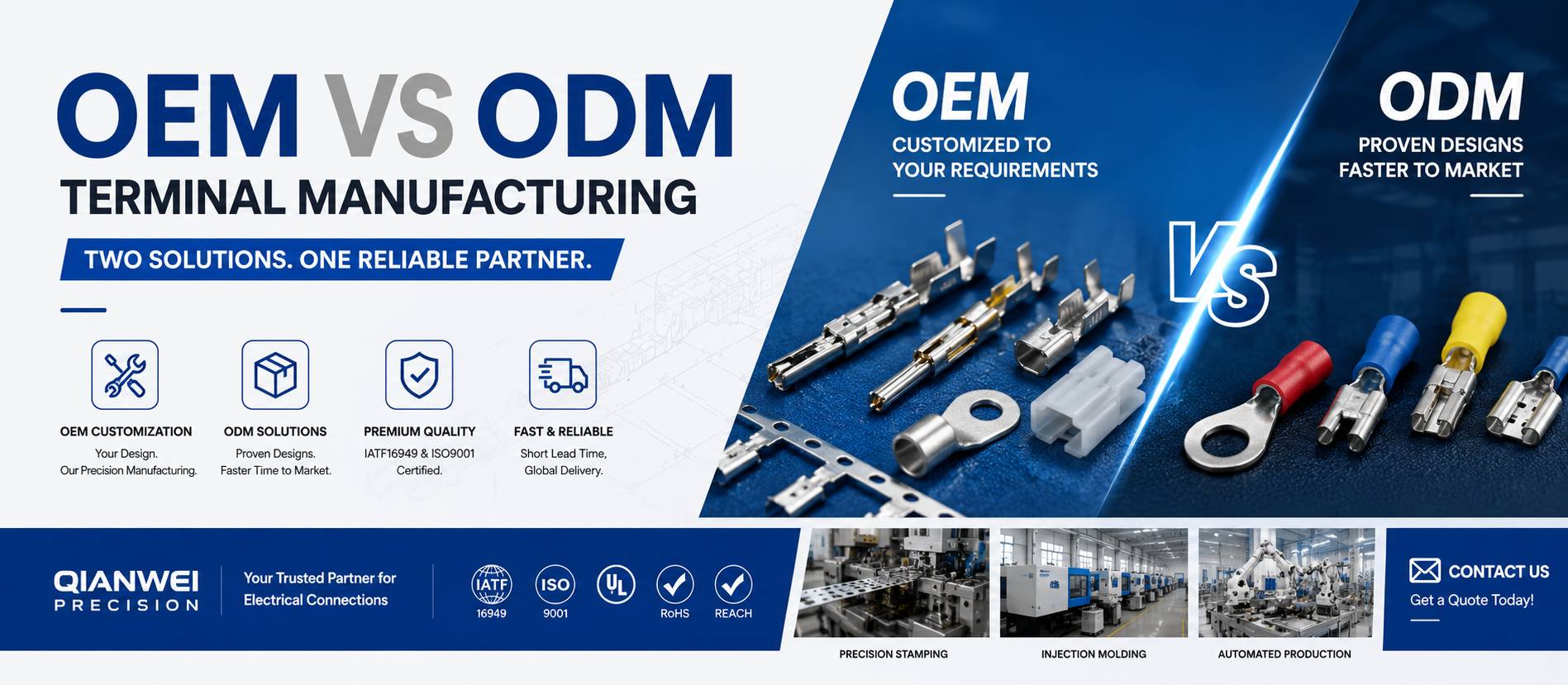
En el terminal electrico y la industria de mazos de cables, Elegir el modelo de fabricación correcto afecta directamente el rendimiento del producto., estructura de costos, tiempo de comercialización, y competitividad a largo plazo.
Para ingenieros de adquisiciones, OEM, y gerentes de producto, la decisión generalmente se reduce a dos opciones:
- OEM (Fabricación de equipos originales) – personalización completa basada en el diseño del cliente
- ODM (Fabricación de diseño original) – productos estandarizados con diseño impulsado por el fabricante
Ambos modelos se utilizan ampliamente en industrias como la de mazos de cables para automóviles., automatización industrial, dispositivos médicos, electrodomésticos, y sistemas de energía renovable.
Sin embargo, Seleccionar el modelo equivocado puede llevar a:
- Costo excesivo de herramientas
- Lanzamiento retrasado del producto
- Diferenciación limitada de productos
- Ineficiencias de la cadena de suministro
Este artículo proporciona una comparación completa a nivel de ingeniería entre la fabricación de terminales OEM y ODM., ayudándole a seleccionar la solución adecuada para su proyecto.
¿Qué es la fabricación de terminales OEM??
Definición
La fabricación de terminales OEM se refiere a un modelo de producción donde el El cliente proporciona especificaciones técnicas completas., y el fabricante es responsable de la ejecución de la producción..
En la mayoría de los proyectos de terminales eléctricas OEM, los clientes proporcionan:
- Dibujos de ingenieria (2Archivos D/3D)
- Especificaciones de materiales
- Requisitos de rendimiento eléctrico
- Tolerancias dimensionales
- Requisitos del entorno de aplicación
Luego el fabricante desarrolla:
- Matrices y estampación
- moldes de inyección (si terminales aislados)
- Procesos de producción
- Soluciones de tratamiento de superficies
- Producción en masa y control de calidad.
Proceso de fabricación OEM para terminales eléctricos
Un flujo de trabajo típico de OEM incluye:
- Análisis de requisitos (revisión de ingeniería)
- DFM (Diseño para fabricación)
- Diseño de herramientas & desarrollo
- Muestreo de prototipos (T0 / muestras T1)
- Validación del cliente & pruebas
- Producción piloto (lote pequeño)
- producción en masa
- inspección de calidad (coeficiente intelectual, IPQC, FQC)
- Envío & logística
Para aplicaciones automotrices o médicas, Los proyectos OEM a menudo también requieren:
- Documentación PPAP
- control de procesos APQP
- Informes de trazabilidad completos
Productos típicos de terminales eléctricos OEM
La fabricación OEM se utiliza comúnmente para:
- Terminales automotrices (conectores de alta confiabilidad)
- Terminales de cable de batería (aplicaciones de alta corriente)
- Terminales de anillo/pala personalizados
- Conectores de alto voltaje
- Terminales de control industriales
- Conectores de dispositivos médicos
- Terminales de clavija de precisión
Ventajas de la fabricación de terminales OEM
1. Control total del diseño
OEM permite un control total sobre:
- Geometría
- Rendimiento eléctrico
- Selección de materiales
- Espesor del revestimiento (estaño, níquel, plata)
- Estructura de prensado
Esto es fundamental para sistemas de alto rendimiento o de misión crítica..
2. Fuerte diferenciación de productos
OEM permite a las empresas construir productos exclusivos, Reducir la competencia en el mercado y evitar guerras directas de precios..
3. Mejor optimización de ingeniería
OEM es ideal cuando:
- La calificación actual es crítica
- Se requiere resistencia a la temperatura.
- La resistencia a las vibraciones importa
- Existen limitaciones de espacio
4. Propiedad intelectual
En la mayoría de los acuerdos OEM:
- El cliente es dueño del diseño.
- El proveedor actúa únicamente como fabricante.
Esto es importante para las líneas de productos de marca..
Desventajas de la fabricación OEM
A pesar de sus ventajas, OEM también tiene limitaciones:
- Mayor costo inicial de herramientas
- Ciclo de desarrollo más largo (2–8 semanas de muestreo típico)
- Requisitos de MOQ más altos
- Requiere aportaciones de ingeniería maduras por parte del cliente
¿Qué es la fabricación de terminales ODM??
Definición
La fabricación de terminales ODM se refiere a un modelo donde el El fabricante ya posee el diseño del producto y las herramientas., y los clientes seleccionan entre las soluciones existentes.
El cliente podrá personalizar:
- Logo
- Embalaje
- Longitud del cable (para montajes)
- Ajustes dimensionales menores.
Pero el diseño principal del producto permanece sin cambios..
Cómo funciona la fabricación ODM
El flujo de trabajo ODM es significativamente más rápido:
- El cliente selecciona el modelo de terminal existente
- Confirma las especificaciones (tamaño, enchapado, aislamiento)
- Personalización menor opcional
- Aprobación de muestra
- producción en masa
No se requiere desarrollo de nuevas herramientas.
Productos comunes de terminales eléctricos ODM
Los modelos ODM suelen incluir:
- Terminales de anillo estándar
- Terminales de engarce aislados
- Terminales de desconexión rápida
- Terminales de virola
- Terminales de batería estándar
- Serie de conectores precertificados
Ventajas de la fabricación de terminales ODM
1. Tiempo de comercialización más rápido
Dado que las herramientas ya existen, El tiempo de entrega se reduce significativamente.
Esto es crítico para:
- Lanzamientos de nuevos productos
- Electrónica de consumo de rápido movimiento
- Validación de prototipo
2. Estructura de menor costo
ODM elimina:
- Costo de desarrollo del molde
- Costo de iteración de ingeniería
Esto lo hace altamente rentable para aplicaciones estándar..
3. MOQ más bajo
ODM es adecuado para:
- Pedidos por lotes pequeños
- Producción de prueba
- Pruebas de mercado
4. Riesgo técnico reducido
Los productos ODM son:
- Probado previamente
- Producido en masa
- Estable en el proceso
Esto reduce las tasas de falla durante la producción..
Desventajas de la fabricación ODM
- Capacidad de personalización limitada
- Menor singularidad del producto
- Diseño compartido entre varios compradores
- Menos diferenciación de marca
Fabricación de terminales OEM versus ODM: Diferencias clave
| Dimensión | OEM | ODM |
|---|---|---|
| Propiedad del diseño | Cliente | Fabricante |
| Estampación | Nuevo desarrollo | Existente |
| Nivel de personalización | Alto | Medio / Bajo |
| Tiempo de desarrollo | Más extenso | más corto |
| Costo inicial | Más alto | Más bajo |
| Cantidad mínima de pedido | Más alto | Más bajo |
| Protección de propiedad intelectual | Fuerte | Limitado |
| Diferenciación de mercado | Alto | Moderado |
OEM frente a ODM: Guía de aplicaciones industriales
Automotor Arnés de cableado
Recomendado: OEM
Razones:
- Requisitos de seguridad estrictos
- Ambientes de alta vibración
- Restricciones de diseño específicas del OEM
Dispositivos médicos
Recomendado: OEM
Razones:
- Cumplimiento normativo
- Requisitos de precisión
- Demandas de trazabilidad
Electrodomésticos
Recomendado: OEM híbrido + ODM
- ODM para terminales estándar
- OEM para conectores críticos
Electrónica de Consumo
Recomendado: ODM
- Ciclos de producto más rápidos
- Prioridad de optimización de costes
Sistemas de energía renovable
Recomendado: OEM
- Aplicaciones de alta corriente
- Estrés ambiental al aire libre
- Requisitos de ciclo de vida largo
Cómo elegir entre fabricación de terminales OEM y ODM
Elija OEM si:
- Necesita un diseño de terminal eléctrico personalizado
- Tienes dibujos de ingenieria.
- Necesita un rendimiento de alta corriente o alta confiabilidad
- Quieres exclusividad del producto
- Planifica una producción en masa a largo plazo
Elija ODM si:
- Necesitas entrega rápida
- El presupuesto es limitado
- Los terminales estándar cumplen con los requisitos
- Estás en etapa de prototipo.
- Quiere un abastecimiento de bajo riesgo
Preguntas clave para hacerle a un fabricante de terminales
Antes de seleccionar un proveedor, evaluar:
Capacidad de ingeniería
- ¿Apoya OEM/ODM??
- ¿Pueden diseñar herramientas internamente??
Capacidad de producción
- cuantos estampados & líneas de inyección?
- ¿Tiene producción automatizada??
Sistemas de Calidad
- ¿Apoya IATF16949? / ISO9001 / ISO13485?
- ¿Ofrecen trazabilidad completa??
Capacidad de personalización
- ¿Puedes personalizar el espesor del revestimiento??
- ¿Puede admitir dimensiones no estándar??
Términos comerciales
- ¿Cuál es su MOQ??
- ¿Cuál es su plazo de entrega para el muestreo??
Cómo Qianwei apoya a los OEM & Fabricación de terminales ODM
Como fabricante profesional de terminales eléctricos, Precisión de Qianwei Proporciona soluciones OEM y ODM adaptadas a aplicaciones industriales globales..
Capacidades OEM
- Diseño de terminal totalmente personalizado
- Centro de herramientas interno
- Estampado de precisión & moldura
- Soporte de ingeniería para dibujos.
- creación rápida de prototipos
- Capacidad de producción de nivel automotriz
Capacidades ODM
- 1800+ moldes de producción existentes
- Serie de terminales estándar
- Soporte de muestreo rápido
- Baja flexibilidad de MOQ
- Soluciones de producción con costes optimizados
Certificaciones & Sistema de Calidad
- IATF16949 (Automotor)
- ISO9001 (Gestión de Calidad)
- ISO13485 (Dispositivos médicos)
- UL
- RoHS
- ALCANZAR
- CCC
Aplicaciones típicas
- Sistemas de mazos de cables para automóviles
- Almacenamiento de energía & sistemas de baterías
- Equipos de automatización industrial.
- Cableado de electrodomésticos
- Dispositivos eléctricos médicos
Por qué los compradores globales eligen OEM + Estrategia híbrida ODM
Las estrategias de adquisiciones modernas a menudo combinan ambos modelos.:
- OEM para componentes centrales de alto valor
- ODM para terminales auxiliares estándar
Este enfoque permite a las empresas:
- Reducir la presión de costos
- Mantener la diferenciación del producto.
- Mejorar la eficiencia de la cadena de suministro
- Acortar los ciclos de desarrollo de productos.
Conclusión
La elección entre la fabricación de terminales OEM y ODM depende de:
- Complejidad técnica
- Restricciones presupuestarias
- Requisitos de tiempo de comercialización
- Necesidades de diferenciación de productos.
Para aplicaciones personalizadas y de alto rendimiento, OEM es la solución preferida. Para proyectos sensibles a los costos y de rápido movimiento, ODM ofrece un camino más eficiente.
Un fabricante profesional que puede admitir tanto OEM como ODM brinda a los equipos de adquisiciones la flexibilidad para optimizar los costos., velocidad, y rendimiento simultáneamente.
Si está desarrollando un nuevo proyecto de terminal eléctrico o buscando un socio de fabricación OEM/ODM confiable, Qianwei Precision puede satisfacer sus necesidades desde el diseño hasta la producción en masa.
👉 Envíanos tus dibujos o especificaciones para obtener evaluación técnica y cotización dentro 24 horas.
Preguntas frecuentes
¿Cuál es la principal diferencia entre terminales OEM y ODM??
OEM está diseñado por el cliente, mientras que ODM está diseñado por el fabricante con una personalización menor.
¿OEM siempre es mejor que ODM??
No necesariamente. OEM es mejor para la personalización, mientras que ODM es mejor en cuanto a velocidad y costo.
¿Se pueden personalizar los terminales ODM??
Sí, pero solo personalización limitada como el logotipo, embalaje, o dimensiones menores.
cual es mas barato: OEM o ODM?
ODM suele ser más barato debido a que no tiene costo de herramientas..
¿Cuánto tiempo lleva el desarrollo de terminales OEM??
Normalmente de 2 a 8 semanas, según la complejidad..
¿Puede un proveedor admitir tanto OEM como ODM??
Sí. Fabricantes avanzados como Qianwei admiten ambos modelos..

