

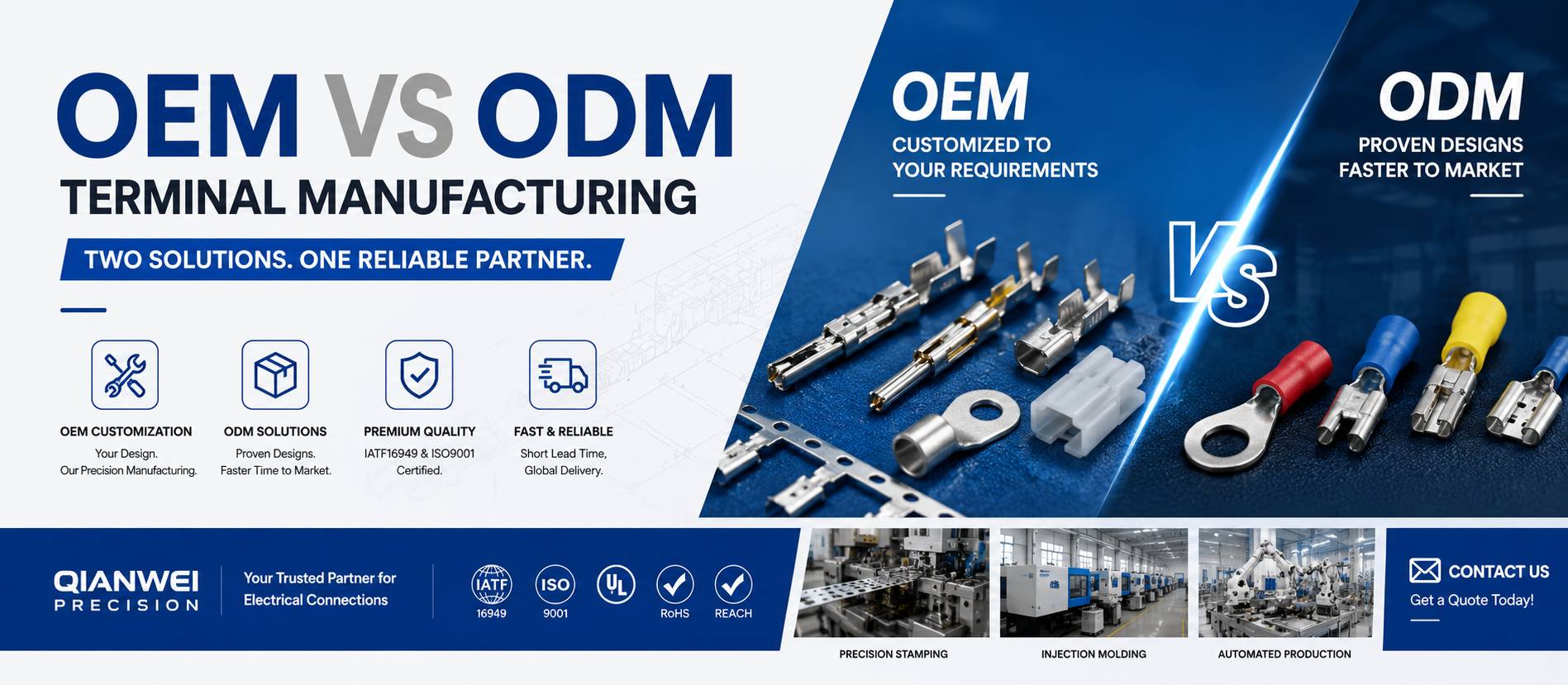
In the electrical terminal and wire harness industry, choosing the right manufacturing model directly impacts product performance, cost structure, time-to-market, and long-term competitiveness.
For procurement engineers, OEMs, and product managers, the decision usually comes down to two options:
- OEM (Original Equipment Manufacturing) – full customization based on customer design
- ODM (Original Design Manufacturing) – standardized products with manufacturer-driven design
Both models are widely used in industries such as automotive wiring harnesses, industrial automation, medical devices, home appliances, and renewable energy systems.
However, selecting the wrong model can lead to:
- Excessive tooling cost
- Delayed product launch
- Limited product differentiation
- Supply chain inefficiencies
This article provides a complete engineering-level comparison of OEM vs ODM terminal manufacturing, helping you select the right solution for your project.
What Is OEM Terminal Manufacturing?
Definition
OEM terminal manufacturing refers to a production model where the customer provides complete technical specifications, and the manufacturer is responsible for production execution.
In most OEM electrical terminal projects, customers provide:
- Engineering drawings (2D/3D files)
- Material specifications
- Electrical performance requirements
- Dimensional tolerances
- Application environment requirements
The manufacturer then develops:
- Tooling and stamping dies
- Injection molds (if insulated terminals)
- Production processes
- Surface treatment solutions
- Mass production and quality control
OEM Manufacturing Process for Electrical Terminals
A typical OEM workflow includes:
- Requirement analysis (engineering review)
- DFM (Design for Manufacturing)
- Tooling design & development
- Prototype sampling (T0 / T1 samples)
- Customer validation & testing
- Pilot production (small batch)
- Mass production
- Quality inspection (IQC, IPQC, FQC)
- Shipment & logistics
For automotive or medical applications, OEM projects often also require:
- PPAP documentation
- APQP process control
- Full traceability reports
Typical OEM Electrical Terminal Products
OEM manufacturing is commonly used for:
- Automotive terminals (high reliability connectors)
- Battery cable lugs (high current applications)
- Custom ring/spade terminals
- High-voltage connectors
- Industrial control terminals
- Medical device connectors
- Precision pin terminals
Advantages of OEM Terminal Manufacturing
1. Full Design Control
OEM allows complete control over:
- Geometry
- Electrical performance
- Material selection
- Plating thickness (tin, nickel, silver)
- Crimping structure
This is critical for high-performance or mission-critical systems.
2. Strong Product Differentiation
OEM enables companies to build exclusive products, reducing market competition and avoiding direct price wars.
3. Better Engineering Optimization
OEM is ideal when:
- Current rating is critical
- Temperature resistance is required
- Vibration resistance matters
- Space constraints exist
4. Intellectual Property Ownership
In most OEM agreements:
- Customer owns the design
- Supplier acts as manufacturer only
This is important for branded product lines.
Disadvantages of OEM Manufacturing
Despite its advantages, OEM also has constraints:
- Higher initial tooling cost
- Longer development cycle (2–8 weeks sampling typical)
- Higher MOQ requirements
- Requires mature engineering input from customer side
What Is ODM Terminal Manufacturing?
Definition
ODM terminal manufacturing refers to a model where the manufacturer already owns the product design and tooling, and customers select from existing solutions.
The customer may customize:
- Logo
- Packaging
- Wire length (for assemblies)
- Minor dimensional adjustments
But the core product design remains unchanged.
How ODM Manufacturing Works
The ODM workflow is significantly faster:
- Customer selects existing terminal model
- Confirms specifications (size, plating, insulation)
- Optional minor customization
- Sample approval
- Mass production
No new tooling development is required.
Common ODM Electrical Terminal Products
ODM models typically include:
- Standard ring terminals
- Insulated crimp terminals
- Quick disconnect terminals
- Ferrule terminals
- Standard battery lugs
- Pre-certified connector series
Advantages of ODM Terminal Manufacturing
1. Faster Time-to-Market
Since tooling already exists, lead time is significantly reduced.
This is critical for:
- New product launches
- Fast-moving consumer electronics
- Prototype validation
2. Lower Cost Structure
ODM eliminates:
- Mold development cost
- Engineering iteration cost
This makes it highly cost-efficient for standard applications.
3. Lower MOQ
ODM is suitable for:
- Small batch orders
- Trial production
- Market testing
4. Reduced Technical Risk
ODM products are:
- Pre-tested
- Mass-produced
- Process-stable
This reduces failure rates during production.
Disadvantages of ODM Manufacturing
- Limited customization capability
- Lower product uniqueness
- Shared design across multiple buyers
- Less brand differentiation
OEM vs ODM Terminal Manufacturing: Key Differences
| Dimension | OEM | ODM |
|---|---|---|
| Design Ownership | Customer | Manufacturer |
| Tooling | New development | Existing |
| Customization Level | High | Medium / Low |
| Development Time | Longer | Shorter |
| Initial Cost | Higher | Lower |
| MOQ | Higher | Lower |
| IP Protection | Strong | Limited |
| Market Differentiation | High | Moderate |
OEM vs ODM: Industry Application Guide
Automotive Wiring Harness
Recommended: OEM
Reasons:
- Strict safety requirements
- High vibration environments
- OEM-specific design constraints
Medical Devices
Recommended: OEM
Reasons:
- Regulatory compliance
- Precision requirements
- Traceability demands
Home Appliances
Recommended: Hybrid OEM + ODM
- ODM for standard terminals
- OEM for critical connectors
Consumer Electronics
Recommended: ODM
- Faster product cycles
- Cost optimization priority
Renewable Energy Systems
Recommended: OEM
- High current applications
- Outdoor environmental stress
- Long lifecycle requirements
How to Choose Between OEM and ODM Terminal Manufacturing
Choose OEM if:
- You require a custom electrical terminal design
- You have engineering drawings
- You need high-current or high-reliability performance
- You want product exclusivity
- You plan long-term mass production
Choose ODM if:
- You need fast delivery
- Budget is limited
- Standard terminals meet requirements
- You are in prototype stage
- You want low-risk sourcing
Key Questions to Ask a Terminal Manufacturer
Before selecting a supplier, evaluate:
Engineering Capability
- Do you support OEM/ODM?
- Can you design tooling in-house?
Production Capability
- How many stamping & injection lines?
- Do you have automated production?
Quality Systems
- Do you support IATF16949 / ISO9001 / ISO13485?
- Do you provide full traceability?
Customization Ability
- Can you customize plating thickness?
- Can you support non-standard dimensions?
Commercial Terms
- What is your MOQ?
- What is your lead time for sampling?
How Qianwei Supports OEM & ODM Terminal Manufacturing
As a professional electrical terminal manufacturer, Qianwei Precision provides both OEM and ODM solutions tailored for global industrial applications.
OEM Capabilities
- Full custom terminal design
- In-house tooling center
- Precision stamping & molding
- Engineering support for drawings
- Rapid prototyping
- Automotive-grade production capability
ODM Capabilities
- 1800+ existing production molds
- Standard terminal series
- Fast sampling support
- Low MOQ flexibility
- Cost-optimized production solutions
Certifications & Quality System
- IATF16949 (Automotive)
- ISO9001 (Quality Management)
- ISO13485 (Medical Devices)
- UL
- RoHS
- REACH
- CQC
Typical Applications
- Automotive wiring harness systems
- Energy storage & battery systems
- Industrial automation equipment
- Home appliance wiring
- Medical electrical devices
Why Global Buyers Choose OEM + ODM Hybrid Strategy
Modern procurement strategies often combine both models:
- OEM for core high-value components
- ODM for standard auxiliary terminals
This approach allows companies to:
- Reduce cost pressure
- Maintain product differentiation
- Improve supply chain efficiency
- Shorten product development cycles
Conclusion
Choosing between OEM and ODM terminal manufacturing depends on:
- Technical complexity
- Budget constraints
- Time-to-market requirements
- Product differentiation needs
For high-performance and customized applications, OEM is the preferred solution. For cost-sensitive and fast-moving projects, ODM offers a more efficient pathway.
A professional manufacturer that can support both OEM and ODM gives procurement teams the flexibility to optimize cost, speed, and performance simultaneously.
If you are developing a new electrical terminal project or looking for a reliable OEM/ODM manufacturing partner, Qianwei Precision can support your requirement from design to mass production.
👉 Send us your drawings or specifications to get technical evaluation and quotation within 24 hours.
FAQs
What is the main difference between OEM and ODM terminals?
OEM is customer-designed, while ODM is manufacturer-designed with minor customization.
Is OEM always better than ODM?
Not necessarily. OEM is better for customization, while ODM is better for speed and cost.
Can ODM terminals be customized?
Yes, but only limited customization such as logo, packaging, or minor dimensions.
Which is cheaper: OEM or ODM?
ODM is usually cheaper due to no tooling cost.
How long does OEM terminal development take?
Typically 2–8 weeks depending on complexity.
Can one supplier support both OEM and ODM?
Yes. Advanced manufacturers like Qianwei support both models.

