

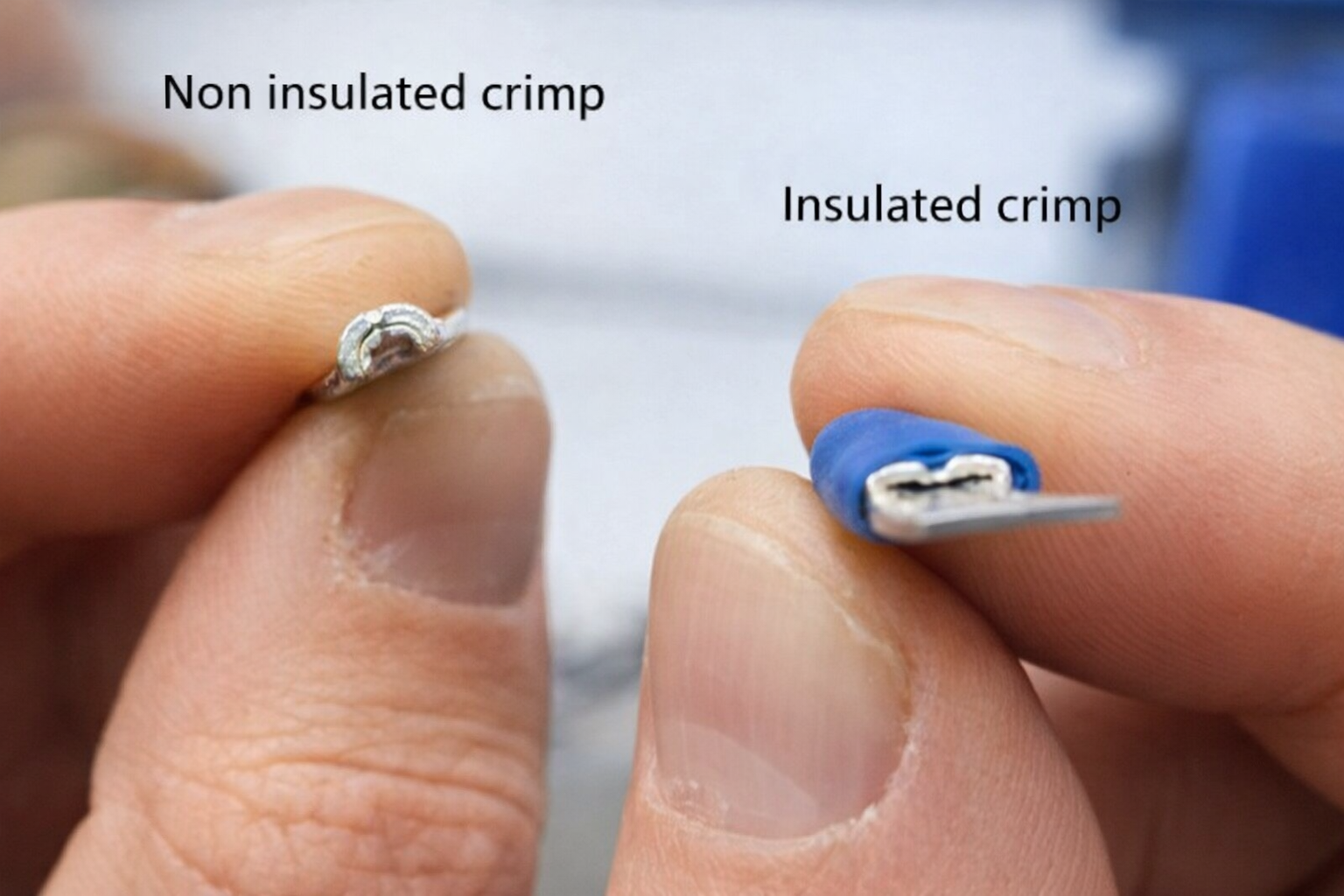
옳은 선택 전기 터미널 is not simply a matter of selecting a connector that fits the wire. The terminal also needs to match the electrical load, 설치 환경, 기계적 요구 사항, and long-term reliability of the application.
One of the most common choices engineers and wiring professionals face is between 절연 및 비절연 단자. Both are widely used in automotive, 선박, 산업의, and electrical wiring, 하지만 그들은 다른 목적으로 사용됩니다.
Insulated terminals provide an additional layer of protection around the connection, while non-insulated terminals offer a more compact metal-to-metal design and can be combined with external insulation when required.
그래서, which type is better?
대답은 응용 프로그램에 따라 다릅니다.. This guide explains the differences between insulated and non-insulated terminals, 장점과 한계, and how to choose the right option for automotive, 선박, and industrial wiring.
무엇입니까 절연 터미널?
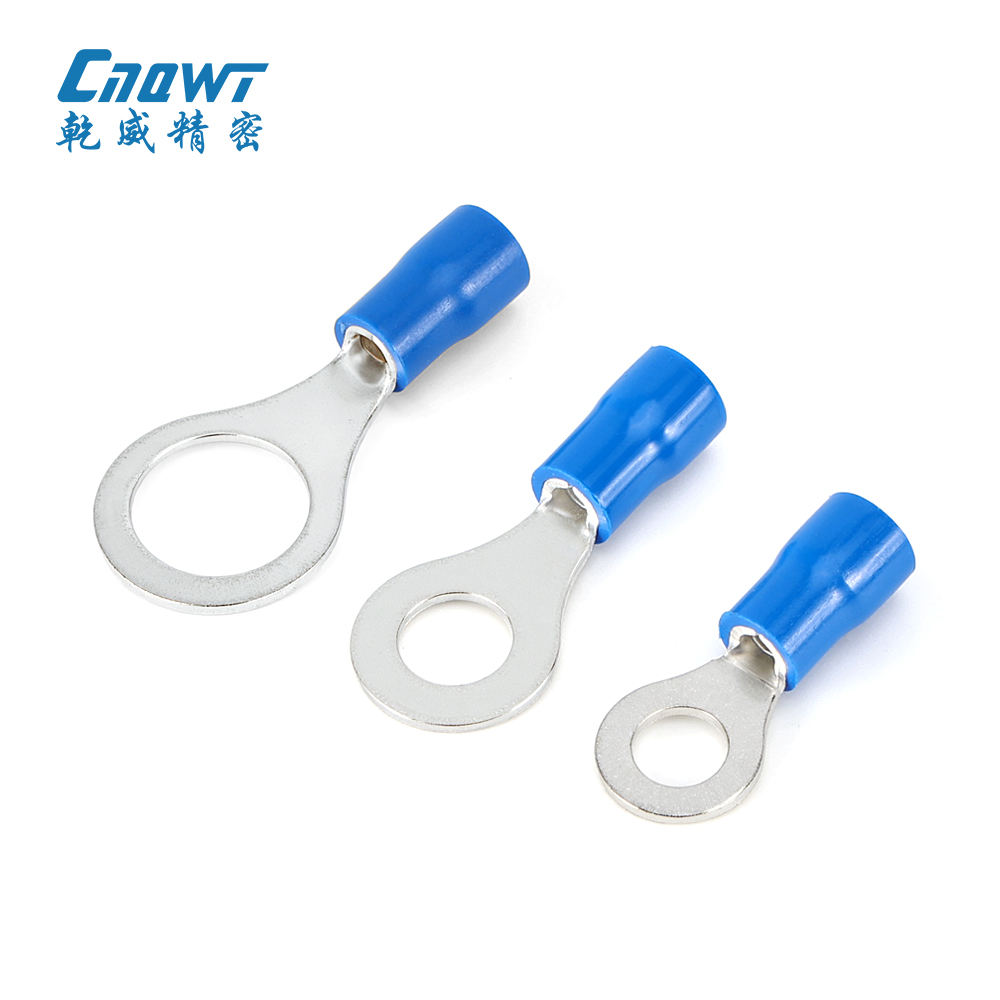
An insulated terminal is an electrical terminal with an insulating material surrounding part or all of the metal connection area. The insulation is usually made from materials such as vinyl, 나일론, or other engineered polymers.
A typical insulated terminal consists of a conductive metal barrel and an insulating sleeve. The metal section provides the electrical connection, while the insulation helps prevent accidental contact with other conductive components.
Insulated terminals are commonly available as:
- 링 터미널
- 포크 또는 스페이드 터미널
- 엉덩이 커넥터
- 핀 터미널
- 블레이드 터미널
- 신속 분리 단자
The color of the insulation is also often used to identify the compatible wire size. 예를 들어, different colors may indicate different wire-gauge ranges, although the exact color coding depends on the terminal standard or manufacturer.
절연 단자의 장점
The main advantage is the additional protection provided around the electrical connection.
Insulated terminals can help:
- Reduce the risk of accidental short circuits
- Protect conductive areas from accidental contact
- Improve handling during wiring installation
- Provide basic protection against contamination
- Make wire assemblies easier to identify
- Reduce the chance of exposed metal contacting nearby components
They are particularly useful where wiring connections are exposed or where additional protection is desirable without adding a separate insulation step.
Limitations of Insulated Terminals
Insulation also introduces some limitations.
An insulated terminal is usually larger than its non-insulated equivalent. This can be important in applications where many connections must fit into a limited space.
The insulation material also has its own temperature, 화학적인, and mechanical limitations. A terminal designed for general electrical wiring may not be suitable for an engine compartment, high-temperature industrial equipment, or other demanding environments.
이러한 이유로, engineers should consider the insulation material and temperature rating rather than assuming that every insulated terminal offers the same performance.
무엇입니까 비절연 단자?
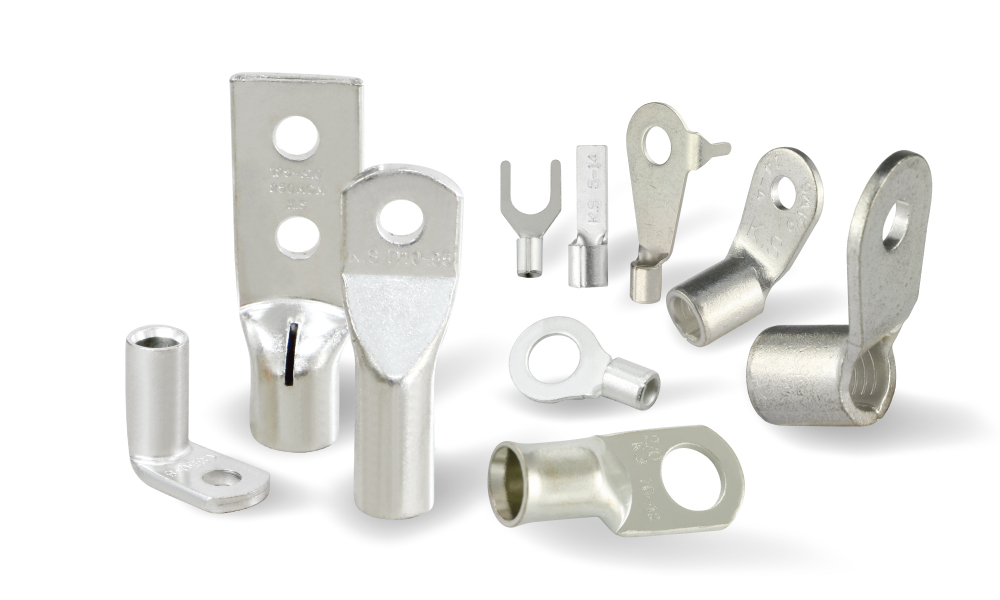
비절연 단자, sometimes called bare terminals, consist primarily of the conductive metal terminal without a permanent insulating sleeve.
They are widely used in professional wire harnesses, 산업 설비, 전기 캐비닛, 배터리 연결, 고전류 애플리케이션.
일반적인 예는 다음과 같습니다:
- Bare ring terminals
- Bare fork terminals
- Bare spade terminals
- Bare butt connectors
- 핀 터미널
- Copper tube terminals
- 고전류 케이블 러그
구리 및 구리 합금은 우수한 전기 전도성과 기계적 성능을 제공하기 때문에 일반적으로 사용됩니다.. Many terminals are also tin-plated to improve corrosion resistance and maintain stable electrical contact.
Advantages of Non-Insulated Terminals
The biggest advantage is their simple and compact construction.
Non-insulated terminals can provide:
- 컴팩트한 크기
- Easy visual inspection
- Good accessibility during crimping
- High-temperature capability when used with suitable materials
- Flexibility for additional insulation methods
- Good suitability for high-current connections
Because there is no pre-installed insulation sleeve, the terminal can also be used with application-specific insulation such as heat-shrink tubing, protective boots, or an enclosed electrical housing.
This makes non-insulated terminals particularly useful when engineers need to control the insulation system separately from the terminal itself.
비절연 단자의 한계
The exposed metal is also the main limitation.
A bare terminal can come into contact with another conductive component if the connection is not properly protected. This can create a short-circuit risk or other electrical problems.
For applications where connections are exposed, non-insulated terminals may therefore require additional protection.
This does not mean that non-insulated terminals are inherently less reliable. In a properly designed electrical enclosure or wire harness, they can provide excellent long-term performance.
절연 대. 비절연 단자: 주요 차이점
The difference between the two types can be summarized as follows:
| 특징 | 절연 터미널 | 비절연 단자 |
|---|---|---|
| Built-in insulation | 예 | 아니요 |
| 단락 보호 | Higher at the connection point | Requires external protection |
| Overall size | Usually larger | Usually more compact |
| 육안검사 | 더 제한적 | 더 쉽게 |
| High-temperature use | Depends on insulation material | Often suitable with proper material selection |
| 설치 | Generally straightforward | Requires more attention to protection |
| Additional insulation | Usually not required | May require heat-shrink, boot, or housing |
| 자동차용 | 매우 흔함 | Also widely used |
| Industrial use | 흔한 | 매우 흔함 |
| High-current use | Application-dependent | Commonly used |
| Custom insulation options | 더 제한적 | 더 유연함 |
The key point is that neither type is universally better.
Insulated terminals prioritize integrated protection and convenience, while non-insulated terminals provide compactness, 유연성, and easier access to the metal connection.
어느 것이 더 안전합니까?: Insulated or Non-Insulated Terminals?
It is tempting to assume that insulated terminals are automatically safer because the conductive area is covered. 실제로, terminal safety depends on the entire electrical connection.
An insulated terminal can be a better choice when:
- The connection is exposed
- Nearby conductive surfaces could cause a short circuit
- Installation is performed in a relatively open environment
- Additional protection needs to be built into the terminal
- Fast and consistent manual installation is important
Non-insulated terminals can also be highly reliable when:
- The connection is inside an electrical enclosure
- The terminal is protected by a connector housing
- Heat-shrink tubing is applied correctly
- The wiring assembly is professionally designed
- The application requires a compact or high-temperature connection
The quality of the crimp is equally important. Even a high-quality insulated terminal can fail if the wrong wire size or crimping tool is used.
절연 대. Non-Insulated Terminals for Automotive Wiring
Automotive electrical systems present several challenges for terminals. Connections may experience vibration, 온도 변화, 수분, 약, limited installation space, and repeated mechanical stress.
일반 자동차 배선용, insulated terminals are often convenient because they provide additional protection around the connection.
They can be useful for:
- 보조 전기 회로
- Aftermarket wiring
- General vehicle wiring
- Exposed connections
- 낮은- and medium-current circuits
하지만, non-insulated terminals are also widely used in automotive applications.
They are particularly suitable for professionally engineered wiring harnesses where the terminal is installed inside a connector housing or protected by another insulation system.
High-current automotive connections are another area where bare terminals are common. 배터리 단자, 전원 연결, and heavy-gauge cable lugs may use a non-insulated metal structure because the electrical and mechanical requirements are more important than having a molded insulation sleeve directly on the terminal.
What Should You Consider for Automotive Terminals?
When selecting a terminal for automotive wiring, 고려하다:
와이어 크기: 단자 배럴은 도체 크기와 일치해야 합니다..
현재의: The terminal must be capable of carrying the expected current without excessive temperature rise.
재료: Copper and copper alloys are common choices for conductive terminals.
도금: Tin plating can improve corrosion resistance and contact stability.
Crimp design: The terminal must provide consistent conductor and insulation support where required.
진동: Automotive connections need sufficient mechanical retention to withstand vibration and movement.
온도: Engine compartments and other high-temperature areas require appropriate terminal and insulation materials.
절연 대. Non-Insulated Terminals for Marine Wiring
Marine wiring requires additional attention because electrical connections may be exposed to high humidity, 응축, 바닷물, and corrosive environments.
이러한 응용 프로그램에서는, corrosion resistance becomes just as important as basic electrical conductivity.
Insulated terminals can be useful for general marine wiring because the insulation provides additional protection around the connection. 하지만, standard insulated terminals should not automatically be considered waterproof.
If the application requires a sealed connection, the terminal system needs to be designed accordingly. This may involve heat-shrink tubing with adhesive, sealed connectors, protective boots, or another suitable enclosure.
When Are Non-Insulated Terminals Used in Marine Applications?
Non-insulated terminals can be appropriate for:
- 배터리 연결
- Enclosed electrical systems
- High-current power connections
- Connections protected by heat-shrink tubing
- Professional marine wiring assemblies
For marine environments, terminal material and plating deserve particular attention.
Tin-plated copper terminals are commonly used because the plating helps protect the underlying copper from environmental exposure.
하지만, plating alone does not make a connection waterproof. The complete connection system still needs appropriate sealing and environmental protection.
절연 대. Non-Insulated Terminals for Industrial Wiring
Industrial electrical systems cover a much wider range of applications than general household wiring.
Terminals may be installed in:
- 제어 캐비닛
- 산업기계
- Motor systems
- 배전 장비
- 자동화 장비
- Production-line equipment
- 산업 제어 시스템
Both insulated and non-insulated terminals can be appropriate.
예를 들어, a non-insulated terminal inside a properly designed electrical cabinet may be completely suitable because the connection is already protected from accidental contact.
대조적으로, an insulated terminal may be more convenient for field wiring where the connection is more exposed.
High-Temperature Industrial Applications
Temperature is an important factor when selecting insulated terminals.
The metal terminal may be capable of handling a high temperature, but the insulation material could have a lower temperature limit.
This is why engineers should evaluate the terminal as a complete assembly rather than looking only at the conductive material.
For high-temperature applications, non-insulated terminals can sometimes provide more flexibility because additional high-temperature insulation can be selected separately.
How to Choose Between Insulated and Non-Insulated Terminals
The best terminal should be selected based on the complete application rather than simply choosing the most protective-looking option.
Consider the Electrical Requirements
Start with:
- 전압
- 현재의
- 와이어 게이지
- 도체 재료
- 접촉 저항
- Expected temperature rise
The terminal must be properly matched to the wire and electrical load.
Consider Mechanical Requirements
Electrical connections also need mechanical stability.
고려하다:
- 인발강도
- Crimp retention
- 진동
- Tensile load
- 와이어 이동
- Mating or mounting requirements
자동차 및 산업용 애플리케이션용, vibration resistance can be particularly important.
환경을 고려하다
Ask where the terminal will operate.
Will it be exposed to:
- 물?
- 소금 스프레이?
- 기름?
- 약?
- 고온?
- 먼지?
- 지속적인 진동?
The environmental conditions can determine whether an insulated terminal, bare terminal with heat-shrink, or fully sealed connector system is appropriate.
Consider Available Space
If space is limited, the compact design of a non-insulated terminal can be an advantage.
This can matter in:
- 조밀한 배선 하니스
- 제어 캐비닛
- Battery compartments
- Compact electrical equipment
- High-density connection areas
Consider the Manufacturing Process
The production method also matters.
For low-volume maintenance work, manually crimped insulated terminals can be convenient.
For large-volume wire harness production, 터미널 기하학, crimp consistency, tooling compatibility, and automation capability become much more important.
A terminal designed for automated crimping may have different requirements from one intended primarily for hand installation.
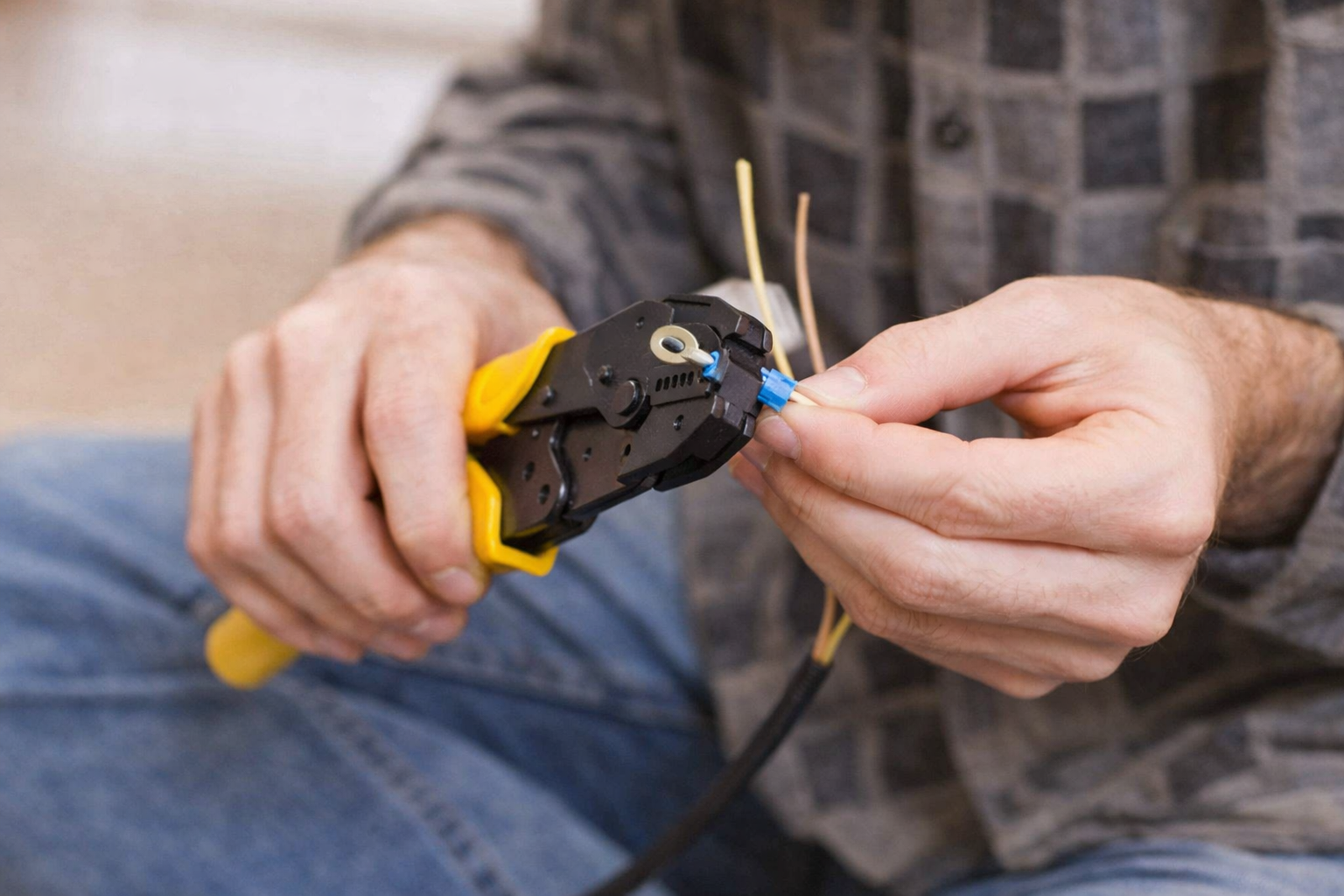
How to Properly Crimp Insulated and Non-Insulated Terminals
Correct crimping is critical regardless of terminal type.
Select the Correct Terminal Size
The terminal must match the conductor cross-section or wire gauge.
A terminal that is too large may produce a weak crimp, while one that is too small can damage the conductor or prevent proper insertion.
Strip the Wire Correctly
Remove the required length of insulation without cutting or damaging the conductor strands.
Too much exposed conductor can create an unnecessary exposed area, while insufficient stripping can prevent the conductor from reaching the correct position inside the terminal.
컨덕터 삽입
The conductor should be fully inserted into the terminal barrel.
For terminals with insulation support, the wire should also be positioned correctly in relation to the insulation crimp area.
Apply the Correct Crimp
Use a crimping tool designed for the terminal and wire size.
Avoid relying on excessive force as a substitute for the correct tooling.
크림프 검사
A finished crimp should be checked for:
- 올바른 와이어 삽입
- Correct crimp position
- 손상된 도체 가닥 없음
- No excessive deformation
- Appropriate mechanical retention
- Proper insulation support where applicable
생산 애플리케이션용, manufacturers may also perform tensile testing, 치수검사, 전기 테스트, or other quality-control procedures.
터미널을 선택할 때 흔히 저지르는 실수
가격만을 기준으로 선택
The cheapest terminal is not necessarily the lowest-cost solution.
전도성이 좋지 않음, inconsistent crimping, 부식, or premature failure can create significantly higher costs later.
Ignoring Wire Gauge
A terminal must be matched to the conductor.
Using an incorrectly sized terminal can result in poor electrical contact or inadequate mechanical retention.
현재 요구사항 무시
A terminal designed for a small control circuit should not automatically be used for a high-current application.
Current capacity depends on the terminal design, 재료, 단면, 연결 품질, 및 작동 조건.
Using the Wrong Crimp Tool
Even a properly manufactured terminal can perform poorly when crimped with unsuitable tooling.
For production wiring, terminal and tooling compatibility should be validated together.
Selecting the Wrong Plating
Environmental conditions should be considered when selecting plating.
예를 들어, applications exposed to moisture or corrosive environments may require more attention to corrosion protection than a dry indoor application.
Assuming Insulated Always Means Better
Insulation is useful, but it is not a substitute for correct engineering.
A non-insulated terminal inside a properly protected enclosure can be more suitable than a large insulated terminal that does not fit the available space or temperature requirements.
Using Non-Insulated Terminals Without Proper Protection
The opposite mistake is also common.
If a bare terminal is used in an exposed location, appropriate insulation or enclosure protection may be necessary to prevent accidental contact and environmental damage.
절연 대. 비절연 단자: Quick Decision Guide
A simple decision framework can help:
| Application Requirement | Typical Choice |
|---|---|
| Exposed general wiring | 절연 |
| 컴팩트한 연결 | 비절연 |
| Enclosed electrical cabinet | 둘 다 |
| Automotive wiring harness | 둘 다 |
| High-current battery connection | Non-insulated or specialized insulated design |
| High-temperature application | Non-insulated or high-temperature insulated |
| 해양 배선 | Insulated or properly sealed/protected |
| Professional wire harness | 둘 다 |
| Easy manual installation | 절연 |
| Custom external insulation | 비절연 |
These are general guidelines rather than universal rules. The actual choice should always be based on the terminal specification and application requirements.
Choosing a Reliable Terminal Manufacturer
For OEM and industrial applications, terminal quality depends on much more than the finished appearance.
A capable manufacturer should be able to control:
- Raw material quality
- 단자 치수
- Stamping precision
- 압착 기하학
- 도금 품질
- 단열재
- Mold accuracy
- 생산 일관성
- 전기적 성능
- 기계적 강도
- 품질검사
~에 첸웨이 정밀, terminal manufacturing combines precision metal stamping, 사출 성형, 금형 제조, 도금, 및 조립 능력. This allows terminal designs to be developed and manufactured with closer control over dimensions, 재료, 생산 일관성.
자동차용, 산업의, 전기 같은, 및 와이어 하니스 애플리케이션, terminals can be developed according to requirements such as wire size, 현재 용량, 재료, 도금, connection structure, 및 설치 방법.
Whether you need insulated terminals for general wiring or non-insulated copper terminals for compact and high-current connections, selecting the right terminal design at the beginning can significantly improve the reliability of the finished wiring system.
자주 묻는 질문
Are insulated terminals better than non-insulated terminals?
꼭 그런 것은 아니다. Insulated terminals provide integrated protection and are convenient for exposed wiring, while non-insulated terminals offer a compact design and greater flexibility for external insulation. The better choice depends on the application.
Can I use non-insulated terminals for automotive wiring?
예. Non-insulated terminals are widely used in automotive wiring harnesses, 배터리 연결, and other professional applications. They are often installed inside connector housings or protected using an appropriate insulation system.
Are non-insulated terminals safe?
예, when they are correctly selected, 주름진, and protected. A non-insulated terminal should not be left exposed where accidental contact or short circuits could occur.
Which terminals are best for marine applications?
There is no single terminal type that is best for every marine application. Corrosion-resistant materials and plating, together with appropriate sealing and environmental protection, are especially important. Insulated or sealed terminals are often preferred for exposed marine wiring.
Do insulated terminals handle high current?
Some do, but insulation alone does not determine current capacity. 터미널 소재, 도체 크기, 접촉면적, 압착 디자인, 온도 등급, and overall construction all affect current-carrying capability.
What is the difference between vinyl and nylon insulated terminals?
Vinyl and nylon are different insulation materials with different mechanical, 온도, 화학적인, and environmental characteristics. The appropriate choice depends on the operating conditions and the terminal manufacturer’s specifications.
내 전선에 맞는 터미널을 선택하는 방법?
Start with the wire size and conductor type, then consider current, 전압, 온도, 환경 노출, 기계적 요구 사항, 사용 가능한 공간, 및 압착방법. The terminal should be matched to the wire and the application rather than selected by size alone.
Can non-insulated terminals be made insulated?
예. Non-insulated terminals can often be combined with heat-shrink tubing, insulating boots, 커넥터 하우징, or other protective systems. This approach provides greater flexibility when a specific insulation system is required.
Need Help Selecting the Right Terminal?
Choosing between an insulated and non-insulated terminal is only one part of terminal selection. 와이어 크기, 현재의, 재료, 도금, 압착 디자인, 환경 조건, and manufacturing requirements all need to work together.
Qianwei Precision provides terminal and connector manufacturing solutions for automotive, 산업의, 전기 같은, 및 와이어 하니스 애플리케이션. Contact us to discuss your terminal specifications, OEM/ODM 요구사항, and application needs.


한 가지 생각 “절연 대. 비절연 단자: 자동차를 위한 완벽한 기술 가이드, 선박 & 산업용 배선”