

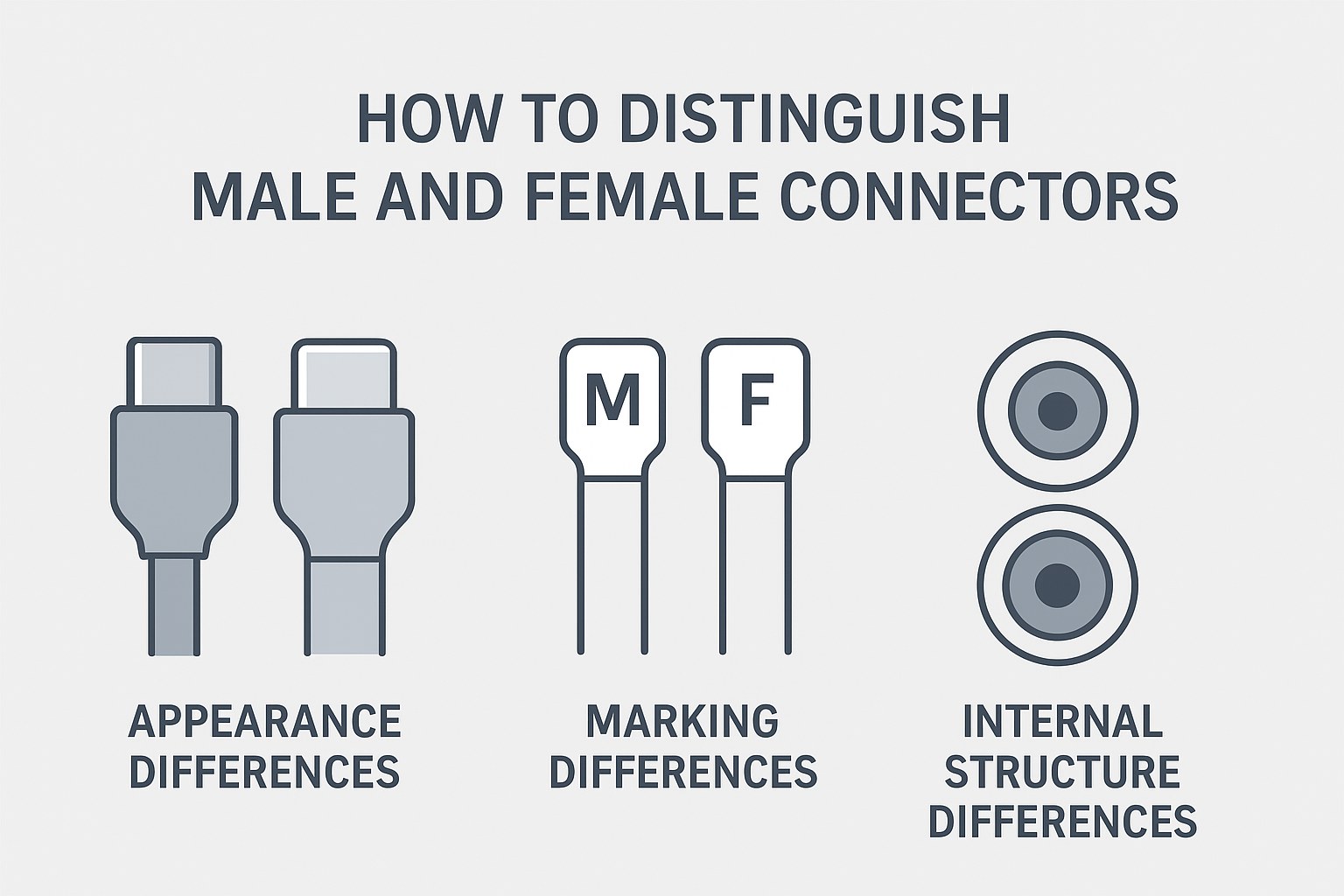
Connectors are essential components used to link two electronic devices or circuits. They are widely applied in communication equipment, automotive systems, consumer electronics, industrial control, and countless other fields. One of the most fundamental concepts in connector design is connector gender—the classification of a connector as either male or female. Correctly identifying the male and female ends is crucial not only for ensuring compatibility but also for preventing electrical failures, signal loss, or even safety hazards. This article explains how to distinguish male and female connectors from three perspectives: appearance, marking, and internal structure.
What Are Male and Female Connectors?
In connector terminology:
-
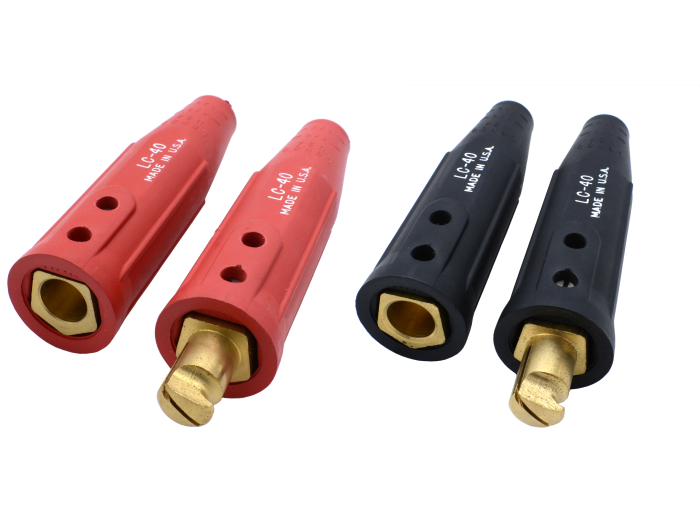
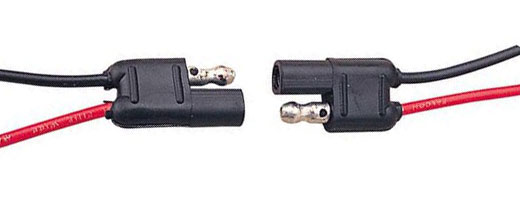
Male connectors have protruding parts—typically metal pins, blades, or plugs.
-
Female connectors have recessed parts—metal holes, sockets, or cavities that receive the male pins.
The two are designed as mating pairs. Male-to-female matching ensures a stable mechanical connection and reliable electrical contact.
Recognizing the gender of a connector helps ensure proper installation, avoids forceful mismating, and protects the integrity of the equipment.
Appearance Differences (Most Intuitive Method)
Appearance is the quickest and most intuitive way to tell the difference between male and female ends.
Male Connector Appearance
-
Features protruding pins, prongs, or plugs
-
The structure is outward-facing
-
Designed to insert into the female connector
Female Connector Appearance
-
Features recessed holes, sockets, or cavities
-
The structure is inward-facing
-
Designed to receive the male connector
Examples
-
USB connectors:
-
Male = the plug with metal prongs
-
Female = the socket with matching holes
-
-
Wire-to-board connectors:
-
Male = plastic housing at the wire side with protruding terminals
-
Female = pin header or socket on the PCB with holes
-
Appearance-based identification works for most standard connectors, making it the primary method used by technicians and engineers.
Marking Differences
Many connectors include gender markings to help users quickly identify the type without relying solely on appearance.
Common markings include:
-
“M” for male
-
“F” for female
-
Gender-specific icons or diagrams printed on housings or packaging
Example
For wire-to-wire or wire-to-board connectors:
-
The male housing may include an “M” stamp
-
The female housing may include an “F” stamp
These markings are especially useful for:
-
Small connectors where appearance is not obvious
-
Dense wiring harnesses
-
High-volume assembly processes
Correct marking helps avoid mismating during assembly and reduces installation errors.
Internal Structural Differences
Some connectors require examining the internal structure to identify gender, especially when the external housing looks similar.
DVI Connectors
-
Male connector:
-
Has 24+1 or 24+5 pins
-
-
Female connector:
-
Has matching 24+1 or 24+5 pin holes
-
The number and arrangement of pins determine the connector type and signal transmission mode.
SMA RF Connectors
-
Male SMA:
-
Contains a center pin
-
-
Female SMA:
-
Contains a center socket (hole)
-
The internal structure affects:
-
Impedance
-
Frequency performance
-
RF signal integrity
Internal features are critical in high-frequency connectors where precise contact shapes determine electrical properties.
Why Correct Identification Matters
Identifying connector gender correctly ensures:
Proper Mechanical Mating
Incorrect mating can cause bent pins, connector damage, or failure during assembly.
Stable Electrical Performance
Matching male and female ends ensures correct contact pressure and conductivity.
Safety and Reliability
Incorrect connections may cause:
-
Short circuits
-
Signal interruption
-
Overheating or equipment damage
Faster and Error-Free Installation
Especially important in:
-
Automotive wiring harnesses
-
PCB assembly
-
Industrial automation equipment
Conclusion
The male and female ends of a connector are defined by their structural shape—male connectors protrude, while female connectors are recessed. Correct identification is essential for proper mating, electrical performance, and safety. You can distinguish between male and female connectors by examining:
-
Appearance differences – pins vs. sockets
-
Marking differences – “M” and “F” labels or icons
-
Internal structural differences – pin count, arrangement, or contact shape
Understanding these distinctions helps ensure reliable connections in communication systems, automotive wiring, home electronics, and industrial equipment.

