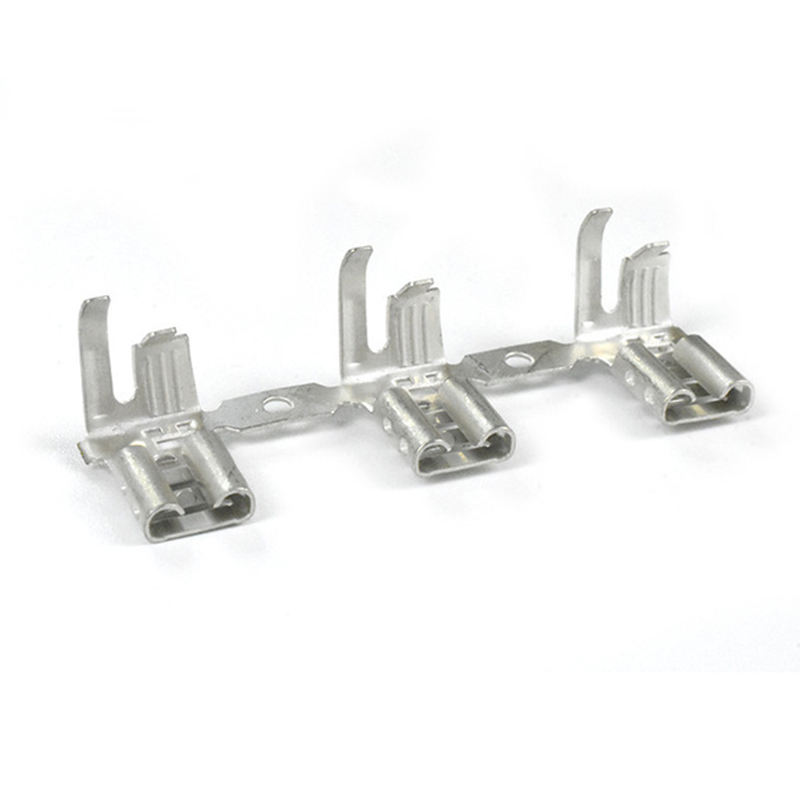
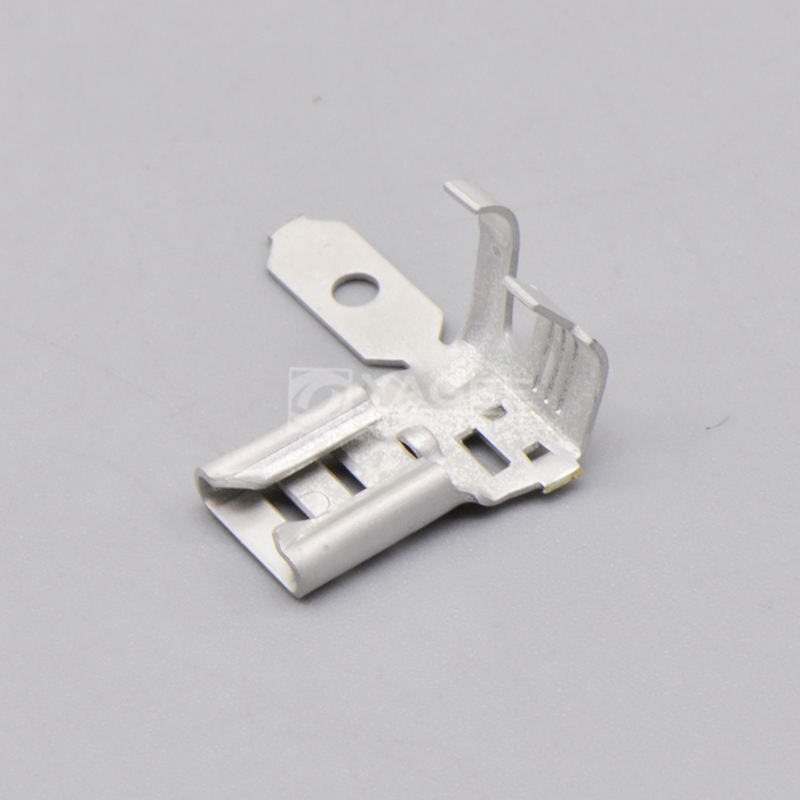
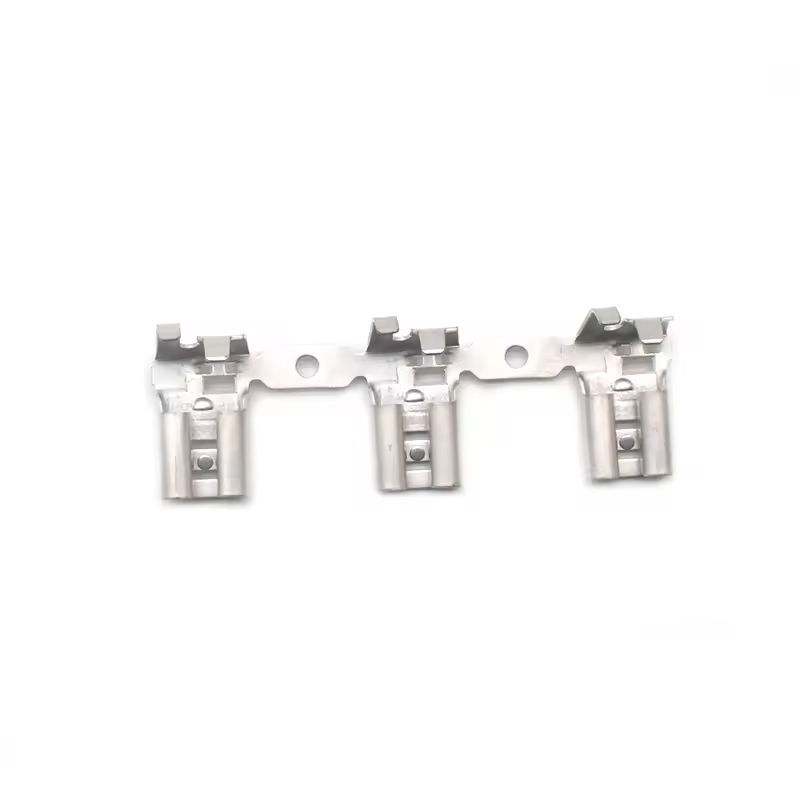
What Are Flag Terminals?
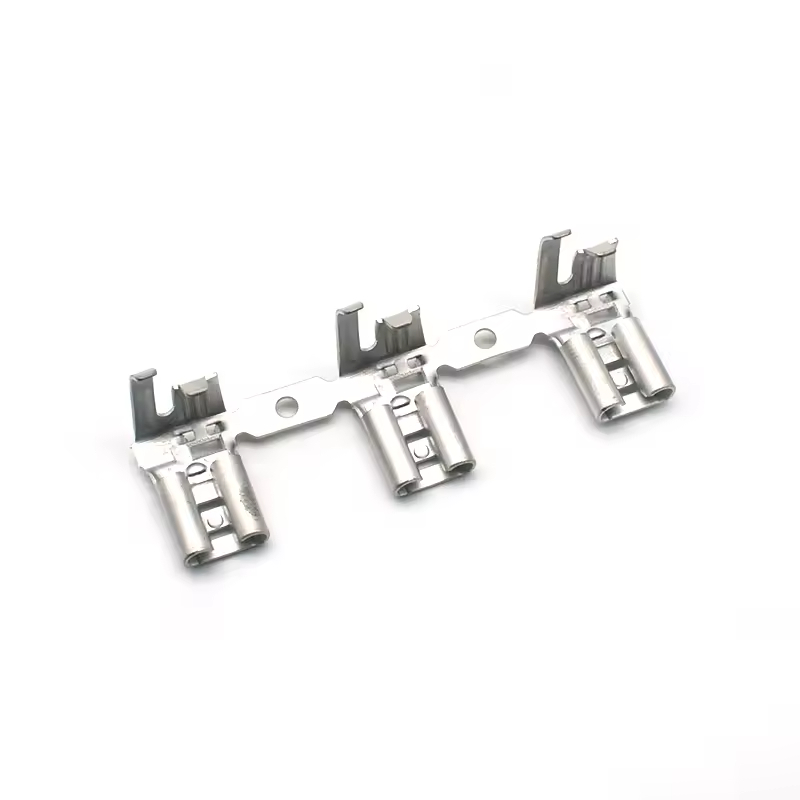
A flag terminal is a crimp electrical connector where the entry wire and connection interface are at 90 Degrees (right angles). The conductor is then crimped into a crimp barrel, with the terminal end attached to a flat tab or blade, to succeed in the tight or constrained layout of an electrical circuit.
The unique trait of flag terminals is that the terminal is made in a design of right angles, such that wires pass parallel to mounting faces rather than sticking outwards. This avoids bending strain on wires and potential damage or disconnection to the confined installations.
Where clearance around a panel, surrounding airflow, and path layout of wiring are important, flag terminals are often employed. Insulated units can also offer greater resistance to electrical shorts, water, and mechanical stress, whereas non-insulated units can be used over a higher temperature range or with bespoke insulation.
Design Engineering Principles
The flag terminals are designed with the highest degree of engineering requirements in order to achieve optimum electrical performance, mechanical property as well as durability.
1. Electrical Conductivity
It is high, which is essential in flag terminal performance. These connectors are normally constructed out of copper or copper alloys to achieve a small resistance and a good flow of current. This terminal geometry is designed to achieve the maximum proportion of contact between the connector and tab to maintain stable movement of current even under load.
2. Right-Angle Efficiency Connection (90 ° Design)
The most important feature of flag terminals is the 90-degree orientation. This design:
- Maximizes space in small assemblies.
- Reduces wire-bending stress
- Allows tidy and clear wiring designs.
The flag design enables running of wires close to surfaces, thereby enhancing the performance of the installation and stability in the long run.
3. Mechanical Strength & Retention of Wires
The design of flag terminals is provided with powerful crimp barrels that fix wire strands. When crimped, the connection offers high pull-out strength, which means that wires stay firmly fixed, even when subjected to mechanical load or movement.
4. Contact Stability & Low Contact Resistance.
A constant contact between the terminal and tab is essential. The design of flag terminals ensures tight, repetitive contact pressure, reducing resistance to a minimum as well as eliminating voltage loss or signal attenuation.
5. Vibration Resistance & Fit-Sure
Vibration is inevitable in places like automotive systems or industrial systems. These flag terminals are meant to hold stable even during continuous movement or mechanical shock, as they do not loosen easily.
6. Heat Dissipation & Thermal Performance
During the operation, electrical connections produce heat. The materials and geometry of flag terminals are designed to facilitate effective heat dissipation, enabling performance over a wide temperature range and avoiding overheating.
Materials We Use in Flag Terminals
The conductive metals and insulating materials are mixed to produce flag terminals of the desirable electrical, mechanical, and environmental performance.
| Material | Key Properties | Typical Use |
| Electrolytic Copper | High conductivity, ductile | Standard electrical wiring |
| Brass | Moderate conductivity, higher mechanical strength than copper, good corrosion resistance | Mechanical terminals, screw-type connectors |
| Phosphor Copper (Phosphor Bronze) | Excellent elasticity, fatigue resistance, good conductivity | Spring terminals, connectors requiring repeated flexing |
| High-Conductivity Alloys | Enhanced strength and conductivity | High-performance or industrial use |
| Insulation Materials (PVC, Nylon, Heat Shrink Tubing) | Electrical insulation, strain relief | Insulated and heat-shrink connectors |
Overview of The Manufacturing Processes
The production of flag terminals consists of complex and high-precision operations to gain reliability, continuity, and functionality.
1. Raw Material Inspection
Every material is checked based on conductivity, composition, and mechanical strength to meet high standards of quality. The material properties are usually tested using advanced testing techniques like spectrometry and tensile tests. This provision helps to remove the defects at an early stage of the process and ensures that the end product has a solid platform.
2. High-Speed Stamping Accuracy
The high-speed stamping machines are used to stamp metal strips into a basic terminal shape with a tight tolerance and consistent diameter. These machines have high efficiency levels and can be accurate as large volumes of production are produced. Exact tooling will guarantee that there is little waste of materials and that all parts have the same geometry.
3. Bending & Right-Angle ( Flag ) Forming
Precision forming tools are then used to bend the stamped terminals into the typical 90-degree flag shape, with all angles being consistent, and structural integrity being maintained. This is a very important step in ensuring that there is the perfect orientation that will assure a suitable fit and performance. Any change in the angle can impact the installation performance and the connection dependability.
4. Barrel Folding and Structure Development of Antiques
The crimp barrel is created to hold a strand of wire in place. The design of the geometry is to make sure that it gives the best crimping and electrical contact. Correct barrel design enables the compressions of the wire strands to be similar to enhance conductivity and mechanical performance. This phase has a direct effect on the long-term stability of the relationship.
5. Annealing and Heat Treatment
The heat treatment enhances the ductility and also alleviates internal stress, which then makes the terminals easier to crimp and strengthens miscellaneous strength. Refinement of the grain structure of the metal is done through controlled heating and cooling cycles to enhance performance. This further enhances cracking and fatigue resistance in the application and installation process.
6. Insulation Sleeve Application (insulated types)
In order to ensure electrical insulation and mechanical protection, the insulated terminals are supplied with PVC, nylon, or heat-shrink sleeves. The insulation is carefully shaped or sprayed to be a tight fit and uniform cover. The layer also increases safety, as it avoids unintentional contact as well as environmental exposure.
7. Surface Treatment & Electroplating
The materials that are used to plate the terminals are either tin, nickel, or silver to enhance the corrosion resistance, conductibility and strength. Plating is meticulously regulated to get a uniform thickness and adhesion. This guarantees security against oxidation and environmental degradation in the long-term.
8. Crimp Quality Inspection & Calibration
The dimensions of crimps are set to make them compatible with the commonly used crimping tools and for the quality of the connection. Crimp profiles are confirmed using specialized gauges and measuring systems. This measure is used to make sure that the terminals will work properly when subjected to mechanical and electrical loads.
9. Inspection of Final & Performance Testing
They are also tested in terms of electrical resistance, mechanical strength, and visual quality to be sensitive in real-life applications. More tests, like pull-out force and vibration resistance, could be carried out as well. Only products that pass the stringent quality check are shipped.
10. Automated Packaging and Production
Large-scale supply is guaranteed with high production efficiency, constant quality, and decent packaging through automation. Automated systems ensure there is less human error and enhance traceability during the production process. Packaging is also uniform in order to safeguard the terminals in transit and storage.
Standard Sizes and Technical Specifications of Flag Terminals
Let’s discuss the different specifications and sizes we deal with.
| Specification | Details |
| Wire Size Range (AWG / mm²) | 22–10 AWG (0.3–6 mm²) |
| Tab Size Compatibility (Width & Thickness) | 2.8 mm, 4.8 mm, 6.3 mm standard tabs |
| Current Rating | 5–30 A, depending on material and size |
| Voltage Rating | Up to 600 V |
| Operating Temperature Range | -40°C to +125°C (varies by insulation) |
| Contact Resistance | < 5 mΩ typical |
| Insulation Type and Thickness | PVC, nylon, heat shrink; 0.5–1.5 mm |
☞ Contact us for your quote today
Surface Finishes and Plating Technology.
Surface finishes can be used to improve the performance, corrosion resistance, and durability of flag terminals. They are also highly important in ensuring that there is a constant electrical contact over time. The selection of the proper plating should be based on the environment of application and performance.
1. Common Plating Materials
A variety of plating materials is applied to satisfy certain electrical, mechanical, and environmental requirements. The plating itself is a key factor that influences the conductivity, the wear resistance, and the corrosion.
2. Tin Plating
Gives it a very high level of corrosion resistance and good conductivity, thus making it usable and has application in general purposes. It is popular because it is inexpensive and sellable. Tin plating, as well can be stably used in relatively harsh environments.
3. Nickel Plating
Durability and heat resistance are higher, and it can be used in high-temperature areas. It has a hard surface too, which is not subject to wear and mechanical damage. Nickel plating has been frequently applied to improve the bond of other coats.
4. Silver Plating
Maximum electrical conductivity is ensured, and it is applied to high-current or precision uses. It is exceptionally good in the area of use where contact resistance is a big issue. Silver is also a good thermal conductor and thus enhances the dissipation of heat.
5. Gold Plating
It offers outstanding corrosiveness qualities and conductivity consistency, and is frequently utilized in delicate electronics. It is most resistant to oxidation and lasts longer. The application of gold plating is mostly in low currenthigh-precisionon signal connections, where uniformity is of crucial importance.
Types of Flag Terminals
There are a variety of types of flag terminals to fit the purposes and conditions of the environment.
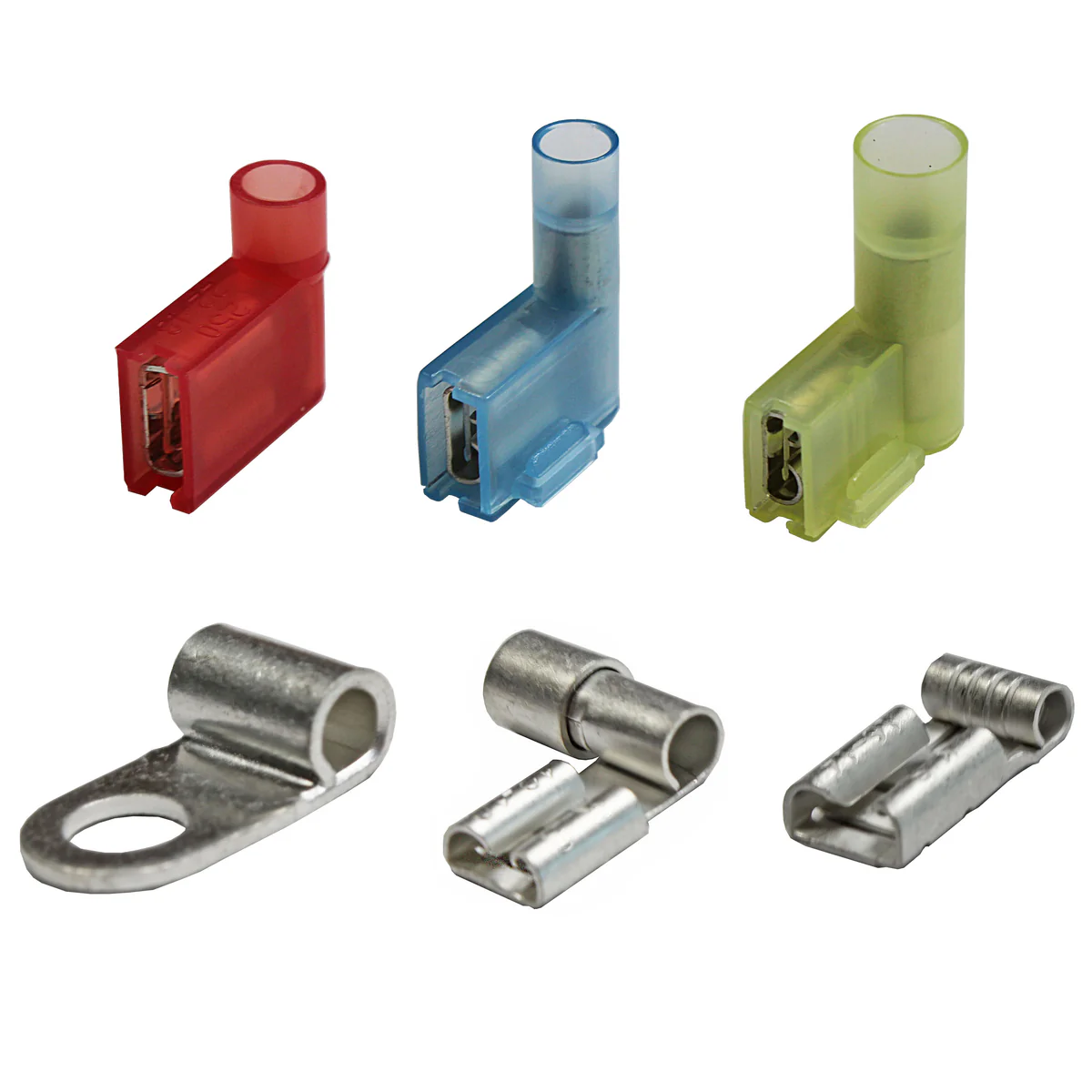
1. Insulated Flag Terminals
These terminals have either PVC or nylon insulation to eliminate short circuiting and to relieve strain. They are typically applied in house and motor vehicle wiring. The insulation also prevents the vibration impact and secures the connection against accidental disconnection. There is also the use of color-coded insulation so that during installation and maintenance, it is easy to identify the sizes of wires used.
2. Uninsulated Flag Terminals
These terminals are custom-sized and flexibly designed to be used in high-temperature applications or other types of insulation. They are suitable in a situation where there is further insulation done externally. They are simple to design, but that is less precise in their heat dissipation. They are also popular at the industry level, where space and customization are paramount.
3. Fully Insulated (Sleeved) Flag Terminals
These terminals have full insulation cover and are safety aware of accidental contact. They are particularly applicable in applications with a stronger demand for electrical protection. The full sleeve design reduces the chances of short circuits in very thick wiring as much as possible. It is also more durable as it protects the connection against dust and moisture.
4. Heat Shrink Flag Terminals
These terminals have heat-shrink tubing, which will seal and protect them against environmental factors. They are generally utilized in marine and outdoor environments. The tubing then forms a tight seal around the wire, which forms a powerful and reliable shield when heated. This increases strain relief and long-term connection stability, also.
5. High-temperature Flag Terminals
These terminals are made of special materials and can handle high temperatures in industrial or automotive environments. They are able to exhibit electrical performance even when continuously heated. The materials used for advanced insulation and plating do not degrade under high temperatures. This renders them to be fit in engine compartments and heavy machinery.
6. Locking Flag Terminals
These have locking features so as to have a good connection and not to disconnect accidentally. They are especially applicable where movement or vibration is constant. Connection stability and reliability over time. The locking feature improves the stability and reliability of connections. It also does not necessitate a lot of maintenance or reconnection.
7. Heavy-Duty Flag Terminals
These terminals are made with high-current operability, increased strength, and durability. They find application in the distributors of industries and power. Their strengthened design enables them to support increased mechanical and electrical loads. This will guarantee a sustained performance even under harsh operational conditions.
Industrial Flag Terminal Applications
The popularity of flag terminals in different industries is due to their compact nature and consistent operation.
- Automotive Wiring Systems: Applied in dashboards, wiring systems, and engine sections.
- Household Appliances:This is suitable when there is a need to have a tight fit on the washing machine and the microwave.
- Industrial Machinery and Equipment: Deliver trustworthy links in automated systems.
- Electrical Panels and Control Systems: Inspect carefully and effectively the wiring designs.
- HVAC Systems: These are applied in heating, ventilation, and air conditioning.
- Consumer Electronics: Facilitate small and effective internal wiring.
- Telecommunications equipment: Supply consistent connections to signal transmission systems.
OEM Solutions and Customization
Qianwei Precision provides extensive customization capabilities:
- Particular right-angle orientation systems.
- Tab sizes and thickness compatibility. Customized tabs.
- Customized insulation covers and colors.
- Special plating to achieve high performance.
- Laser marking and branding available.
- Packaging and supply chain solution.
These solutions enable manufacturers to enable flag terminals to be seamlessly integrated into their systems and provide the same quality and performance.
Quality and Compliance
Qianwei Precision maintains that all flag terminals are internationally qualified in terms of quality and safety:
- Quality Management Systems ISO 9001.
- IATF 16949 (Automotive Standards)
- RoHS and REACH Compliance
- UL Certification Support
- Mechanical and Electrical Performance Testing.
- Environmental testing and Salt spray testing.
Why Select Qianwei Precision by Flag Terminals?
The following are the major reasons to select Qianwei Precision:
- Knowledge of compact and right-angle terminal design.
- High precision stamping and forming.
- Higher electrical performance and reliability.
- Strict quality tight control at each level.
- A large variety of standard and custom solutions.
- Greater global OEM supply and automation.
☞ Contact us for your quote today
Conclusion
Flag terminals are an important aspect of contemporary electrical systems, as their purpose is to provide efficient, reliable, and space-saving contacts. Its right-angle form, superior material usage, and accuracy of engineering will guarantee high electrical performance, hardiness, and longevity in a wide variety of applications.
In automotive and industrial systems, consumer electronics, and telecommunications, flag terminals offer the flexibility and reliability needed in the modern, sophisticated wiring scenarios. Qianwei Precision produces products meeting the highest standards of performance and safety, manufactured with high-tech manufacturing, high-quality standards, and large-scale customization.
FAQs
What is a flag terminal?
A flag terminal is an electric connector with a right angle, and it is used to connect wires to tabs in smaller areas.
Why are flag terminals used?
They are utilized to conserve space and enhance the wiring organization in small or restricted spaces.
Can flag terminals be used in high temperatures?
Yes, extreme environments are intended by high-temperature variants.
Which materials are usually used?
Copper, tinned copper, electric bronze, phosphor bronze, and high-conductivity alloys.
Are flag terminals usable outdoors?
Yes, heat-shrink and insulated types have some protection against moisture and corrosion.
How do I choose the right size?
Choose according to wire gauge, tab size compatibility, and current needs.