

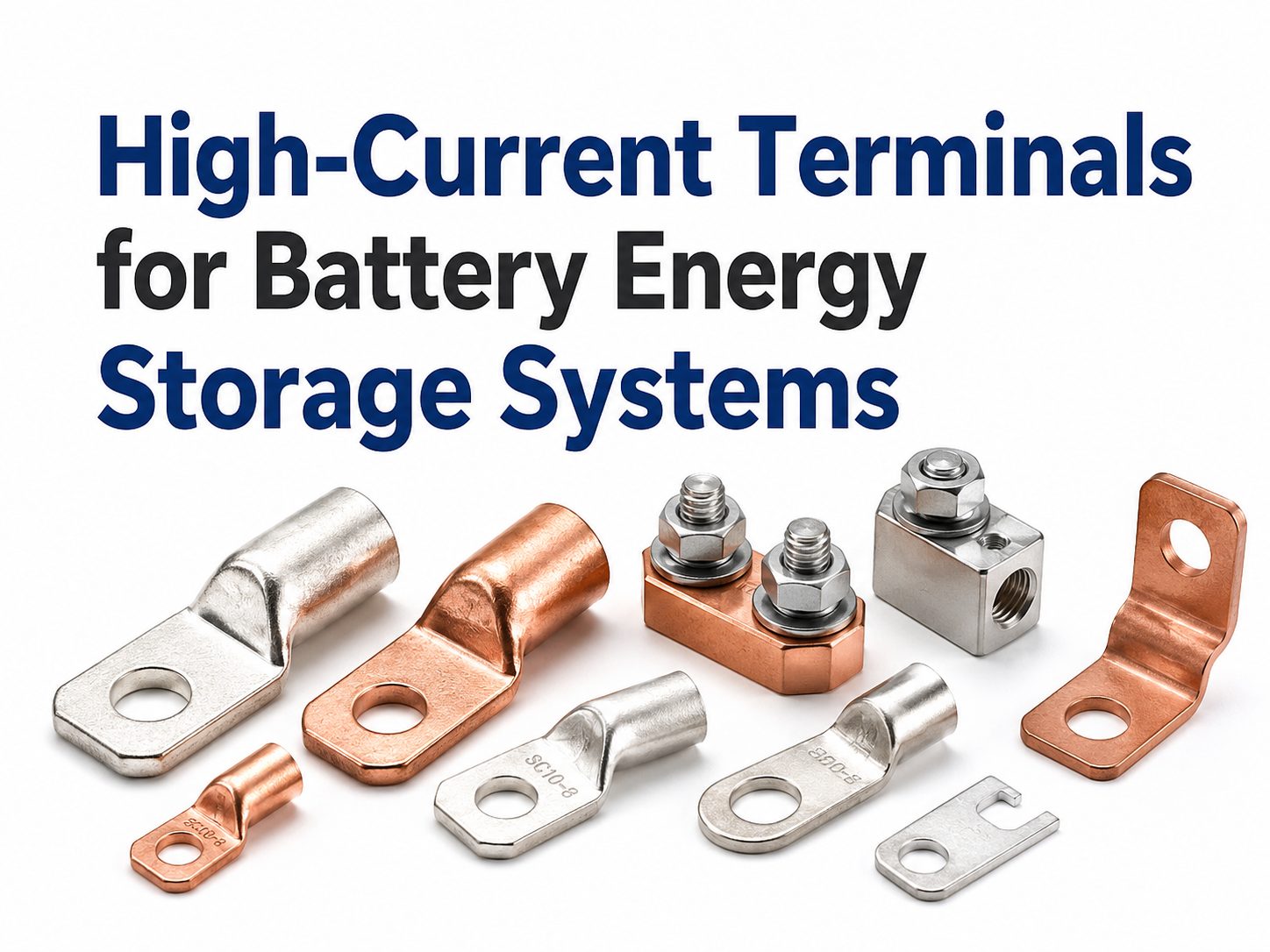
As battery energy storage systems (BESS) become more widely used in renewable energy, backup power, commercial energy storage, and industrial power applications, the reliability of every electrical connection becomes increasingly important.
A battery energy storage system may handle high continuous currents, large cable sizes, temperature changes, vibration, and long operating hours. Under these conditions, the terminal is more than just a small metal connection component. A properly designed high-current terminal helps provide a stable electrical path, reduce contact resistance, control heat generation, and maintain mechanical reliability over time.
For BESS manufacturers and system integrators, choosing the right high-current terminal requires more than simply checking the rated current. Material, conductor size, connection method, plating, temperature, installation conditions, and mechanical requirements should all be considered.
This guide explains the key factors to consider when selecting high-current terminals for battery energy storage systems.
1. Why High-Current Terminals Matter in BESS
A typical battery energy storage system includes battery cells, modules, battery packs, racks, busbars, battery management systems (BMS), power conversion systems (PCS), and other electrical components.
Electrical energy needs to move reliably between these components. High-current terminals provide the connection between cables, busbars, batteries, and other conductive parts.
In high-current applications, even a small increase in contact resistance can generate significant heat.
The relationship can be expressed as:
P = I²R
where:
- P = heat generated by resistance
- I = electrical current
- R = electrical resistance
As current increases, the effect of resistance becomes much more significant. This is why a connection that works well in a low-current application may not be suitable for a BESS application.
A well-designed high-current terminal should therefore provide:
- High current-carrying capability
- Low and stable contact resistance
- Sufficient mechanical strength
- Good thermal performance
- Corrosion resistance
- Reliable connection over the expected service life
For battery manufacturers and energy storage equipment manufacturers, terminal quality can directly affect the reliability of the entire electrical system.
2. What Are High-Current Terminals?
A high-current terminal is an electrical terminal designed to carry relatively large amounts of current while maintaining a reliable electrical and mechanical connection.
Compared with standard terminals used in electronics or low-power wiring, high-current terminals generally have larger conductive areas, stronger mechanical structures, and materials suitable for higher electrical loads.
High-Current Terminal vs. Standard Terminal
| Feature | Standard Terminal | High-Current Terminal |
|---|---|---|
| Current capacity | Low to medium | High |
| Conductor size | Small to medium | Medium to large |
| Conductive area | Smaller | Larger |
| Heat management | General | More critical |
| Mechanical requirements | General | Higher |
| Typical applications | Electronics, appliances | Batteries, BESS, EV, power equipment |
There is no universal current value that defines a terminal as “high-current.” The appropriate rating depends on terminal design, material, conductor size, connection method, temperature conditions, and applicable testing requirements.
Common Types of High-Current Battery Terminals
Depending on the system design, high-current terminals may include:
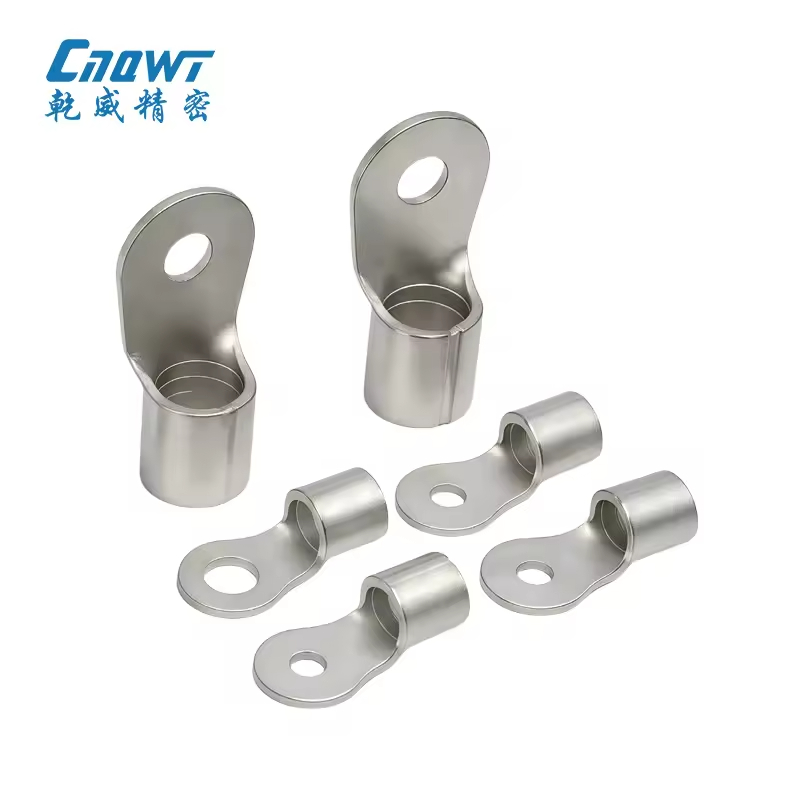
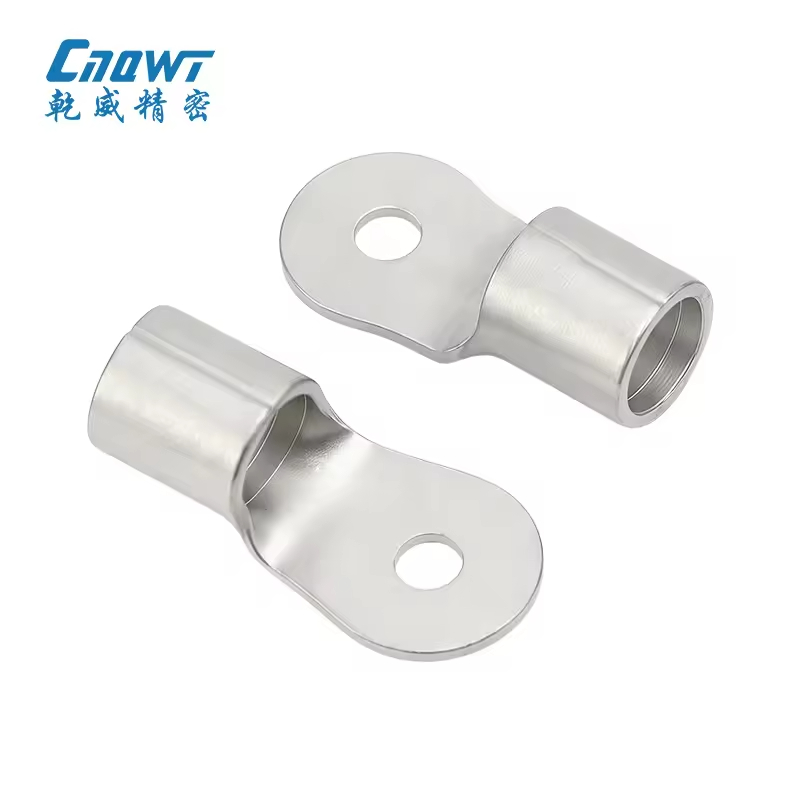
- Ring terminals
- Cable lug terminals
- Battery terminals
- Bolt-on terminals
- Busbar terminals
- Custom stamped terminals
- High-current wire terminals
The best choice depends on how the terminal will be installed and how current will flow through the connection.

3. Where Are High-Current Terminals Used in Battery Energy Storage Systems?
High-current terminals can be used at several points within a battery energy storage system.
A simplified electrical path can be described as:
Battery Cell → Battery Module → Battery Pack → Battery Rack → DC Busbar → PCS → Grid
The terminal requirements can change at each stage.
3.1 Battery Cell and Module Connections
Battery modules contain multiple cells connected together to achieve the required voltage and capacity.
Terminal components may be used to connect conductors between battery modules or to connect module-level wiring to other electrical components.
Space can be limited in battery assemblies, so terminals may need to combine high electrical performance with compact dimensions.
3.2 Battery Pack Connections
Battery packs typically require reliable high-current connections between internal conductors, cables, busbars, and external power connections.
At this level, terminal design must consider current capacity, mechanical strength, temperature rise, and installation space.
3.3 Battery Rack and Battery Cluster Connections
In larger energy storage systems, multiple battery packs may be installed in racks or connected into battery clusters.
These connections can carry substantial currents, making terminal selection particularly important.
3.4 DC Busbar Connections
Busbars are widely used to distribute DC power in energy storage systems.
Bolted or custom-designed terminals can be used to connect cables to busbars or other conductive components.
The contact area and mechanical stability of these connections are especially important because loose or poorly designed connections can increase resistance and heat generation.
3.5 BMS and Power Connections
Not every connection inside a BESS carries high current. Battery management systems also contain low-current signal and monitoring circuits.
This means that terminal selection should be based on the specific electrical function rather than simply assuming that every connection in a BESS requires a high-current terminal.
4. Key Requirements for High-Current BESS Terminals
Selecting a terminal for a battery energy storage system requires a combination of electrical, mechanical, thermal, and environmental considerations.
4.1 Current-Carrying Capacity
The first question is usually:
How much current will the terminal carry?
However, the answer should not be based only on the maximum current.
Consider:
- Continuous operating current
- Peak current
- Duty cycle
- Ambient temperature
- Terminal temperature
- Conductor size
- Connection resistance
- Installation conditions
A terminal used continuously at high current may have different requirements from one that only experiences short-duration current peaks.
The terminal, conductor, crimp connection, and mating interface should be considered as one electrical system.
4.2 Low Contact Resistance
Low contact resistance is critical in high-current applications.
When resistance increases, more electrical energy is converted into heat. This can cause:
- Higher terminal temperature
- Voltage drop
- Reduced electrical efficiency
- Accelerated material degradation
- Potential connection failure
Good terminal design should provide a stable conductive path and sufficient contact area.
Proper crimping or fastening is equally important. Even a high-quality terminal can perform poorly if the connection is improperly assembled.
4.3 Material Selection
Copper is one of the most commonly used materials for high-current terminals because of its excellent electrical and thermal conductivity.
Copper Terminals
Copper terminals offer:
- High electrical conductivity
- Good thermal conductivity
- Good machinability and formability
- Suitable performance for high-current applications
Copper is therefore widely used in battery terminals, cable lugs, busbar connections, and other power applications.
Copper Alloys
Copper alloys can provide a balance between electrical conductivity and mechanical strength.
They may be considered when the terminal requires additional structural performance, spring properties, or resistance to deformation.
Aluminum
Aluminum is lightweight and can be useful in certain high-current power applications.
However, aluminum connections require careful consideration of oxidation, material compatibility, contact design, and joining methods.
The appropriate material depends on the complete application rather than electrical conductivity alone.
5. Plating and Surface Treatment
Surface treatment can have a significant effect on the long-term performance of electrical terminals.
Common plating options include:
Tin Plating
Tin plating is widely used for electrical terminals because it provides good conductivity and corrosion protection while offering a practical balance between performance and cost.
It is commonly used for copper terminals and wire terminals.
Nickel Plating
Nickel plating can provide improved resistance to heat, corrosion, and demanding environmental conditions.
It may be considered for applications where the terminal is exposed to higher temperatures or more aggressive environments.
Silver Plating
Silver has excellent electrical conductivity and can be considered for specialized high-performance electrical applications.
However, plating selection should be based on the actual operating environment, electrical requirements, temperature, and cost target.
For BESS applications, the plating should also be compatible with the mating material and expected service environment.
6. How to Choose the Right High-Current Terminal for BESS
A practical selection process can be divided into several steps.
Step 1: Determine the Operating Current
Identify:
- Continuous current
- Maximum current
- Peak current
- Duty cycle
Do not select a terminal based only on a nominal current value without considering the actual operating conditions.
Step 2: Determine the Cable Size
The terminal must match the conductor it is designed to connect.
Important parameters include:
- Cable cross-sectional area
- Wire gauge
- Conductor material
- Cable construction
- Insulation diameter
A mismatch between the cable and terminal can lead to poor crimping, increased resistance, or insufficient mechanical strength.
Step 3: Select the Terminal Material
Copper, copper alloy, or aluminum may be suitable depending on the application.
Electrical conductivity, mechanical strength, weight, corrosion resistance, and manufacturing requirements should all be considered.
Step 4: Choose the Connection Method
Common methods include:
- Crimping
- Bolting
- Welding
- Busbar connection
Crimped terminals are commonly used with flexible cables, while bolted connections are frequently used for battery and busbar applications.
Step 5: Select the Plating
Choose the surface treatment according to:
- Operating temperature
- Humidity
- Corrosion exposure
- Electrical requirements
- Expected service life
Step 6: Consider the Operating Environment
For BESS installations, consider:
- Temperature
- Humidity
- Vibration
- Dust
- Corrosive environments
- Indoor or outdoor installation
A terminal intended for a controlled indoor environment may have different requirements from one installed in an outdoor energy storage system.
7. Crimping vs. Bolted Connections for High-Current Terminals
Both crimped and bolted connections can be used in high-current applications, but they serve different purposes.
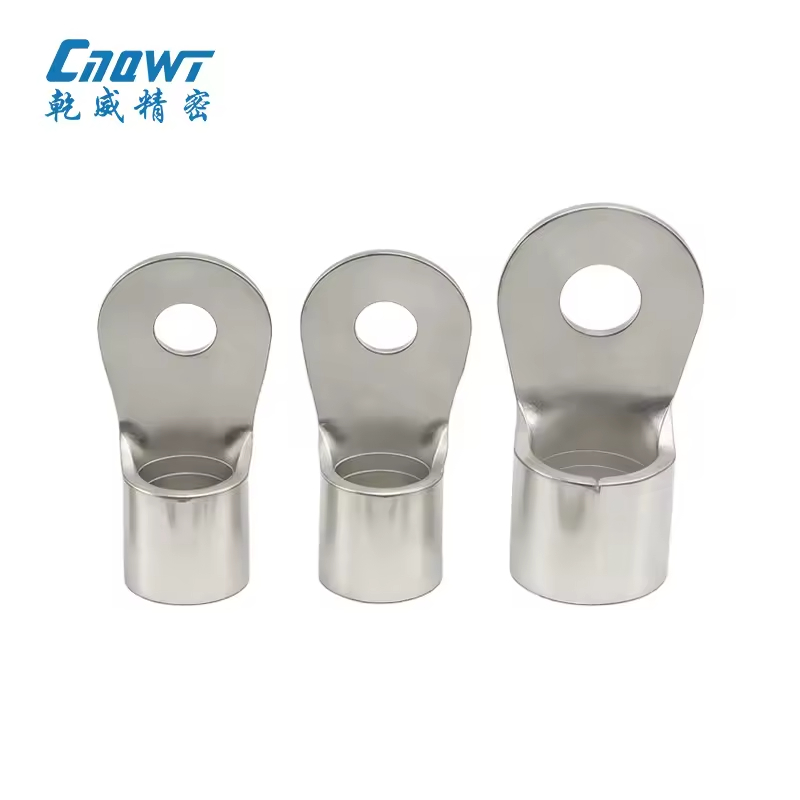
Crimped High-Current Terminals
A crimp terminal is mechanically attached to the conductor using a controlled crimping process.
Advantages include:
- Reliable electrical connection
- Good mechanical strength
- Consistent production
- Efficient assembly
- Suitable for flexible cables
Crimp quality is critical. Incorrect crimp height, insufficient compression, damaged conductors, or improper tooling can increase resistance and reduce pull-out strength.
Bolted High-Current Terminals
Bolted terminals are commonly used where a removable mechanical connection is required.
They are suitable for:
- Battery connections
- Busbars
- Power distribution
- Large cable connections
- Serviceable electrical assemblies
The connection should be designed with appropriate contact area and fastening conditions.
Crimped vs. Bolted
| Connection Method | Typical Application | Main Advantage |
|---|---|---|
| Crimped | Flexible power cables | Reliable cable connection |
| Bolted | Battery and busbar connections | Strong and serviceable |
| Welded | Permanent connections | Compact permanent joint |
The choice depends on the architecture of the BESS and how the system will be assembled, maintained, and serviced.
8. Common Failure Problems with High-Current Battery Terminals
Terminal problems are not always caused by the terminal itself. Assembly conditions, cable selection, fastening, and environmental factors can also affect connection performance.
8.1 Terminal Overheating
Possible causes include:
- Excessive current
- High contact resistance
- Loose connection
- Incorrect crimping
- Undersized terminal
- Insufficient contact area
Overheating should always be investigated because repeated thermal stress can affect both the terminal and surrounding components.
8.2 Voltage Drop
A poor connection can create additional resistance and lead to voltage drop.
This can reduce electrical efficiency and may affect the performance of equipment connected to the battery system.
8.3 Corrosion
Moisture, humidity, salt, and other environmental conditions can cause corrosion.
Appropriate material selection and plating can help improve corrosion resistance.
8.4 Loose Mechanical Connection
A loose bolted connection can increase contact resistance and generate heat.
Proper installation procedures and suitable mechanical design are therefore important for high-current connections.
8.5 Terminal Cracking or Deformation
Mechanical stress, excessive forming force, improper installation, or unsuitable material selection can cause deformation or cracking.
For stamped terminals, tooling accuracy and material control are especially important.
8.6 Poor Crimping
A poor crimp may result in:
- High electrical resistance
- Low pull-out strength
- Intermittent electrical connection
- Excessive heat generation
For high-current applications, crimp tooling and process control should be carefully managed.
9. Testing High-Current Terminals for BESS Applications
Testing requirements depend on the terminal design and application, but several types of testing are commonly considered during product development and quality control.
Electrical Tests
These may include:
- Contact resistance testing
- Current-carrying capability testing
- Temperature-rise testing
- Voltage-drop testing
Mechanical Tests
Depending on the terminal structure:
- Pull-out force testing
- Crimp strength testing
- Terminal deformation testing
- Vibration testing
Environmental Tests
For demanding applications, testing may include:
- Temperature cycling
- Humidity exposure
- Corrosion testing
- Salt spray testing
Testing should be defined according to the actual application requirements, applicable specifications, and customer quality standards.
10. Custom High-Current Terminals for Battery Energy Storage
Standard terminals do not always fit the mechanical and electrical requirements of a battery energy storage system.
A custom high-current terminal may be required when the application has:
- Special cable sizes
- Limited installation space
- Custom mounting holes
- Special terminal geometry
- Specific plating requirements
- High current requirements
- Special assembly requirements
- Large-volume production requirements
For example, a BESS manufacturer may need a terminal that fits a specific battery housing while also accommodating a particular cable size and mounting position.
In these cases, working directly with a terminal manufacturer can help optimize the terminal design for both electrical performance and production efficiency.
A typical custom terminal manufacturing process can include:
Design → Tooling → Stamping → Plating → Inspection → Mass Production
Precision stamping is particularly useful for producing high-volume metal terminals with consistent dimensions.
Tooling design also plays an important role in controlling terminal geometry, crimping features, mounting dimensions, and production consistency.
11. What to Look for in a High-Current Terminal Manufacturer
When selecting a supplier for BESS terminals, buyers should evaluate more than the product catalog.
Important factors include:
Material Control
The manufacturer should have reliable control over the raw material used for terminals.
Precision Stamping
Accurate stamping is important for maintaining terminal dimensions and consistent production quality.
Tooling Capability
For custom terminals, in-house or controlled tooling capability can shorten development cycles and improve manufacturing consistency.
Plating Capability
The supplier should be able to provide appropriate surface treatment according to the application requirements.
Inspection and Testing
Dimensional inspection, electrical testing, mechanical testing, and other quality-control processes can help ensure consistent terminal performance.
Production Capacity
For battery and energy storage projects, production capacity and stable delivery are important, especially when the project moves from prototype to mass production.
Customization
Qianwei Precision with design and manufacturing capabilities can help develop terminals around the customer’s cable, housing, mounting, and electrical requirements.
12. High-Current Terminal Selection Checklist
Before ordering high-current terminals for a battery energy storage system, confirm the following:
- Continuous operating current
- Peak current
- Cable cross-sectional area
- Terminal material
- Surface plating
- Connection method
- Mounting dimensions
- Contact area
- Operating temperature
- Environmental conditions
- Required mechanical strength
- Required electrical testing
- Applicable certifications or standards
- Annual production volume
A complete specification makes it easier for a terminal manufacturer to recommend or develop the right solution.
13. FAQs
What is a high-current terminal?
A high-current terminal is an electrical connection component designed to carry relatively large currents while maintaining reliable electrical and mechanical performance. Its actual current capability depends on its material, geometry, conductor size, connection method, temperature, and application conditions.
What terminals are used in battery energy storage systems?
BESS applications can use battery terminals, cable lugs, ring terminals, busbar terminals, bolt-on terminals, and custom high-current terminals. The appropriate type depends on the system architecture and connection method.
How do I choose a terminal for a high-current application?
Start with the continuous and peak current, then consider cable size, terminal material, contact area, connection method, plating, temperature, environmental conditions, and mechanical requirements.
What material is best for high-current battery terminals?
Copper is widely used because of its high electrical and thermal conductivity. Copper alloys and aluminum may also be appropriate depending on the mechanical, weight, environmental, and cost requirements.
Are copper terminals suitable for BESS applications?
Yes. Copper terminals are widely considered for high-current battery and power applications because of their electrical conductivity and thermal performance. The final design should also consider plating, corrosion protection, mechanical strength, and the specific operating environment.
What causes a battery terminal to overheat?
Common causes include excessive current, high contact resistance, loose connections, poor crimping, insufficient contact area, and an undersized terminal or conductor.
What is the difference between a battery terminal and a cable lug?
A battery terminal is a broader term describing a terminal used to make an electrical connection to a battery. A cable lug is generally designed to terminate a cable and connect it to another conductive component, often using a bolt or stud. The two terms can overlap depending on the product design and application.
Can high-current terminals be customized?
Yes. High-current terminals can be customized for cable size, mounting dimensions, terminal geometry, material, plating, and other application requirements. Custom stamping is commonly used when a project requires a specific terminal design or high-volume production.
Conclusion
High-current terminals are an important part of reliable battery energy storage systems. As BESS installations become larger and power levels increase, the electrical and mechanical performance of each high-current connection becomes more important.
When selecting a terminal, do not focus only on the rated current. Consider the complete application, including current, cable size, material, contact resistance, connection method, plating, temperature, environment, and mechanical requirements.
For manufacturers of battery packs, energy storage systems, power equipment, and related products, a qualified terminal manufacturer can also provide support from initial terminal design and tooling through precision stamping, plating, inspection, and mass production.
If you are developing custom high-current terminals for battery energy storage systems, working with an experienced manufacturer can help create a terminal solution that fits both the electrical requirements and the production needs of your project.

