

Introduction
Electrical terminals are widely used in automotive wiring harnesses, industrial automation systems, renewable energy equipment, consumer electronics, and EV battery systems. Although terminals are small components, they play a critical role in ensuring reliable electrical connections.
Modern electrical systems operate under increasingly demanding conditions. Terminals may be exposed to:
- Continuous vibration
- Rapid temperature changes
- Mechanical stress
- Humidity
- Thermal expansion and contraction
- Long-term electrical loads
These environmental factors can gradually affect terminal performance and lead to:
- Loose connections
- Increased contact resistance
- Crimp degradation
- Signal interruption
- Electrical failure
- Reduced service life
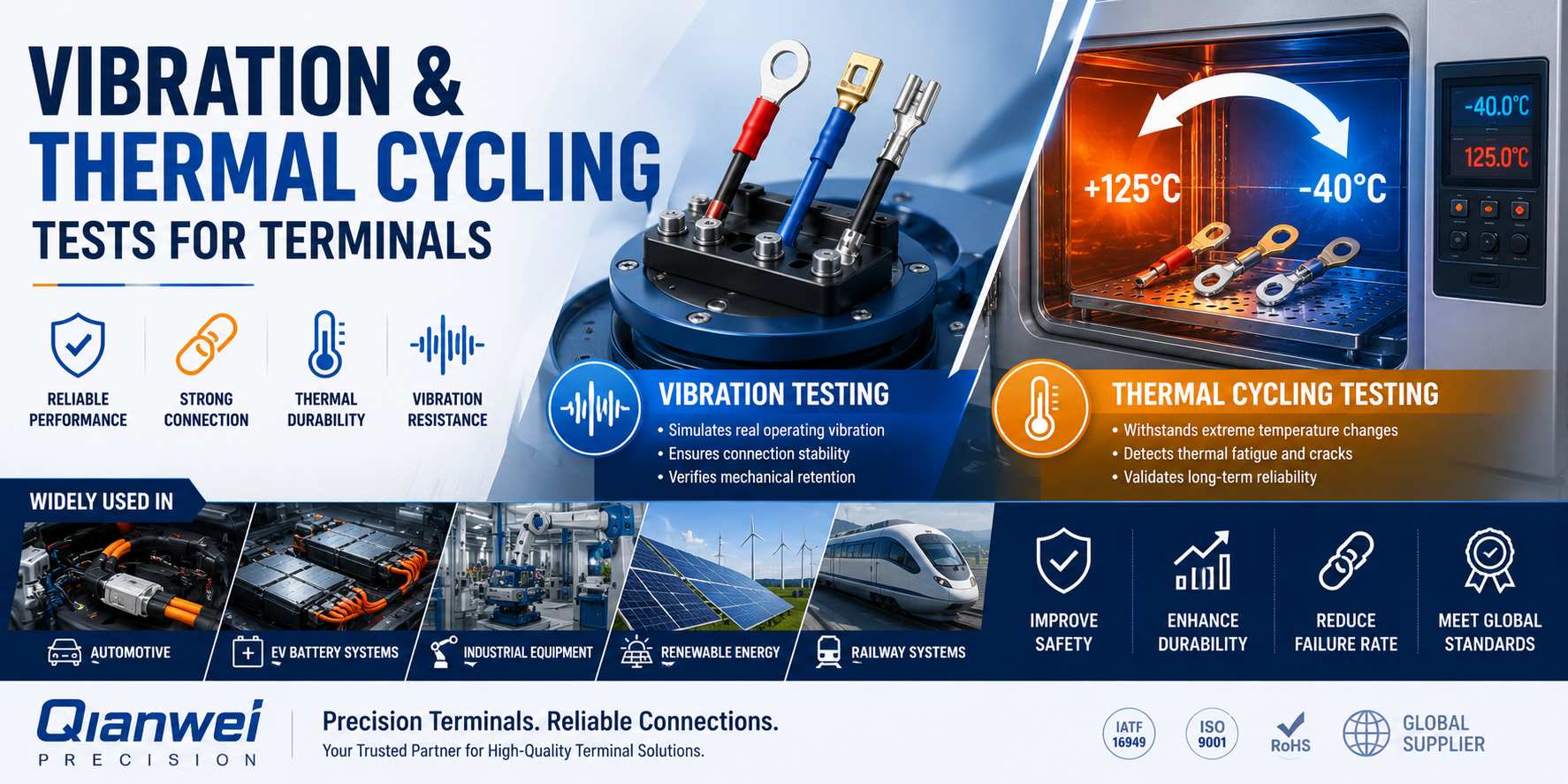
To ensure long-term reliability, manufacturers perform environmental durability tests before products enter mass production. Among these tests, vibration testing and thermal cycling testing are two of the most important reliability validation methods.
This article explains how these tests work, why they matter, and how they help improve terminal performance.
Why Reliability Testing Is Important for Electrical Terminals
Electrical terminals often work in environments that involve constant movement and temperature changes.
For example:
Automotive terminals experience:
- Vehicle vibration
- Road shock
- Engine heat
- Seasonal temperature changes
Industrial terminals may face:
- Machine vibration
- Continuous operation
- Thermal stress
Outdoor systems such as solar installations experience:
- Day-night temperature fluctuations
- Humidity
- UV exposure
Without proper validation, these conditions may reduce reliability over time.
Reliability testing helps manufacturers:
- Verify product durability
- Prevent field failures
- Improve electrical safety
- Meet automotive standards
- Increase customer confidence
What Is Vibration Testing for Electrical Terminals?
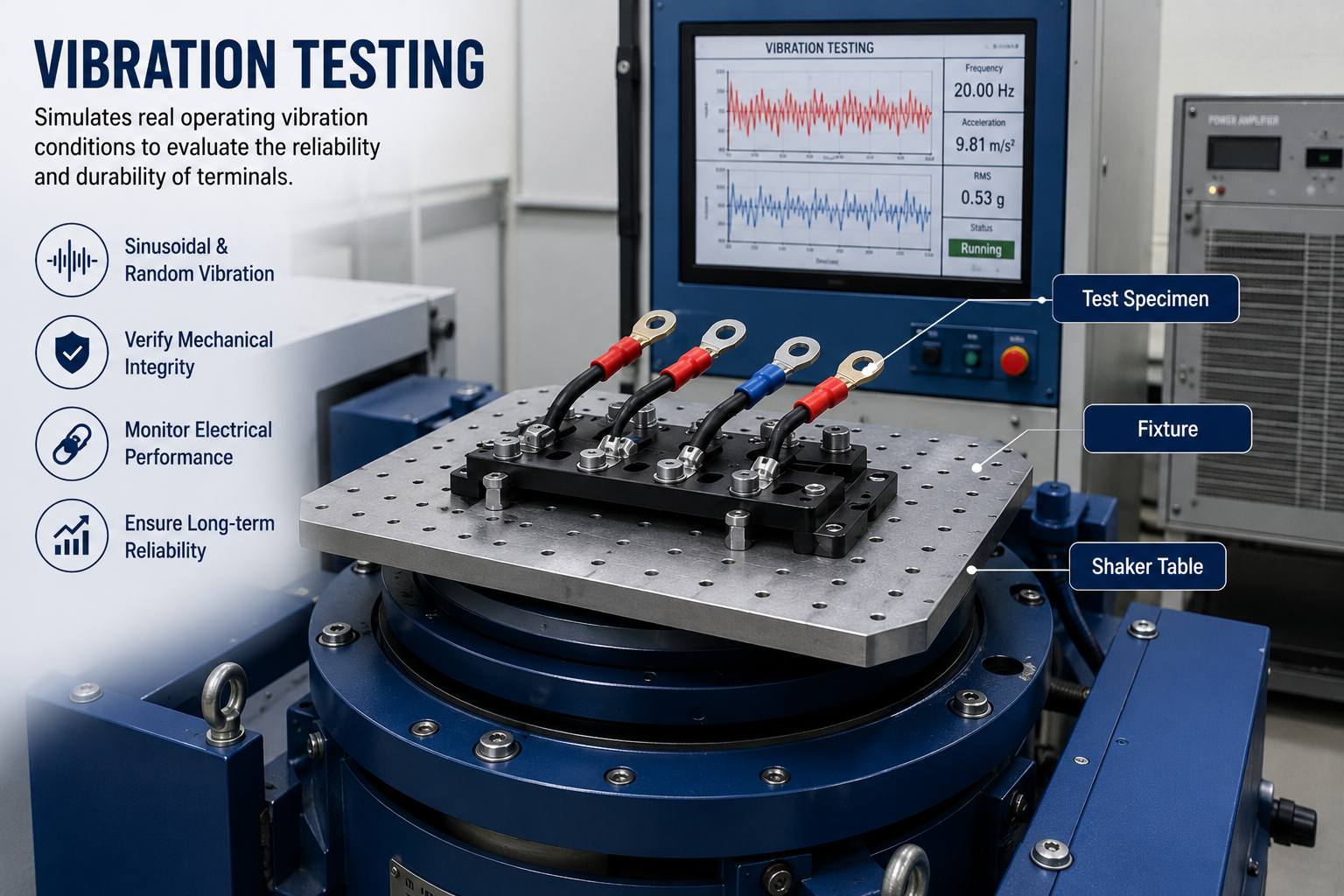
Vibration testing evaluates how terminals perform under repeated mechanical movement.
The test simulates actual operating environments where terminals experience vibration over long periods.
Common examples include:
- Vehicles driving on uneven roads
- Industrial machinery operation
- Railway equipment movement
- Wind-induced vibration in renewable energy systems
The goal is to verify whether the terminal can maintain:
- Stable contact force
- Mechanical retention
- Electrical conductivity
- Structural integrity
after prolonged vibration exposure.
Why Vibration Testing Is Necessary
Even small vibrations can affect electrical connections over time.
Repeated vibration may gradually loosen connections and reduce reliability.
Automotive Applications
Vehicles continuously generate vibration from:
- Engines
- Road conditions
- Braking
- Acceleration
Automotive terminals must withstand these conditions throughout the vehicle lifespan.
Industrial Equipment
Industrial machines often operate continuously.
Constant motion can gradually affect:
- Connector retention
- Crimp stability
- Terminal positioning
Railway Systems
Rail transportation subjects terminals to strong mechanical stress and vibration.
High reliability is essential for safe operation.
Renewable Energy Equipment
Wind turbines and outdoor power systems experience continuous movement and environmental stress.
Reliability testing helps ensure long service life.
Common Failure Modes Caused by Vibration
Several problems may appear during vibration testing.
Terminal Loosening
Repeated movement may reduce contact force.
This can create unstable electrical connections.
Contact Wear
Mechanical movement between surfaces may cause wear.
This may increase contact resistance.
Increased Resistance
Poor contact stability can reduce conductivity efficiency.
Higher resistance often leads to heat generation.
Wire Fatigue
Vibration may repeatedly bend conductors.
Over time, this may cause wire damage.
Crimp Damage
Weak crimp structures may lose retention strength after vibration exposure.
Types of Vibration Tests for Terminals
Different testing methods simulate different environments.
Sinusoidal Vibration Test
Sinusoidal testing applies vibration at fixed frequencies.
The purpose is to identify:
- Resonance points
- Mechanical weaknesses
- Structural instability
Manufacturers gradually change frequencies during testing.
Random Vibration Test
Random vibration testing better represents real operating conditions.
Instead of fixed frequencies, vibration occurs randomly across multiple directions.
Applications include:
- Automotive validation
- EV systems
- Transportation equipment
This method closely simulates real road conditions.
Mechanical Shock Testing
Mechanical shock testing evaluates sudden impacts.
Examples include:
- Vehicle collisions
- Equipment dropping
- Transportation shocks
The test verifies structural resistance.
Typical Vibration Test Procedure
Although parameters vary by industry, vibration testing usually follows similar steps.
Step 1: Sample Preparation
Terminals are assembled with wires and connectors.
Step 2: Installation
Samples are mounted onto vibration fixtures.
The setup must simulate actual installation conditions.
Step 3: Parameter Setup
Typical parameters include:
- Frequency range
- Acceleration level
- Test duration
- Axis direction
Step 4: Electrical Monitoring
During testing, engineers monitor:
- Contact resistance
- Signal continuity
- Electrical stability
Step 5: Final Inspection
After testing, manufacturers inspect:
- Surface condition
- Crimp quality
- Deformation
- Mechanical retention
What Is Thermal Cycling Testing?
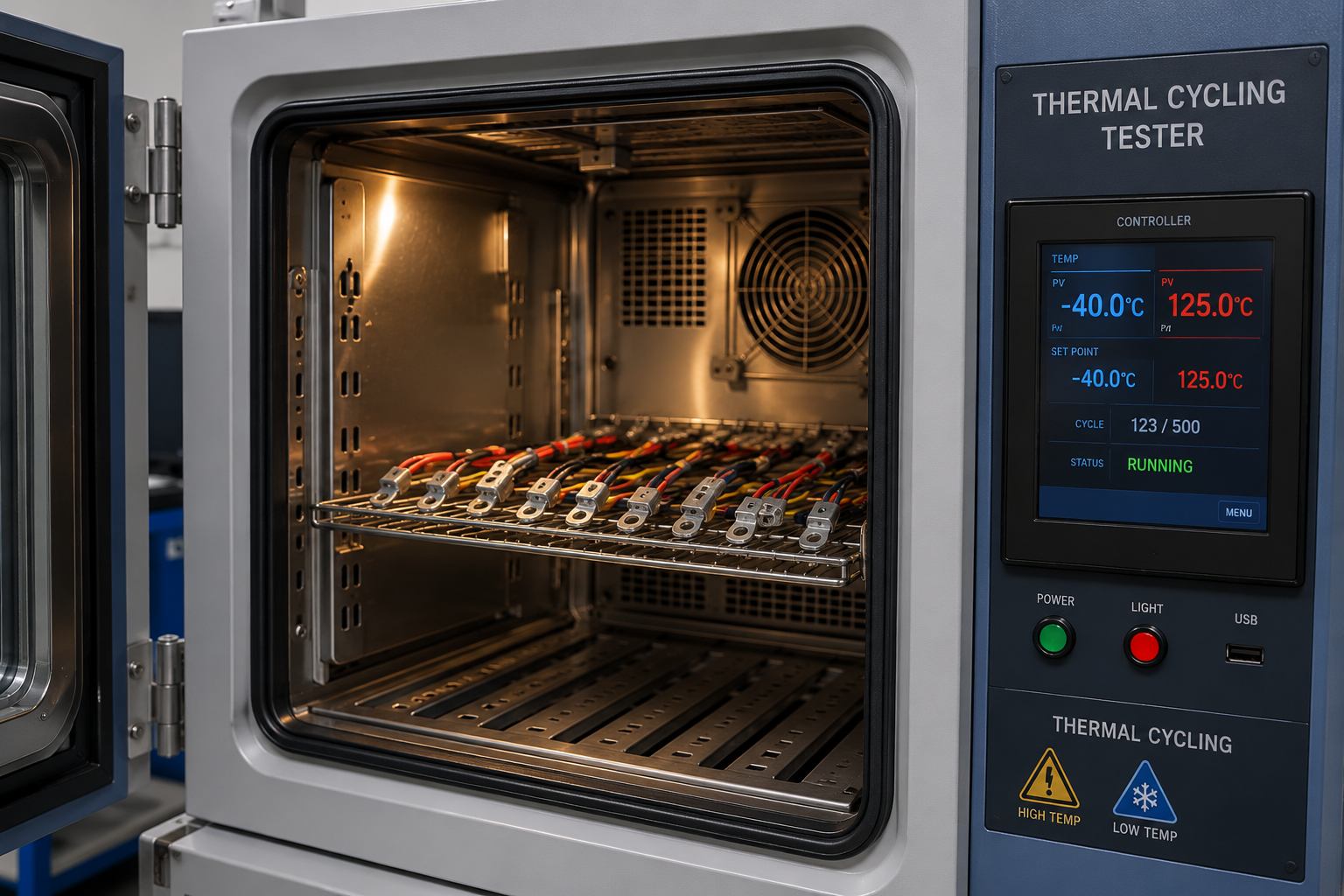
Thermal cycling testing evaluates terminal performance under repeated temperature changes.
The test repeatedly exposes terminals to alternating high and low temperatures.
Example:
-40°C → +125°C
This process simulates actual environmental conditions.
Applications include:
- Automotive engine compartments
- EV battery systems
- Outdoor equipment
- Renewable energy systems
Why Thermal Cycling Testing Is Important
Temperature changes create expansion and contraction inside materials.
Over time, repeated thermal stress may affect:
- Metal structures
- Crimp connections
- Contact surfaces
- Plating layers
Thermal cycling helps identify potential durability problems before field use.
Thermal Cycling Failure Mechanisms
Several issues may occur during repeated temperature changes.
Expansion and Contraction Stress
Metal components expand when heated and contract when cooled.
Repeated cycles create mechanical stress.
Crack Formation
Thermal fatigue may create small cracks in the material.
These cracks can grow over time.
Increased Contact Resistance
Repeated expansion may affect contact pressure.
Reduced pressure increases resistance.
Oxidation Risks
Temperature changes may accelerate oxidation in poor-quality surfaces.
Crimp Relaxation
Long-term thermal exposure may reduce crimp retention force.
Thermal Cycling Test Procedure
Step 1: Temperature Setup
Common ranges include:
-40°C to +125°C
Automotive products may require even wider ranges.
Step 2: Hold Time
Samples remain at each temperature for a specified duration.
This ensures complete thermal stabilization.
Step 3: Cycle Repetition
Typical cycle quantities include:
- 50 cycles
- 100 cycles
- 500 cycles
Longer testing provides better durability validation.
Step 4: Electrical Evaluation
Manufacturers inspect:
- Contact resistance
- Conductivity stability
- Mechanical integrity
Step 5: Final Inspection
After testing, samples are checked for:
- Cracks
- Oxidation
- Deformation
- Contact issues
Vibration vs Thermal Cycling Tests
Although both tests evaluate reliability, their focus differs.
| Item | Vibration Test | Thermal Cycling Test |
|---|---|---|
| Purpose | Mechanical durability | Thermal durability |
| Simulation | Movement | Temperature changes |
| Main Risk | Loosening | Fatigue |
| Typical Applications | Automotive | EV / Outdoor systems |
Most automotive projects require both tests.
Combined Environmental Testing
Modern validation increasingly combines multiple stress conditions.
Examples include:
Vibration + Thermal Cycling
Evaluates simultaneous thermal and mechanical stress.
Salt Spray + Thermal Cycling
Used for corrosion validation.
Temperature + Humidity Testing
Simulates outdoor environments.
Multi-Stress Reliability Testing
Provides more realistic validation.
Reliability Testing for Automotive Terminals
Automotive systems place extremely high demands on terminals.
Engine Compartment Conditions
Terminals near engines experience:
- Heat
- Oil exposure
- Vibration
- Temperature fluctuations
EV Battery Systems
Electric vehicles require long-term reliability.
Battery terminals experience:
- Current loads
- Thermal cycling
- Vibration
Vehicle Motion Environment
Road conditions continuously affect connectors and wiring systems.
Long-Life Requirements
Automotive terminals often require service life exceeding ten years.
Reliability testing helps verify performance.
Reliability Testing for Renewable Energy Systems
Solar and energy storage systems often operate outdoors for decades.
Terminals must resist:
- Seasonal temperature changes
- Humidity
- Environmental stress
Thermal cycling validation becomes essential.
Common Defects Found After Testing
Reliability tests often reveal hidden issues.
Common defects include:
Cracks
Thermal fatigue may create fractures.
Terminal Deformation
Mechanical stress may change geometry.
Increased Contact Resistance
Poor contact pressure affects conductivity.
Loose Connections
Vibration may reduce retention force.
Surface Oxidation
Environmental stress may damage plating.
How Manufacturers Improve Reliability
Manufacturers continuously optimize terminal design.
Methods include:
Better Material Selection
Higher-quality copper alloys improve durability.
Optimized Crimp Design
Improved geometry increases retention strength.
Better Plating Technology
Stable plating improves corrosion resistance.
Precision Manufacturing
Tight tolerances improve consistency.
Strict Reliability Testing
Comprehensive testing reduces field failures.
Why Choose Qianwei Precision
Qianwei Precision provides reliable terminal manufacturing solutions with advanced testing capability.
Our advantages include:
- Precision stamping technology
- Stable electroplating process
- Automotive manufacturing experience
- OEM & ODM support
- Strict quality control system
Testing Capabilities
Qianwei Precision supports:
- Vibration testing
- Thermal cycling testing
- Salt spray testing
- Pull-out force testing
- Conductivity testing
- Dimensional inspection
Product Applications
Our products are widely used in:
- Automotive terminals
- EV battery systems
- PCB terminals
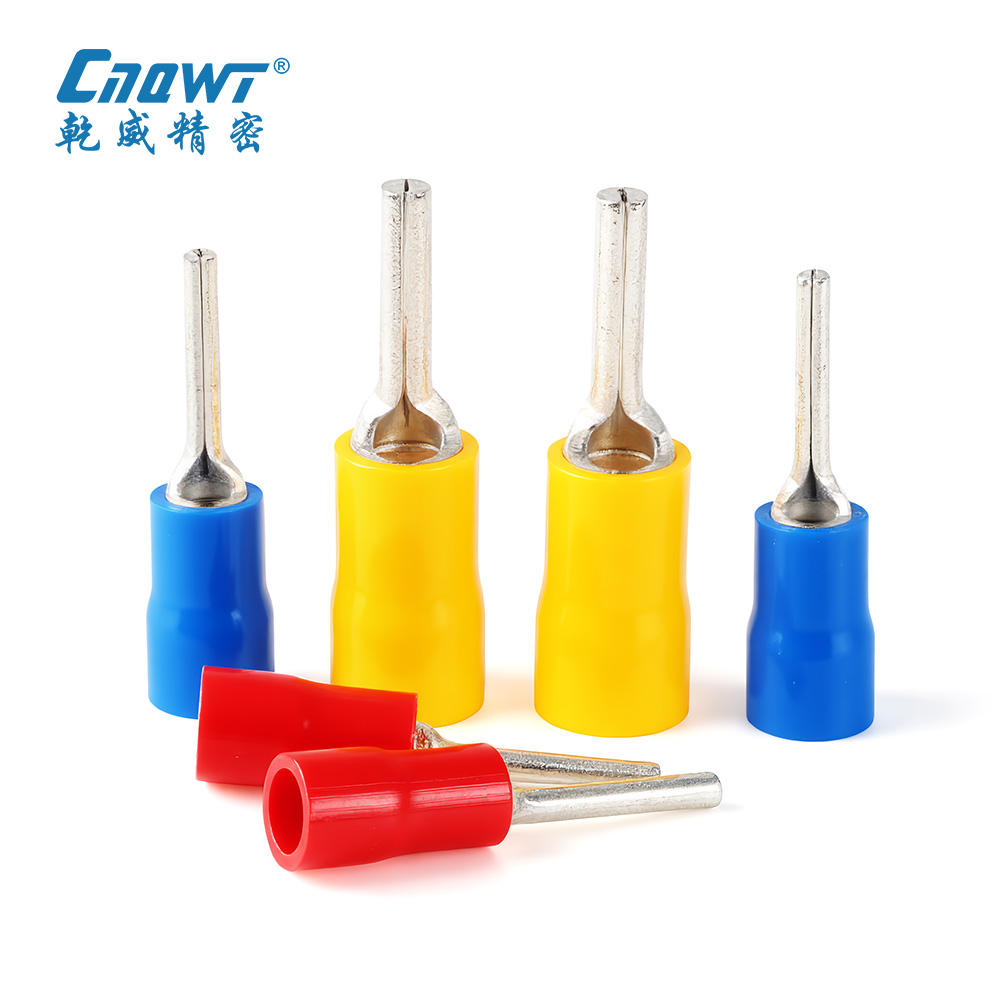
- Ring terminals
- Cable lugs
- Wiring harnesses
Conclusion
Vibration testing and thermal cycling testing are essential reliability validation methods for electrical terminals.
These tests help manufacturers identify:
- Mechanical weaknesses
- Thermal fatigue issues
- Contact instability
- Structural defects
As automotive, EV, and renewable energy systems continue evolving, reliability requirements are becoming increasingly strict.
Comprehensive testing significantly improves product safety, durability, and long-term performance.
Reliable electrical systems begin with reliable terminal validation.
Looking for Reliable Terminal Solutions?
Qianwei Precision provides high-quality terminal manufacturing with professional testing capability and OEM customization support.
Contact Qianwei Precision today for reliable electrical connection solutions.
FAQs
What is vibration testing for electrical terminals?
Vibration testing evaluates how electrical terminals perform under repeated mechanical movement and vibration conditions.
It helps verify:
- Contact stability
- Mechanical retention
- Crimp reliability
- Long-term durability
This test is commonly used in automotive, industrial, and transportation applications.
Why is thermal cycling testing important for terminals?
Thermal cycling testing evaluates terminal reliability under repeated temperature changes.
The test helps identify issues caused by:
- Thermal expansion and contraction
- Material fatigue
- Contact resistance changes
- Crimp relaxation
It is important for automotive, EV, and outdoor applications.
What causes terminal failure during vibration tests?
Common failure modes include:
- Terminal loosening
- Increased contact resistance
- Contact wear
- Wire fatigue
- Crimp damage
- Connector instability
These issues may gradually develop under continuous vibration.
How are vibration tests performed on terminals?
Typical vibration testing includes:
- Sample preparation
- Terminal installation
- Setting vibration parameters
- Electrical monitoring during testing
- Final inspection and evaluation
Manufacturers often monitor resistance and signal continuity throughout the test.
What temperature range is used in thermal cycling tests?
Common temperature ranges include:
-40°C to +125°C
Some automotive or EV applications may require wider temperature ranges depending on project requirements.
How many thermal cycles are typically required?
Typical thermal cycling tests may include:
- 50 cycles
- 100 cycles
- 500 cycles
The required number depends on customer standards and application environments.
Can vibration increase contact resistance?
Yes.
Continuous vibration may reduce contact force or create surface wear, which can increase contact resistance and affect conductivity performance.
Why do automotive terminals require vibration testing?
Automotive terminals operate under conditions such as:
- Engine vibration
- Road movement
- Braking impacts
- Temperature fluctuations
Vibration testing ensures long-term reliability throughout the vehicle lifecycle.
What defects can thermal cycling testing reveal?
Thermal cycling tests may reveal:
- Cracks
- Surface oxidation
- Crimp relaxation
- Contact instability
- Increased resistance
- Material fatigue
These defects may not be visible during normal inspection.
What standards apply to terminal reliability testing?
Common standards include:
- USCAR standards
- IEC standards
- ISO requirements
- Automotive OEM specifications
Different industries may use different validation requirements.
Are vibration and thermal cycling tests both necessary?
In many applications, yes.
Vibration testing evaluates mechanical durability, while thermal cycling evaluates thermal reliability.
Together they provide more complete validation for long-term terminal performance.
Which industries commonly use vibration and thermal cycling tests?
These tests are widely used in:
- Automotive wiring harnesses
- EV battery systems
- Industrial automation equipment
- Railway systems
- Renewable energy systems
- Outdoor electrical installations


One thought on “Vibration and Thermal Cycling Tests for Terminals”