

Introduction
Electrical connections are critical to the safety and performance of any electrical system. Whether in automotive wiring harnesses, industrial control cabinets, household appliances, renewable energy equipment, or PCB assemblies, selecting the proper connection method directly affects conductivity, reliability, maintenance efficiency, and installation costs.
Two commonly used connection solutions are butt connectors and terminal blocks.
Although both are designed to create electrical connections, they serve very different purposes and operate differently.
Choosing the wrong solution may lead to:
- Unstable conductivity
- Difficult maintenance
- Loose connections
- Increased installation costs
- Reduced reliability
This article compares butt connectors and terminal blocks in detail, including structure, installation, applications, advantages, disadvantages, and selection guidelines.
What Are Butt Connectors?
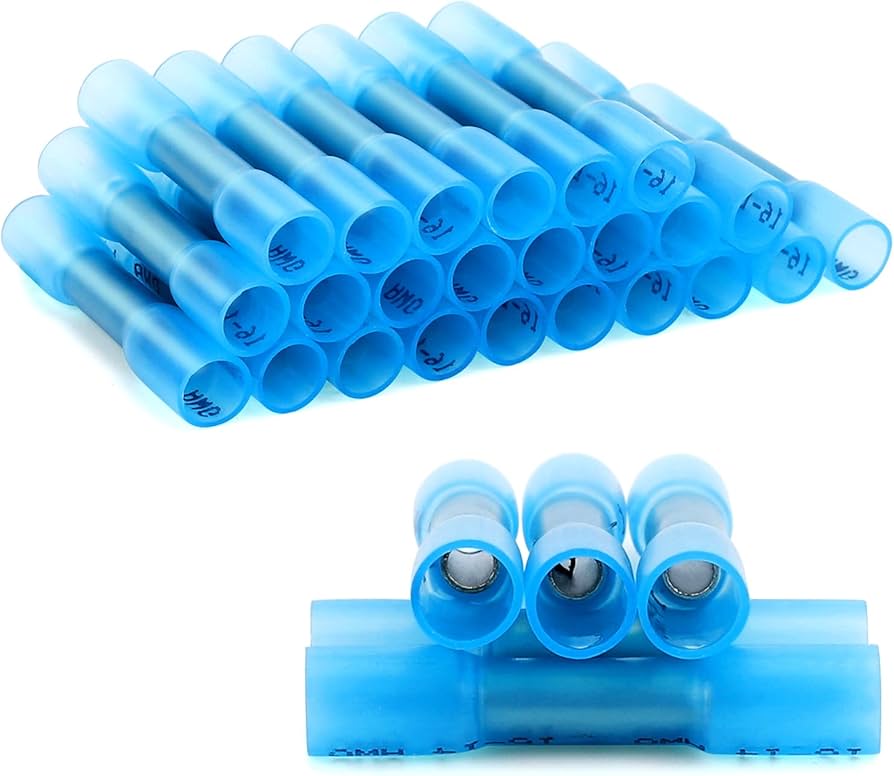
A butt connector is a crimp terminal used to join two wires end-to-end.
It usually consists of:
- Metal crimp barrel
- Insulation sleeve
- Optional heat shrink layer
After crimping, the wires become permanently connected.
Butt connectors are widely used in:
- Automotive wiring harnesses
- Marine systems
- Appliance wiring
- Cable repairs
- Outdoor electrical installations
Their compact design and strong vibration resistance make them popular in high-mobility environments.
How Butt Connectors Work
The installation process is relatively simple.
Wire Insertion
Both wire ends are stripped and inserted from opposite sides.
Crimp Compression
A crimping tool compresses the metal barrel.
The deformation creates both:
- Mechanical retention
- Electrical conductivity
Permanent Connection
Once crimped, the connection becomes permanent and generally cannot be reused.
Types of Butt Connectors
Different environments require different connector designs.
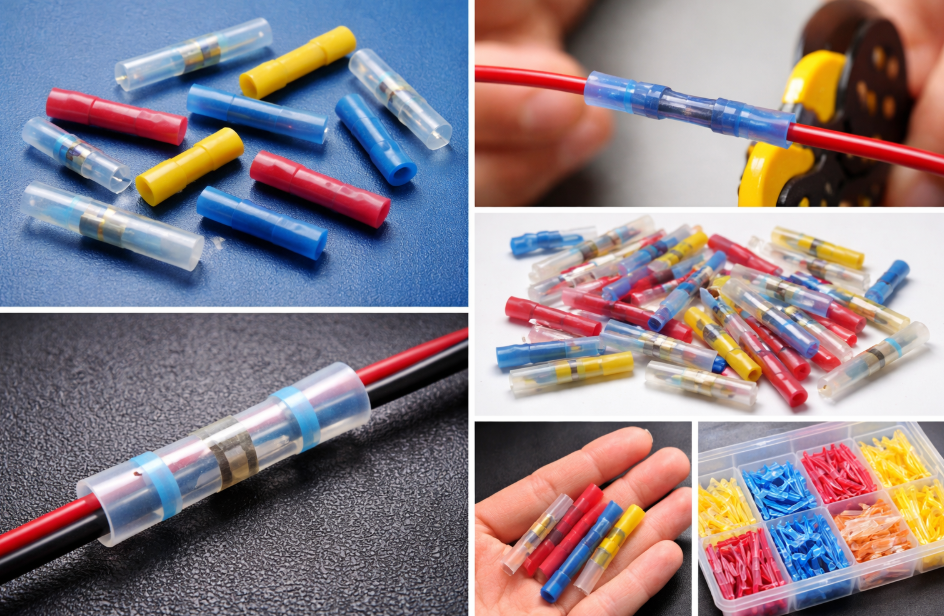
Non-Insulated Butt Connectors
These connectors consist only of the metal barrel.
Advantages:
- Lower cost
- Compact size
- Suitable for custom insulation systems
Common applications include industrial equipment.
Insulated Butt Connectors
An insulation sleeve surrounds the metal barrel.
Benefits include:
- Better electrical safety
- Easy color identification
- Simplified installation
Heat Shrink Butt Connectors
These connectors integrate heat shrink tubing.
Advantages:
- Waterproof protection
- Improved insulation
- Better corrosion resistance
Widely used in automotive and marine wiring.
Waterproof Butt Connectors
Designed for outdoor environments.
Common uses:
- Solar systems
- Marine equipment
- Outdoor lighting
- Renewable energy installations
What Are Terminal Blocks?
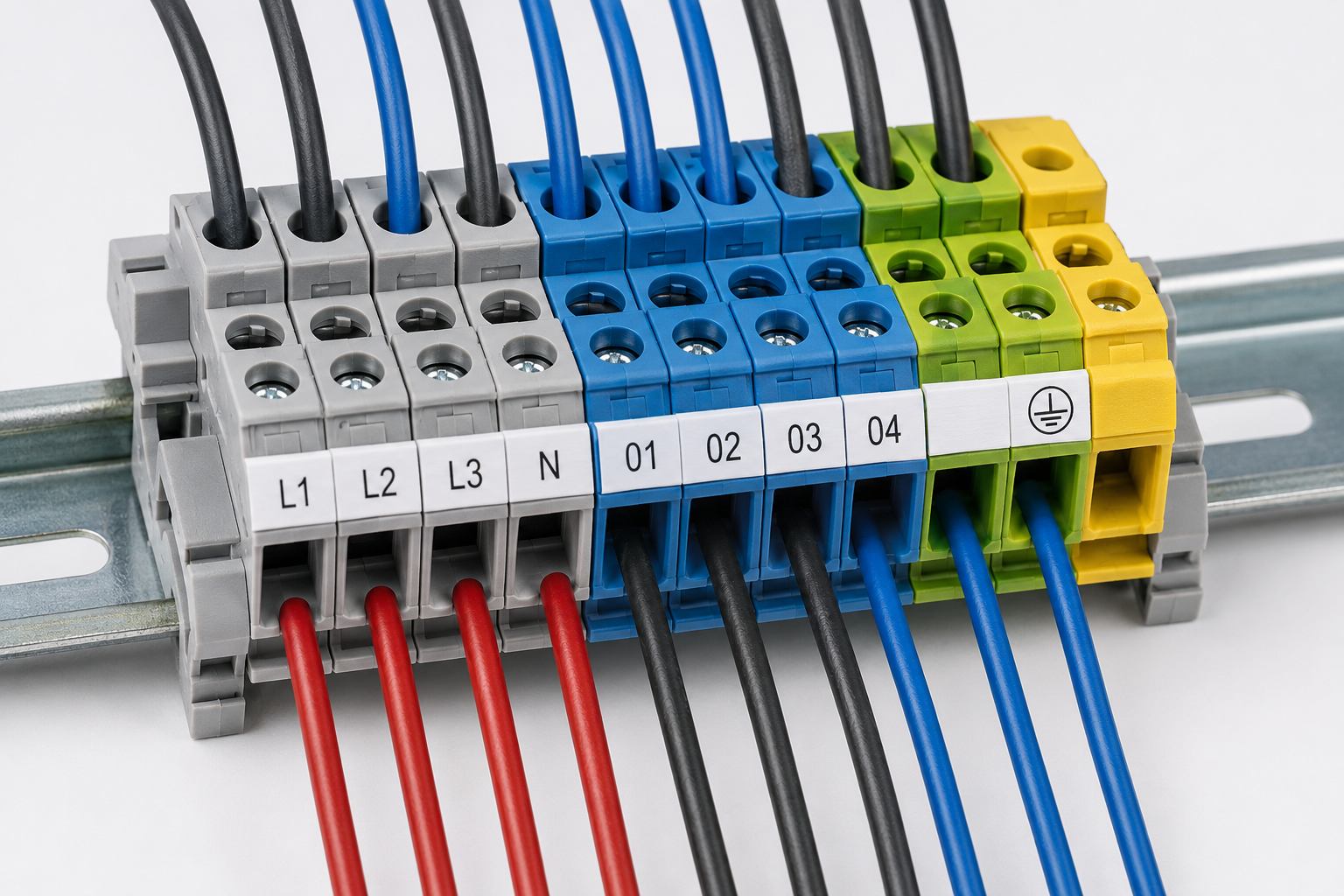
Terminal blocks are mechanical connection devices used to connect multiple wires.
Unlike butt connectors, terminal blocks are designed for removable and serviceable wiring systems.
They are commonly found in:
- Control cabinets
- Distribution panels
- Industrial equipment
- Automation systems
- PCB assemblies
Terminal blocks simplify wiring organization and maintenance.
How Terminal Blocks Work
Terminal blocks secure wires mechanically.
Common connection methods include:
Screw Connection
A screw compresses the conductor.
Advantages:
- High retention force
- Stable connection
Spring Clamp Connection
Spring pressure secures the wire.
Benefits:
- Fast installation
- Reduced maintenance
Push-In Technology
Wires are inserted directly.
Advantages:
- Tool-free installation
- High assembly efficiency
Types of Terminal Blocks
Screw Terminal Blocks
The most common design.
Suitable for:
- Industrial control systems
- Power distribution equipment
Spring Terminal Blocks
Use spring force instead of screws.
Advantages:
- Faster installation
- Better vibration resistance
DIN Rail Terminal Blocks
Mounted on DIN rails.
Widely used in:
- Automation cabinets
- Industrial equipment
Barrier Terminal Blocks
Provide separation between terminals.
Often used in high-current systems.
PCB Terminal Blocks
Designed for printed circuit board applications.
Common in electronics and control modules.
Butt Connectors vs Terminal Blocks: Structural Differences
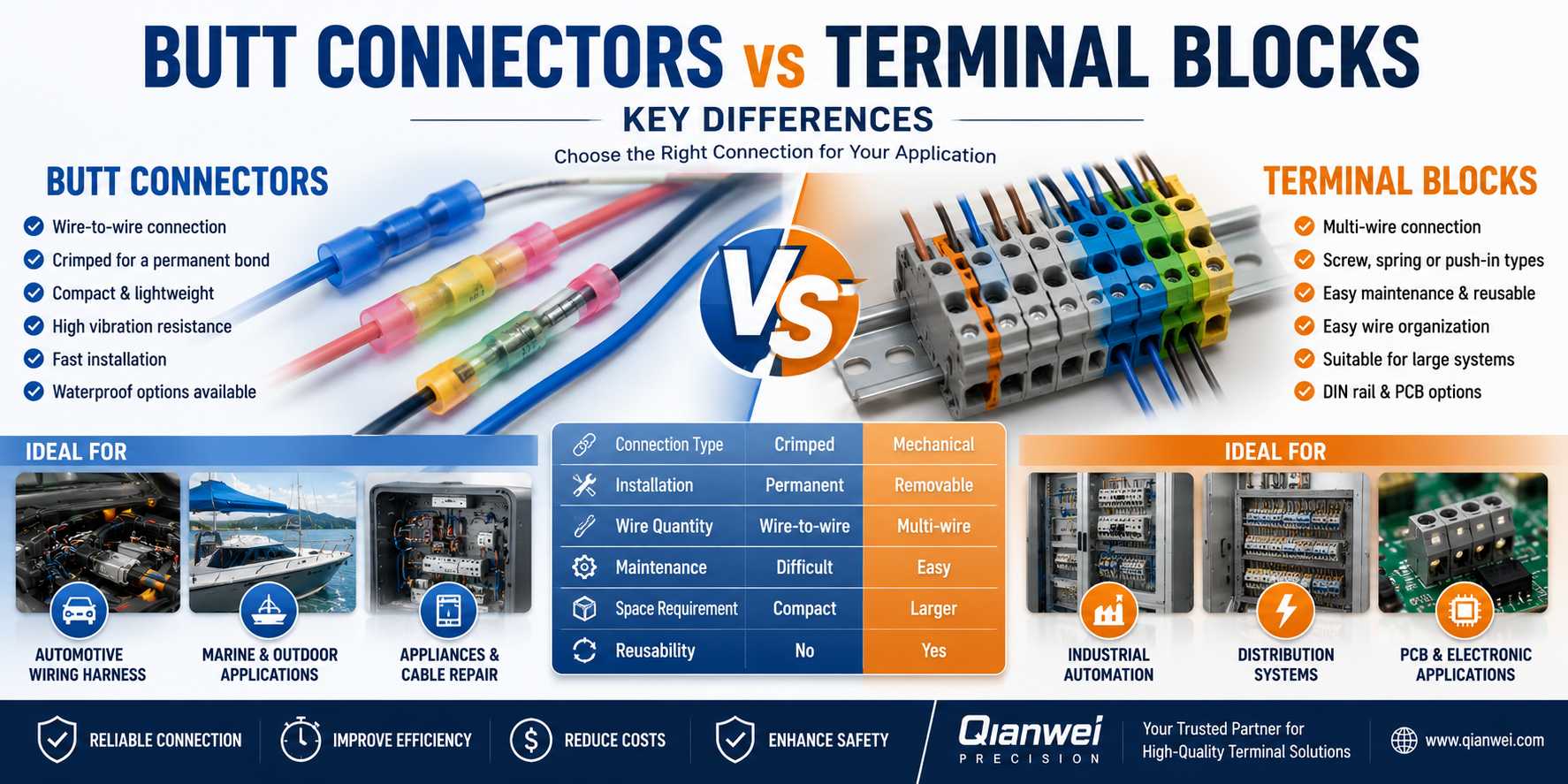
| Feature | Butt Connectors | Terminal Blocks |
|---|---|---|
| Connection Type | Crimped | Mechanical |
| Installation | Permanent | Removable |
| Wire Quantity | Wire-to-wire | Multi-wire |
| Maintenance | Difficult | Easy |
| Space Requirement | Compact | Larger |
| Reusability | No | Yes |
The structural difference largely determines their applications.
Installation Differences
The installation process also differs significantly.
Butt Connector Installation
Step 1: Strip Wire Ends
Remove insulation.
Step 2: Insert Conductors
Insert wires from opposite sides.
Step 3: Crimp Compression
Apply force using a crimp tool.
Step 4: Inspection
Verify retention strength and conductivity.
Installation is fast and suitable for mass production.
Terminal Block Installation
Step 1: Prepare Wire
Strip insulation.
Step 2: Insert Wire
Position wire inside the terminal.
Step 3: Tighten or Lock
Use screw, spring, or push mechanism.
Step 4: Verify Connection
Inspect retention and continuity.
Terminal blocks usually require more installation time.
Advantages of Butt Connectors
Compact Design
Butt connectors occupy minimal space.
This is critical for:
- Automotive wiring harnesses
- Compact electronics
- Dense cable assemblies
Fast Installation
Crimping provides quick assembly.
Ideal for high-volume production.
Lower Cost
Compared with terminal blocks, butt connectors usually cost less.
Excellent Vibration Resistance
Crimped connections resist movement effectively.
This makes butt connectors highly suitable for:
- Vehicles
- Railway equipment
- Machinery
Waterproof Options Available
Heat shrink and sealed versions provide excellent environmental protection.
Advantages of Terminal Blocks
Easy Maintenance
Terminal blocks can be disconnected and reused.
Maintenance becomes much easier.
Flexible Wiring Modifications
Wiring changes do not require cutting wires.
Better Wire Organization
Terminal blocks simplify multi-wire systems.
Reusable Design
Unlike butt connectors, terminal blocks can be reused repeatedly.
Suitable for Large Systems
Complex electrical cabinets benefit greatly from terminal blocks.
Disadvantages of Butt Connectors
Although effective, butt connectors have limitations.
Non-Reusable Structure
After crimping, disassembly is difficult.
Maintenance Difficulty
Repairs often require cutting and replacement.
Permanent Connection
Not ideal for systems requiring frequent modification.
Disadvantages of Terminal Blocks
Larger Installation Space
Terminal blocks require more room.
This may limit use in compact systems.
Higher Cost
Initial investment is usually higher.
Possible Screw Loosening
Traditional screw terminals may loosen under vibration.
Regular inspection may be necessary.
Butt Connector Applications
Automotive Wiring Harnesses
Automotive systems prefer butt connectors because they offer:
- Compact size
- Vibration resistance
- Lightweight structure
Marine Wiring
Heat shrink butt connectors provide waterproof sealing.
Appliance Wiring
Household devices commonly use crimp connections.
Cable Repair
Butt connectors provide fast cable restoration.
Outdoor Electrical Systems
Waterproof designs support harsh environments.
Terminal Block Applications
Industrial Automation
Control cabinets rely heavily on terminal blocks.
Distribution Systems
Power panels require organized wiring distribution.
Renewable Energy Equipment
Solar and energy storage systems often use terminal blocks.
PCB Assemblies
PCB terminal blocks simplify board connections.
Which Is Better for Automotive Wiring?
In automotive applications, butt connectors are generally preferred.
Reasons include:
- Compact size
- Strong vibration resistance
- Permanent connection
- Lightweight design
- Fast assembly
Modern wiring harnesses require dense packaging and high reliability.
Crimp connectors fit these needs perfectly.
Terminal blocks are occasionally used in auxiliary vehicle systems but are less common.
Which Is Better for Industrial Equipment?
Industrial systems often favor terminal blocks.
Advantages include:
- Easy maintenance
- Wire organization
- Reconfiguration capability
- Large system support
Complex control cabinets benefit significantly from removable connections.
Butt Connectors vs Terminal Blocks for Outdoor Use
Outdoor environments create additional challenges.
These include:
- Moisture
- UV exposure
- Corrosion
- Temperature changes
Waterproof butt connectors perform very well in harsh environments.
Terminal blocks may require protective enclosures.
Conductivity Comparison
Both solutions provide good conductivity when installed correctly.
However:
Butt connectors usually provide lower contact resistance due to direct crimp compression.
Terminal blocks offer flexibility but may require maintenance.
Reliability Comparison
Vibration Resistance
Winner: Butt connectors
Crimped structures resist movement better.
Maintenance Efficiency
Winner: Terminal blocks
Reusable connections simplify service.
Thermal Performance
Both perform well when properly selected.
Cost Comparison
| Factor | Butt Connectors | Terminal Blocks |
|---|---|---|
| Initial Cost | Lower | Higher |
| Installation Speed | Faster | Moderate |
| Maintenance | Difficult | Easy |
| Reusability | No | Yes |
How to Choose Between Butt Connectors and Terminal Blocks
Choose butt connectors if you need:
- Permanent connections
- Automotive applications
- High vibration resistance
- Compact installation
Choose terminal blocks if you need:
- Easy maintenance
- Frequent modifications
- Multi-wire systems
- Industrial installations
Application requirements determine the best option.
Common Selection Mistakes
Avoid these mistakes:
Ignoring Environment Conditions
Outdoor systems require waterproof protection.
Overlooking Maintenance Needs
Permanent connections may complicate service.
Wrong Current Rating Selection
Current capacity must match requirements.
Ignoring Space Limitations
Large terminal blocks may not fit compact assemblies.
Why Choose Qianwei Precision
Qianwei Precision specializes in electrical terminals and wiring solutions.
Our strengths include:
- Precision terminal manufacturing
- Automotive wiring experience
- OEM & ODM support
- Stable quality control
- Customized solutions
Product Applications
We support:
- Butt connectors
- Ring terminals
- PCB terminals
- Wiring harnesses
- Automotive connectors
- Cable assemblies
Conclusion
Butt connectors and terminal blocks serve different purposes.
Butt connectors excel in:
- Compact installations
- Automotive systems
- High vibration environments
- Permanent wiring
Terminal blocks perform better in:
- Industrial equipment
- Control systems
- Maintainable installations
- Multi-wire distribution
Neither is universally better.
The best choice depends on:
- Environment
- Maintenance requirements
- Space limitations
- Reliability targets
Choosing the right connection method improves safety, performance, and long-term reliability.
Looking for Reliable Terminal Solutions?
Qianwei Precision provides professional electrical terminals and custom wiring solutions for automotive and industrial applications.
Contact Qianwei Precision today for customized terminal solutions and engineering support.
FAQs
What is the main difference between butt connectors and terminal blocks?
The main difference is the connection method.
Butt connectors create a permanent crimped wire-to-wire connection, while terminal blocks provide removable mechanical connections for multiple wires.
Are butt connectors better for automotive wiring?
Yes, in many automotive applications butt connectors are preferred because they offer:
- Compact size
- Strong vibration resistance
- Lightweight design
- Fast installation
- Permanent connections
They are widely used in automotive wiring harnesses.
Can terminal blocks replace butt connectors?
Not always.
Terminal blocks are suitable for systems requiring maintenance and wire modifications, while butt connectors are better for permanent compact installations.
The choice depends on application requirements.
Which connection method is more reliable?
Both can be reliable when properly selected and installed.
- Butt connectors perform better in vibration environments
- Terminal blocks provide easier maintenance and serviceability
Reliability depends on the operating environment.
Are butt connectors waterproof?
Standard butt connectors are not waterproof.
However, heat shrink butt connectors and adhesive-lined waterproof butt connectors provide excellent sealing against:
- Moisture
- Dust
- Corrosion
These are commonly used in marine and outdoor applications.
Are terminal blocks reusable?
Yes.
One major advantage of terminal blocks is reusability.
Wires can be disconnected and reinstalled multiple times, making maintenance easier.
Which option is better for industrial equipment?
Terminal blocks are usually preferred for industrial equipment because they provide:
- Easy maintenance
- Wire organization
- Expandability
- Reconfiguration flexibility
They are widely used in control cabinets and automation systems.
Do terminal blocks require maintenance?
Some terminal blocks do.
Traditional screw terminal blocks may require periodic inspection because vibration can gradually loosen screws.
Spring clamp designs usually require less maintenance.
Can butt connectors handle vibration?
Yes.
Crimped butt connectors provide excellent vibration resistance and are commonly used in:
- Vehicles
- Railway systems
- Industrial machinery
Their permanent structure helps maintain connection stability.
Which is more cost-effective: butt connectors or terminal blocks?
Generally:
- Butt connectors → lower initial cost and faster installation
- Terminal blocks → higher cost but easier maintenance and reuse
The total cost depends on the project lifecycle.
Can terminal blocks be used outdoors?
Yes, but protection is often required.
Outdoor terminal block installations may need:
- Waterproof enclosures
- UV protection
- Corrosion-resistant materials
For direct exposure environments, waterproof butt connectors are often preferred.
What applications commonly use butt connectors?
Typical applications include:
- Automotive wiring harnesses
- Appliance wiring
- Cable repairs
- Marine systems
- Outdoor electrical installations
- Renewable energy equipment

