

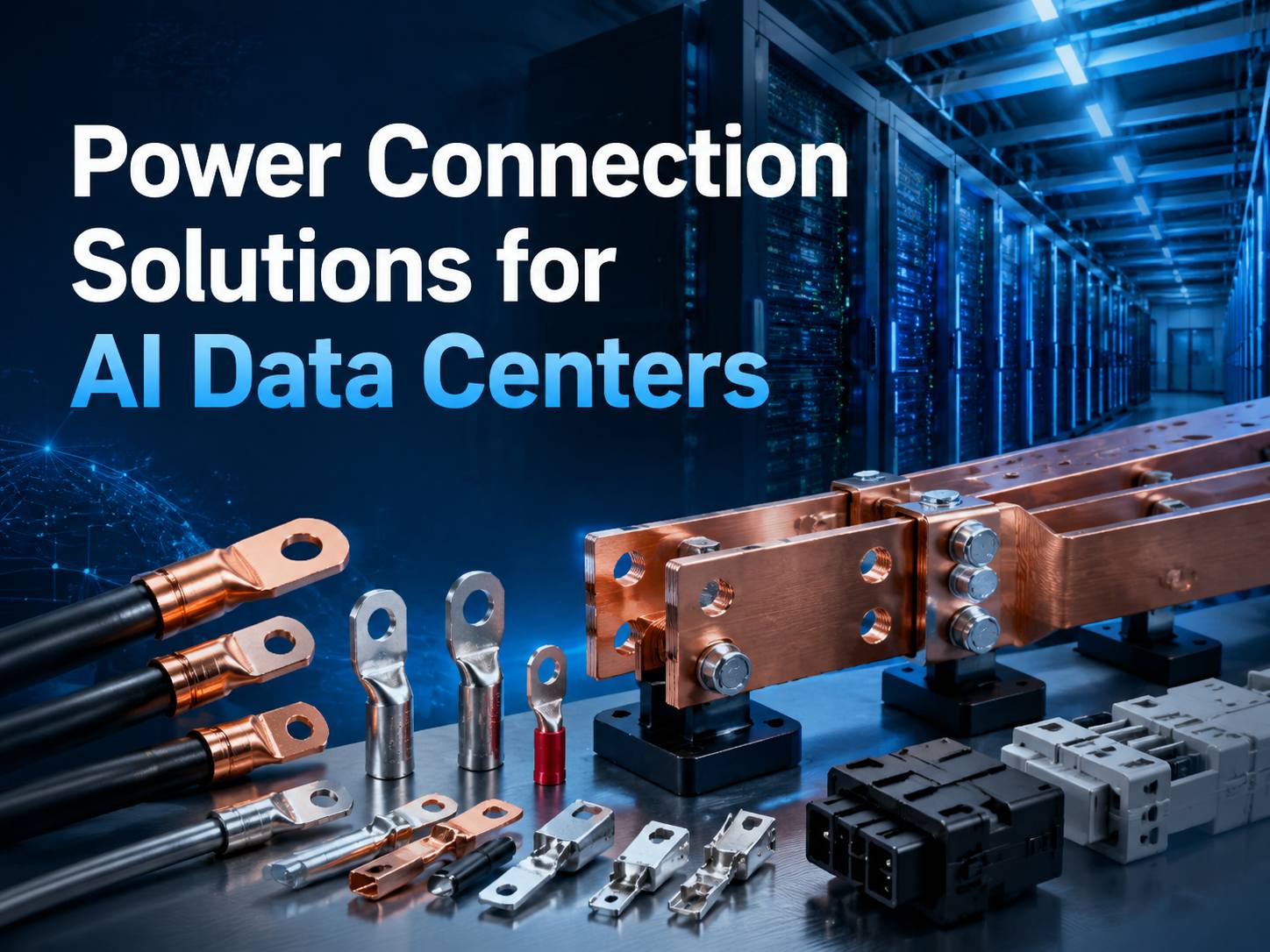
Artificial intelligence is transforming the way modern data centers are designed and operated. The rapid development of generative AI, large language models, and high-performance computing has created an unprecedented demand for computing power. As AI workloads become more complex, data centers are deploying larger GPU clusters, higher-density servers, and advanced cooling systems to support massive computational requirements.
However, increased computing performance also brings a significant challenge: dramatically higher power consumption.
Traditional data center power systems were originally designed for conventional enterprise servers with moderate power requirements. Today, AI servers equipped with multiple high-performance GPUs can consume several times more energy than traditional servers. A single AI server rack that previously required 10–20kW may now demand 60kW, 120kW, or even higher power levels.
This rapid increase in power density creates new requirements for electrical infrastructure. Power distribution systems must deliver higher current safely while maintaining low energy loss, efficient heat management, and long-term reliability.
At the center of this challenge are power connection solutions.
High-current electrical terminals, busbar systems, power connectors, and custom cable assemblies play a critical role in ensuring stable power delivery from the grid to AI computing equipment. Even a small increase in contact resistance can generate excessive heat, reduce energy efficiency, and create potential reliability risks in mission-critical AI facilities.
For AI data centers operating 24/7, power connection components are no longer simple electrical accessories. They have become essential infrastructure components that directly impact system uptime, operational efficiency, and scalability.
This article explores the key technologies, materials, design considerations, and manufacturing requirements behind advanced power connection solutions for AI data centers.
Why AI Data Centers Require Advanced Power Connection Solutions
AI Workloads Are Driving Unprecedented Power Demand
The growth of artificial intelligence has changed data center power requirements dramatically.
Traditional cloud computing mainly focuses on:
- Web hosting
- Database processing
- Enterprise applications
- General computing workloads
These applications usually operate with relatively predictable power consumption.
AI computing is different.
Training large language models and running AI inference workloads require massive parallel processing capabilities. Modern AI systems rely on thousands of GPUs working simultaneously, creating extremely high electrical loads.
For example:
- AI training clusters require continuous high-power operation for weeks or months.
- GPU servers consume significantly more power than conventional servers.
- Large-scale AI factories require dedicated power infrastructure.
As AI adoption continues, data center operators must redesign electrical systems around higher power density rather than simply adding more servers.
Higher Power Density Means Higher Current Requirements
Power consumption growth directly increases current requirements.
The relationship between power and current means that higher electrical loads require stronger connection systems capable of handling increased current safely.
Modern AI data centers are moving toward:
- High-current AC distribution
- 48V DC power architecture
- 400V DC power systems
- 800V DC future architectures
These systems require electrical connection components capable of supporting hundreds or even thousands of amperes.
Typical applications include:
| Application | Current Requirement |
|---|---|
| Server power modules | 50A–200A |
| Rack power distribution | 200A–600A |
| Battery backup systems | 500A+ |
| High-power busbar systems | 1000A+ |
When current density increases, traditional connectors and terminals may experience:
- Excessive heat generation
- Higher contact resistance
- Material degradation
- Reduced service life
Therefore, AI data centers require specially engineered high-current connection solutions.
Why Power Connection Reliability Matters in AI Infrastructure
AI data centers operate under extremely demanding conditions.
Unlike ordinary commercial facilities, downtime can result in:
- Lost computing capacity
- Interrupted AI training processes
- Increased operational costs
- Reduced service availability
A small electrical failure inside a power connection system can potentially affect an entire server rack or computing cluster.
Critical reliability factors include:
Low Contact Resistance
Electrical resistance at connection points directly affects energy loss and heat generation.
High-quality terminals and connectors must maintain stable contact resistance throughout their service life.
Thermal Management
As current increases, heat becomes one of the biggest challenges.
Poorly designed connections may cause:
- Hot spots
- Connector overheating
- Insulation damage
- Premature failure
Optimized terminal geometry, suitable materials, and proper plating help improve thermal performance.
Mechanical Stability
Power connections must withstand:
- Equipment vibration
- Thermal expansion
- Installation stress
- Long-term operation
Reliable mechanical retention ensures that electrical performance remains stable over time.
Understanding AI Data Center Power Architecture
A modern AI data center requires a complete power delivery chain from the utility grid to individual GPU servers.
The typical power architecture includes several stages.
Utility Grid Input
The power journey begins with electricity supplied from the utility network.
Large AI data centers require:
- High-voltage power input
- Stable energy supply
- Redundant power sources
Because AI workloads require continuous operation, many facilities integrate multiple power sources to improve reliability.
UPS Systems
Uninterruptible Power Supply (UPS) systems provide backup power protection.
UPS systems help:
- Prevent sudden shutdowns
- Stabilize voltage fluctuations
- Support continuous operation during power interruptions
High-current terminals and busbar connections inside UPS systems must handle significant electrical loads while maintaining safety and reliability.
Switchgear Systems
Switchgear controls and protects electrical distribution.
Key components include:
- Circuit breakers
- Protection devices
- Distribution panels
- Busbar assemblies
High-performance terminals are essential for secure connections within switchgear cabinets.
Power Distribution Units (PDUs)
PDUs distribute electrical power from central systems to server racks.
Modern AI data center PDUs require:
- Higher current capacity
- Compact design
- Efficient heat dissipation
- Reliable connectors
Rack-Level Power Distribution
At the rack level, electrical connections become even more critical.
AI racks contain:
- Multiple GPUs
- Power supply units
- Cooling systems
- Networking equipment
High-current connectors and terminals must deliver stable power while fitting into increasingly compact spaces.
Key Power Connection Components in AI Data Centers
The power infrastructure of an AI data center depends on multiple electrical connection components working together. Each component must provide stable conductivity, mechanical reliability, and long-term durability under high-current operating conditions.
The most important power connection components include:
- High-current electrical terminals
- Copper busbar systems
- High-power connectors
- Custom cable assemblies
These components form the foundation of reliable power delivery for AI computing infrastructure.
High-Current Electrical Terminals for AI Data Centers
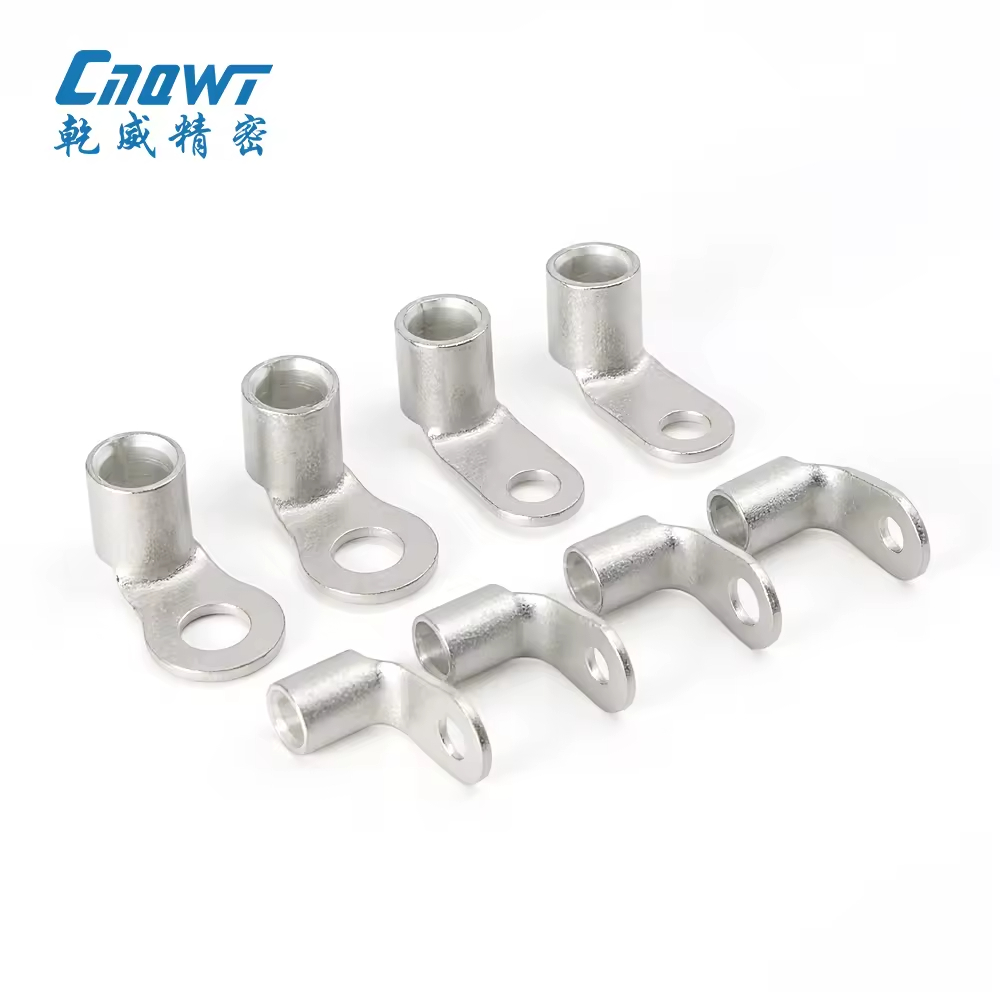
Electrical terminals are critical connection points that transfer power between cables, busbars, switches, batteries, and power modules.
In AI data center applications, terminals must handle significantly higher electrical loads compared with traditional industrial equipment.
Common terminal types include:
Ring Terminals
Ring terminals are widely used in high-current power connections because they provide:
- Secure mechanical fastening
- Large contact areas
- Stable electrical performance
Applications include:
- Battery backup systems
- UPS connections
- Power distribution cabinets
Crimp Terminals
Crimp terminals create reliable electrical connections by mechanically compressing the terminal onto the conductor.
Advantages include:
- Low contact resistance
- High mechanical strength
- Fast automated assembly
- Consistent quality
For AI infrastructure, precision crimping is especially important because poor crimp quality can increase resistance and create heat accumulation.
Busbar Terminals
Busbar terminals connect high-current distribution systems with electrical equipment.
They are commonly used in:
- Power distribution units
- Switchgear systems
- Battery energy storage systems
- High-power server infrastructure
A well-designed busbar terminal provides:
- High current capacity
- Excellent thermal performance
- Compact installation
- Long service life
Copper Busbar Connection Solutions
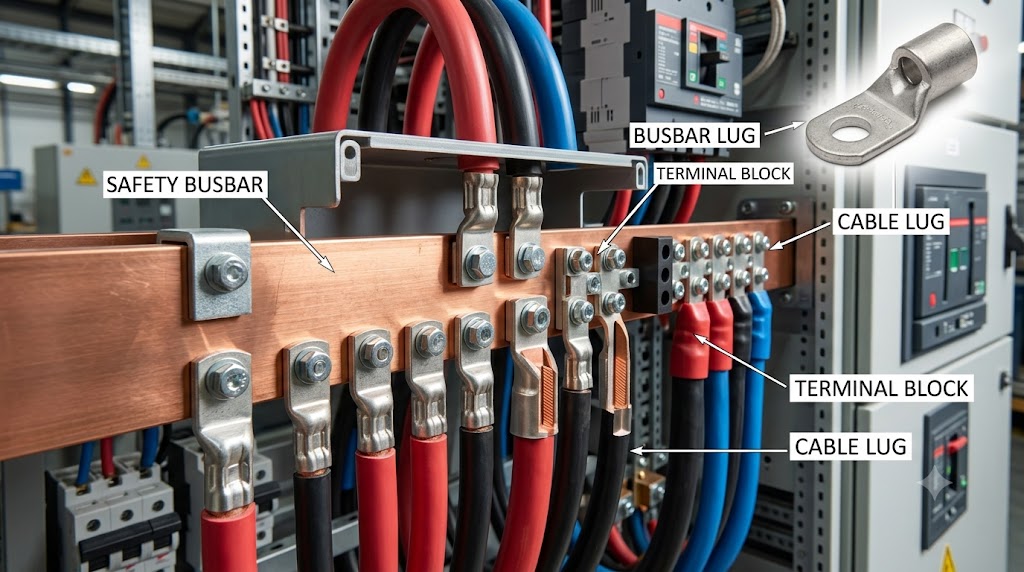
As AI rack power requirements continue increasing, copper busbar systems are becoming increasingly important in modern data centers.
Traditional cable-based power distribution may become inefficient when dealing with extremely high current levels.
Busbars provide a more efficient solution.
Advantages of Copper Busbars
Excellent Electrical Conductivity
Copper has one of the highest electrical conductivity levels among industrial metals.
Benefits include:
- Lower electrical resistance
- Reduced energy loss
- Improved power efficiency
Superior Heat Dissipation
High-current applications generate significant heat.
Copper busbars provide:
- Large conductive surfaces
- Efficient thermal transfer
- Better temperature management
This helps prevent overheating in high-density AI environments.
Space Optimization
AI data centers require maximum computing density.
Compared with multiple large power cables, busbar systems offer:
- Smaller installation footprint
- Cleaner cabinet layouts
- Easier maintenance
Higher Reliability
Busbar systems reduce potential failure points by minimizing:
- Cable joints
- Connection complexity
- Installation errors
This makes them ideal for mission-critical AI facilities.
High-Power Connectors for AI Server Systems
AI servers require specialized connectors capable of handling high current while maintaining compact designs.
Unlike traditional data center connectors, AI power connectors must support:
- Higher current density
- More frequent maintenance cycles
- Higher operating temperatures
- Increased mechanical stress
Blind-Mate Power Connectors
Blind-mate connectors allow technicians to install or replace server modules without precise alignment.
Advantages:
- Faster maintenance
- Reduced installation time
- Lower operational downtime
They are widely used in:
- AI server racks
- Modular computing systems
- High-density GPU platforms
Modular Power Connectors
Modular connectors provide flexible system design.
Benefits:
- Scalable power architecture
- Easy upgrades
- Simplified maintenance
As AI computing requirements continue growing, modular designs allow data centers to expand capacity without completely rebuilding power systems.
Custom Cable Assemblies for AI Power Applications
Although busbars are becoming more common, cable assemblies remain essential in many AI data center applications.
Custom cable assemblies provide flexibility for complex layouts.
Typical applications include:
- Power supply connections
- Battery systems
- Rack-level distribution
- Equipment integration
Requirements for AI Data Center Cable Assemblies
High-performance cable assemblies require:
Large Conductor Size
Higher current requires larger conductor cross-sections to reduce resistance and heat generation.
High-Temperature Insulation
Materials must withstand:
- Continuous operation
- Thermal cycling
- High ambient temperatures
Secure Terminal Connections
Cable performance depends heavily on terminal quality.
Poor connection points may cause:
- Increased resistance
- Power loss
- Local overheating
Major Challenges in AI Data Center Power Connections
As AI infrastructure becomes more powerful, electrical connection systems face several technical challenges.
Heat Generation Management
Heat is one of the biggest challenges in high-current power systems.
The higher the current passing through a connection, the more heat is generated due to electrical resistance.
Poor connection design can lead to:
- Hot spots
- Terminal discoloration
- Material degradation
- Reduced equipment lifetime
How to Reduce Heat in Power Connections
Engineers use several approaches:
Increase Contact Area
A larger contact surface reduces current concentration.
Improve Material Selection
High-conductivity copper alloys help reduce electrical losses.
Optimize Plating Technology
Proper plating improves:
- Contact stability
- Corrosion resistance
- Long-term conductivity
Improve Thermal Design
Design factors include:
- Terminal geometry
- Heat dissipation paths
- Airflow considerations
Contact Resistance Control
Contact resistance is a critical parameter in AI power connection systems.
Even a small increase in resistance can create significant heat when hundreds of amperes flow continuously.
For example:
A connection operating at high current with poor contact quality may experience:
- Increased power loss
- Higher temperature rise
- Accelerated aging
Therefore, high-quality terminals require:
- Precise stamping dimensions
- Stable contact force
- Smooth surface finishing
- Reliable plating
High Current Density Challenges
AI data centers are moving toward higher power density designs.
This creates challenges such as:
Limited Installation Space
More power must be delivered within smaller rack spaces.
Higher Thermal Stress
Components operate closer to their thermal limits.
More Complex Power Distribution
Engineers must balance:
- Current capacity
- Size limitations
- Cooling requirements
- Safety standards
Mechanical Reliability Requirements
Electrical connections must remain stable throughout the equipment lifecycle.
Important factors include:
Retention Force
Terminals must maintain secure mechanical contact.
Vibration Resistance
AI data centers contain:
- Cooling fans
- Pumps
- Mechanical equipment
These can create vibration that affects connections over time.
Mating Cycle Performance
Connectors used in modular AI systems require high durability.
Typical requirements include:
- Hundreds or thousands of mating cycles
- Stable electrical performance after repeated use
Continuous 24/7 Operation Requirements
AI data centers cannot tolerate frequent maintenance or unexpected failures.
Power connection components must provide:
- Long service life
- Stable conductivity
- Corrosion resistance
- Predictable performance
This makes precision manufacturing and strict quality control essential.
Materials Used in AI Data Center Power Connections
Material selection plays a critical role in the performance and reliability of power connection systems.
For AI data centers, electrical connection components must achieve a balance between:
- High electrical conductivity
- Mechanical strength
- Thermal performance
- Corrosion resistance
- Long-term reliability
The most commonly used materials include copper, copper alloys, and specialized surface plating technologies.
Copper: The Preferred Material for High-Current Applications
Copper is the most widely used conductor material in power connection systems because of its excellent electrical performance.
Advantages of Copper
Excellent Electrical Conductivity
Copper provides:
- Low electrical resistance
- Efficient current transmission
- Reduced energy loss
This makes copper ideal for:
- Busbars
- Power terminals
- High-current connectors
- Battery connections
Superior Thermal Performance
High-current AI data center systems generate significant heat.
Copper helps manage thermal challenges through:
- Fast heat transfer
- Efficient heat dissipation
- Stable operating temperature
This improves system reliability and reduces the risk of overheating.
Long-Term Reliability
Copper maintains stable performance over long operating periods.
It is suitable for:
- 24/7 data center operation
- High-load environments
- Mission-critical power systems
Copper Alloys for Electrical Terminals
Although pure copper offers excellent conductivity, copper alloys are often preferred for precision terminal manufacturing because they provide improved mechanical performance.
Common copper alloy materials include:
- Phosphor bronze
- Brass
- Copper-nickel alloys
- High-strength copper alloys
Advantages of Copper Alloys
Higher Mechanical Strength
Copper alloys provide:
- Better stamping performance
- Improved terminal durability
- Higher resistance to deformation
This is especially important for connectors requiring stable contact force.
Better Spring Performance
Many electrical terminals rely on elastic deformation to maintain contact pressure.
Copper alloys provide:
- Stable spring force
- Long contact life
- Reliable mating performance
Better Manufacturing Capability
Copper alloys are suitable for:
- Precision stamping
- Progressive die manufacturing
- Automated terminal production
This enables consistent dimensions and high-volume production.
Surface Plating Technologies for AI Power Connections
Surface plating significantly affects the electrical and mechanical performance of terminals and connectors.
The right plating solution improves:
- Contact reliability
- Corrosion resistance
- Wear resistance
- Electrical stability
Tin Plating
Tin plating is one of the most common choices for electrical terminals.
Advantages:
- Good conductivity
- Cost-effective
- Excellent solderability
- Suitable for high-volume applications
Typical applications:
- Power terminals
- Cable connectors
- Industrial electrical connections
Nickel Plating
Nickel plating provides excellent protection against corrosion and oxidation.
Benefits include:
- High temperature resistance
- Improved surface hardness
- Better environmental durability
Applications:
- Industrial power systems
- Harsh environment connectors
- High-temperature applications
Silver Plating
Silver plating is often selected for high-current applications.
Advantages:
- Extremely low contact resistance
- Excellent electrical conductivity
- Superior performance under high current
Common applications:
- High-power connectors
- Switchgear contacts
- Energy storage systems
Gold Plating
Gold plating provides excellent corrosion resistance.
Advantages:
- Stable electrical performance
- Oxidation resistance
- Long contact life
However, due to higher cost, it is usually used for:
- Precision signal connectors
- Aerospace applications
- High-reliability electronic systems
Comparing Busbar and Cable Connections for AI Data Centers
As AI computing power continues increasing, engineers must select the most suitable power distribution method.
Both cables and busbars have advantages depending on application requirements.
| Feature | Busbar System | Cable System |
|---|---|---|
| Current Capacity | Very High | High |
| Space Efficiency | Excellent | Moderate |
| Installation | Simple modular installation | More flexible routing |
| Heat Management | Excellent | Depends on cable design |
| Maintenance | Easier | More complex |
| Scalability | Excellent | Moderate |
| Weight | Lower for high current | Higher at large sizes |
Why AI Data Centers Prefer Busbar Solutions
For extremely high-density computing environments, busbars provide several advantages.
Compact Power Distribution
AI racks require maximum space utilization.
Busbars allow:
- Smaller installation footprint
- Cleaner cabinet design
- Better equipment organization
Improved Thermal Performance
Compared with large cable bundles, busbars offer:
- Better heat dissipation
- Lower temperature rise
- More predictable thermal behavior
Higher Reliability
Busbar systems reduce:
- Cable connections
- Installation errors
- Potential failure points
This improves long-term operational stability.
Power Connection Solutions for Liquid-Cooled AI Data Centers
The rapid growth of AI computing has introduced new cooling technologies.
Traditional air cooling is becoming insufficient for high-density AI systems.
Many advanced AI data centers are adopting:
- Direct-to-chip liquid cooling
- Immersion cooling
- Rear-door heat exchangers
These technologies improve thermal management but also create new requirements for electrical connections.
Challenges in Liquid-Cooled AI Power Systems
Higher Environmental Requirements
Liquid cooling environments may involve:
- Higher humidity
- Condensation risks
- Cooling fluid exposure
Power connection components must provide:
- Corrosion resistance
- Sealing protection
- Environmental durability
Thermal Cycling
AI systems frequently experience temperature changes during:
- Startup
- Shutdown
- Load changes
Repeated thermal cycling can affect:
- Contact stability
- Material expansion
- Mechanical retention
Therefore, connector materials and designs must withstand long-term thermal stress.
IP-Rated Power Connectors
For demanding environments, sealed connectors may be required.
Important protection features include:
- Moisture resistance
- Dust protection
- Secure locking mechanisms
- Insulation protection
These features help maintain reliable operation in advanced cooling environments.
Designing High-Reliability Power Connections for AI Infrastructure
Engineering design determines the final performance of power connection systems.
Several critical factors must be considered.
Current Rating Design
The first consideration is selecting the correct current capacity.
Engineers must evaluate:
- Maximum operating current
- Continuous load conditions
- Temperature rise limits
- Safety margins
Oversized designs increase cost and space requirements, while undersized designs create reliability risks.
Temperature Rise Control
Temperature rise is one of the most important parameters for high-current connections.
Factors affecting temperature include:
- Contact resistance
- Material conductivity
- Terminal geometry
- Cooling conditions
- Current density
Proper design helps maintain stable operating temperatures.
Contact Force Optimization
Reliable electrical contact requires appropriate mechanical pressure.
Too little contact force may cause:
- Increased resistance
- Electrical instability
- Heat generation
Too much force may cause:
- Excessive wear
- Difficult assembly
Precision terminal design balances electrical and mechanical performance.
Creepage and Clearance Requirements
High-power electrical systems must maintain proper insulation distances.
Design considerations include:
- Operating voltage
- Environmental conditions
- Safety requirements
Proper creepage and clearance design prevents:
- Electrical arcing
- Insulation failure
- Safety hazards
EMI Considerations
Although AI data centers mainly focus on power delivery, electromagnetic compatibility remains important.
Good connection design helps reduce:
- Electrical noise
- Electromagnetic interference
- System instability
Quality Testing for AI Data Center Power Components
For AI data centers, power connection failures can result in significant operational losses. Therefore, every terminal, connector, and busbar component must undergo strict testing before deployment.
High-quality manufacturers use comprehensive testing processes to verify:
- Electrical performance
- Mechanical reliability
- Material quality
- Environmental durability
- Long-term operating stability
These tests ensure that power connection components can withstand the demanding conditions of modern AI infrastructure.
Electrical Performance Testing
Electrical testing is essential for evaluating the reliability of high-current connection components.
Contact Resistance Testing
Contact resistance directly affects:
- Energy efficiency
- Heat generation
- Long-term reliability
Low contact resistance helps:
- Reduce power loss
- Minimize temperature rise
- Improve system efficiency
Precision terminals must maintain stable resistance values throughout their service life.
Current Carrying Capacity Testing
High-current terminals and connectors must be tested under realistic operating conditions.
Testing evaluates:
- Maximum current capability
- Continuous current performance
- Thermal behavior
- Safety margins
This ensures components can safely support high-power AI server applications.
Temperature Rise Testing
Temperature rise testing measures how components perform under high electrical loads.
Key evaluation factors include:
- Terminal temperature
- Heat dissipation performance
- Material stability
- Connection reliability
Effective thermal control is critical for AI data centers where power density continues increasing.
Dielectric Strength Testing
High-voltage applications require insulation verification.
Testing confirms:
- Electrical isolation performance
- Safety under operating voltage
- Resistance against electrical breakdown
Mechanical Reliability Testing
Electrical performance alone is not enough. Power connections must also maintain mechanical integrity.
Pull Force Testing
Pull force testing evaluates:
- Terminal crimp strength
- Cable retention
- Mechanical stability
A strong mechanical connection helps prevent:
- Loose connections
- Increased resistance
- Unexpected failures
Mating Cycle Testing
AI data centers increasingly use modular equipment designs.
Connectors may need to support:
- Repeated installation
- Equipment replacement
- Maintenance operations
Mating cycle testing ensures stable performance after repeated connections.
Vibration Testing
Although data centers are controlled environments, equipment vibration can still occur from:
- Cooling fans
- Pumps
- Mechanical systems
Vibration testing verifies that terminals and connectors remain secure during long-term operation.
Environmental Testing
AI data center components must maintain performance under various environmental conditions.
Thermal Cycling Testing
Thermal cycling simulates repeated temperature changes.
It evaluates:
- Material expansion
- Contact stability
- Mechanical durability
Humidity Testing
High humidity environments can accelerate:
- Oxidation
- Corrosion
- Electrical degradation
Humidity testing ensures long-term reliability.
Salt Spray Testing
Salt spray testing evaluates corrosion resistance.
It is especially important for components used in:
- Industrial environments
- Coastal facilities
- Energy storage systems
Material and Manufacturing Quality Control
Advanced AI power connection components require precision manufacturing.
Important quality control processes include:
Dimensional Inspection
Ensures:
- Accurate terminal dimensions
- Consistent tolerances
- Proper assembly compatibility
Plating Thickness Inspection
Controls:
- Surface protection
- Contact performance
- Corrosion resistance
Metallographic Analysis
Examines:
- Material structure
- Stamping quality
- Potential defects
Industry Standards and Certifications for AI Power Connections
Global AI infrastructure requires suppliers to meet strict quality and safety standards.
Important certifications and standards include:
UL Certification
UL standards verify electrical safety performance.
Benefits:
- Improved product reliability
- Easier global acceptance
- Enhanced customer confidence
RoHS Compliance
RoHS ensures products limit hazardous substances.
It supports:
- Environmental responsibility
- Global market requirements
REACH Compliance
REACH evaluates chemical safety requirements.
It ensures materials meet international regulations.
ISO 9001 Quality Management System
ISO 9001 demonstrates controlled manufacturing processes.
It covers:
- Quality management
- Process control
- Continuous improvement
IATF 16949 Automotive Quality System
Although originally developed for automotive manufacturing, IATF 16949 represents a high standard for:
- Precision manufacturing
- Process stability
- Traceability
These capabilities are highly valuable for high-reliability electrical components.
Future Trends in AI Data Center Power Connection Solutions
The evolution of artificial intelligence will continue pushing power infrastructure toward higher performance levels.
Several major trends are shaping the future of AI data center power systems.
Higher Rack Power Density
Future AI racks will continue increasing power consumption.
Current rack power levels:
- 30kW
- 60kW
- 120kW
Future AI systems may require:
- 300kW+
- 500kW+
This will drive demand for:
- Larger busbars
- Higher-current terminals
- Advanced cooling solutions
- New power distribution architectures
Transition Toward 800V DC Power Systems
Traditional data centers mainly use AC distribution.
However, higher-density AI systems are driving interest in DC power architectures.
Advantages of higher-voltage DC systems include:
- Lower energy loss
- Higher efficiency
- Reduced current requirements
- Improved scalability
This transition will require new generations of:
- DC connectors
- High-voltage terminals
- Busbar systems
AI Factory Infrastructure
The future of AI is moving beyond individual data centers toward large-scale AI factories.
AI factories require:
- Massive computing clusters
- Dedicated energy infrastructure
- Advanced power management systems
Power connection solutions will become a key enabling technology.
Sustainable AI Power Systems
Energy efficiency is becoming increasingly important.
Future AI infrastructure will integrate:
- Renewable energy
- Battery energy storage systems
- Smart power monitoring
- Intelligent distribution systems
Reliable electrical connections will help improve:
- Energy efficiency
- System stability
- Operational sustainability
Why Choose Qianwei Precision for AI Data Center Power Connection Solutions?
As AI infrastructure continues evolving, selecting the right power connection manufacturer is critical.
Qianwei Precision provides customized electrical connection solutions designed for demanding industrial applications.
Professional Precision Terminal Manufacturing
With more than 10 years of manufacturing experience, Qianwei Precision specializes in:
- High-current electrical terminals
- Precision metal stamping
- Custom connectors
- Cable assembly solutions
Advanced Manufacturing Capability
Qianwei Precision operates multiple production capabilities, including:
- High-speed stamping workshop
- Injection molding workshop
- Mold manufacturing workshop
- Cable assembly production
This integrated manufacturing model allows better control over:
- Product quality
- Development speed
- Production consistency
Custom Design Capability
Every AI data center project has different power requirements.
Qianwei Precision supports customization including:
- Terminal structure design
- Material selection
- Surface plating
- Current rating optimization
- Packaging solutions
Strict Quality Control
Quality systems include:
- Dimensional inspection
- Electrical testing
- Mechanical testing
- Material verification
Certifications include:
- UL
- RoHS
- REACH
- ISO9001
- IATF16949
Reliable OEM/ODM Partner
Qianwei Precision supports global customers with:
- Engineering collaboration
- Rapid prototyping
- Mass production
- Stable supply capability
Whether you need high-current terminals, custom connectors, or precision power connection components, Qianwei Precision provides solutions designed for next-generation AI infrastructure.
Conclusion
The rapid development of artificial intelligence is transforming data center infrastructure. As GPU computing power increases, traditional electrical systems must evolve to support higher current levels, greater power density, and stricter reliability requirements.
Advanced power connection solutions—including high-current terminals, copper busbars, power connectors, and custom cable assemblies—are becoming essential components of modern AI data centers.
Reliable connections help ensure:
- Lower energy loss
- Better thermal performance
- Higher system uptime
- Long-term operational stability
For AI infrastructure developers, choosing an experienced precision manufacturer is critical. With strong engineering capabilities, advanced manufacturing processes, and strict quality control, Qianwei Precision provides customized power connection solutions to support the next generation of AI data centers.
Looking for reliable high-current terminals, busbar solutions, or custom power connectors for AI data center applications? Contact Qianwei Precision today to discuss your project requirements.
FAQs
What are power connection solutions for AI data centers?
Power connection solutions include electrical terminals, busbars, connectors, and cable assemblies designed to deliver reliable power to high-density AI computing systems.
Why do AI data centers need high-current terminals?
AI servers consume significantly more power than traditional servers. High-current terminals ensure stable electrical transmission while reducing heat generation and energy loss.
What is the difference between busbars and cables?
Busbars provide compact, high-current distribution with excellent thermal performance, while cables offer more flexible installation options.
Which materials are best for AI data center power connections?
Copper and copper alloys are commonly used because they provide excellent conductivity, mechanical strength, and long-term reliability.
How can connector overheating be prevented?
Overheating can be reduced through:
- Lower contact resistance
- Better materials
- Proper plating
- Optimized terminal design
- Effective thermal management
Can power terminals be customized for AI applications?
Yes. Manufacturers can customize:
- Terminal dimensions
- Current capacity
- Materials
- Plating
- Connection structures
based on specific AI infrastructure requirements.
What certifications should AI power connection suppliers have?
Important certifications include:
- UL
- RoHS
- REACH
- ISO9001
- IATF16949
These certifications demonstrate quality control and manufacturing reliability.

