

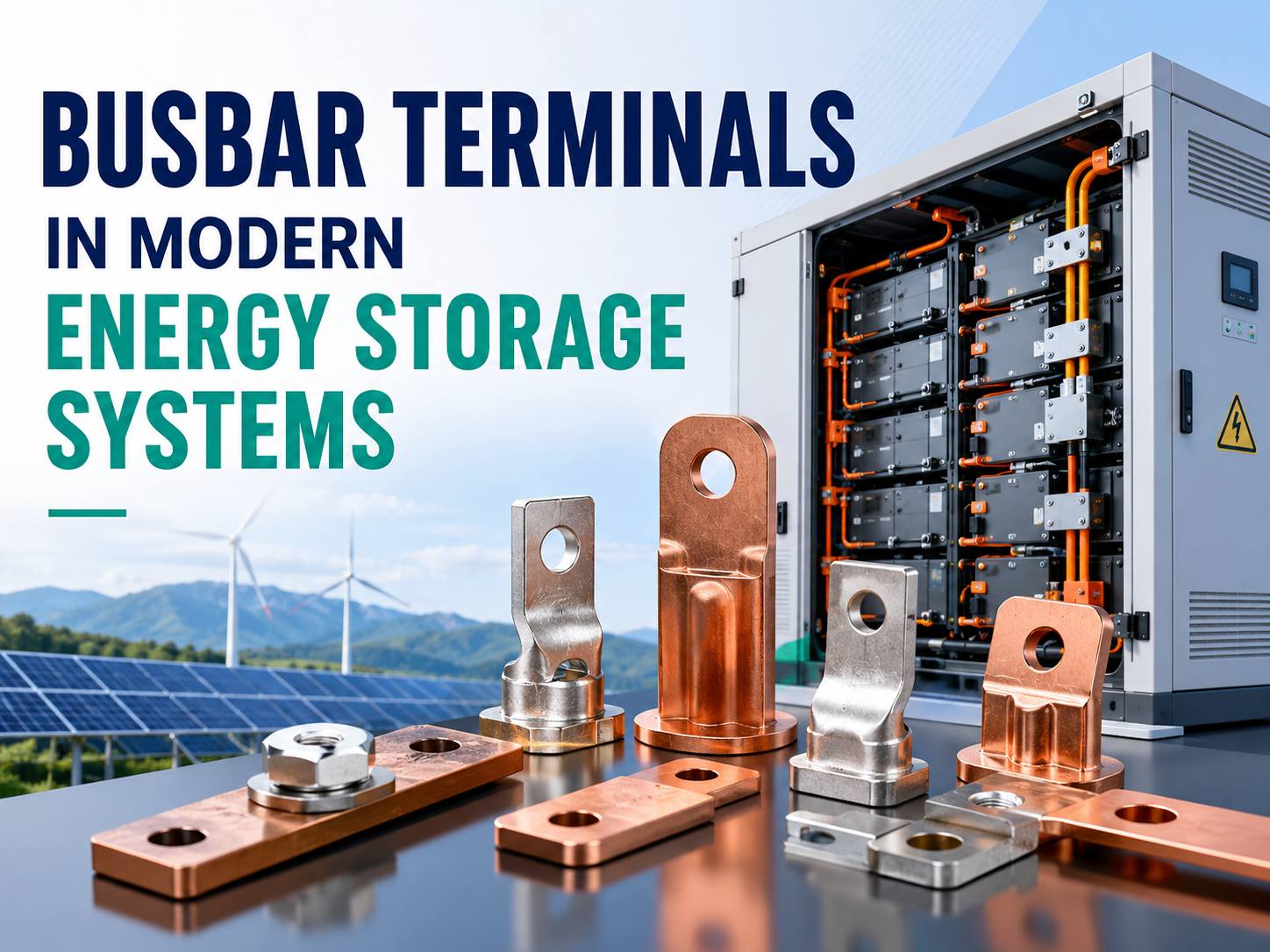
As the world accelerates its transition toward renewable energy, Battery Energy Storage Systems (BESS) have become one of the most important technologies supporting modern power infrastructure. Energy storage enables solar farms, wind power plants, microgrids, electric vehicle charging stations, and industrial facilities to store electricity when supply exceeds demand and release it when additional power is needed.
Unlike conventional electrical systems, modern energy storage installations must handle extremely high currents while maintaining outstanding efficiency, safety, and long-term reliability. Every battery module, inverter, power conversion system (PCS), and power distribution cabinet depends on stable electrical connections to transfer energy with minimal loss.
One component plays a particularly critical role in this process: the busbar terminal.
Although often overlooked, busbar terminals form the connection between busbars, battery modules, power equipment, and cables. They must safely conduct hundreds—or even thousands—of amperes continuously while resisting vibration, thermal cycling, corrosion, and mechanical stress. A poorly designed or improperly manufactured terminal can increase contact resistance, generate excessive heat, reduce system efficiency, and in severe cases lead to equipment failure or safety hazards.
As energy storage systems become larger and more power-dense, busbar terminals are evolving from simple connection hardware into highly engineered components that directly influence electrical performance, operational reliability, and maintenance costs.
In this guide, you’ll learn:
- What busbar terminals are and how they work
- Why they are essential in Battery Energy Storage Systems (BESS)
- Different types of busbar terminals
- Material selection and plating options
- Engineering design considerations
- Manufacturing and quality testing
- Common failure modes and prevention
- How to select the right busbar terminal supplier
Whether you are designing a utility-scale energy storage project, manufacturing battery systems, or sourcing electrical terminals for power distribution equipment, understanding busbar terminal technology is essential for building safer and more efficient electrical systems.
What Is a Busbar Terminal?
A busbar terminal is a high-current electrical connection component that joins a busbar to another conductive element, such as a battery cell, cable lug, power distribution unit, switchgear, inverter, or power conversion system.
Its primary function is to provide a secure, low-resistance electrical path capable of transferring large amounts of current while maintaining mechanical stability over years of operation.
Unlike conventional wire connectors, busbar terminals are specifically designed for high-power applications where electrical efficiency and thermal management are critical.
Modern busbar terminals are commonly manufactured from high-conductivity copper or copper alloys and are often protected with surface plating such as tin, silver, or nickel to improve corrosion resistance and maintain consistent electrical contact.
Busbar vs. Busbar Terminal vs. Busbar Connector
These three terms are often used interchangeably, but they describe different components within a power distribution system.
| Component | Function |
|---|---|
| Busbar | A solid conductor that distributes electrical power throughout the system. |
| Busbar Terminal | The connection point that joins the busbar to equipment, batteries, or cables. |
| Busbar Connector | A broader term referring to various devices used to connect busbars together or connect busbars to electrical equipment. |
Think of the busbar as the highway that carries electricity, while the busbar terminal is the interchange that allows power to flow safely between different electrical devices.
Main Components of a Busbar Terminal Assembly
A complete busbar terminal assembly typically includes several carefully engineered components working together.
Copper Busbar
The busbar serves as the primary conductor carrying electrical current throughout the energy storage system.
Because copper offers excellent electrical and thermal conductivity, it remains the preferred material for most high-current applications.
Terminal Contact Area
The contact interface is where electricity transfers between two conductive components.
This area must provide:
- Maximum contact surface
- Stable contact pressure
- Low electrical resistance
- Minimal heat generation
The quality of this interface directly influences the efficiency and reliability of the entire power system.
Fastening Hardware
Most busbar terminals use bolts, nuts, or specialized clamping mechanisms to maintain consistent mechanical pressure.
Proper fastening helps prevent:
- Loose connections
- Contact resistance increases
- Electrical arcing
- Vibration-induced failures
Torque specifications are carefully controlled during assembly to ensure reliable long-term performance.
Surface Plating
Protective plating improves both electrical and environmental performance.
Common surface treatments include:
- Tin plating
- Silver plating
- Nickel plating
The choice depends on operating current, environmental conditions, and expected service life.
How Busbar Terminals Work
Busbar terminals appear simple, but their performance depends on several engineering principles.
When electrical current flows through a busbar terminal, it passes across the contact interface between two conductive surfaces.
Ideally, electricity should encounter as little resistance as possible.
A well-designed terminal achieves this by combining:
- High-conductivity materials
- Large contact areas
- Uniform contact pressure
- Precision-machined surfaces
- Secure mechanical fastening
This combination minimizes electrical resistance, reduces voltage drop, and limits heat generation.
Because battery energy storage systems often operate continuously under high load, maintaining stable electrical contact is essential for maximizing efficiency and preventing premature failure.
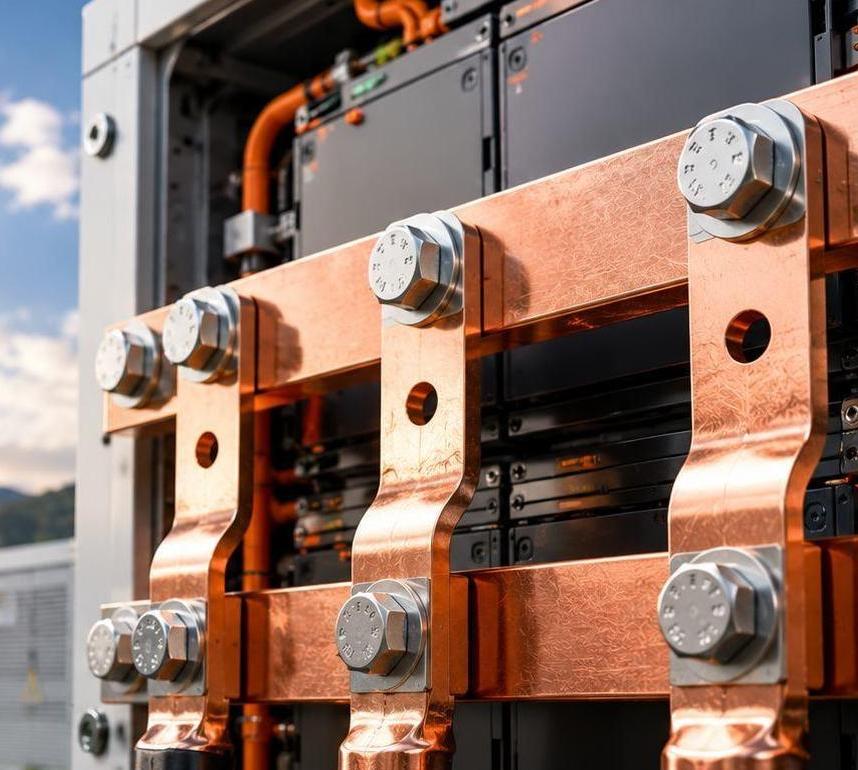
Why Modern Energy Storage Systems Depend on Busbar Terminals
As renewable energy installations continue to expand, battery systems are becoming larger, more powerful, and increasingly complex.
Large-scale BESS installations may contain thousands of battery cells connected across multiple modules, racks, and containers.
Transferring electrical power safely throughout this network requires highly reliable connection technology.
Busbar terminals have become the preferred solution because they support:
- Higher current capacity
- Lower electrical losses
- Improved thermal performance
- Compact installation
- Easier maintenance
- Greater long-term reliability
Supporting High-Current Power Distribution
Perhaps the most important reason for using busbar terminals is their ability to carry large electrical currents safely.
Typical applications include:
| System Component | Typical Current |
|---|---|
| Battery Module | 100–300 A |
| Battery Pack | 300–600 A |
| Battery Rack | 600–1000 A |
| PCS DC Input | 800–1500 A |
| Utility-Scale Energy Storage | 1500 A+ |
Traditional cable assemblies become increasingly difficult to manage at these current levels.
Busbar systems provide a shorter, wider current path that reduces electrical resistance while simplifying system layout.
Reducing Energy Loss
Every electrical connection introduces resistance.
According to Joule’s Law, electrical energy lost through resistance is converted into heat.
In large energy storage systems operating continuously, even small increases in resistance can lead to:
- Higher operating temperatures
- Lower system efficiency
- Greater cooling requirements
- Increased operating costs
Busbar terminals reduce these losses by providing a larger contact surface and shorter electrical path than many traditional cable connections.
Improving Thermal Performance
Heat is one of the greatest challenges in modern battery systems.
As current increases, even minor imperfections in electrical connections can create localized hot spots.
A properly engineered busbar terminal minimizes temperature rise by:
- Maximizing electrical conductivity
- Increasing contact area
- Maintaining consistent contact pressure
- Reducing resistance throughout the connection
Better thermal performance not only improves efficiency but also extends the service life of batteries and electrical equipment.
Enabling Compact System Design
Modern BESS installations are designed to maximize energy density while minimizing footprint.
Compared with traditional cable assemblies, busbars occupy less space and provide cleaner routing within battery cabinets and power distribution systems.
Busbar terminals complement this approach by offering compact, high-current connections that simplify assembly and reduce installation complexity.
This makes them especially valuable in containerized energy storage systems, where every millimeter of available space matters.
Enhancing Long-Term Reliability
Energy storage systems are expected to operate for 15 to 25 years with minimal maintenance.
During this time, electrical connections experience:
- Daily charge and discharge cycles
- Thermal expansion and contraction
- Mechanical vibration
- Environmental exposure
- Continuous electrical loading
High-quality busbar terminals are engineered to withstand these conditions while maintaining low contact resistance and stable mechanical performance over the entire service life of the system.
Bar Terminals vs. Traditional Cable Connections
For decades, conventional cable assemblies have been widely used for electrical power distribution. However, as Battery Energy Storage Systems (BESS) continue to increase in capacity and power density, traditional cable-based connections are gradually being replaced by busbar systems.
Busbar terminals provide a more efficient, compact, and reliable method of transmitting high current between batteries, power conversion systems, switchgear, and distribution equipment.
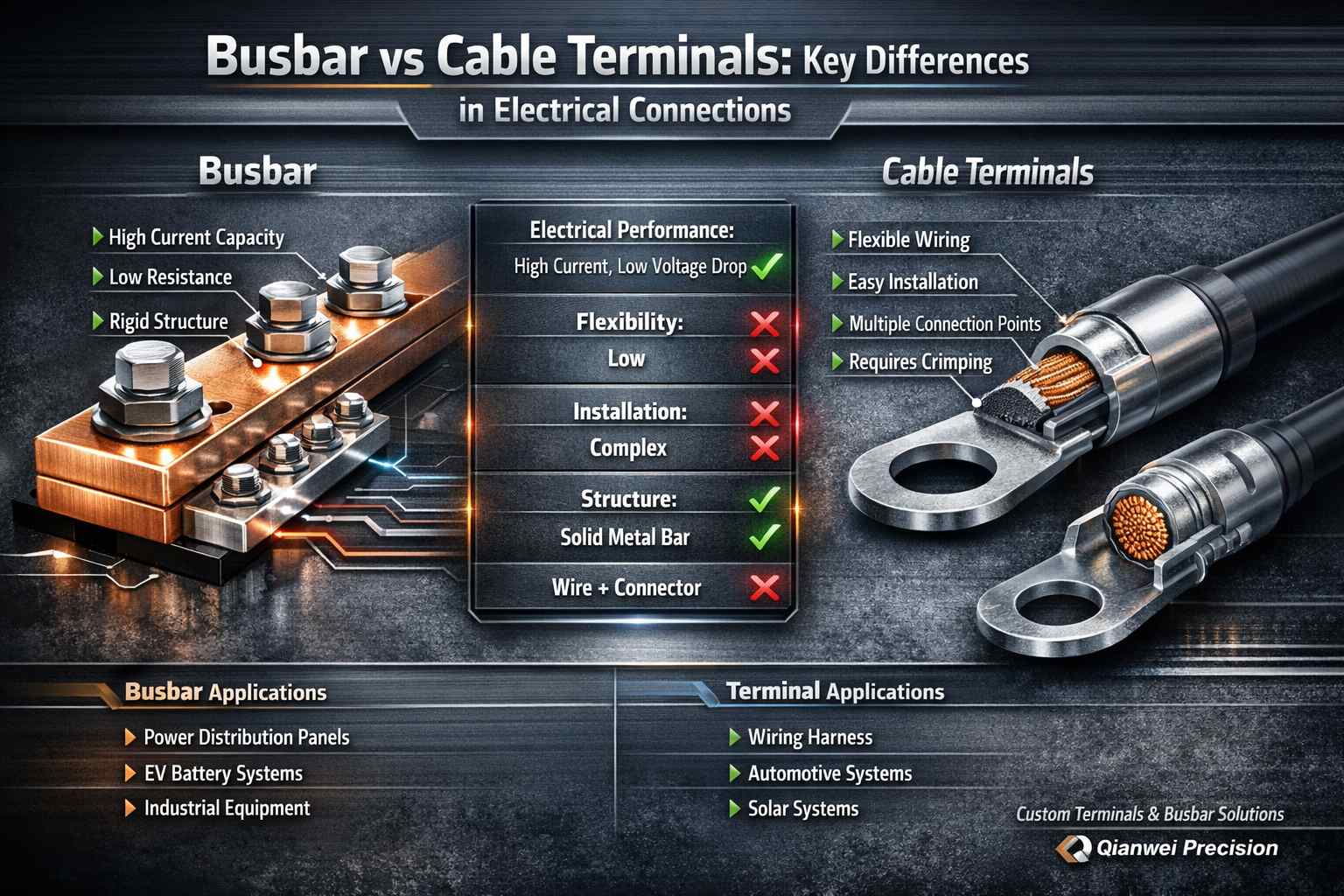
Understanding the differences between these two connection methods helps engineers select the most suitable solution for modern energy storage applications.
| Feature | Busbar Terminal | Traditional Cable Connection |
|---|---|---|
| Current Carrying Capacity | Excellent | Good |
| Contact Resistance | Very Low | Moderate |
| Heat Dissipation | Excellent | Moderate |
| Voltage Drop | Low | Higher |
| Installation Space | Compact | Requires More Space |
| Mechanical Stability | High | Moderate |
| Maintenance | Minimal | More Frequent |
| Scalability | Excellent | Limited |
As system power continues to increase, busbar terminals offer clear advantages in electrical efficiency and long-term reliability.
Higher Current Capacity
One of the greatest strengths of busbar terminals is their ability to safely carry extremely high electrical currents.
Unlike round conductors, busbars use a wide, flat cross-section that provides a larger conductive area.
This design allows electrical current to distribute more evenly across the conductor while reducing current density.
Lower current density means:
- Lower conductor temperature
- Reduced electrical losses
- Higher continuous current ratings
- Better overload capability
For modern BESS installations operating at hundreds or even thousands of amperes, this advantage is significant.
Improved Heat Dissipation
Heat is the primary enemy of electrical connections.
Every connection generates heat due to electrical resistance. If heat cannot dissipate efficiently, connection temperatures increase, accelerating oxidation, loosening fasteners, and reducing service life.
Busbars naturally provide better cooling because of their large exposed surface area.
Combined with precision-engineered busbar terminals, the entire power distribution system can operate at lower temperatures than equivalent cable assemblies.
Lower Voltage Drop
Voltage drop directly affects system efficiency.
When current travels through long cable assemblies with multiple connection points, electrical losses increase.
Busbar systems minimize these losses by providing:
- Shorter current paths
- Larger conductive cross-sections
- Fewer connection interfaces
- Lower contact resistance
Even a small reduction in voltage drop can translate into significant energy savings across large-scale energy storage facilities operating around the clock.
Better Space Utilization
Containerized energy storage systems must accommodate batteries, cooling equipment, inverters, PCS units, fire protection systems, and monitoring devices within limited space.
Cable assemblies can quickly become difficult to organize as current levels increase.
Busbars provide:
- Cleaner layouts
- Easier cable routing
- Reduced installation complexity
- Improved airflow
- Better accessibility for maintenance
This makes busbar terminals particularly attractive for modular battery systems.
Types of Busbar Terminals
Different energy storage applications require different terminal designs. Selecting the appropriate type depends on electrical requirements, installation method, mechanical constraints, and environmental conditions.
Copper Busbar Terminals
Copper busbar terminals are the industry standard for high-current applications.
Because copper combines exceptional electrical conductivity with excellent thermal performance, it is widely used in:
- Utility-scale BESS
- AI data center power systems
- UPS equipment
- EV charging stations
- Industrial switchgear
Advantages
- Excellent conductivity
- Low contact resistance
- Superior heat dissipation
- Long service life
- High mechanical reliability
Copper terminals are typically the preferred choice whenever maximum electrical efficiency is required.
Aluminum Busbar Terminals
Aluminum provides a lightweight and cost-effective alternative to copper.
Although its electrical conductivity is lower, aluminum offers significant weight reduction.
Typical applications include:
- Renewable energy projects
- Large photovoltaic installations
- Wind power equipment
- Cost-sensitive power distribution systems
To achieve equivalent current capacity, aluminum conductors generally require a larger cross-sectional area than copper.
Flexible Busbar Terminals
Flexible busbars consist of multiple thin copper laminations bonded together.
Unlike rigid busbars, flexible designs absorb mechanical movement caused by:
- Thermal expansion
- Equipment vibration
- Installation tolerance
- Mechanical displacement
Flexible busbar terminals are frequently used in:
- Battery modules
- PCS equipment
- Electric vehicles
- High-frequency power converters
They improve reliability by reducing stress on electrical connections.
Laminated Busbar Assemblies
As switching frequencies continue to increase in modern power electronics, laminated busbars have become increasingly popular.
A laminated busbar combines multiple conductive layers separated by insulation.
Benefits include:
- Lower inductance
- Reduced electromagnetic interference (EMI)
- Improved switching performance
- Compact installation
- Better thermal management
These assemblies are commonly found in advanced inverters and power conversion systems.
Custom Busbar Terminals
No two energy storage projects are exactly alike.
Voltage, current, mounting methods, installation space, and environmental conditions vary considerably between applications.
For this reason, many OEMs prefer customized busbar terminals designed specifically for their systems.
Typical customization options include:
- Terminal geometry
- Hole size and location
- Thickness
- Surface plating
- Bending angle
- Current rating
- Insulation requirements
- Assembly method
Custom manufacturing allows engineers to optimize both electrical performance and production efficiency.
Materials Used in Busbar Terminal Manufacturing
Selecting the appropriate material is one of the most important engineering decisions in terminal design.
The material determines:
- Electrical conductivity
- Mechanical strength
- Corrosion resistance
- Thermal performance
- Manufacturing cost
- Product lifespan
High-Conductivity Copper
Copper remains the benchmark material for high-current electrical terminals.
Its conductivity exceeds that of most engineering metals, making it ideal for power transmission.
Benefits
- Outstanding electrical conductivity
- Excellent thermal conductivity
- Low energy loss
- Stable long-term performance
- High corrosion resistance with proper plating
High-purity copper is widely used in premium battery energy storage systems where efficiency is a priority.
Brass
Brass combines copper with zinc to improve mechanical properties.
Compared with pure copper, brass offers:
- Higher hardness
- Better wear resistance
- Easier machining
- Lower production cost
Although its conductivity is lower than copper, brass performs well in medium-current applications requiring greater structural strength.
Copper Alloys
Some specialized applications require a balance between conductivity and mechanical performance.
Copper alloys can provide:
- Improved fatigue resistance
- Higher tensile strength
- Better spring characteristics
- Increased durability
These materials are often selected for terminals subject to repeated mechanical loading.
Surface Plating Options
Surface treatment protects the base material while maintaining stable electrical contact throughout the product’s service life.
Choosing the correct plating improves both electrical performance and environmental durability.
| Plating | Conductivity | Corrosion Resistance | Typical Application |
|---|---|---|---|
| Tin | Excellent | Excellent | General BESS terminals |
| Silver | Outstanding | Very Good | High-current premium systems |
| Nickel | Good | Excellent | High-temperature environments |
| Gold | Excellent | Outstanding | Precision signal connections |
Tin Plating
Tin plating is the most widely used finish for busbar terminals.
Its popularity comes from its excellent balance of:
- Cost
- Conductivity
- Corrosion resistance
- Solderability
- Manufacturing compatibility
For most energy storage applications, tin plating provides sufficient protection while maintaining excellent electrical performance.
Silver Plating
Silver offers the highest electrical conductivity of all commonly used plating materials.
Advantages include:
- Extremely low contact resistance
- Excellent heat transfer
- High current capability
- Superior electrical performance
Silver plating is often specified for mission-critical power distribution equipment where efficiency is the top priority.
Nickel Plating
Nickel is frequently used where environmental durability is more important than maximum conductivity.
Its advantages include:
- Excellent wear resistance
- High hardness
- Strong corrosion protection
- Good performance at elevated temperatures
Nickel is commonly used in harsh industrial environments.
Engineering Design Considerations
Designing a busbar terminal involves much more than selecting a conductive material.
Engineers must optimize multiple electrical and mechanical parameters simultaneously.
Key considerations include:
Current Carrying Capacity
The terminal must safely handle the maximum continuous and peak operating current without excessive temperature rise.
Contact Resistance
Low contact resistance minimizes power loss and heat generation, improving efficiency and extending service life.
Temperature Rise
Terminal geometry should promote effective heat dissipation to maintain stable operating temperatures under continuous load.
Creepage and Clearance Distance
Adequate insulation spacing is essential for preventing flashover and ensuring safe operation in high-voltage energy storage systems.
Mechanical Strength
The terminal must maintain consistent contact pressure despite vibration, thermal expansion, and repeated maintenance cycles.
Corrosion Protection
Proper material selection and surface plating help maintain electrical performance in humid, coastal, or industrial environments.
Coming in Part 3
In the next section, we’ll examine where busbar terminals are used throughout Battery Energy Storage Systems, explore the complete manufacturing process from raw copper to finished component, review quality testing procedures, and discuss the international standards that define reliable high-current terminal solutions. This section will connect engineering design with real-world applications, making the article even more valuable for design engineers, procurement teams, and system integrators.
Excellent. Below is Part 3 of the Pillar Page. This section is designed to strengthen EEAT, improve keyword coverage for BESS, PCS, Busbar Manufacturing, Busbar Testing, and increase topical authority. It connects engineering theory with real-world applications, which Google favors for technical content.
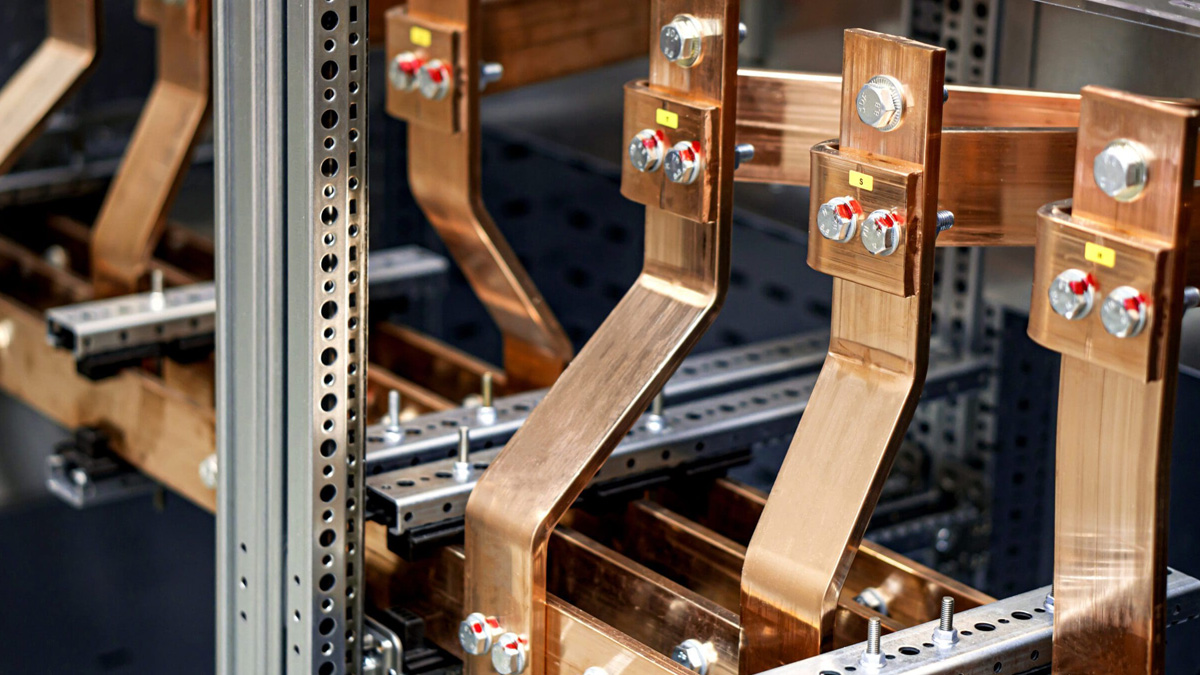
Applications of Busbar Terminals in Modern Energy Storage Systems
Busbar terminals are used throughout Battery Energy Storage Systems (BESS), connecting every major electrical subsystem from the battery cells to the utility grid. Their primary role is to transfer high current safely and efficiently while minimizing energy loss, maintaining thermal stability, and ensuring long-term operational reliability.
As energy storage projects continue to scale from residential installations to multi-megawatt utility systems, the demand for precision-engineered busbar terminals has increased significantly.
Battery Module Connections
A battery module consists of multiple lithium-ion cells connected in series and parallel.
Within each module, busbar terminals provide reliable electrical connections between individual cells while ensuring consistent current distribution.
Key requirements include:
- Low contact resistance
- High conductivity
- Compact dimensions
- Excellent vibration resistance
- Consistent contact pressure
Because thousands of charge and discharge cycles occur throughout the battery’s lifetime, these terminals must maintain stable performance without loosening or degrading.
Battery Pack Assemblies
Multiple battery modules are combined to form a battery pack.
At this stage, busbar terminals must handle substantially higher current while maintaining electrical balance between modules.
Typical design considerations include:
- Higher current ratings
- Improved thermal management
- Increased mechanical strength
- Simplified maintenance
- Optimized installation space
High-quality busbar terminals help reduce voltage imbalance and improve overall battery efficiency.
Battery Rack Systems
Large-scale energy storage systems contain multiple battery packs installed within standardized racks.
Each rack requires robust power distribution capable of handling hundreds or even thousands of amperes.
Busbar terminals used in battery racks should provide:
- Stable electrical contact
- High fault-current capability
- Long-term reliability
- Easy installation and replacement
Since racks are often installed in containerized systems, compact terminal designs help maximize energy density while simplifying maintenance.
Power Conversion Systems (PCS)
The Power Conversion System (PCS) is responsible for converting DC power from batteries into AC power for the electrical grid, and vice versa during charging.
High-current busbar terminals connect:
- Battery output
- DC busbars
- Inverter modules
- Capacitor banks
- Switching devices
These applications demand extremely low contact resistance because even minor power losses reduce conversion efficiency.
As PCS power ratings continue to increase, precision busbar terminals become increasingly important.
DC Distribution Cabinets
DC distribution cabinets collect electrical power from multiple battery strings before delivering it to the PCS.
Within these cabinets, busbar terminals connect:
- DC breakers
- Fuse assemblies
- Monitoring equipment
- Busbar systems
- Output terminals
Reliable electrical connections help ensure stable system operation while minimizing maintenance requirements.
Inverters
Modern renewable energy systems rely on inverters to convert stored DC energy into usable AC electricity.
Busbar terminals inside inverter systems must withstand:
- High switching frequencies
- Elevated temperatures
- Continuous current loading
- Electrical transients
Careful material selection and precision manufacturing help maintain stable performance under these demanding conditions.
Grid Connection Equipment
At the final stage of the power distribution chain, busbar terminals connect energy storage systems to transformers and utility distribution equipment.
These applications require:
- Maximum current carrying capability
- Excellent mechanical strength
- Long service life
- High environmental durability
Reliable grid connections are essential for maintaining system availability and ensuring uninterrupted power delivery.
Busbar Terminals Beyond Energy Storage
Although BESS is one of the fastest-growing markets, busbar terminals are also widely used across other high-current industries.
Typical applications include:
| Industry | Typical Application |
|---|---|
| Solar Power | Combiner boxes, inverters, DC distribution |
| Wind Energy | Converter cabinets, switchgear |
| Electric Vehicle Charging | High-power DC charging stations |
| AI Data Centers | Power distribution units (PDUs), UPS, busway systems |
| UPS Systems | Battery banks, power modules |
| Industrial Automation | High-current control cabinets |
| Rail Transportation | Traction power distribution |
| Marine & Offshore | Shipboard electrical systems |
This diversity demonstrates the versatility of busbar terminals in modern electrical infrastructure.
Manufacturing Process of High-Quality Busbar Terminals
Manufacturing busbar terminals for energy storage applications requires tight control over every production stage. Precision, consistency, and material quality directly influence electrical performance and long-term reliability.
A typical manufacturing workflow includes:
Raw Material → Precision Stamping → Forming → CNC Machining (if required) → Deburring → Surface Plating → Inspection → Assembly → Packaging
Each stage contributes to the overall quality of the finished component.
Step 1: Raw Material Selection
Production begins with selecting high-quality conductive materials.
Common options include:
- Oxygen-free copper
- Electrolytic tough pitch (ETP) copper
- Brass
- Copper alloys
Material certification ensures consistent conductivity, mechanical properties, and chemical composition.
Step 2: Precision Stamping
For high-volume production, progressive stamping is the preferred manufacturing method.
Using high-speed presses and precision dies, manufacturers create complex terminal geometries with exceptional repeatability.
Benefits include:
- Tight dimensional tolerances
- High production efficiency
- Minimal material waste
- Excellent consistency
Step 3: Forming and Bending
After stamping, terminals are formed into their final three-dimensional shape.
Modern forming equipment ensures:
- Accurate bend angles
- Uniform contact geometry
- Stable mechanical performance
Even small dimensional deviations can affect contact pressure and electrical performance.
Step 4: CNC Machining
Certain custom busbar terminals require additional machining operations.
CNC machining is used for:
- Precision mounting holes
- Threaded features
- Complex geometries
- Prototype development
This process enables manufacturers to produce specialized components for unique customer applications.
Step 5: Surface Plating
Surface treatment protects the terminal while improving electrical performance.
Typical plating options include:
- Tin
- Silver
- Nickel
Plating thickness, adhesion, and surface uniformity are carefully controlled to ensure long-term reliability.
Step 6: Inspection and Quality Verification
Every production batch undergoes rigorous inspection before shipment.
Typical inspections include:
- Dimensional measurement
- Visual inspection
- Surface finish evaluation
- Material verification
- Plating thickness measurement
Many manufacturers also employ automated vision systems to improve inspection efficiency and consistency.
Quality Testing for Busbar Terminals
High-current terminals must demonstrate reliable performance under demanding operating conditions.
Comprehensive testing validates both electrical and mechanical performance before products are released.
Current Carrying Test
This test verifies the terminal’s ability to safely carry its rated current continuously.
Engineers monitor:
- Temperature rise
- Electrical stability
- Material deformation
- Contact integrity
Contact Resistance Test
One of the most important electrical tests measures resistance across the connection interface.
Low contact resistance contributes to:
- Lower heat generation
- Higher efficiency
- Reduced voltage drop
- Longer service life
Temperature Rise Test
Continuous high-current operation naturally generates heat.
Manufacturers monitor temperature increases to confirm the terminal remains within acceptable operating limits under full-load conditions.
Mechanical Pull-Out Test
This test evaluates the strength of the mechanical connection.
Strong pull-out performance reduces the risk of loose terminals during transportation, installation, or long-term operation.
Vibration Test
Energy storage systems may experience vibration during transportation or operation.
Testing verifies that electrical connections remain stable after prolonged mechanical stress.
Thermal Cycling Test
Repeated charging and discharging causes continuous expansion and contraction of conductive materials.
Thermal cycling tests evaluate whether terminals maintain:
- Contact pressure
- Structural integrity
- Low resistance
after thousands of temperature changes.
Salt Spray Corrosion Test
Protective plating is evaluated under accelerated corrosion conditions.
This test is especially important for installations located near coastal environments or in humid climates.
Standards and Compliance
Although requirements vary by project and market, reputable busbar terminal manufacturers typically produce components in accordance with internationally recognized quality and environmental management systems.
Common references include:
| Standard | Purpose |
|---|---|
| ISO 9001 | Quality management system |
| IATF 16949 | Advanced manufacturing quality processes |
| RoHS | Restriction of hazardous substances |
| REACH | Chemical compliance |
| UL | Product safety requirements |
| IEC Design Considerations | Electrical design and safety guidance |
Meeting these requirements helps ensure product consistency, regulatory compliance, and compatibility with global customer expectations.
Excellent. This is the final section (Part 4) of the Pillar Page. This chapter is written to maximize conversion, while maintaining technical authority and SEO value. It helps move readers from learning about busbar terminals to selecting a manufacturing partner.
Common Busbar Terminal Failures and How to Prevent Them
Even the most advanced Battery Energy Storage Systems can experience performance issues if electrical connections are not properly designed or maintained. Many system failures originate not from batteries or power electronics, but from poor electrical contacts.
Understanding the most common failure modes helps engineers improve reliability and extend equipment service life.
Loose Electrical Connections
Loose connections are among the most common causes of overheating in high-current systems.
Common Causes
- Improper installation torque
- Thermal expansion and contraction
- Mechanical vibration
- Insufficient contact pressure
- Poor terminal design
Possible Consequences
- Increased contact resistance
- Localized overheating
- Electrical arcing
- Reduced system efficiency
- Unexpected downtime
Prevention
- Use precision-engineered terminals with optimized contact geometry.
- Apply the manufacturer’s recommended torque values.
- Perform periodic torque inspections during maintenance.
- Select locking hardware where vibration is expected.
Overheating
Heat generation is unavoidable in high-current electrical systems, but excessive heat indicates poor electrical performance.
Common Causes
- High contact resistance
- Undersized conductors
- Oxidized contact surfaces
- Inadequate cooling
- Overloaded circuits
Prevention
- Use high-conductivity copper terminals.
- Increase effective contact area.
- Select appropriate current ratings with sufficient safety margins.
- Improve ventilation or cooling around high-current components.
Corrosion and Oxidation
Over time, environmental exposure can degrade electrical contact surfaces.
Although many BESS installations operate indoors, humidity, condensation, and airborne contaminants can still accelerate corrosion.
Prevention
- Tin plating for general applications
- Silver plating for premium electrical performance
- Nickel plating for harsh industrial environments
- Proper enclosure sealing
- Regular inspection during preventive maintenance
Electrical Arcing
Electrical arcs can occur when current passes through loose or damaged connections.
Arcing produces extremely high temperatures capable of damaging terminals, insulation, and surrounding equipment.
Prevention
- Maintain proper contact pressure.
- Replace damaged terminals immediately.
- Avoid repeated tightening beyond recommended torque.
- Use terminals specifically designed for high-current applications.
Mechanical Fatigue
Battery systems experience thousands of charge and discharge cycles throughout their operating life.
Repeated thermal expansion, contraction, and vibration gradually fatigue mechanical components.
Prevention
- Select materials with excellent fatigue resistance.
- Optimize terminal geometry.
- Use flexible busbars where movement is expected.
- Validate designs through thermal cycling and vibration testing.
How to Choose the Right Busbar Terminal
Selecting the right busbar terminal involves more than matching a current rating. Engineers should evaluate the complete operating environment, electrical requirements, and long-term maintenance strategy.
1. Determine Current Requirements
Start by identifying:
- Continuous operating current
- Peak current
- Short-circuit current
- Future expansion requirements
Selecting a terminal with adequate safety margin improves long-term reliability.
2. Evaluate Voltage Requirements
Higher system voltages require careful attention to:
- Creepage distance
- Clearance distance
- Insulation materials
- Arc resistance
Modern BESS installations increasingly operate at 1000V DC and above, making insulation design more critical than ever.
3. Choose the Right Material
Material selection should balance conductivity, strength, weight, and cost.
| Material | Best For |
|---|---|
| Copper | Maximum conductivity |
| Brass | Mechanical strength |
| Copper Alloy | High durability |
| Aluminum | Lightweight systems |
4. Select Appropriate Surface Plating
Different operating environments require different protective finishes.
| Environment | Recommended Plating |
|---|---|
| Standard indoor BESS | Tin |
| High-current premium systems | Silver |
| Corrosive environments | Nickel |
5. Consider Installation Space
Compact battery systems require terminals designed for high current within limited space.
Evaluate:
- Mounting method
- Bend angle
- Hole spacing
- Cable routing
- Service accessibility
6. Verify Manufacturing Quality
Ask potential suppliers about:
- Production equipment
- Tooling capability
- Quality control system
- Testing equipment
- Process traceability
- Engineering support
Reliable manufacturing is just as important as good design.
Future Trends in Busbar Terminal Technology
As renewable energy, AI computing, and electric transportation continue to expand, busbar technology is evolving rapidly.
Several industry trends are shaping the future of high-current electrical connections.
Higher Voltage Energy Storage Systems
Modern utility-scale projects are increasingly adopting:
- 1000V DC
- 1500V DC
- Higher-power PCS architectures
Higher voltages require improved insulation, tighter dimensional control, and more advanced terminal designs.
AI-Driven Power Infrastructure
The rapid growth of AI data centers is driving demand for higher current power distribution.
Future AI facilities will require:
- Larger busbars
- Higher-current terminals
- Better thermal management
- Greater power density
Many technologies developed for energy storage are now being adapted for AI infrastructure.
Liquid-Cooled Energy Storage Systems
Liquid cooling is becoming more common as battery capacities increase.
Electrical terminals must operate reliably in systems with:
- Higher ambient humidity
- Tighter installation space
- Improved thermal performance requirements
This trend places greater emphasis on corrosion resistance and sealing performance.
Smart Busbar Systems
Future busbar assemblies may integrate sensors capable of monitoring:
- Temperature
- Current
- Voltage
- Contact resistance
Real-time monitoring enables predictive maintenance, helping operators detect potential failures before they cause downtime.
Advanced Manufacturing
Manufacturers are increasingly adopting:
- AI-assisted quality inspection
- Automated optical inspection (AOI)
- Digital production traceability
- Robotic assembly
- Smart manufacturing systems
These technologies improve consistency, reduce defects, and support large-scale production.
Why Choose Qianwei Precision
Choosing the right manufacturing partner is essential for ensuring reliable electrical performance and long-term product quality.
With more than a decade of experience in precision electrical terminals and metal stamping, Qianwei Precision supports customers across the renewable energy, automotive, industrial automation, and electrical equipment industries.
Engineering Support
Our engineering team works closely with customers to develop customized terminal solutions based on:
- Current requirements
- Installation space
- Material selection
- Surface plating
- Manufacturing feasibility
- Cost optimization
From concept to mass production, we help customers accelerate product development while ensuring manufacturability.
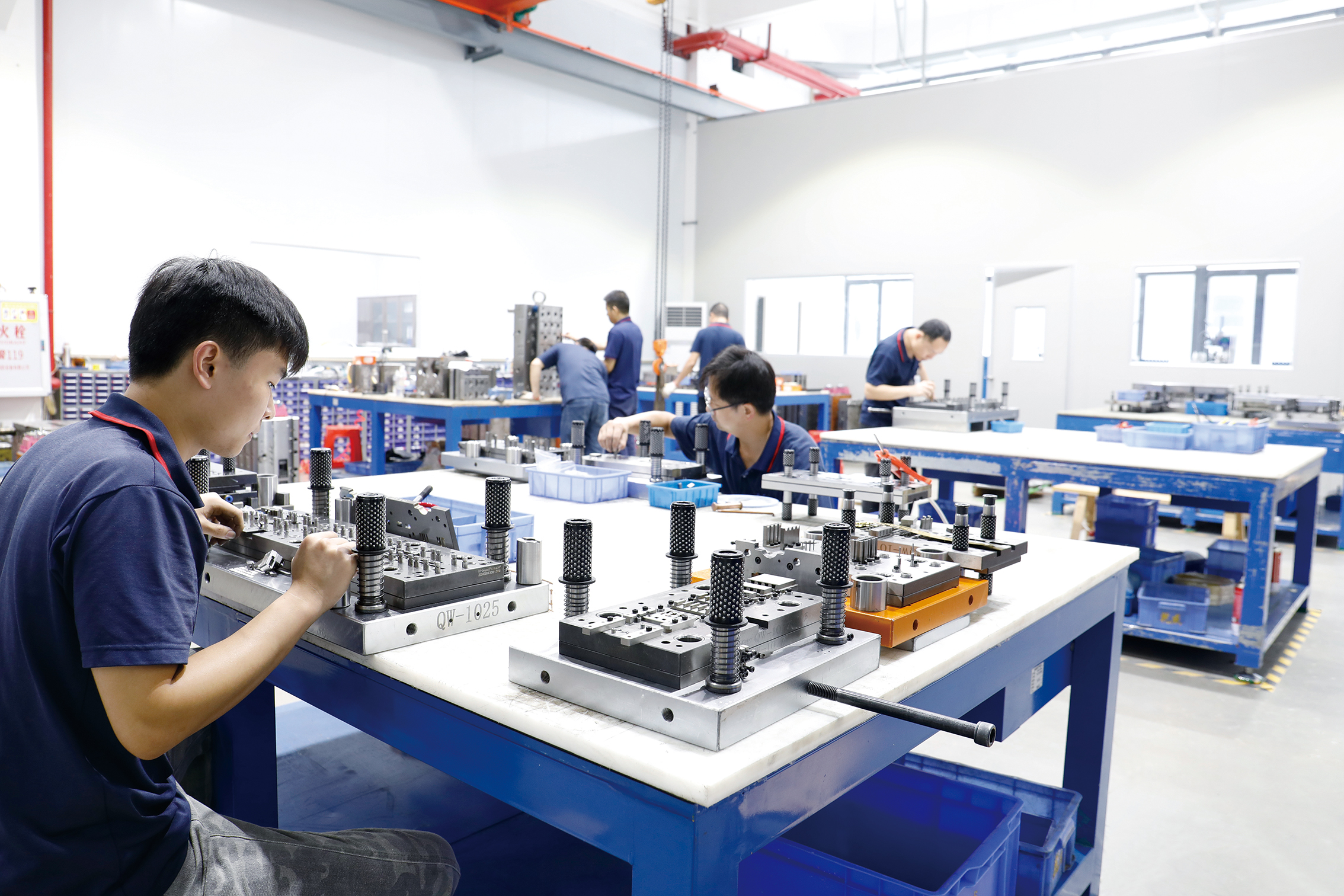
Precision Manufacturing
Qianwei Precision operates advanced production facilities equipped with:
- High-speed precision stamping machines
- Progressive die technology
- CNC machining equipment
- Precision bending systems
- Automated assembly lines
- Vision inspection systems
These capabilities enable consistent, high-volume production while maintaining tight dimensional tolerances.
Strict Quality Management
Quality is built into every stage of production.
Our quality management system includes:
- Incoming material inspection
- In-process quality control
- Final dimensional inspection
- Electrical performance testing
- Mechanical validation
- Full production traceability
This systematic approach helps ensure every shipment meets customer expectations.
OEM & ODM Services
Whether you require a standard busbar terminal or a fully customized high-current solution, Qianwei Precision provides flexible manufacturing services, including:
- Custom terminal design
- Prototype development
- Tooling design
- Sample validation
- Mass production
- Technical support
Our engineering team collaborates closely with customers to optimize performance, cost, and manufacturability.
Global Manufacturing Partner
We serve customers in industries including:
- Battery Energy Storage Systems (BESS)
- Solar Energy
- Electric Vehicles
- EV Charging Infrastructure
- AI Data Centers
- Industrial Automation
- Consumer Electronics
- Home Appliances
By combining engineering expertise with precision manufacturing, Qianwei Precision helps customers build safer, more efficient, and more reliable electrical systems.
Conclusion
As Battery Energy Storage Systems continue to grow in size and complexity, reliable electrical connections are becoming more critical than ever.
Busbar terminals are no longer simple connection components—they are essential elements of modern power distribution systems. Their performance directly affects energy efficiency, thermal management, operational safety, and system reliability.
Selecting the right busbar terminal requires careful consideration of material selection, contact resistance, current capacity, manufacturing quality, and environmental performance.
For equipment manufacturers, system integrators, and renewable energy developers, partnering with an experienced terminal manufacturer helps reduce technical risk while improving product performance.
With advanced manufacturing capabilities, engineering expertise, and a commitment to quality, Qianwei Precision delivers high-current busbar terminal solutions that meet the evolving demands of modern energy storage systems.
Whether you are developing next-generation battery technology or expanding utility-scale energy storage projects, our team is ready to help you build reliable electrical connections that power the future.
FAQs
1. What is a busbar terminal?
A busbar terminal is a high-current electrical connection component that links busbars to batteries, cables, power distribution units, or other electrical equipment.
2. Why are busbar terminals important in Battery Energy Storage Systems?
They provide low-resistance, high-current connections that improve electrical efficiency, reduce heat generation, and enhance system reliability.
3. What material is best for busbar terminals?
High-conductivity copper is generally preferred because of its excellent electrical and thermal performance. Aluminum and copper alloys may be selected for specific applications.
4. What is the difference between a busbar and a busbar terminal?
A busbar distributes electrical power, while a busbar terminal provides the secure connection between the busbar and other electrical components.
5. What surface plating is commonly used?
Tin plating is the most common choice, while silver plating is used for premium high-current applications and nickel plating for harsh environments.
6. How much current can a busbar terminal carry?
Depending on its design and material, busbar terminals can handle currents ranging from tens of amperes to well over 1,500 A.
7. How do busbar terminals reduce heat generation?
By minimizing contact resistance, increasing contact area, and using highly conductive materials, busbar terminals reduce electrical losses that are converted into heat.
8. What tests should busbar terminals pass?
Typical tests include current carrying, contact resistance, temperature rise, pull-out force, vibration, thermal cycling, and salt spray corrosion testing.
9. Can busbar terminals be customized?
Yes. Manufacturers often provide custom dimensions, materials, plating, hole patterns, and current ratings to meet specific customer requirements.
10. Are busbar terminals suitable for AI data centers?
Absolutely. High-current busbar terminals are increasingly used in AI data centers for power distribution units, UPS systems, and high-density server racks.
11. What is the expected service life of a busbar terminal?
With proper design, material selection, and maintenance, busbar terminals can operate reliably for 15–25 years in many energy storage applications.
12. Why choose Qianwei Precision?
Qianwei Precision combines precision stamping, advanced manufacturing, engineering support, and rigorous quality control to deliver customized high-current terminal solutions for energy storage, AI infrastructure, EVs, and industrial power systems.

