

Why Terminal Materials Matter in Energy Storage Systems
The global energy storage market is growing rapidly as renewable energy, electric vehicles, and smart grid technologies continue to expand. From residential battery systems to large-scale Battery Energy Storage Systems (BESS), reliable electrical connections have become a critical factor affecting system performance, safety, and service life.
Among all electrical components inside an energy storage system, terminals may appear small, but they play a vital role. They serve as the connection point between battery cells, busbars, power distribution units, inverters, and other electrical components. A poorly designed terminal can lead to increased resistance, excessive heat generation, energy loss, and even system failure.
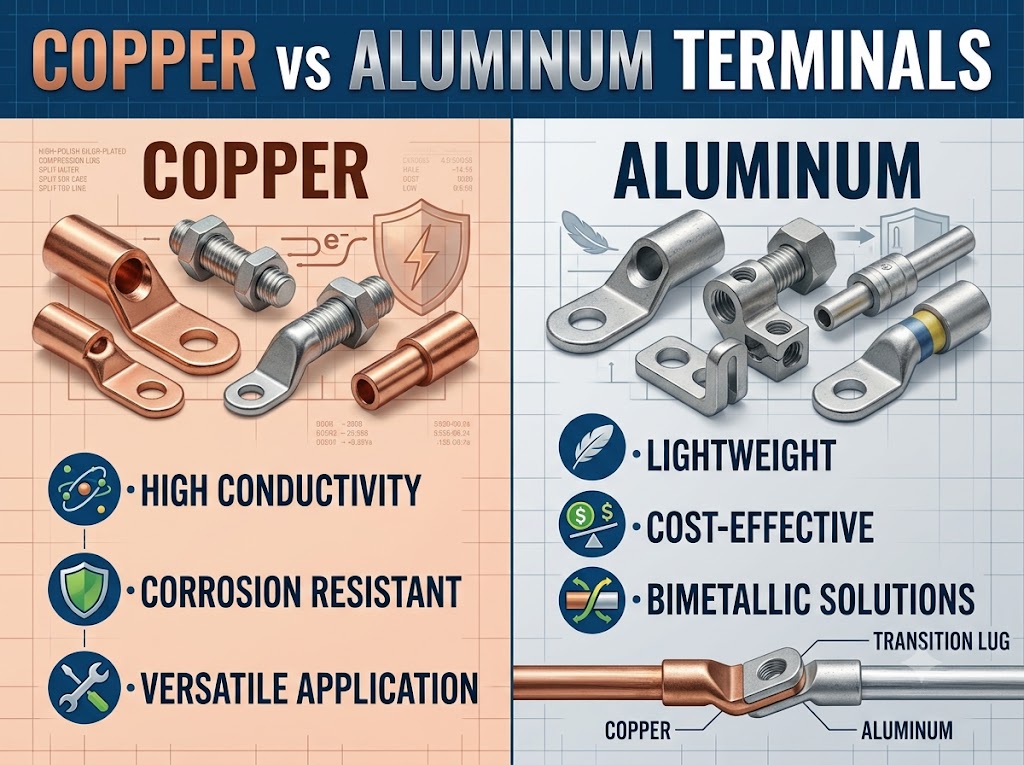
One of the most important decisions during terminal design is material selection. Copper and aluminum are the two most commonly used materials for high-current electrical terminals. Each material offers different advantages in terms of conductivity, weight, cost, thermal performance, and long-term reliability.
Choosing between copper and aluminum terminals requires engineers to carefully evaluate application requirements, including current capacity, installation environment, mechanical requirements, and total system cost.
The Role of Electrical Terminals in Battery Systems
Electrical terminals are responsible for transferring electrical energy between different components within an energy storage system.
In battery applications, terminals are commonly used in:
- Battery cell connections
- Battery modules
- Battery packs
- Busbar assemblies
- Power distribution systems
- Energy storage cabinets
- Charging and discharging circuits
During operation, terminals must handle high current while maintaining stable electrical contact over thousands of charge and discharge cycles.
A high-quality energy storage terminal needs to provide:
- Low contact resistance
- Reliable current transmission
- Strong mechanical connection
- Resistance against vibration and thermal cycling
- Long-term corrosion protection
Unlike ordinary low-power electrical connections, energy storage terminals often operate under demanding conditions. Large currents generate heat, while repeated temperature changes can create mechanical stress between connected materials.
Therefore, terminal material selection directly influences:
- System efficiency
- Thermal management design
- Battery safety
- Maintenance requirements
- Overall product lifetime
Key Performance Factors for Energy Storage Terminals
When comparing copper and aluminum terminals, engineers typically evaluate several critical performance factors.
Electrical Conductivity
Electrical conductivity is one of the most important characteristics of terminal materials.
Lower electrical resistance allows current to flow more efficiently, reducing:
- Voltage drop
- Power loss
- Heat generation
Copper has excellent electrical conductivity, which makes it widely used in applications requiring high current density and compact terminal designs.
Aluminum has lower conductivity compared with copper, but it can still achieve reliable performance when designed with a larger cross-sectional area and optimized connection structure.
Thermal Performance
High-current energy storage applications naturally generate heat during operation.
The terminal material affects:
- Heat dissipation capability
- Temperature rise
- Cooling system requirements
Copper provides excellent thermal conductivity, allowing heat to transfer away from the connection point more efficiently.
This advantage is particularly important in:
- Fast charging systems
- High-power battery packs
- Industrial energy storage applications
Aluminum also provides good thermal performance while offering significant weight advantages, making it attractive for applications where system weight reduction is important.
Mechanical Reliability
Energy storage terminals must maintain stable electrical contact throughout the entire product lifecycle.
Mechanical performance affects:
- Contact pressure stability
- Bolt connection reliability
- Resistance to vibration
- Resistance to deformation
Copper terminals generally provide higher mechanical strength and better durability under repeated mechanical stress.
Aluminum terminals require more careful structural design because aluminum is softer and more sensitive to mechanical deformation.
Corrosion Resistance
Energy storage systems may operate in challenging environments, including:
- High humidity
- Outdoor installations
- Temperature fluctuations
- Industrial environments
Surface protection is often required to improve terminal reliability.
Common surface treatments include:
- Tin plating
- Nickel plating
- Anti-oxidation coatings
Proper plating technology helps reduce oxidation, maintain low contact resistance, and extend terminal service life.
Copper Terminals for Energy Storage Applications
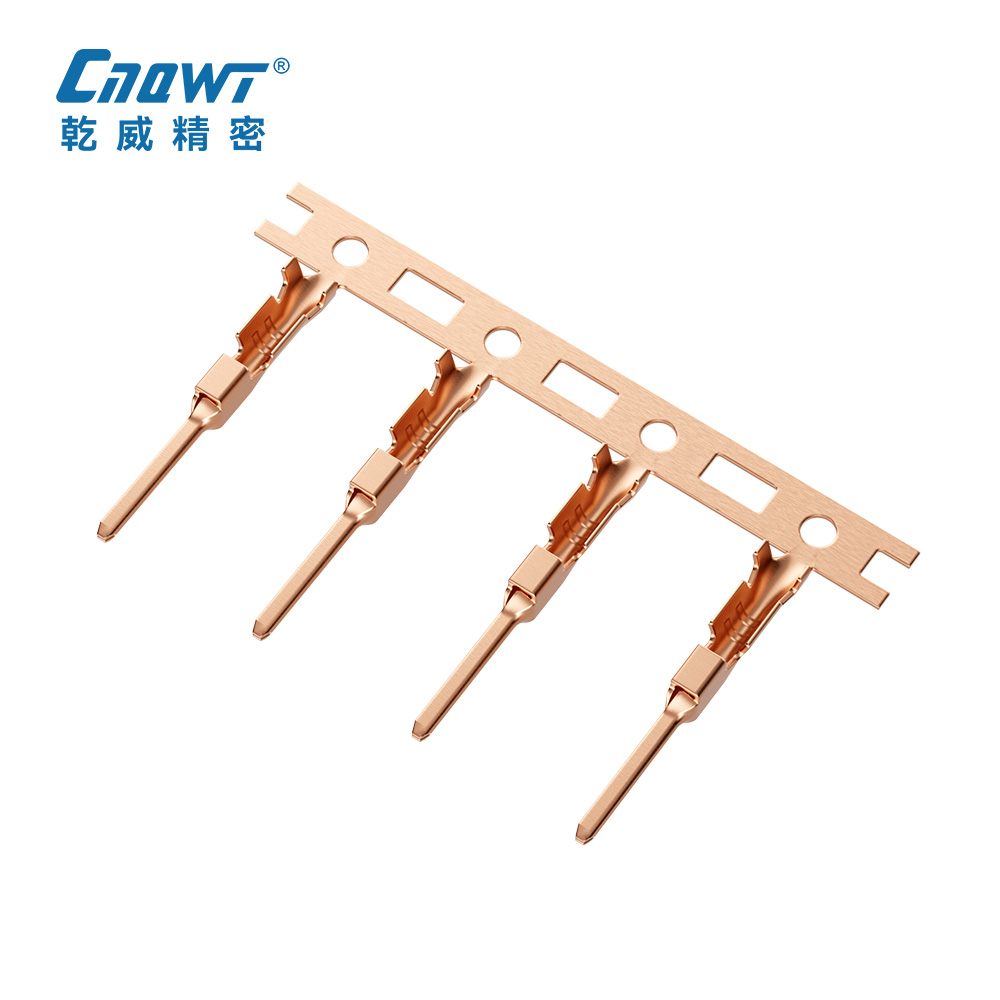
Copper terminals have been widely adopted in high-performance electrical systems because of their excellent electrical and mechanical properties.
For energy storage applications, copper is often selected when reliability, current capacity, and compact design are the top priorities.
Advantages of Copper Battery Terminals
Excellent Electrical Conductivity
The biggest advantage of copper terminals is their superior electrical conductivity.
Compared with aluminum, copper provides:
- Lower electrical resistance
- Higher current carrying capability
- Reduced energy loss
- Better performance in compact designs
For battery systems where available installation space is limited, copper terminals allow engineers to achieve the required current capacity without significantly increasing terminal size.
This makes copper an ideal choice for:
- High-current battery packs
- Power conversion systems
- EV battery connections
- Premium energy storage solutions
Superior Thermal Performance
Thermal management is a major challenge in modern energy storage systems.
When current passes through a terminal, electrical resistance generates heat. Excessive temperature rise can reduce efficiency and accelerate component aging.
Copper’s excellent thermal conductivity helps:
- Dissipate heat faster
- Reduce hot spots
- Improve connection stability
- Support higher operating currents
For applications requiring frequent charging and discharging cycles, copper terminals provide additional reliability.
Better Mechanical Strength
Mechanical reliability is another important advantage of copper.
Copper terminals provide:
- High tensile strength
- Strong contact stability
- Better resistance to deformation
This is especially valuable in applications using:
- Bolted connections
- Heavy-duty busbars
- Industrial battery systems
A stable mechanical connection helps maintain consistent electrical performance throughout thousands of operating cycles.
Limitations of Copper Terminals
Although copper provides excellent electrical and mechanical performance, it also has several limitations that engineers need to consider during energy storage system design.
Higher Material Cost
Copper is a premium conductor material with a higher raw material cost compared with aluminum.
For large-scale energy storage projects containing thousands of connection points, material cost can become a significant part of the overall system budget.
This is especially important for:
- Utility-scale BESS projects
- Large battery container systems
- Cost-sensitive energy storage applications
In these cases, aluminum terminals may provide a more economical solution when electrical requirements allow.
However, many high-performance energy storage systems continue to use copper terminals because the improved conductivity and reliability can reduce long-term operational risks.
Higher Weight
Copper has a relatively high density compared with aluminum.
Copper density:
- Approximately 8.96 g/cm³
Aluminum density:
- Approximately 2.7 g/cm³
The higher density of copper means copper terminals are heavier, which may affect:
- Battery pack weight
- Transportation costs
- Installation efficiency
- System mobility
For stationary energy storage systems, weight may not be a major concern. However, for applications such as mobile energy storage units and electric vehicles, reducing weight becomes increasingly important.
Potential Corrosion Issues
Copper itself offers good corrosion resistance, but it can still experience surface oxidation under certain environmental conditions.
Oxidation may affect:
- Contact resistance
- Electrical stability
- Long-term reliability
To improve durability, copper terminals are often treated with protective coatings such as:
- Tin plating
- Nickel plating
- Silver plating for specialized applications
These surface treatments provide additional protection against oxidation and environmental exposure.
Aluminum Terminals for Energy Storage Applications
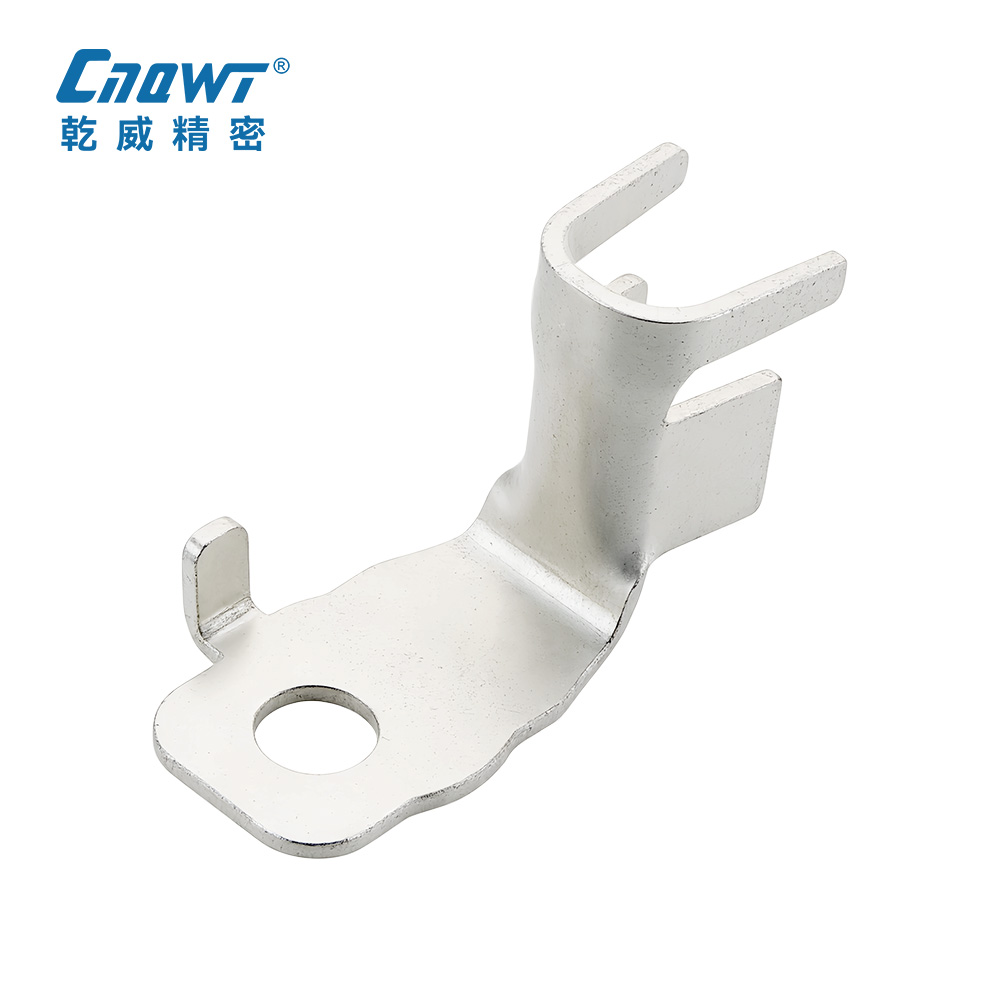
Aluminum terminals have become increasingly popular in energy storage applications due to their lightweight characteristics and cost advantages.
As battery systems continue moving toward larger capacity and higher installation volumes, manufacturers are looking for solutions that balance electrical performance with system cost and weight.
Aluminum provides an attractive alternative, especially in applications where space availability and current requirements allow for optimized designs.
Advantages of Aluminum Battery Terminals
Lightweight Design
The biggest advantage of aluminum terminals is their significantly lower weight.
With a density approximately one-third that of copper, aluminum can greatly reduce the overall weight of electrical connection systems.
Weight reduction benefits include:
- Easier installation
- Lower transportation costs
- Improved system flexibility
- Reduced structural requirements
This makes aluminum terminals suitable for:
- Mobile energy storage systems
- EV battery applications
- Large battery modules
- Lightweight power systems
For applications where every kilogram matters, aluminum provides a strong advantage.
Cost Efficiency
Aluminum is generally more cost-effective than copper due to its lower material cost and wider availability.
For large-scale energy storage projects, using aluminum terminals can help reduce:
- Component cost
- Manufacturing expenses
- Overall system investment
This advantage is particularly valuable for:
- Grid-scale energy storage projects
- Renewable energy storage installations
- High-volume battery production
When properly designed, aluminum terminals can deliver reliable electrical performance while maintaining competitive pricing.
Good Electrical Performance With Proper Design
Although aluminum has lower electrical conductivity than copper, it can still provide excellent performance when engineered correctly.
Design factors that improve aluminum terminal performance include:
- Increasing conductor cross-sectional area
- Optimizing terminal geometry
- Improving contact surface design
- Applying appropriate plating technologies
With proper engineering, aluminum terminals can meet the requirements of many energy storage applications.
Limitations of Aluminum Terminals
Despite its advantages, aluminum also presents several challenges that must be addressed during terminal design.
Lower Electrical Conductivity
Compared with copper, aluminum has higher electrical resistance.
This means aluminum terminals generally require:
- Larger conductor sizes
- More installation space
- Careful thermal management
For extremely high-current applications where compact size is critical, copper remains the preferred choice.
However, in large energy storage systems where space is available, aluminum can provide a practical balance between performance and cost.
Oxidation Problems
One of the main challenges of aluminum terminals is oxidation.
When aluminum is exposed to air, an aluminum oxide layer naturally forms on the surface.
This oxide layer can:
- Increase contact resistance
- Reduce electrical stability
- Affect long-term connection performance
To overcome this issue, manufacturers use technologies such as:
- Tin plating
- Nickel plating
- Surface treatment processes
- Anti-oxidation coatings
Proper surface protection is essential for ensuring reliable aluminum electrical connections.
Lower Mechanical Strength
Compared with copper, aluminum has lower mechanical strength.
Potential challenges include:
- Greater sensitivity to mechanical stress
- Higher risk of deformation
- Reduced thread durability in some designs
Therefore, aluminum terminals require careful consideration of:
- Connection torque
- Terminal structure
- Contact pressure
- Mechanical reinforcement
A well-designed aluminum terminal can still achieve excellent reliability in demanding energy storage environments.
Copper vs Aluminum Terminals: Direct Comparison
Selecting between copper and aluminum terminals requires a comprehensive evaluation of electrical, mechanical, and economic factors.
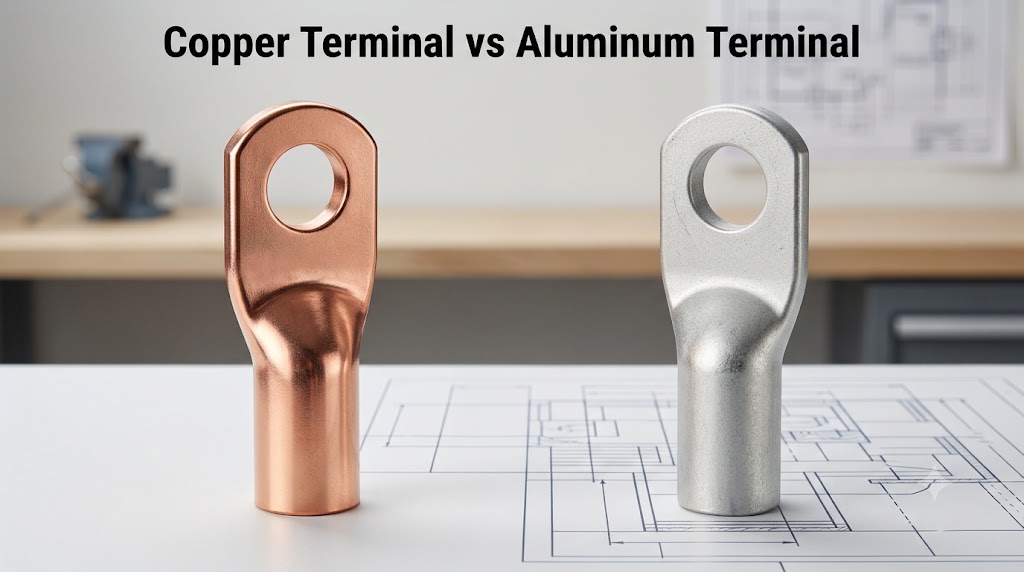
The following table provides a direct comparison:
| Performance Factor | Copper Terminal | Aluminum Terminal |
|---|---|---|
| Electrical Conductivity | Excellent | Good |
| Current Carrying Capability | Higher | Lower |
| Weight | Heavy | Lightweight |
| Material Cost | Higher | Lower |
| Thermal Conductivity | Excellent | Good |
| Mechanical Strength | High | Medium |
| Corrosion Protection Requirement | Moderate | Higher |
| Space Efficiency | Excellent | Requires larger size |
| Manufacturing Cost | Higher | Lower |
| Large-scale Project Economics | Medium | Excellent |
Copper vs Aluminum Terminal Conductivity Comparison
Electrical conductivity is often the first factor engineers consider when selecting terminal materials.
Copper has a significant advantage because it offers lower electrical resistance.
Lower resistance helps reduce:
- Heat generation
- Energy loss
- Voltage drop
For example, in high-current battery systems, even a small increase in resistance can create additional heat during continuous operation.
This additional heat may affect:
- Battery efficiency
- Thermal management systems
- Component lifetime
Copper terminals are therefore commonly selected for applications where maximum electrical performance is required.
However, aluminum can achieve comparable results through engineering optimization.
By increasing conductor size and improving terminal design, aluminum terminals can provide reliable performance while maintaining advantages in weight and cost.
Copper vs Aluminum Terminals in Different Energy Storage Applications
Different energy storage systems have different priorities. There is no single material that is suitable for every application.
The best choice depends on:
- Current level
- Installation space
- Weight requirements
- Cost targets
- Environmental conditions
Residential Energy Storage Systems
Residential battery systems usually prioritize:
- Compact design
- Safety
- Long service life
- Easy installation
Copper terminals are often preferred because:
- Space is limited
- High reliability is required
- Higher current density is beneficial
Applications include:
- Home solar storage systems
- Residential backup batteries
- Small energy storage cabinets
For these systems, the performance advantages of copper often justify the higher material cost.
Commercial and Industrial BESS
Commercial and industrial energy storage systems usually involve larger battery capacities and higher installation volumes.
Typical requirements include:
- Cost control
- High reliability
- Long operating cycles
Both copper and aluminum terminals can be used depending on system design.
Copper is suitable for:
- High-power connection points
- Compact electrical cabinets
- Critical current paths
Aluminum is suitable for:
- Large-scale battery systems
- Cost-sensitive projects
- Applications where weight reduction is valuable
EV Battery Systems
Electric vehicles require electrical connections that can handle high current, frequent charging cycles, vibration, and limited installation space.
Battery terminals in EV applications must provide:
- High current carrying capability
- Low electrical resistance
- Strong mechanical stability
- Long-term durability under vibration and temperature changes
Copper Terminal Advantages in EV Applications
Copper terminals are commonly used in areas where electrical performance is the highest priority.
Key benefits include:
- Excellent conductivity for fast charging systems
- Lower heat generation during high-current operation
- Compact terminal design
- Reliable performance under repeated charge and discharge cycles
Copper is often selected for:
- Battery pack connections
- Power distribution units
- High-current charging interfaces
For high-performance EV platforms where space is limited, copper remains one of the preferred materials.
Aluminum Terminal Advantages in EV Applications
Although copper provides better conductivity, aluminum offers important advantages for electric vehicles.
The main benefit is weight reduction.
Reducing battery system weight can improve:
- Driving range
- Energy efficiency
- Vehicle performance
Aluminum terminals can be attractive for:
- Large battery packs
- Cost-sensitive EV platforms
- Applications where weight optimization is critical
With proper surface treatment and structural design, aluminum terminals can provide reliable long-term performance.
Renewable Energy Storage Projects
Renewable energy storage systems, including solar and wind energy storage projects, typically require high reliability and cost efficiency.
Large-scale projects may include thousands of electrical connection points, making material selection a major factor affecting total system cost.
Copper Terminals for Renewable Energy Storage
Copper terminals are suitable for:
- High-current connection points
- Power conversion equipment
- Compact electrical systems
Advantages include:
- Lower electrical losses
- Better thermal management
- Higher current density
Aluminum Terminals for Renewable Energy Storage
For large-scale renewable energy storage projects, aluminum terminals provide several advantages:
- Lower material cost
- Reduced system weight
- Better economic efficiency
They are commonly considered for:
- Utility-scale battery storage
- Large battery container systems
- Cost-focused energy projects
When combined with proper engineering solutions, aluminum terminals can deliver reliable performance for long-duration energy storage applications.
Copper-Aluminum Hybrid Terminal Solutions
As energy storage systems become larger and more complex, many manufacturers are adopting hybrid terminal designs that combine the advantages of copper and aluminum.
Instead of choosing only one material, engineers can optimize each connection point based on actual performance requirements.
Why Hybrid Designs Are Becoming Popular
Copper-aluminum hybrid terminals provide a balanced solution between electrical performance, weight, and cost.
Typical design approaches include:
- Copper contact areas for high conductivity
- Aluminum conductor sections for weight reduction
- Protective plating layers for corrosion prevention
Benefits include:
Improved Electrical Performance
Copper sections provide:
- Low contact resistance
- Reliable current transmission
- Stable electrical performance
Reduced System Weight
Using aluminum in suitable areas helps:
- Reduce component weight
- Improve installation efficiency
- Lower transportation costs
Better Cost Control
Hybrid solutions allow manufacturers to use premium materials only where necessary.
This helps optimize:
- Material cost
- Manufacturing efficiency
- Overall system economics
Copper Aluminum Transition Technology
Connecting copper and aluminum directly creates several technical challenges.
The main concerns include:
Galvanic Corrosion
Copper and aluminum have different electrochemical properties.
When exposed to moisture, direct contact between the two materials may cause galvanic corrosion.
Potential results:
- Increased contact resistance
- Material degradation
- Reduced connection lifetime
Different Thermal Expansion Rates
Copper and aluminum expand differently when temperatures change.
Repeated heating and cooling cycles may create:
- Mechanical stress
- Reduced contact pressure
- Connection reliability issues
Solutions for Reliable Copper-Aluminum Connections
Manufacturers use several technologies to improve reliability:
Bimetal Terminal Technology
Copper and aluminum are joined through specialized manufacturing processes.
Advantages:
- Stable electrical transition
- Reduced corrosion risk
- Improved mechanical reliability
Surface Plating Technology
Common plating options include:
- Tin plating
- Nickel plating
Benefits:
- Improved corrosion resistance
- Lower contact resistance
- Better long-term stability
Optimized Mechanical Design
Engineering improvements include:
- Controlled contact pressure
- Proper fastening torque
- Enhanced terminal structure
These solutions help copper-aluminum hybrid terminals meet demanding energy storage requirements.
How to Choose Between Copper and Aluminum Terminals
Selecting the right terminal material requires evaluating the complete application environment.
Engineers should consider electrical, mechanical, environmental, and economic factors together.
Consider Current Requirements
The first question is:
How much current does the terminal need to carry?
High-current applications typically favor copper because of:
- Lower resistance
- Higher current density
- Better thermal performance
Examples:
- Fast charging systems
- High-power battery packs
- Compact energy storage modules
For moderate-current applications, aluminum can provide excellent value.
Consider Space Limitations
Available installation space directly affects material selection.
Choose copper terminals when:
- Space is limited
- High current density is required
- Compact design is important
Choose aluminum terminals when:
- More installation space is available
- Weight reduction is a priority
Because aluminum has lower conductivity, larger conductor dimensions may be required.
Consider Cost Targets
Cost is an important factor in large-scale energy storage projects.
Copper provides:
- Higher performance
- Better conductivity
- Premium reliability
Aluminum provides:
- Lower material cost
- Reduced weight
- Better economic efficiency
For high-volume production, aluminum can significantly reduce total system cost.
Consider Environmental Conditions
Energy storage terminals may operate in different environments:
- Indoor facilities
- Outdoor battery containers
- Humid locations
- Industrial environments
Important considerations include:
- Temperature range
- Humidity exposure
- Corrosion risks
- Maintenance requirements
Surface treatment and protective coatings are essential for improving long-term reliability.
Manufacturing Considerations for Energy Storage Terminals
Material selection is only one part of terminal performance.
Manufacturing quality, precision control, and testing capability also directly influence final product reliability.
Precision Stamping
High-quality energy storage terminals require precise manufacturing processes.
Precision stamping ensures:
- Accurate dimensions
- Consistent tolerances
- Stable assembly performance
- Reliable electrical contact
Advanced stamping technology allows manufacturers to produce high-volume terminal components while maintaining strict quality standards.
Surface Treatment Technologies
Surface treatment plays an important role in terminal performance.
Common solutions include:
Tin Plating
Advantages:
- Good conductivity
- Improved corrosion resistance
- Excellent solderability
Nickel Plating
Advantages:
- Excellent oxidation resistance
- Improved durability
- Suitable for harsh environments
Protective Coatings
Used to improve:
- Environmental resistance
- Long-term stability
- Connection reliability
Proper surface treatment is especially important for aluminum terminals because it helps overcome oxidation challenges.
Quality Testing
Reliable energy storage terminals require comprehensive testing before mass production.
Typical testing includes:
Contact Resistance Testing
Ensures:
- Stable electrical connection
- Low energy loss
- Consistent performance
Current Carrying Test
Evaluates:
- Maximum current capability
- Temperature rise performance
- Thermal stability
Mechanical Strength Testing
Checks:
- Terminal deformation resistance
- Connection strength
- Pull-out force
Environmental Testing
Includes:
- Salt spray testing
- Temperature cycling
- Humidity testing
These tests help ensure terminals can maintain performance throughout their service life.
Why Choose Qianwei Precision for Energy Storage Terminal Solutions?
Choosing the right terminal manufacturer is essential for ensuring product reliability, production consistency, and long-term supply stability.
Qianwei Precision provides customized terminal solutions for energy storage, battery systems, automotive electronics, and industrial applications.
Customized Copper and Aluminum Terminal Manufacturing
Every energy storage system has different electrical and mechanical requirements.
Qianwei Precision supports:
- Custom copper terminals
- Custom aluminum terminals
- Battery connection components
- High-current terminal solutions
- OEM and ODM manufacturing
Our engineering team works with customers to optimize:
- Material selection
- Terminal structure
- Plating requirements
- Electrical performance
Advanced Manufacturing Capability
Qianwei Precision integrates multiple manufacturing capabilities, including:
- Precision metal stamping
- Injection molding
- Mold development
- Automatic assembly
- Wire harness production
With in-house tooling development and production experience, we help customers achieve:
- Faster product development
- Stable mass production
- Consistent product quality
Quality Certifications
To support global customers, Qianwei Precision follows strict quality management systems.
Certifications and standards include:
- ISO9001 Quality Management System
- IATF16949 Automotive Quality Management System
- UL certification
- RoHS compliance
- REACH compliance
Our quality control process covers:
- Raw material inspection
- Production monitoring
- Dimensional inspection
- Electrical performance testing
- Final product inspection
Applications Served
Qianwei Precision terminal solutions are widely used in:
- Energy storage systems
- Battery packs
- Automotive electronics
- Electric vehicles
- Industrial equipment
- Power distribution systems
With experience in precision connectors and electrical terminals, Qianwei Precision helps customers develop reliable connection solutions for next-generation energy applications.
Conclusion: Choosing the Right Terminal Material for Energy Storage Applications
Copper and aluminum terminals both play important roles in modern energy storage systems.
Copper terminals provide advantages in:
- Electrical conductivity
- Thermal performance
- Mechanical strength
- Compact high-current applications
They are ideal for systems where maximum performance and reliability are the primary goals.
Aluminum terminals provide advantages in:
- Lightweight design
- Cost efficiency
- Large-scale deployment
They are suitable for applications where reducing system weight and material cost are important considerations.
The right choice is not simply about choosing copper or aluminum. It requires evaluating the complete system requirements, including:
- Rated current
- Operating environment
- Space limitations
- Weight requirements
- Manufacturing cost
- Long-term reliability
For many advanced energy storage systems, the best solution may combine both materials through optimized designs such as copper-aluminum hybrid terminals.
As energy storage technology continues to evolve, high-quality terminal solutions will play an increasingly important role in improving system efficiency, safety, and lifetime performance.
Customized Copper and Aluminum Terminal Solutions from Qianwei Precision
Qianwei Precision specializes in customized electrical terminals and connector solutions for energy storage, automotive, industrial, and power applications.
With capabilities including:
- Precision metal stamping
- Mold manufacturing
- Injection molding
- Surface treatment
- Wire harness assembly
- Customized terminal development
Qianwei Precision supports customers from initial design to mass production.
Whether you need high-current copper terminals, lightweight aluminum terminals, or customized battery connection solutions, our engineering team can help optimize the right solution for your application.
Contact Qianwei Precision today to discuss your energy storage terminal requirements and develop a reliable connection solution for your next-generation battery system.

