

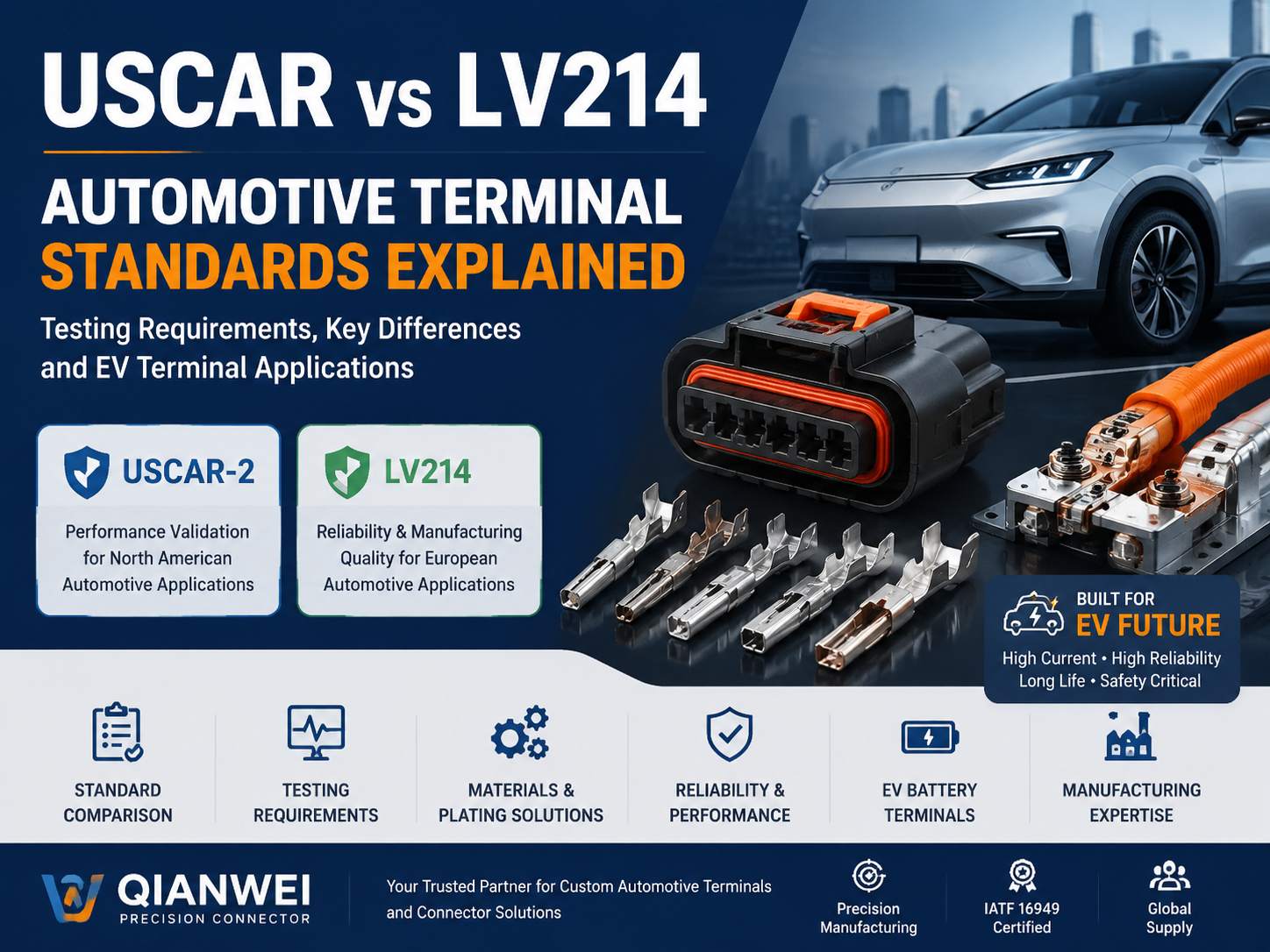
Introduction: Why Automotive Terminal Standards Matter
Modern vehicles are becoming increasingly dependent on electrical and electronic systems. From traditional engine control systems and safety modules to advanced driver assistance systems (ADAS), electric vehicle (EV) battery systems, and intelligent cockpit technologies, reliable electrical connections are essential for vehicle performance and safety.
At the center of these electrical systems are automotive terminals and connectors. Although they are small components, terminals play a critical role in ensuring stable power transmission and signal communication throughout the vehicle.
A failure in an automotive terminal can lead to serious problems, including:
- Intermittent electrical connection
- Increased contact resistance
- Signal interruption
- Power loss
- System malfunction
- Potential safety risks
Unlike consumer electronic connectors, automotive terminals must operate under extremely demanding conditions, including:
- Continuous vibration from driving
- Extreme temperature changes
- Humidity and water exposure
- Corrosive environments
- High current loads in electric vehicles
- Long service life requirements
To ensure reliability, global automotive manufacturers and suppliers rely on strict testing specifications. Among the most recognized automotive connector standards are:
- USCAR-2 (United States Automotive Connector Performance Standard)
- LV214 (German Automotive Connector Testing Standard)
These standards define performance requirements for electrical connectors, terminals, and wire harness systems, helping manufacturers achieve consistent quality and long-term reliability.
This article explains what USCAR and LV214 are, how they differ, what tests they require, and how automotive terminal manufacturers can meet these demanding requirements.
What Are Automotive Terminal Standards?
The Importance of Automotive Connector Reliability
An automotive terminal is responsible for creating a secure electrical connection between wires, components, and electronic control units (ECUs).
A high-quality terminal must provide:
1. Stable Electrical Performance
The terminal must maintain excellent conductivity while minimizing electrical resistance.
Important parameters include:
- Contact resistance
- Voltage drop
- Current carrying capability
- Thermal performance
For example, EV battery terminals often carry hundreds of amperes of current. Even a small increase in contact resistance can generate excessive heat and affect system safety.
2. Strong Mechanical Performance
Vehicles experience continuous mechanical stress during operation.
Automotive terminals must withstand:
- Road vibration
- Engine vibration
- Mechanical shock
- Repeated connection cycles
Key mechanical requirements include:
- Terminal retention force
- Insertion force
- Withdrawal force
- Locking performance
A terminal that becomes loose after long-term vibration may cause intermittent failures.
3. Environmental Durability
Automotive electrical components are exposed to harsh environments.
Typical challenges include:
- Temperature extremes from -40°C to +125°C
- High humidity
- Water exposure
- Salt corrosion
- Chemical contamination
Therefore, automotive terminals require:
- Corrosion-resistant materials
- Proper plating technology
- Reliable sealing structures
What Is USCAR-2 Automotive Terminal Standard?
Overview of USCAR
USCAR stands for United States Council for Automotive Research.
It was established by major American automotive manufacturers to improve cooperation and standardization within the automotive industry.
The most widely referenced connector specification is:
USCAR-2: Performance Specification for Automotive Electrical Connector Systems
USCAR-2 defines the performance requirements and testing methods for automotive electrical connector systems, including:
- Terminals
- Connector housings
- Wire harness assemblies
- Electrical connection interfaces
The standard is widely applied by automotive OEMs and Tier 1 suppliers in North America.
Its purpose is to verify that automotive connectors can maintain reliable electrical and mechanical performance throughout the vehicle lifetime.
Key Testing Requirements of USCAR-2
1. Electrical Performance Testing
Electrical reliability is one of the most important requirements in automotive terminal design.
USCAR-2 evaluates electrical performance through multiple tests.
Contact Resistance Testing
Contact resistance directly affects electrical efficiency.
Low contact resistance provides:
- Better conductivity
- Lower heat generation
- More stable current transmission
During testing, terminals are evaluated to ensure resistance remains within acceptable limits after environmental and mechanical stress.
Voltage Drop Testing
Voltage drop testing verifies whether a terminal can transfer electrical power efficiently.
A high-quality terminal should maintain stable voltage transmission even under:
- High current conditions
- Temperature changes
- Long-term operation
This is especially important for:
- EV battery connections
- Power distribution systems
- Motor control applications
Current Cycling Testing
Automotive terminals may experience repeated heating and cooling caused by current flow.
Current cycling testing evaluates:
- Thermal stability
- Contact reliability
- Resistance changes over time
This helps identify potential failure risks caused by thermal expansion and material fatigue.
2. Mechanical Performance Testing
Automotive terminals must maintain secure connections despite vibration and mechanical stress.
USCAR-2 evaluates several mechanical characteristics.
Terminal Insertion Force
Insertion force measures the force required to insert a terminal into a connector housing.
The goal is to achieve a balance:
- Too high → difficult assembly and increased production cost
- Too low → insufficient connection reliability
Precision terminal design ensures consistent insertion performance during automated assembly.
Terminal Retention Force
Terminal retention force measures how securely the terminal remains locked inside the connector housing.
High retention force prevents:
- Terminal back-out
- Loose connections
- Assembly failures
This is especially important for automotive wire harness systems installed in high-vibration areas.
Connector Mating Durability
Automotive connectors may require multiple connection and disconnection cycles during:
- Vehicle assembly
- Maintenance
- Service operations
Durability testing evaluates whether the terminal maintains stable performance after repeated mating cycles.
3. Environmental Reliability Testing
Automotive terminals must survive harsh operating environments.
USCAR-2 includes environmental tests such as:
Temperature Cycling Test
Vehicles experience significant temperature variations.
Testing evaluates performance under repeated temperature changes between:
- Low temperature conditions
- High temperature conditions
The goal is to ensure:
- Stable contact performance
- No material cracking
- No terminal deformation
Humidity Resistance Test
Moisture can accelerate corrosion and increase contact resistance.
Humidity testing verifies:
- Plating protection
- Material durability
- Electrical stability
Corrosion Resistance Test
Automotive terminals often use protective plating such as:
- Tin plating
- Nickel plating
- Gold plating
Corrosion testing evaluates whether terminals maintain reliable conductivity after exposure to corrosive environments.
What Is LV214 Automotive Connector Standard?
Overview of LV214
LV214 is one of the most important automotive connector testing specifications used in the European automotive industry.
The full name of LV214 is:
Electrical and Mechanical Test Specification for Connector Systems in Motor Vehicles
Unlike general electrical connector standards, LV214 was developed specifically for automotive applications, focusing on the long-term reliability of connector systems used in vehicles.
The standard was mainly promoted by German automotive manufacturers and suppliers to establish consistent testing requirements for automotive electrical connections.
It is commonly associated with European automotive OEM supply chains, including:
- Premium passenger vehicle manufacturers
- Automotive wiring harness suppliers
- Connector manufacturers
- Tier 1 electrical system suppliers
LV214 evaluates not only the connector itself but also the complete connection system, including:
- Terminal design
- Connector housing
- Wire crimp connection
- Mechanical locking structure
- Electrical performance
- Environmental durability
For automotive terminal manufacturers, meeting LV214 requirements means having strong capabilities in:
- Precision stamping
- Material control
- Plating technology
- Crimping process control
- Reliability testing
Why Do European Automotive Manufacturers Use LV214?
European vehicles are known for advanced electronic systems and strict reliability requirements.
Modern vehicles contain hundreds of electrical connectors controlling:
- Powertrain systems
- Battery management systems
- Safety systems
- Infotainment systems
- ADAS functions
- Body electronics
A connector failure may affect:
- Vehicle operation
- Passenger safety
- System communication
Therefore, European automotive manufacturers require suppliers to demonstrate that terminals can maintain stable performance throughout the vehicle lifecycle.
LV214 provides a standardized method to verify:
- Electrical reliability
- Mechanical durability
- Manufacturing consistency
- Environmental resistance
Key Testing Requirements of LV214
LV214 includes several categories of testing to evaluate automotive connector performance.
The main areas include:
- Mechanical performance testing
- Electrical performance testing
- Environmental durability testing
- Crimp connection quality evaluation
- Vibration and mechanical stress testing
1. Mechanical Performance Testing According to LV214
Terminal Insertion and Withdrawal Force
Similar to USCAR requirements, LV214 evaluates the mechanical forces required during connector assembly.
Important parameters include:
Terminal Insertion Force
The force required to insert the terminal into the connector housing.
A well-designed terminal should provide:
- Smooth assembly
- Stable locking
- Reliable contact pressure
Terminal Withdrawal Force
The force required to remove the terminal from the housing.
Insufficient retention force may cause:
- Terminal movement
- Connection interruption
- Electrical failure
Therefore, LV214 requires terminals to maintain sufficient mechanical retention during vehicle operation.
2. Crimp Quality: A Core Requirement of LV214
One of the biggest differences between LV214 and many general connector standards is its strong focus on crimp connection quality.
In automotive wire harness manufacturing, the terminal-to-wire crimp connection is one of the most critical points.
Even if the terminal material and design are excellent, poor crimping can result in:
- Increased electrical resistance
- Wire pull-out failure
- Heat generation
- Intermittent connection
LV214 emphasizes controlling the complete crimping process.
Important Crimp Parameters
1. Crimp Height
Crimp height measures the compressed height of the terminal barrel after wire crimping.
Correct crimp height ensures:
- Proper mechanical strength
- Stable electrical contact
- Consistent production quality
2. Crimp Width
Crimp width affects:
- Compression uniformity
- Wire contact area
- Pull-out strength
3. Pull-Out Force
Pull-out force testing verifies how much force is required to separate the wire from the terminal.
Higher pull-out strength indicates:
- Better mechanical connection
- More reliable wire harness performance
4. Crimp Force Monitoring
Automotive manufacturers increasingly require real-time monitoring of crimping processes.
This helps detect:
- Missing wires
- Incorrect terminal positioning
- Abnormal crimp pressure
- Production defects
For high-volume automotive terminal production, process monitoring is essential for maintaining consistent quality.
3. Electrical Reliability Testing in LV214
Electrical performance is a key evaluation area in LV214.
Typical tests include:
Contact Resistance Testing
Contact resistance directly influences:
- Power efficiency
- Heat generation
- Signal stability
Low and stable contact resistance ensures reliable electrical transmission.
Current Carrying Capability Testing
Automotive terminals must safely handle rated current loads.
This is especially important for:
- EV battery connections
- Charging systems
- Power distribution modules
Testing evaluates:
- Temperature rise
- Current stability
- Long-term reliability
Voltage Drop Testing
Voltage drop testing confirms that electrical losses remain within acceptable limits.
A reliable terminal should maintain:
- Stable voltage transmission
- Consistent performance
- Low energy loss
4. Environmental Durability Testing
Automotive terminals must operate under extreme environmental conditions.
LV214 evaluates resistance against:
Temperature Cycling
Vehicles experience repeated temperature changes during:
- Engine operation
- Parking conditions
- Seasonal temperature variation
Temperature cycling tests verify:
- Material stability
- Contact reliability
- Housing durability
Humidity and Moisture Resistance
Moisture can cause:
- Oxidation
- Corrosion
- Increased resistance
LV214 evaluates whether connector systems can maintain electrical performance in humid environments.
Corrosion Resistance
Automotive connectors may encounter:
- Road salt
- Water spray
- Industrial contaminants
Testing evaluates:
- Plating protection
- Terminal surface durability
- Long-term conductivity
Common plating solutions include:
Tin Plating
Advantages:
- Good electrical conductivity
- Cost-effective
- Widely used in automotive terminals
Nickel Plating
Advantages:
- High-temperature resistance
- Strong corrosion protection
Gold Plating
Advantages:
- Excellent conductivity
- Extremely low contact resistance
Usually applied in:
- Signal terminals
- High-reliability applications
5. LV214 Vibration Testing and Severity Grades
Vehicle vibration is one of the biggest challenges for electrical connections.
Automotive terminals installed in different vehicle locations experience different vibration levels.
LV214 defines different vibration requirements based on application conditions.
Typical vibration classifications include:
| Vibration Grade | Typical Application |
|---|---|
| SG1 | Low vibration areas, interior electronics |
| SG2 | General vehicle applications |
| SG3 | High vibration areas |
| SG4 | Severe environments such as powertrain areas |
Higher vibration grades require stronger:
- Terminal retention design
- Contact force stability
- Mechanical locking structures
Why LV214 Is Important for Automotive Terminal Suppliers
For a terminal manufacturer, LV214 is not only a testing requirement.
It represents a complete manufacturing capability evaluation.
A supplier needs strong control over:
Material Selection
Common materials:
- Phosphor bronze (C5191)
- Copper alloy (C7025)
- Brass
Requirements:
- Stable conductivity
- Good spring performance
- Corrosion resistance
Precision Stamping
Automotive terminals require:
- Accurate dimensions
- Consistent tolerances
- Smooth contact surfaces
Precision stamping directly affects:
- Contact force
- Insertion performance
- Electrical reliability
Plating Control
Plating thickness and uniformity influence:
- Corrosion resistance
- Contact resistance
- Service life
Automated Quality Inspection
Mass production requires:
- Dimensional inspection
- Electrical testing
- Force testing
- Surface inspection
This ensures every terminal meets automotive requirements.
USCAR vs LV214: Understanding the Differences Between Automotive Connector Standards
USCAR and LV214 are two of the most recognized automotive connector testing specifications in the global automotive industry.
Although both standards aim to ensure reliable electrical connections, they were developed for different automotive markets and have slightly different priorities.
In simple terms:
- USCAR focuses on connector system performance and reliability, mainly for North American automotive applications.
- LV214 focuses on connector reliability plus manufacturing process quality, especially for European automotive applications.
For automotive terminal manufacturers, understanding these differences is essential when developing products for global customers.
USCAR vs LV214 Comparison Table
| Category | USCAR-2 | LV214 |
|---|---|---|
| Origin | United States | Germany |
| Main Market | North America | Europe |
| Developed For | Automotive electrical connector systems | Automotive connector systems in vehicles |
| Main Focus | Connector performance validation | Connector performance + production quality |
| Typical Users | US automotive OEM suppliers | European automotive OEM suppliers |
| Electrical Testing | Required | Required |
| Mechanical Testing | Required | Required |
| Temperature Testing | Required | Required |
| Corrosion Testing | Required | Required |
| Vibration Testing | Required | Required with detailed severity levels |
| Crimp Quality Evaluation | Important | Strong emphasis |
| Manufacturing Process Control | Required | Highly emphasized |
1. Difference in Development Background
USCAR: Developed for North American Automotive Requirements
USCAR was created through cooperation between major North American automotive manufacturers.
The goal was to establish a unified performance evaluation system for automotive electrical connectors.
The standard focuses on answering:
Can this connector maintain reliable electrical and mechanical performance throughout vehicle operation?
Therefore, USCAR-2 places strong emphasis on:
- Electrical stability
- Connector durability
- Environmental resistance
- Mechanical reliability
It is widely recognized in automotive supply chains serving North American vehicles.
LV214: Developed for German Automotive Engineering Requirements
LV214 was created based on the requirements of German automotive manufacturers and suppliers.
German automotive engineering traditionally places strong emphasis on:
- Precision manufacturing
- Process control
- Long-term reliability
- Zero-defect production
Therefore, LV214 not only tests whether a connector works, but also evaluates whether the manufacturing process can consistently produce reliable connections.
This is why LV214 places significant attention on:
- Terminal crimp quality
- Production consistency
- Wire harness manufacturing control
2. Difference in Testing Focus
USCAR Focus: Connector System Performance
USCAR-2 mainly evaluates the overall performance of the connector system.
Key questions:
- Can the connector maintain electrical conductivity?
- Can the terminal withstand vibration?
- Can the connection survive temperature changes?
- Does the terminal maintain retention force?
Typical tests include:
Electrical Performance
- Contact resistance
- Voltage drop
- Current cycling
Mechanical Performance
- Terminal retention force
- Insertion force
- Withdrawal force
Environmental Performance
- Temperature cycling
- Humidity
- Corrosion
- Chemical resistance
LV214 Focus: Connection System and Manufacturing Quality
LV214 evaluates not only the connector design but also the quality of the manufacturing process.
It asks:
Can this supplier repeatedly manufacture reliable terminals and wire harness connections?
Therefore, LV214 pays more attention to:
Terminal Crimping Process
Including:
- Crimp height
- Crimp width
- Pull-out force
- Crimp force monitoring
Production Consistency
Including:
- Dimensional accuracy
- Process capability
- Quality inspection
This makes LV214 especially important for high-volume automotive wire harness production.
3. Difference in Vibration Requirements
Both standards require vibration testing because vehicle environments create continuous mechanical stress.
However, LV214 provides more detailed vibration classification.
USCAR Vibration Testing
USCAR evaluates whether connectors can maintain performance under vibration conditions.
The focus is:
- No electrical interruption
- No terminal damage
- No mechanical failure
LV214 Vibration Grades
LV214 classifies vibration requirements according to application location.
Example:
| Grade | Application Example |
|---|---|
| SG1 | Vehicle interior electronics |
| SG2 | Standard vehicle areas |
| SG3 | Engine compartment applications |
| SG4 | High vibration and harsh environments |
This allows engineers to select appropriate connector designs based on installation location.
For example:
An EV battery connection system may require higher vibration resistance compared with an interior control module.
4. Difference in Crimp Connection Requirements
This is one of the most important differences.
Why Crimp Quality Matters
In automotive wire harness systems, the terminal and wire connection is created through mechanical crimping.
A poor crimp can cause:
- Higher resistance
- Heat accumulation
- Signal instability
- Wire separation
Even a high-quality terminal can fail if the crimp process is uncontrolled.
USCAR Approach
USCAR evaluates the performance of the connector system after assembly.
It focuses on:
- Electrical reliability
- Mechanical strength
- Environmental durability
LV214 Approach
LV214 places stronger emphasis on the crimp manufacturing process itself.
Manufacturers are expected to control:
- Terminal positioning
- Wire insertion depth
- Crimp height
- Crimp force
- Pull-out strength
For automotive terminal suppliers, this means advanced production control systems are required.
5. USCAR and LV214 Requirements for EV Battery Terminals
Electric vehicles have significantly increased requirements for automotive terminals.
Compared with traditional vehicles, EV systems involve:
- Higher voltage
- Higher current
- Higher thermal load
- Longer service life requirements
Examples include:
- Battery pack terminals
- Charging connectors
- Power distribution terminals
- Motor connection terminals
High Current Performance
EV battery terminals must provide:
- Low contact resistance
- Excellent conductivity
- Stable current transmission
Common materials include:
Copper Alloy
Advantages:
- Excellent conductivity
- Good mechanical strength
- Suitable for high-current applications
Examples:
- C7025 copper alloy
- Phosphor bronze C5191
Thermal Reliability
High current creates heat.
A reliable EV terminal must control:
- Temperature rise
- Material expansion
- Contact pressure changes
USCAR and LV214 testing helps verify long-term thermal stability.
Mechanical Safety
EV battery systems experience:
- Vehicle vibration
- Thermal expansion
- Mechanical shock
Terminal design must ensure:
- Strong locking
- Stable contact force
- Reliable connection throughout vehicle life
6. Which Standard Should Automotive Terminal Suppliers Follow?
The answer depends on the target market.
For North American Automotive Customers
Focus on:
- USCAR-2 performance requirements
- Electrical reliability testing
- Mechanical durability
- Environmental testing
Typical customers:
- US automotive OEM suppliers
- Automotive electronics companies
- Wire harness manufacturers
For European Automotive Customers
Focus on:
- LV214 requirements
- Crimp quality control
- Manufacturing consistency
- Advanced inspection capability
Typical customers:
- German automotive suppliers
- European EV manufacturers
- Premium vehicle manufacturers
For Global Automotive Supply Chains
Many international suppliers need to understand both standards.
A manufacturer capable of supporting both USCAR and LV214 requirements can serve:
- North American customers
- European customers
- Global EV manufacturers
This provides stronger competitiveness in the automotive connector market.
What Does This Mean for Automotive Terminal Manufacturers?
Meeting USCAR and LV214 requirements requires more than producing metal stamped parts.
A professional automotive terminal supplier needs:
1. Advanced Manufacturing Capability
Including:
- Precision stamping
- Progressive die technology
- Injection molding
- Automated assembly
2. Material and Plating Expertise
Capability in:
- Copper alloy selection
- Tin plating
- Nickel plating
- Gold plating
3. Automotive Quality Management
Important systems include:
- IATF 16949
- ISO 9001
- Automotive PPAP process
- Traceability management
4. Reliability Testing Capability
Including:
- Contact resistance testing
- Salt spray testing
- Temperature cycling
- Vibration testing
- Pull force testing
How USCAR and LV214 Apply to EV Battery Terminals
The rapid growth of electric vehicles (EVs) has significantly increased the performance requirements for automotive terminals.
Traditional automotive electrical systems typically operate at lower voltage and current levels. However, EV power systems involve:
- High-voltage battery packs
- High-current charging systems
- Electric motors
- Battery management systems (BMS)
- Power distribution units (PDU)
In these applications, a small terminal failure can lead to:
- Excessive heat generation
- Power interruption
- Reduced vehicle performance
- Safety risks
Therefore, EV battery terminals must achieve higher levels of:
- Electrical conductivity
- Mechanical strength
- Thermal stability
- Corrosion resistance
- Long-term reliability
Standards such as USCAR and LV214 provide important guidelines for validating these performance requirements.
Why EV Battery Terminals Require Higher Reliability
1. Higher Current Loads
Electric vehicles require significantly more electrical power compared with traditional vehicles.
Battery terminals may carry:
- High continuous current
- Short-term peak current
- Frequent charging and discharging cycles
When current flows through a terminal, electrical resistance generates heat.
The relationship can be explained by:
Power loss = Current² × Resistance
This means even a small increase in contact resistance can create significant heat under high-current conditions.
Therefore, EV terminals require:
- Low contact resistance
- Stable contact pressure
- Excellent conductivity materials
2. Extreme Thermal Conditions
EV battery systems generate heat during:
- Fast charging
- High-speed driving
- Heavy acceleration
- Battery discharge cycles
Automotive terminals must maintain performance under temperature fluctuations.
Typical requirements include:
- High-temperature resistance
- Thermal cycling durability
- Stable plating performance
Poor thermal performance may result in:
- Increased resistance
- Terminal deformation
- Reduced connection reliability
3. Long Service Life Requirements
Modern vehicles are designed for long operating lifetimes.
EV battery terminals must maintain performance through:
- Thousands of charging cycles
- Years of vibration exposure
- Continuous environmental stress
Therefore, terminal design must consider:
- Material fatigue
- Contact force stability
- Corrosion protection
Material Selection for Automotive Terminals
Material selection directly affects terminal performance.
Automotive terminal manufacturers commonly use copper-based alloys because they provide an excellent balance between:
- Electrical conductivity
- Mechanical strength
- Spring performance
- Corrosion resistance
1. Phosphor Bronze (C5191) Automotive Terminals
Phosphor bronze is widely used for automotive electrical terminals.
Advantages include:
Excellent Spring Performance
Phosphor bronze maintains stable elastic properties.
This helps ensure:
- Reliable contact pressure
- Long mating life
- Vibration resistance
Good Electrical Conductivity
Although copper has higher conductivity, phosphor bronze provides a better balance between:
- Conductivity
- Mechanical strength
This makes it suitable for:
- Automotive connectors
- Sensor terminals
- Wire harness terminals
Strong Corrosion Resistance
Phosphor bronze performs well in demanding environments.
It can withstand:
- Humidity
- Temperature changes
- Automotive operating conditions
2. Copper Alloy C7025 Automotive Terminals
C7025 copper alloy is another popular material for high-performance automotive terminals.
Key advantages:
High Electrical Conductivity
Suitable for:
- Power terminals
- Battery connections
- High-current applications
High Strength
C7025 provides:
- Good mechanical durability
- Stable terminal structure
- Resistance to deformation
Excellent Manufacturing Performance
It works well with:
- Precision stamping
- High-speed production
- Automated assembly
Automotive Terminal Plating Technology
Plating plays an essential role in automotive terminal reliability.
The correct plating solution improves:
- Corrosion resistance
- Contact stability
- Service life
- Electrical performance
Tin Plated Automotive Terminals
Tin plating is one of the most common solutions.
Advantages:
- Good conductivity
- Cost-effective
- Suitable for mass automotive applications
Common applications:
- Power terminals
- Battery connectors
- Wire harness terminals
Nickel Plated Automotive Terminals
Nickel plating provides:
- High-temperature resistance
- Strong corrosion protection
- Improved surface durability
It is often used in:
- Engine compartment applications
- High-temperature environments
Gold Plated Automotive Terminals
Gold plating provides excellent electrical performance.
Advantages:
- Extremely low contact resistance
- Excellent corrosion resistance
- Stable signal transmission
Common applications:
- Sensors
- Electronic control systems
- Low-current signal connectors
Manufacturing Process for USCAR and LV214-Compliant Automotive Terminals
Producing automotive terminals that meet demanding standards requires strict manufacturing control.
A professional automotive terminal manufacturing process typically includes:
Step 1: Precision Stamping
Metal stamping is the foundation of terminal manufacturing.
High-precision progressive stamping produces:
- Accurate terminal dimensions
- Consistent geometry
- Stable contact structure
Important factors include:
- Tool precision
- Material feeding accuracy
- Stamping speed control
Poor stamping quality may affect:
- Contact force
- Terminal insertion performance
- Connector reliability
Step 2: Surface Treatment and Plating
After stamping, terminals undergo surface treatment.
The process controls:
- Plating thickness
- Surface uniformity
- Adhesion quality
Proper plating ensures:
- Stable electrical performance
- Long-term corrosion resistance
Step 3: Injection Molding and Connector Assembly
Many automotive connector systems require plastic housings.
Injection molding ensures:
- Accurate housing dimensions
- Proper terminal positioning
- Reliable locking structures
The terminal and housing must work together as a complete connection system.
Step 4: Quality Inspection and Reliability Testing
Automotive terminal manufacturers must perform strict inspection.
Typical tests include:
Dimensional Inspection
Checks:
- Terminal length
- Width
- Thickness
- Critical tolerances
Mechanical Testing
Includes:
- Insertion force
- Retention force
- Pull-out force
Electrical Testing
Includes:
- Contact resistance
- Voltage drop
- Current capability
Environmental Testing
Includes:
- Temperature cycling
- Salt spray
- Humidity testing
Qianwei Precision Automotive Terminal Manufacturing Capability
As automotive electrical systems continue to evolve, manufacturers need suppliers with strong engineering capability and production experience.
Guangdong Qianwei Precision Connector Co., Ltd. specializes in customized automotive terminals, precision connectors, and wire harness components for global industrial applications.
With more than 10 years of manufacturing experience, Qianwei Precision provides:
- Precision metal stamping
- Plastic injection molding
- Cable assembly
- Custom terminal development
- High-volume production support
Precision Manufacturing for Automotive Applications
Qianwei Precision supports automotive terminal projects requiring:
- High dimensional accuracy
- Stable electrical performance
- Reliable mechanical strength
- Consistent mass production quality
Manufacturing capabilities include:
Precision Stamping
Supporting:
- Copper alloy terminals
- Battery terminals
- Wire harness terminals
Custom Tooling Development
In-house mold capability helps improve:
- Development speed
- Product consistency
- Cost control
Automated Production
Automation improves:
- Production efficiency
- Quality consistency
- Batch-to-batch reliability
Quality Control for Automotive Terminal Reliability
Automotive customers require strong quality management throughout the manufacturing process.
Key quality controls include:
Material Inspection
Ensuring:
- Correct alloy composition
- Stable material performance
Process Monitoring
Monitoring:
- Stamping accuracy
- Plating quality
- Assembly consistency
Performance Testing
Verification includes:
- Electrical testing
- Mechanical testing
- Environmental reliability testing
These controls help automotive terminals meet demanding application requirements.
How to Choose an Automotive Terminal Manufacturer?
Choosing the right automotive terminal supplier is critical for vehicle reliability, production stability, and long-term supply chain success.
Automotive terminals are not simple stamped metal parts. They are safety-related components that require:
- Advanced manufacturing technology
- Strict quality control
- Reliable testing capability
- Automotive industry experience
When evaluating a supplier, automotive engineers and purchasing teams should consider several key factors.
1. Check Automotive Industry Experience
A qualified automotive terminal manufacturer should understand the requirements of automotive applications.
Important experience includes:
- Automotive wire harness components
- EV battery terminals
- High-current connectors
- Sensor terminals
- Power distribution terminals
Automotive projects require different capabilities compared with general electronic connectors because they involve:
- Higher reliability requirements
- Longer product lifecycles
- Stricter quality systems
A supplier with automotive experience can better support:
- Design optimization
- Material selection
- Production validation
- Reliability improvement
2. Evaluate Quality Management Systems
Automotive customers usually require suppliers to operate under strict quality management systems.
Important certifications and systems include:
IATF 16949
IATF 16949 is one of the most important quality management standards in the automotive industry.
It focuses on:
- Defect prevention
- Process control
- Continuous improvement
- Supply chain quality
A manufacturer following automotive quality systems can better control:
- Production consistency
- Traceability
- Risk management
ISO 9001 Quality Management
ISO 9001 demonstrates that a company has established systematic quality management processes.
It covers:
- Manufacturing control
- Inspection procedures
- Customer satisfaction improvement
PPAP Capability
Automotive customers often require PPAP (Production Part Approval Process).
PPAP verifies that a supplier can consistently produce parts that meet customer requirements.
Typical PPAP documents include:
- Product drawings
- Process flow charts
- Control plans
- Inspection reports
- Capability studies
- Sample approval records
3. Verify Testing and Validation Capability
A professional automotive terminal supplier should have the ability to verify product performance.
Important testing capabilities include:
Electrical Testing
Including:
- Contact resistance testing
- Voltage drop testing
- Current carrying capability testing
These tests confirm stable electrical performance.
Mechanical Testing
Including:
- Terminal retention force
- Insertion force
- Withdrawal force
- Pull-out force
These tests ensure reliable mechanical connection.
Environmental Testing
Including:
- Temperature cycling
- Humidity testing
- Salt spray testing
- Corrosion resistance testing
These tests simulate real vehicle operating conditions.
4. Check Material and Plating Expertise
Material selection has a direct impact on terminal performance.
A capable supplier should understand different copper alloy options.
Common materials include:
Phosphor Bronze (C5191)
Suitable for:
- Connector terminals
- Signal applications
- Spring contact components
Advantages:
- Good elasticity
- Stable contact force
- Corrosion resistance
Copper Alloy (C7025)
Suitable for:
- High-current terminals
- EV applications
- Power connectors
Advantages:
- Excellent conductivity
- High strength
- Good thermal performance
Brass
Suitable for:
- General electrical terminals
- Cost-sensitive applications
Advantages:
- Good machinability
- Balanced performance
Plating selection should also match the application.
Examples:
| Plating | Typical Application |
|---|---|
| Tin | Power terminals, battery connections |
| Nickel | High-temperature environments |
| Gold | Signal and high-reliability connections |
5. Evaluate Manufacturing Capability
Automotive terminal production requires precise and stable manufacturing processes.
Important capabilities include:
Precision Metal Stamping
The supplier should have:
- High-speed stamping equipment
- Precision tooling
- Stable production control
This ensures:
- Accurate dimensions
- Consistent contact performance
- Reliable assembly
In-House Tooling Development
A strong mold capability helps suppliers provide:
- Faster product development
- Better design control
- Improved production stability
Automated Production
Automation helps achieve:
- Higher consistency
- Lower defect rates
- Stable mass production
This is especially important for automotive customers requiring millions of terminals annually.
6. Confirm Customization Capability
Automotive applications often require customized solutions.
A capable terminal manufacturer should support customization of:
Material
Options include:
- Copper alloy
- Phosphor bronze
- Brass
Plating
Options include:
- Tin plating thickness
- Nickel plating
- Gold plating
Mechanical Performance
Customization may include:
- Contact force
- Retention force
- Terminal geometry
Packaging
Options include:
- Reel packaging
- Tape packaging
- Bulk packaging
7. Review Supplier Communication and Engineering Support
Automotive projects often require close cooperation between customers and suppliers.
A reliable supplier should provide:
- Technical communication
- Drawing review
- DFM suggestions
- Prototype support
- Production optimization
Engineering support during the design stage can prevent:
- Manufacturing difficulties
- Cost increases
- Reliability issues
Why Choose Qianwei Precision for Automotive Terminal Solutions?
As automotive manufacturers continue moving toward electrification and intelligent vehicles, reliable terminal solutions have become more important than ever.
Qianwei Precision provides customized automotive terminal manufacturing solutions for customers requiring:
- High electrical performance
- Precision manufacturing
- Reliable quality control
- Stable mass production
Our capabilities include:
Precision Metal Stamping
Supporting:
- Automotive terminals
- Battery terminals
- Connector components
- Wire harness terminals
Custom Connector Manufacturing
Including:
- Terminal development
- Plastic injection molding
- Connector assembly
Integrated Manufacturing Capability
With in-house capabilities covering:
- Tooling development
- Precision stamping
- Injection molding
- Cable assembly
- Quality inspection
Qianwei Precision helps customers reduce supply chain complexity and improve product reliability.
Conclusion: Understanding Automotive Terminal Standards for Better Supplier Selection
Automotive terminals are small components with a critical role in vehicle safety and performance.
As vehicles become more electrified and connected, terminal requirements continue to increase.
USCAR and LV214 provide important guidelines to evaluate:
- Electrical reliability
- Mechanical durability
- Environmental resistance
- Manufacturing consistency
The key differences are:
- USCAR focuses on automotive connector performance validation, mainly for North American applications.
- LV214 focuses on connector reliability and manufacturing process quality, especially in European automotive supply chains.
For automotive OEMs and Tier 1 suppliers, choosing a terminal manufacturer with:
- Precision manufacturing capability
- Automotive quality systems
- Reliability testing experience
- Material and plating expertise
is essential for building reliable vehicle electrical systems.
Qianwei Precision supports global customers with customized automotive terminals, EV battery terminal solutions, and connector components designed for demanding automotive applications.
Looking for a reliable automotive terminal manufacturer? Contact Qianwei Precision for customized connector and terminal solutions.
FAQs
Q1: What is the difference between USCAR and LV214?
USCAR and LV214 are automotive connector testing specifications used in different markets.
USCAR is mainly used in North American automotive applications and focuses on connector system performance.
LV214 is commonly used in European automotive applications and places stronger emphasis on connector reliability, crimp quality, and manufacturing process control.
Q2: Is USCAR a certification?
No.
USCAR is not a certification like ISO 9001 or IATF 16949.
It is a performance specification that defines testing requirements for automotive electrical connector systems.
Manufacturers use USCAR testing methods to verify product reliability.
Q3: Is LV214 only for German automotive manufacturers?
LV214 was developed mainly for German automotive applications, but its requirements are widely referenced by European automotive suppliers.
Many global connector manufacturers consider LV214 when developing products for European vehicle platforms.
Q4: What tests should automotive terminals pass?
Common automotive terminal validation tests include:
- Contact resistance testing
- Current cycling testing
- Temperature cycling testing
- Vibration testing
- Corrosion resistance testing
- Terminal retention testing
- Insertion and withdrawal force testing
Q5: What materials are commonly used for automotive terminals?
Common materials include:
- C5191 phosphor bronze
- C7025 copper alloy
- Brass
The final material selection depends on:
- Current requirement
- Mechanical strength
- Temperature conditions
- Application environment
Q6: Are USCAR and LV214 important for EV battery terminals?
Yes.
EV battery terminals require extremely high reliability because they handle:
- High current
- High voltage
- Thermal stress
- Long service life requirements
USCAR and LV214 provide valuable guidelines for validating electrical and mechanical performance.

