

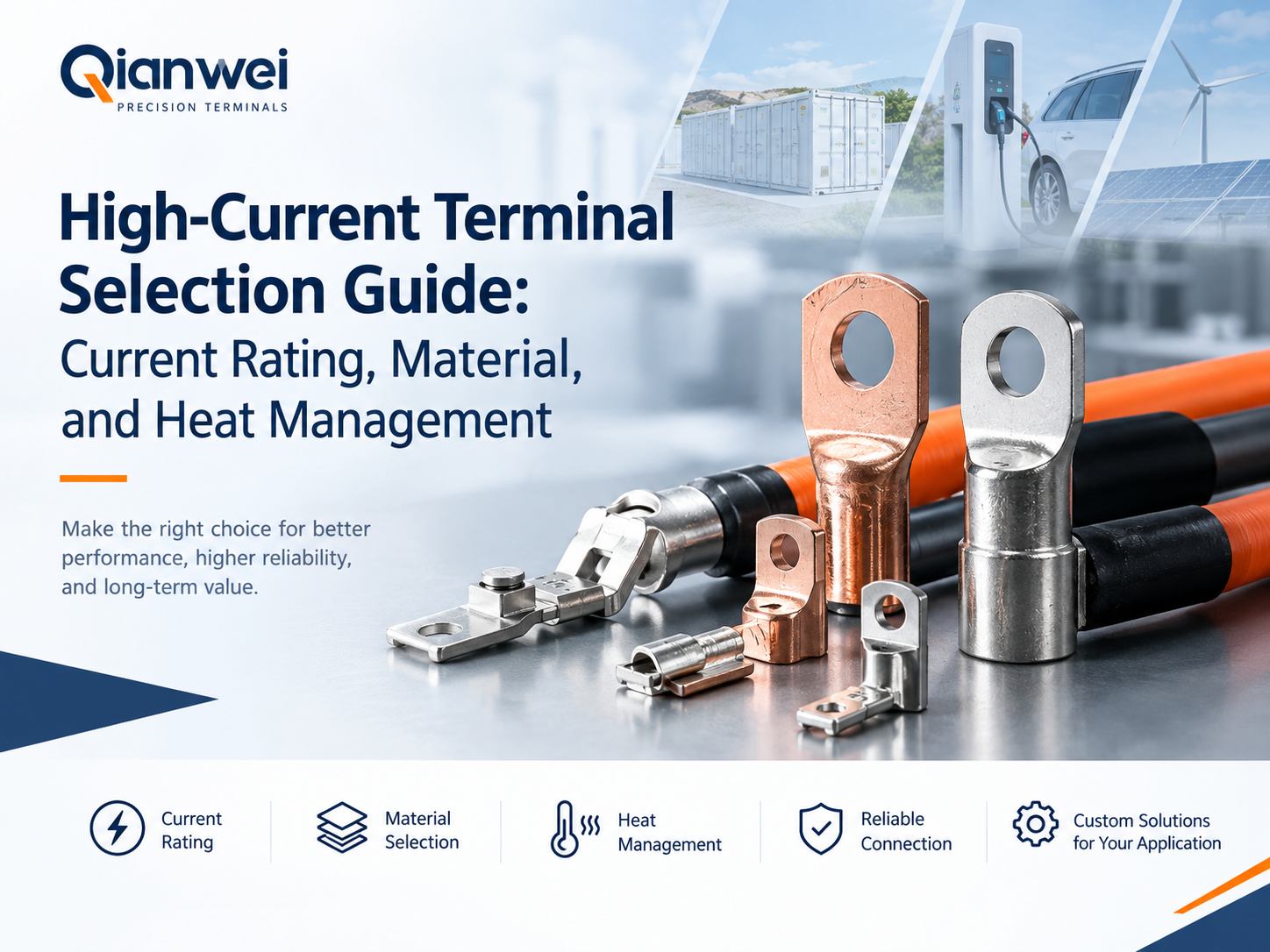
Choosing the right high-current terminal is important for any electrical system that handles significant power. A terminal may look like a relatively small component, but its electrical resistance, material, contact area, and connection quality can directly affect system performance and reliability.
For battery systems, energy storage equipment, EV charging systems, industrial power equipment, and other high-current applications, selecting a terminal based only on its advertised current rating is not enough. Engineers and purchasing teams also need to consider temperature rise, conductor size, material, plating, crimp quality, operating environment, and expected service life.
So, how do you choose a high-current terminal for a specific application?
This guide explains the key factors to consider, from current rating and material selection to heat management, testing, and customization.
What Is a High-Current Terminal?
A high-current terminal is an electrical terminal designed to carry relatively large amounts of current while maintaining acceptable electrical and mechanical performance.
Compared with standard electrical terminals, high-current terminals generally require greater attention to:
- Current-carrying capability
- Contact resistance
- Temperature rise
- Terminal thickness
- Contact area
- Mechanical strength
- Crimp quality
- Plating and corrosion resistance
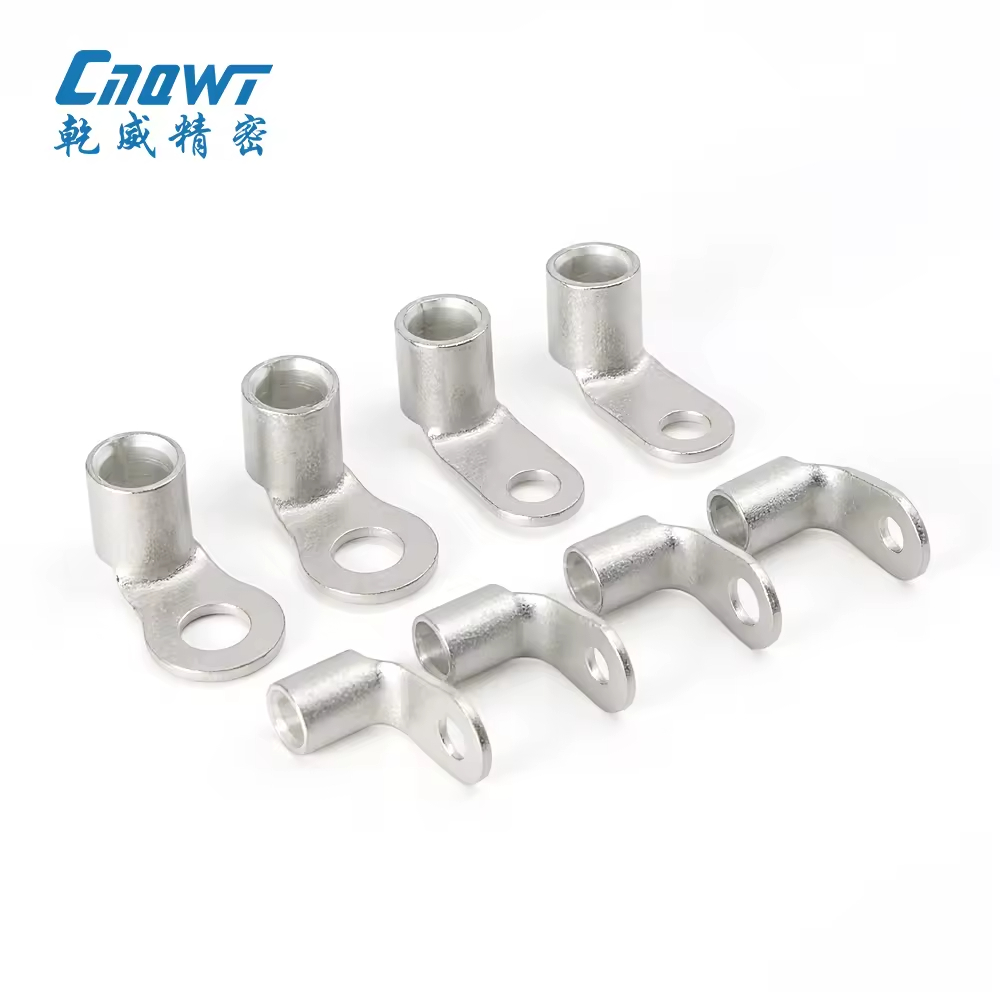
High-current terminals are commonly used in battery systems, BESS, EV charging equipment, industrial power equipment, power distribution systems, renewable energy equipment, and other applications where electrical loads are relatively high.
The exact definition of “high current” depends on the application. There is no single current value that automatically makes a terminal a high-current terminal. Instead, the terminal must be evaluated according to the current, conductor size, operating conditions, and applicable requirements of the specific system.
1. Start With the Required Current Rating
The first step in selecting a high-current terminal is understanding how much current the terminal needs to carry.
However, do not look only at the maximum current shown on the equipment specification.
Continuous Current vs. Peak Current
Electrical systems can experience different types of loads.
Continuous current is the current that the terminal is expected to carry for an extended period. This is particularly important for applications such as battery storage and industrial power equipment.
Peak current is a higher current that may occur for a short period. Starting motors, charging systems, and certain power electronics can generate temporary current peaks.
A suitable terminal should be able to handle the actual operating conditions rather than simply the nominal current.
For example, a system operating at 150 A continuously may require a different terminal solution from a system that normally operates at 80 A but occasionally reaches a much higher peak current.
Consider the Operating Conditions
Current capacity is affected by the environment in which the terminal is installed.
Important factors include:
- Ambient temperature
- Continuous operating time
- Duty cycle
- Airflow
- Enclosure design
- Installation density
- Nearby heat sources
- Cable size and configuration
A terminal operating inside a well-ventilated enclosure may have different thermal conditions from one installed in a compact sealed housing.
For this reason, current rating should always be considered together with temperature-rise requirements.
Leave a Reasonable Operating Margin
It is generally better to avoid designing a system so that the terminal operates continuously at its absolute limit.
A reasonable operating margin can help accommodate changes in temperature, load, manufacturing variation, and long-term operating conditions.
The appropriate margin depends on the application and the applicable testing or engineering requirements, so it should be determined based on actual system conditions rather than applying one fixed percentage to every project.
2. Choose the Right Terminal Material
Material selection has a direct effect on electrical conductivity, mechanical performance, manufacturability, and cost.
For high-current electrical terminals, copper, brass, and phosphor bronze are commonly considered depending on the required performance.
Copper
Copper offers excellent electrical conductivity and is widely used where low electrical resistance and efficient current transmission are important.
Copper terminals are particularly suitable for applications involving:
- Battery connections
- Power distribution
- High-current cables
- Energy storage equipment
- Industrial electrical systems
Copper can provide excellent electrical performance, although the specific copper grade, thickness, terminal geometry, and manufacturing process still need to be selected according to the application.
Brass
Brass provides a useful combination of electrical conductivity, mechanical strength, corrosion resistance, and stamping performance.
It can be suitable for electrical terminals where both mechanical properties and electrical performance are important.
For some applications, brass can also provide a practical balance between performance and manufacturing cost.
Phosphor Bronze
Phosphor bronze is known for its good spring properties, fatigue resistance, and mechanical durability.
It can be useful for terminals or contact components where maintaining contact force over time is important.
However, for applications requiring very high current conductivity, material selection should be evaluated carefully because conductivity is only one part of the overall terminal design.
Copper vs. Brass vs. Phosphor Bronze
There is no universally “best” material for every terminal.
| Property | Copper | Brass | Phosphor Bronze |
|---|---|---|---|
| Electrical conductivity | Excellent | Good | Moderate |
| Mechanical strength | Good | Good | Excellent |
| Spring properties | Moderate | Moderate | Excellent |
| High-current suitability | Excellent | Good | Application dependent |
| Typical application | Power and battery systems | Electrical terminals | Contact and spring components |
The final choice should consider current requirements, mechanical loads, manufacturing method, environment, cost, and customer specifications.
3. Pay Attention to Contact Resistance
Contact resistance is one of the most important factors in high-current terminal performance.
Even when the terminal material itself has good conductivity, poor contact conditions can create significant resistance at the connection point.
The relationship between current, resistance, and heat can be explained by:
P = I²R
where:
- P is power dissipated as heat
- I is current
- R is electrical resistance
As current increases, even a relatively small resistance can generate considerable heat.
What Causes High Contact Resistance?
Common causes include:
- Poor crimping
- Insufficient contact pressure
- Incorrect terminal dimensions
- Oxidation or contamination
- Poor plating
- Loose connections
- Insufficient contact area
- Terminal deformation
This is why a high-current terminal should not be evaluated only by its bulk material.
The actual connection between the terminal and conductor, and between the terminal and mating component, is equally important.
Why Low Contact Resistance Matters
Low and stable contact resistance can help reduce:
- Heat generation
- Voltage drop
- Energy loss
- Localized hot spots
- Long-term degradation
For high-current applications, maintaining stable electrical contact over the expected service life is often more important than achieving a high current rating on paper.
4. Understand Heat Management
Heat management is a critical part of high-current terminal selection.
When current flows through a terminal, electrical resistance generates heat. As current increases, heat generation can increase rapidly because it is proportional to the square of current.
This means that a small increase in current can have a much larger effect on heat generation.
Factors That Affect Terminal Temperature
Terminal temperature can be affected by:
- Current level
- Contact resistance
- Terminal material
- Terminal thickness
- Contact area
- Crimp quality
- Ambient temperature
- Airflow
- Installation configuration
- Duration of operation
For example, two terminals carrying the same current may have different temperature performance if one has a better contact structure or lower resistance.
Temperature Rise Matters
A terminal’s current rating should not be considered independently from its temperature-rise performance.
During engineering validation, it can be useful to evaluate the terminal under representative operating conditions and measure temperature at critical locations.
The objective is not simply to carry current, but to carry the required current without excessive temperature rise that could affect the terminal, insulation, surrounding components, or long-term reliability.
5. Consider Terminal Size, Thickness, and Contact Area
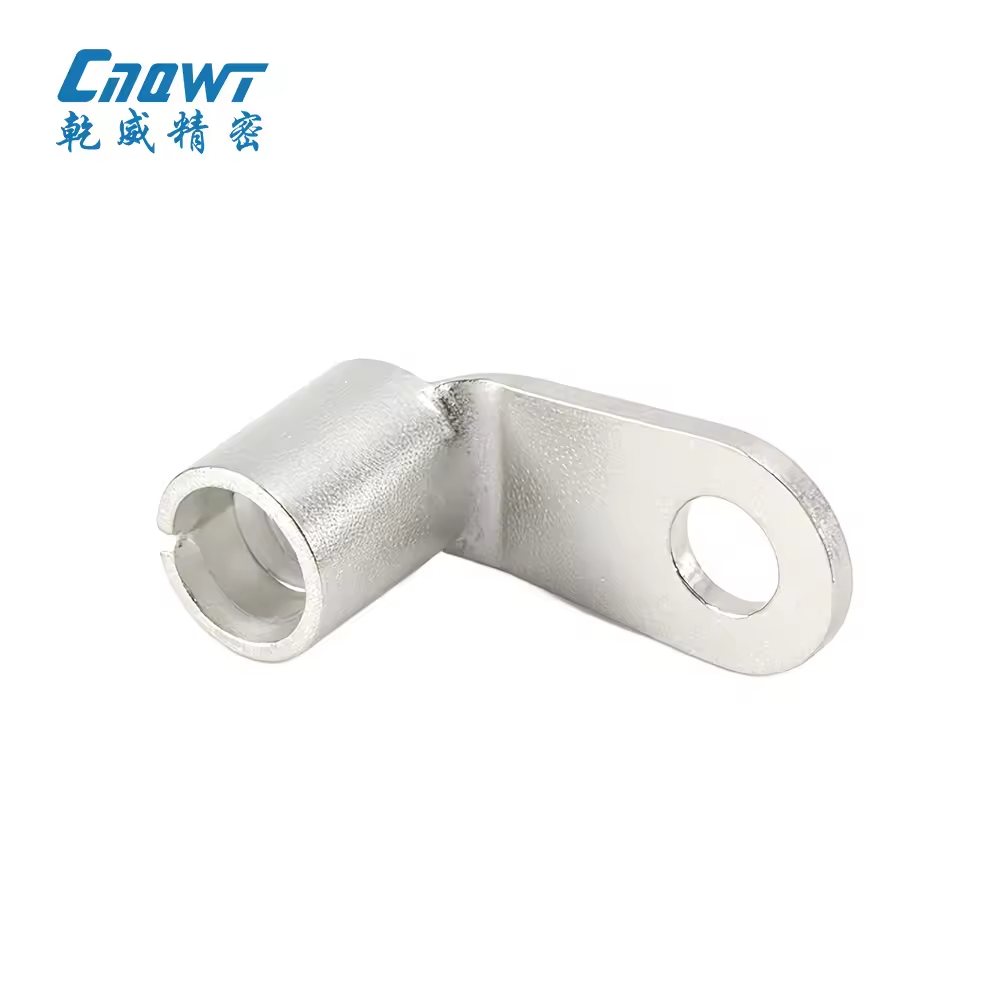
Terminal geometry has a major influence on electrical and mechanical performance.
Match the Terminal to the Cable Size
The terminal must be compatible with the conductor cross-section.
An improperly sized terminal can result in:
- Poor crimping
- Increased resistance
- Mechanical weakness
- Excessive heat
- Unstable electrical performance
The cable size, conductor construction, terminal barrel, and crimp geometry should therefore be considered together.
Terminal Thickness
Increasing terminal thickness can improve mechanical strength and can contribute to current-carrying capability, but thickness alone does not determine performance.
Terminal design also depends on:
- Material conductivity
- Geometry
- Contact area
- Current path
- Heat dissipation
- Connection method
A thicker terminal is not automatically the best solution if the rest of the design is not optimized.
Contact Area
A properly designed contact area helps distribute current and maintain a stable electrical connection.
For high-current applications, engineers should consider both the size and geometry of the actual electrical contact rather than simply looking at the external dimensions of the terminal.
6. Select the Right Plating
Plating is another important consideration for electrical terminals.
A suitable plating system can improve corrosion resistance, surface durability, and contact stability under the intended operating conditions.
Common options include:
- Tin plating
- Nickel plating
- Nickel and tin plating
The appropriate option depends on factors such as:
- Operating temperature
- Electrical requirements
- Corrosion exposure
- Mating conditions
- Environmental requirements
- Expected service life
For example, a terminal used in a controlled indoor environment may have different plating requirements from one exposed to humidity, temperature cycling, vibration, or other harsh conditions.
Plating should therefore be treated as part of the overall terminal design rather than simply a cosmetic finish.
7. Evaluate the Crimp and Connection Method
For crimp terminals, connection quality is directly related to electrical performance.
A poorly crimped terminal can have higher resistance and may generate localized heat under load.
Potential problems include:
- Insufficient conductor compression
- Excessive conductor compression
- Incorrect crimp dimensions
- Incomplete conductor insertion
- Damaged strands
- Terminal deformation
What Should Engineers Check?
Depending on the application, manufacturers may evaluate:
- Crimp height
- Crimp width
- Conductor insertion
- Pull-out force
- Electrical resistance
- Cross-section quality
- Terminal dimensions
A good crimp should provide both reliable electrical contact and sufficient mechanical retention.
This is particularly important in high-current applications because a connection that appears mechanically acceptable may still have unacceptable electrical resistance.
8. Match the Terminal to the Application Environment
The same high-current terminal design may not be suitable for every application.
Battery and BESS Applications
Battery and battery energy storage systems can require terminals that provide:
- Stable current carrying capability
- Low contact resistance
- Good thermal performance
- Mechanical durability
- Corrosion resistance
- Long-term reliability
Continuous current and heat management are particularly important because some battery systems operate under sustained electrical loads.
EV and Charging Equipment
EV and charging applications can combine high current with temperature variation, vibration, repeated operation, and limited installation space.
Terminal selection should therefore consider:
- Current requirements
- Temperature rise
- Contact stability
- Mechanical retention
- Environmental conditions
- Connection cycles
.jpg)
Industrial and Power Equipment
Industrial systems may operate continuously and under demanding mechanical or environmental conditions.
For these applications, engineers may place greater emphasis on:
- Long-term electrical stability
- Mechanical strength
- Cable compatibility
- Corrosion resistance
- Manufacturing consistency
9. Test and Validate Before Mass Production
Before moving a high-current terminal into mass production, testing should confirm that the design performs under the intended operating conditions.
Depending on the application, testing may include:
- Current-carrying tests
- Temperature-rise tests
- Contact resistance tests
- Crimp pull-force tests
- Dimensional inspection
- Material verification
- Plating inspection
- Corrosion or environmental testing
- Mechanical durability testing
Testing requirements should be established according to the application, customer specifications, and applicable industry or product requirements.
Prototype Testing vs. Mass Production
A prototype that performs well under one set of conditions does not automatically guarantee consistent mass-production performance.
Production control is equally important.
Manufacturers should maintain control over:
- Raw material
- Tooling
- Stamping parameters
- Plating
- Dimensional tolerances
- Crimping characteristics
- Inspection procedures
Consistent manufacturing is essential when terminals are used in high-current systems where small changes in resistance or geometry can affect thermal performance.
10. When Should You Choose a Custom High-Current Terminal?
Standard terminals can be a good choice when the cable size, current requirement, mounting method, and installation environment match an existing design.
However, customization may be necessary when standard products cannot meet the application requirements.
A custom high-current terminal may be appropriate when you need:
- A specific cable size
- Special terminal dimensions
- Custom mounting holes
- A particular contact geometry
- Special crimp dimensions
- Specific material
- Customized thickness
- Special plating
- Space-saving geometry
- High-volume production tooling
What Can a Manufacturer Customize?
A capable terminal manufacturer can work with the customer from initial design through mass production.
The process may include:
Design → Tooling → Precision Stamping → Plating → Inspection → Mass Production
This integrated process can help reduce communication gaps between different suppliers and provide better control over dimensional consistency and production quality.
High-Current Terminal Selection Checklist
Before selecting a high-current terminal, purchasing teams and engineers can review the following checklist:
- Required continuous current
- Peak current
- Cable cross-section
- Operating temperature
- Duty cycle
- Terminal material
- Terminal thickness
- Contact area
- Contact resistance
- Plating requirement
- Crimp method
- Mechanical strength
- Environmental conditions
- Required testing
- Annual production volume
- Customization requirements
The more complete the application information is, the easier it is for a terminal manufacturer to recommend or develop an appropriate solution.
Choose the Right High-Current Terminal Manufacturer
Selecting a high-current terminal is not simply a matter of choosing the terminal with the highest advertised current rating.
A reliable solution requires a balance between current capacity, material, contact resistance, terminal geometry, heat management, connection quality, plating, and operating environment.
For OEM projects, custom high-current terminals can provide greater flexibility when standard products do not meet the required electrical or mechanical specifications.
Qianwei Precision provides custom electrical terminal manufacturing services, including material selection, tooling development, precision stamping, plating, inspection, and mass production.
When contacting a high-current terminal manufacturer, providing the following information can help accelerate the evaluation:
- Required current
- Cable size
- Terminal drawing or sample
- Material requirements
- Plating requirements
- Application environment
- Estimated order quantity
Looking for a custom high-current terminal for your battery, BESS, EV, industrial, or power application? Contact Qianwei Precision to discuss your requirements and develop a terminal solution for your project.
FAQs
What is considered a high-current terminal?
There is no universal current threshold that defines a high-current terminal. The definition depends on the application, conductor size, operating conditions, temperature-rise requirements, and terminal design.
How do I choose a high-current terminal?
Start with the required continuous and peak current, then evaluate cable size, material, terminal thickness, contact area, contact resistance, heat management, plating, connection method, and operating environment.
Is copper better than brass for high-current terminals?
Copper generally offers higher electrical conductivity, while brass can provide a useful balance of conductivity, mechanical strength, manufacturability, and cost. The best material depends on the specific application.
Why do high-current terminals get hot?
Heat is generated by electrical resistance. The basic relationship is P = I²R, so higher current can produce significantly more heat. Poor crimping, loose connections, insufficient contact area, and increased contact resistance can make the problem worse.
Can a high-current terminal be customized?
Yes. Custom terminals can be developed for specific cable sizes, dimensions, materials, plating requirements, crimp structures, mounting configurations, and production requirements.
Are high-current terminals suitable for BESS and battery applications?
Yes. High-current terminals are commonly used in battery and energy storage systems, where current capacity, low contact resistance, thermal performance, mechanical reliability, and corrosion resistance are important considerations.

