

Introduction
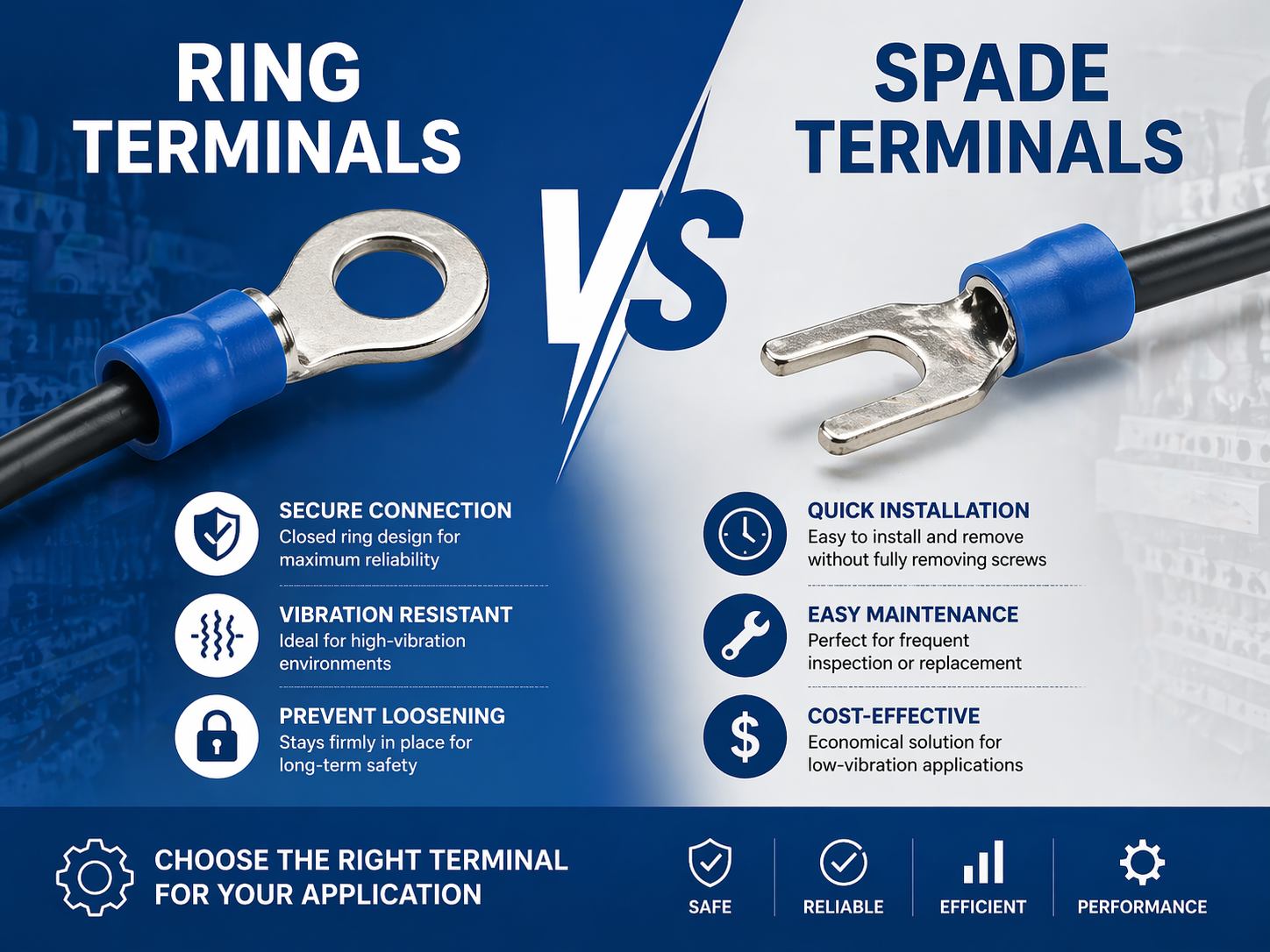
In any electrical system—whether it’s automotive wiring, industrial machinery, or home appliances—the reliability of your connection depends heavily on one small but critical component: the terminal.
Two of the most widely used terminal types are ring terminals and spade (fork) terminals. At first glance, they may seem interchangeable. But in real-world applications, choosing the wrong one can lead to loose connections, overheating, system failure, or even safety hazards.
So how do you decide which one is right?
This guide breaks down the exact differences between ring terminals and spade terminals, compares their performance across key criteria, and gives you a practical, step-by-step selection method—so you can choose the right solution for your application with confidence.
What Is a Ring Terminal?
Structure and Design
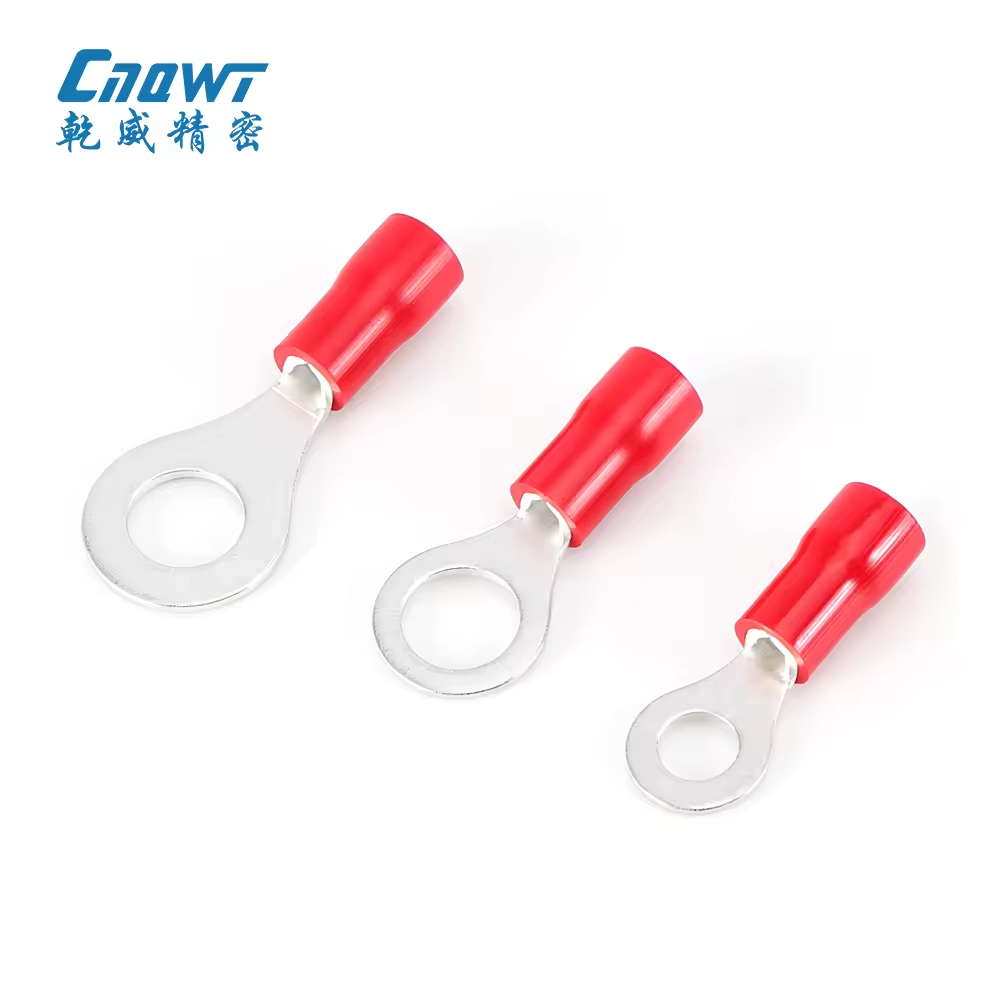
A ring terminal features a closed circular loop at the connection end. This ring is designed to fit securely around a screw or stud.
Unlike other terminal types, the connection is fully enclosed, which means the screw must be completely removed before installation or removal.
Key Features
- Maximum connection security
- Excellent resistance to vibration
- Prevents accidental disconnection
- Ideal for permanent or semi-permanent installations
Typical Materials
Ring terminals are usually made from:
- Tinned copper (most common, excellent conductivity + corrosion resistance)
- Copper
- Brass
They are available in:
- Insulated (PVC, নাইlon)
- Non-insulated
- Heat-shrink variants
What Is a Spade Terminal (Fork Terminal)?
Structure and Design
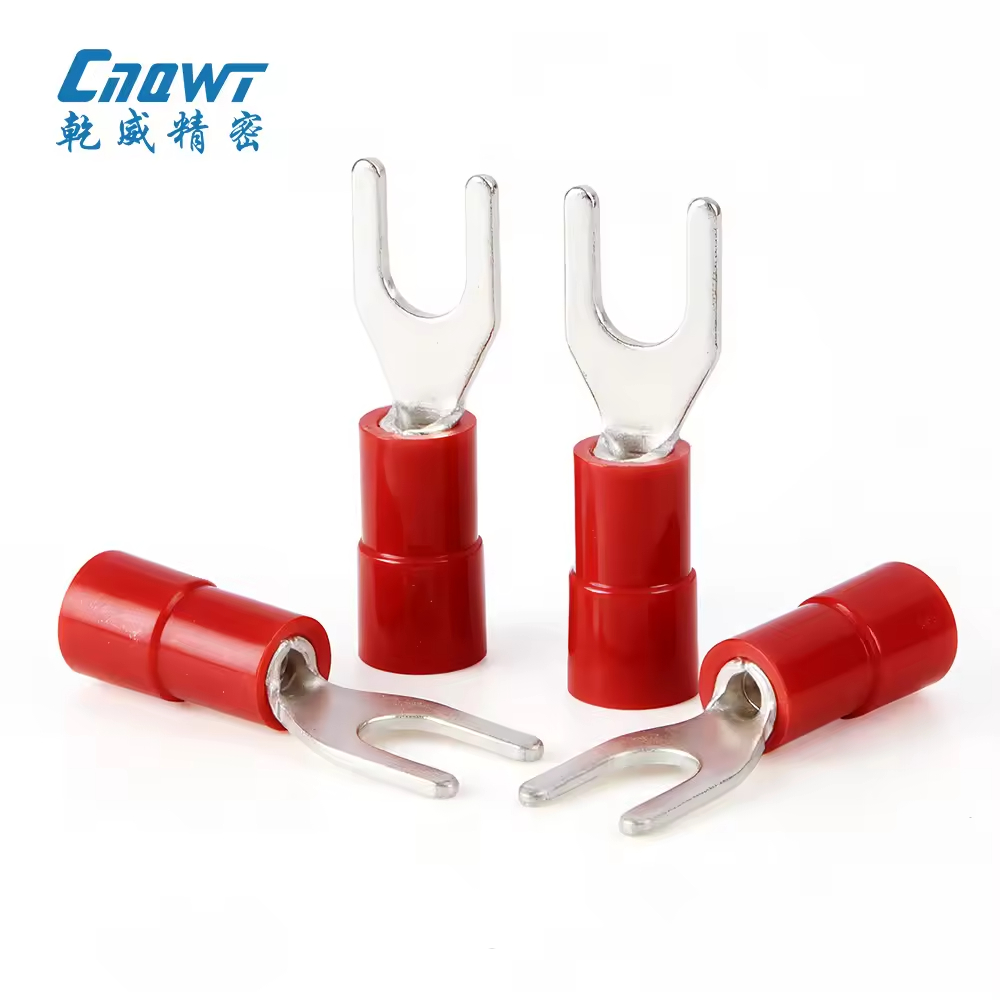
A spade terminal, also known as a fork terminal, features a U-shaped opening. This design allows the terminal to be slipped under a screw without fully removing it.
Key Features
- Fast and convenient installation
- Easy removal and maintenance
- Ideal for applications requiring frequent disconnection
Common Variants
- Standard fork terminals
- Locking spade terminals (with anti-slip design)
- Insulated and non-insulated versions
Ring Terminal vs Spade Terminal: Key Differences
1. Connection Security
- Ring Terminal:
Provides a fully secured connection. Once fastened, it cannot slip out unless the screw is removed. - Spade Terminal:
Can potentially loosen or slip out, especially if the screw is not tightened properly or in high-vibration environments.
Verdict: Ring terminals are significantly safer.
2. Ease of Installation
- Ring Terminal:
Requires complete removal of the screw → more time-consuming - Spade Terminal:
Simply loosen the screw and slide in → fast installation
Verdict: Spade terminals win in speed and convenience.
3. Vibration Resistance
- Ring Terminal:
Designed for high-vibration environments such as automotive or heavy machinery - Spade Terminal:
More prone to loosening under vibration
Verdict: Ring terminals are the industry standard for vibration-heavy applications.
4. Maintenance Efficiency
- Spade Terminal:
Ideal for systems requiring frequent inspection or replacement - Ring Terminal:
Less convenient due to full disassembly requirement
Verdict: Spade terminals are better for maintenance-heavy systems.
5. Electrical Performance
Both terminal types can provide excellent conductivity if properly installed, but:
- Ring terminals offer more stable contact pressure
- Spade terminals may suffer from inconsistent contact over time
Verdict: Ring terminals offer more reliable long-term electrical performance.
6. Cost Comparison
- Spade terminals: Generally lower cost
- Ring terminals: Slightly higher cost due to added reliability
Important Insight:
The real cost is not the terminal—it’s the failure risk. In critical systems, ring terminals are far more cost-effective in the long run.
Application Scenarios Comparison
Where Ring Terminals Are Used
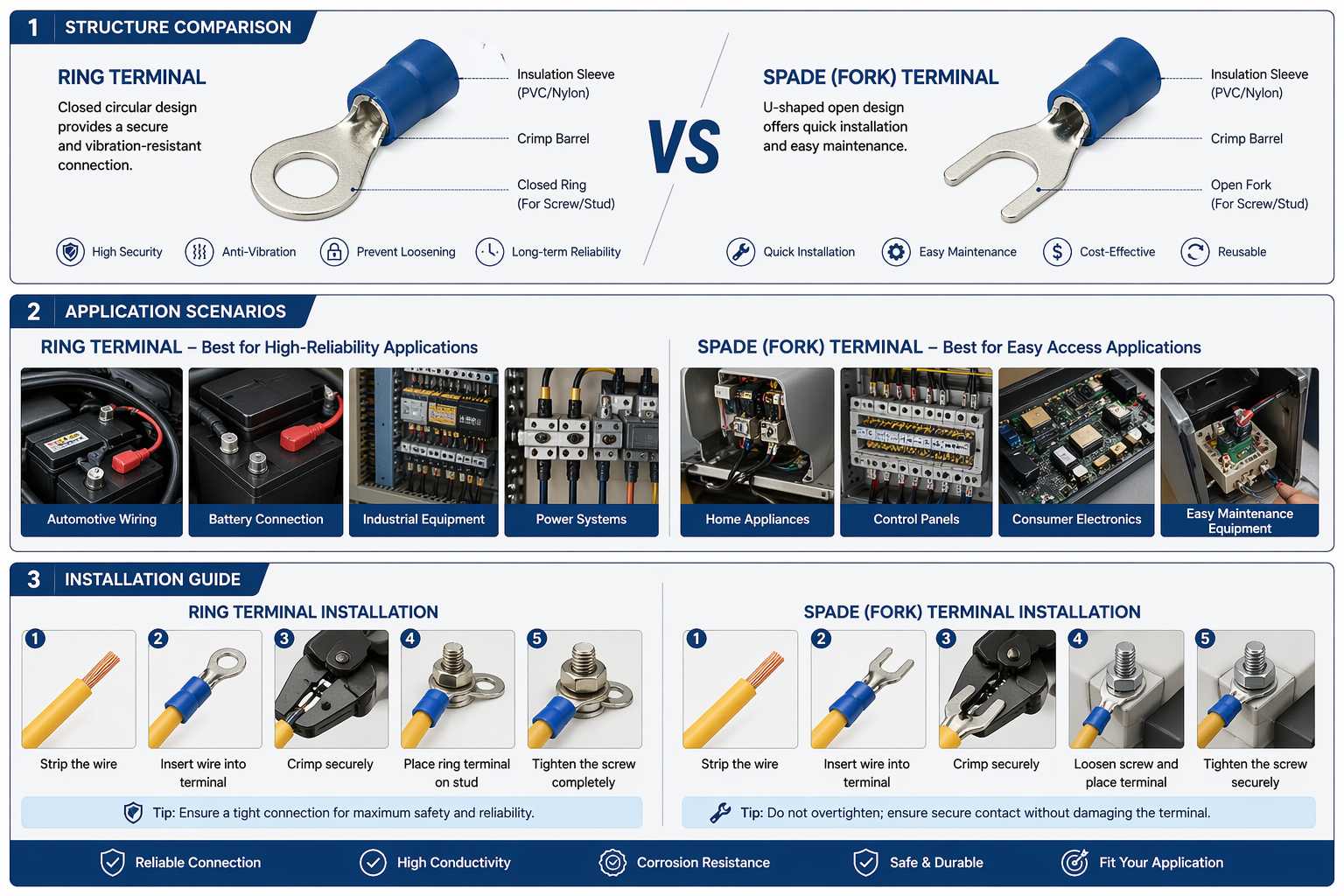
Ring terminals are preferred in high-reliability environments, including:
- Automotive wiring harnesses
- Battery connections
- Industrial equipment
- Power distribution systems
- Renewable energy systems
Why? Because failure is not an option.
Where Spade Terminals Are Used
Spade terminals are commonly used in:
- Home appliances
- Control panels
- Consumer electronics
- Low-vibration environments
Why? Because speed and serviceability matter more than maximum security.
Pros and Cons Summary
Ring Terminal
Advantages:
- Superior safety
- Strong anti-vibration performance
- Long-term reliability
Disadvantages:
- Slower installation
- Less convenient for maintenance
Spade Terminal
Advantages:
- Quick installation
- Easy to remove and replace
- Cost-effective
Disadvantages:
- Higher risk of loosening
- Not suitable for critical connections
How to Choose Between Ring and Spade Terminals (Step-by-Step Guide)
Choosing the right terminal isn’t guesswork. Use this structured approach:
Step 1: Evaluate Vibration Level
- High vibration (automotive, motors) → Ring Terminal
- Low vibration → Either option works
Step 2: Consider Maintenance Frequency
- Frequent servicing → Spade Terminal
- Permanent installation → Ring Terminal
Step 3: Check Current Load
- High current applications → Ring Terminal (more stable contact)
- Low current → Both acceptable
Step 4: Analyze Installation Constraints
- Limited time or access → Spade Terminal
- Safety-critical installation → Ring Terminal
Step 5: Assess Safety Requirements
If the connection is:
- Safety-critical
- Hard to access
- Costly to fail
→ Always choose Ring Terminal
Common Mistakes When Choosing Terminals
Avoid these frequent errors:
1. Choosing Based on Price Alone
Cheaper terminals can lead to expensive failures.
2. Ignoring Vibration Conditions
This is the #1 cause of loose connections.
3. Incorrect Stud Size
Mismatch between terminal hole and screw leads to poor contact.
4. Overlooking Insulation Type
Improper insulation can cause short circuits or corrosion.
5. Poor Crimping Quality
Even the best terminal fails if crimped incorrectly.
Custom Terminal Solutions for Your Application
Standard terminals don’t always meet the demands of modern electrical systems. That’s where customization becomes critical.
At Qianwei Precision, we specialize in high-performance electrical terminals tailored to your application requirements.
Why Choose Qianwei Precision?
- Extensive customization experience
- Over 1,800+ mass-production stamping & injection molds
- Fast tooling development and modification
- Support for:
- Material selection (copper, brass, alloys)
- Surface treatment (tin plating, nickel plating, etc.)
- Precision stamping and forming
What You Get
- Application-specific design support
- Rapid prototyping
- Stable mass production
- Strict quality control (ISO-certified systems)
Contact Us
Looking for the right terminal solution?
- Request drawings review
- Get FREE samples
- Start your OEM/ODM project today
Contact Qianwei Precision now and improve your connection reliability.
Conclusion
The difference between ring terminals and spade terminals comes down to one core principle:
- Ring Terminal = Maximum Security
- Spade Terminal = Maximum Convenience
There is no universally “better” option—only the one that best fits your application.
If your priority is safety, durability, and long-term reliability, choose ring terminals.
If your priority is speed, flexibility, and easy maintenance, spade terminals are the better choice.
And if you’re unsure?
Work with an experienced manufacturer like Qianwei Precision to get a custom-engineered solution that fits your exact requirements.
FAQs
Are ring terminals better than spade terminals?
Not universally. Ring terminals are better for safety and vibration resistance, while spade terminals are better for quick installation and maintenance.
Can spade terminals come loose?
Yes. In high-vibration environments, spade terminals can loosen if not properly secured.
Why are ring terminals used in automotive applications?
Because they provide a secure, vibration-resistant connection, which is essential in vehicles.
Are spade terminals safe?
Yes, but only in low-vibration, non-critical applications.
Can I replace a ring terminal with a spade terminal?
It is not recommended for critical systems. Doing so may increase the risk of disconnection.


One thought on “Ring Terminal vs Spade Terminal: Key Differences, Applications & How to Choose”