

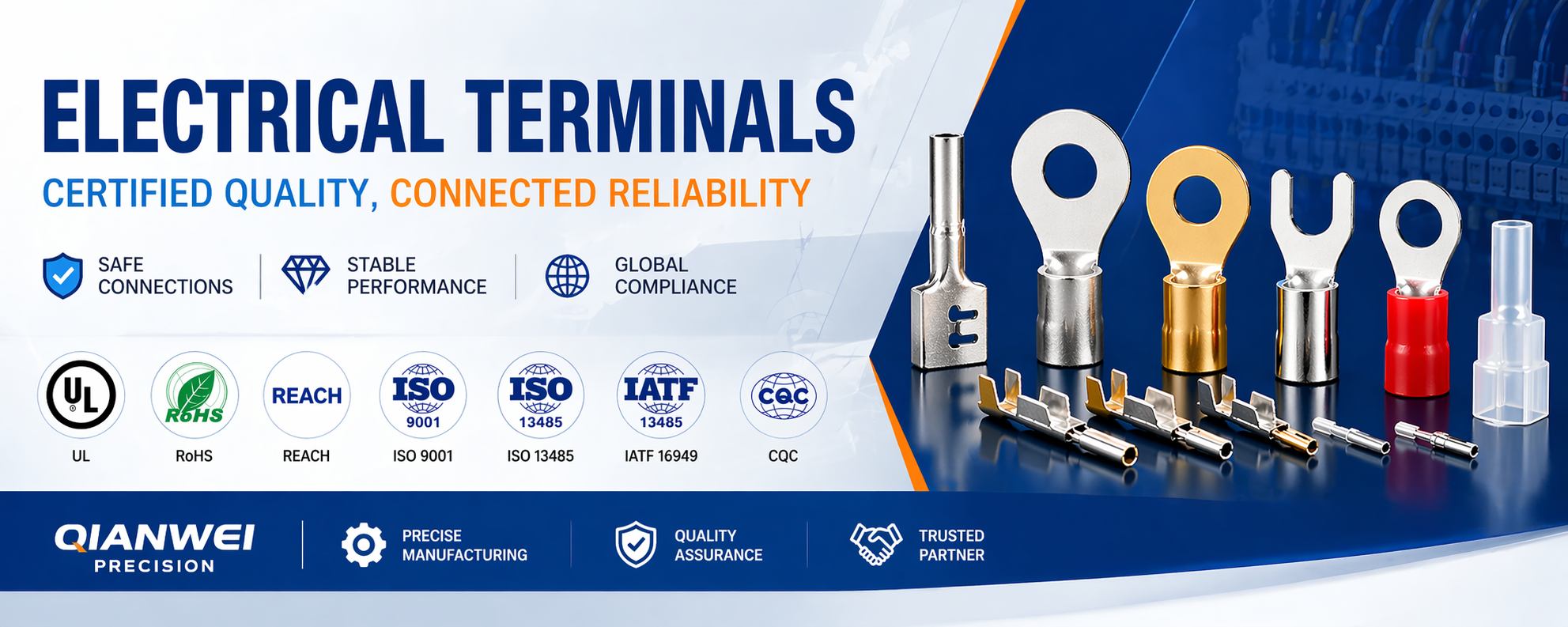
In today’s highly regulated electrical industry, selecting the right terminals is no longer just about size, material, or price. Compliance with international standards and certifications has become a decisive factor in ensuring product safety, market access, and long-term reliability.
For OEM buyers, engineers, and procurement managers, understanding which certifications matter—and which suppliers truly meet them—can significantly reduce risk and improve product performance.
This guide provides a practical, buyer-focused breakdown of electrical terminal standards and certifications, with a clear emphasis on UL, RoHS, REACH, ISO systems, and automotive/medical compliance.
Why Standards and Certifications Matter in Electrical Terminals
Electrical terminals are critical connection points. Any failure can result in:
- Overheating and fire hazards
- Signal instability or power loss
- Equipment downtime
- Compliance rejection in export markets
The Real Value of Certified Terminals
1. Safety Assurance
Certified terminals undergo strict testing for insulation, conductivity, and mechanical strength.
2. Market Access
Without proper certifications, products may be blocked from entering key markets such as:
- United States
- European Union
- Automotive supply chains
3. Quality Consistency
Certified manufacturing systems ensure every batch meets the same standard.
4. Reduced Total Cost
Higher upfront cost, but significantly lower failure and warranty risk.
5. Stronger Procurement Confidence
Certification is often a mandatory requirement in B2B sourcing.
Core Certifications for Electrical Terminals (What Really Matters)
Instead of chasing every global standard, buyers should focus on practical and market-relevant certifications.
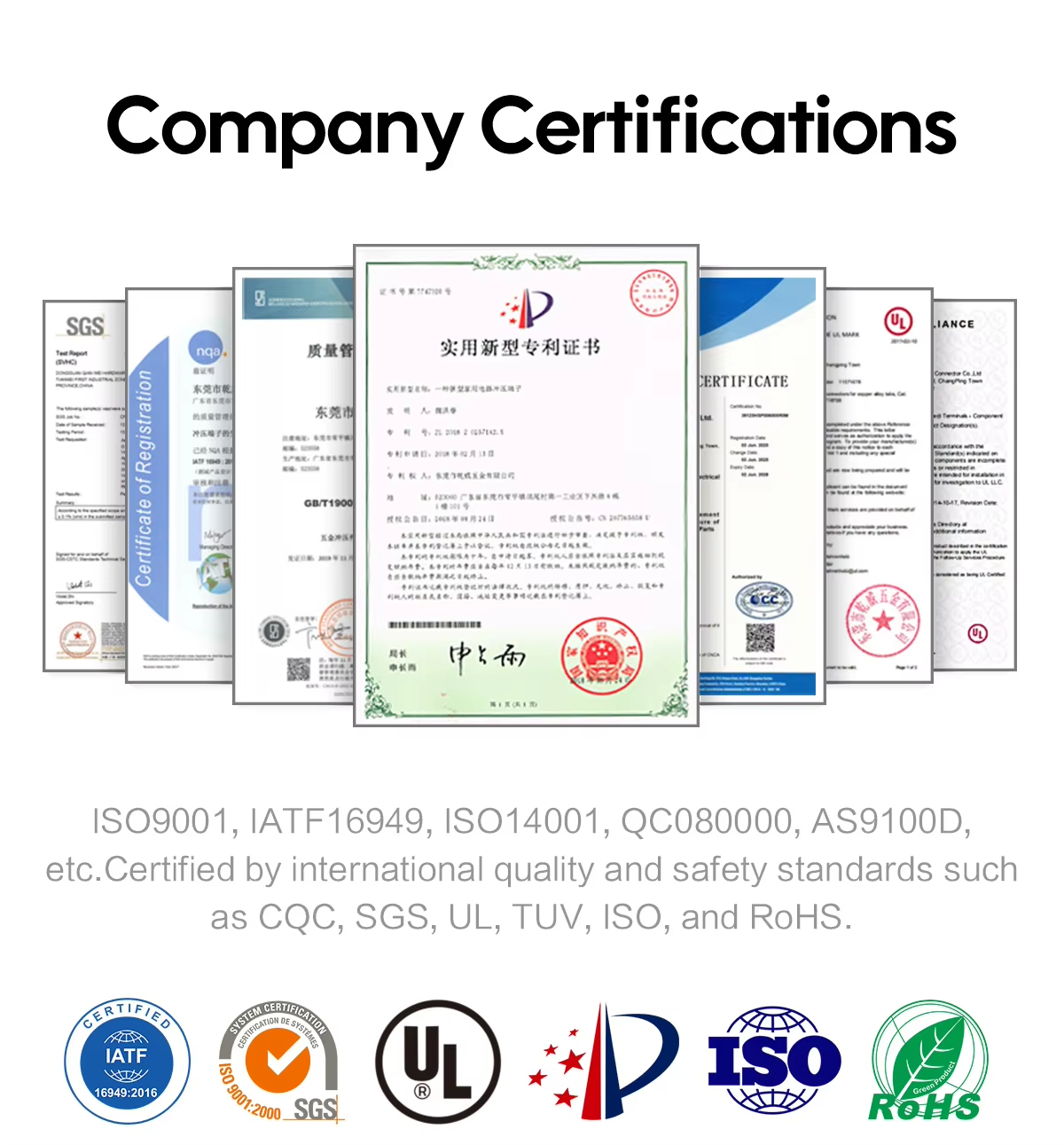
UL Certification (North America Market Entry)
UL certification is one of the most critical standards for electrical terminals entering the U.S. and Canadian markets.
Key UL Standards:
- UL 486A/B – Wire connectors
- UL 1059 – Terminal blocks
- UL 1977 – Component connectors
What UL Certification Guarantees
- Fire resistance performance
- Electrical insulation safety
- Long-term reliability under load
Where UL Is Required
- Building electrical systems
- HVAC and appliances
- Industrial control equipment
👉 If you target North America, UL is not optional—it is essential.
RoHS Compliance (EU Environmental Requirement)
RoHS restricts hazardous substances such as:
- Lead (Pb)
- Mercury (Hg)
- Cadmium (Cd)
Why RoHS Matters
- Mandatory for EU market entry
- Increasingly required globally
- Impacts plating, base materials, and coatings
Non-compliant terminals can lead to:
- Customs rejection
- Legal penalties
- Brand damage
REACH Regulation (Chemical Safety Compliance)
REACH focuses on chemical transparency and safety.
Key Impacts on Terminals
- Requires declaration of chemical substances
- Affects coatings, insulation, and alloys
- Ensures long-term environmental compliance
For buyers, REACH compliance means:
- Safer materials
- Better traceability
- Reduced regulatory risk
 ISO 9001 (Quality Management System)
 ISO 9001 (Quality Management System)
ISO 9001 ensures that a manufacturer operates under a controlled and repeatable quality system.
What It Means for Buyers
- Stable production processes
- Documented quality control (IQC, IPQC, OQC)
- Continuous improvement
This is the baseline requirement for most serious suppliers.
IATF 16949 (Automotive Industry Standard)
IATF 16949 is the global quality standard for automotive suppliers.
Why It Matters
- Required for automotive wiring harness and connectors
- Focus on defect prevention
- Strict process control and traceability
Applications
- Automotive wiring systems
- EV battery connections
- High-vibration environments
👉 If your application involves vehicles, this certification is critical.
ISO 13485 (Medical Device Quality Standard)
ISO 13485 is designed for manufacturers supplying medical-grade components.
Key Benefits
- Strict quality and risk management
- Full traceability
- Compliance with medical regulations
Typical Applications
- Medical equipment wiring
- Surgical devices
- Diagnostic systems
This certification significantly enhances high-end market credibility.
CQC Certification (China Quality Certification)
CQC is a widely recognized certification in China.
What It Indicates
- Compliance with Chinese safety standards
- Product reliability and quality
- Easier entry into domestic and Asia markets
Electrical Terminal Testing: What Certifications Are Based On
Certifications are not just labels—they are backed by rigorous testing protocols.
Mechanical Testing
- Pull-Out Force Test
Ensures wires remain securely attached - Crimp Strength Test
Verifies structural integrity
👉 Weak crimps are one of the top causes of electrical failure.
Electrical Testing
- Current Carrying Capacity
Defines safe operating limits - Contact Resistance
Measures efficiency of electrical connection
Low resistance = less heat + higher efficiency
Environmental Testing
- Temperature cycling
- Corrosion resistance (salt spray)
- Humidity exposure
These tests simulate real-world conditions such as:
- Outdoor installations
- Automotive environments
- Industrial facilities
How to Choose Certified Electrical Terminals (Step-by-Step)
A structured approach ensures you select the right product—not just a compliant one.
Step 1: Define Your Application
Identify:
- Current and voltage requirements
- Operating environment
- Mechanical stress conditions
Step 2: Match Certifications to Market
| Market | Required Certifications |
|---|---|
| North America | UL |
| Europe | RoHS + REACH |
| Automotive | IATF 16949 |
| Medical | ISO 13485 |
Step 3: Verify Supplier Credentials
Always request:
- Certification copies
- Test reports
- Material declarations
Important: Certification must be verifiable—not just claimed.
Step 4: Validate with Samples
Before bulk purchase:
- Test crimping performance
- Check compatibility with your tooling
- Run internal validation
👉 This step prevents costly production issues.
Common Mistakes Buyers Should Avoid
Even experienced sourcing teams make these mistakes:
❌ Choosing low price over compliance
Cheap terminals often fail certification requirements.
❌ Ignoring environmental regulations
RoHS/REACH issues can block shipments.
❌ Not verifying certifications
Fake or expired certificates are common in low-cost supply chains.
❌ Overlooking application conditions
Terminals must match real-world environments.
Industry Applications and Certification Requirements
Automotive Industry
- IATF 16949
- RoHS / REACH
- High vibration resistance
Medical Equipment
- ISO 13485
- High reliability and traceability
Industrial Equipment
- UL
- ISO 9001
Consumer Electronics & Appliances
- UL
- RoHS
How Certified Terminals Improve Product Performance
Using certified terminals leads to measurable improvements:
- Lower failure rates
- Reduced maintenance costs
- Stable electrical performance
- Extended product lifespan
For OEMs, this directly translates into:
- Fewer warranty claims
- Higher customer satisfaction
- Stronger brand reputation
Why Work with a Certified Terminal Manufacturer
Choosing the right supplier is a strategic decision.
What a Reliable Manufacturer Should Offer
1. Multi-Certification Capability
- UL
- RoHS / REACH
- ISO systems
- Automotive & medical certifications
2. Advanced Manufacturing
- High-precision stamping
- Automated production
- Consistent quality output
3. Strong Customization Ability
- Fast tooling development
- Support for custom terminal designs
- Flexible production
4. Full Documentation Support
- Certification files
- Test reports
- Compliance documentation
Qianwei Precision: Certified for High-End Applications
Qianwei Precision is positioned as a high-reliability terminal manufacturer with strong certification support:
- UL certified products for North America
- RoHS & REACH compliant materials
- ISO 9001 quality management system
- IATF 16949 for automotive applications
- ISO 13485 for medical-grade manufacturing
- CQC certification for China market
Manufacturing Strengths
- 1800+ production molds
- High-precision automated tooling center
- Fast custom development capability
- Stable large-scale production
What This Means for Buyers
- Faster project approval
- Reduced compliance risk
- Reliable long-term supply
Conclusion: Certification Is a Competitive Advantage
In today’s global market, certifications are not just compliance tools—they are business enablers.
They help you:
- Enter international markets
- Ensure product safety
- Build customer trust
- Reduce long-term risk
For serious buyers, the decision is clear:
Choose certified terminals from qualified manufacturers—or risk costly failures.
If you are sourcing electrical terminals for automotive, medical, or industrial applications:
Work with a supplier that delivers verified certifications, stable quality, and fast customization.
👉 Contact Qianwei Precision today to request free samples, certification documents, and technical support for your project.
FAQs
1. What is the most important certification for electrical terminals?
UL is critical for North America, while RoHS and REACH are essential for Europe.
2. Do all terminals need UL certification?
Only if entering North American markets or required by your application.
3. What is the difference between RoHS and REACH?
RoHS restricts hazardous substances; REACH regulates chemical usage and disclosure.
4. How can I verify a supplier’s certification?
Request official documents and test reports.
5. Is ISO 9001 enough for quality assurance?
It ensures system quality, but product certifications like UL are also needed.
6. What certification is needed for automotive terminals?
IATF 16949 is the key requirement.
7. Are certified terminals more expensive?
Yes—but they reduce long-term risk and cost.
8. Can I export without RoHS compliance?
Not to the EU market.
9. What certification is required for medical applications?
ISO 13485 is essential.
10. What is CQC certification?
A Chinese certification ensuring product safety and quality.

