

Introduction
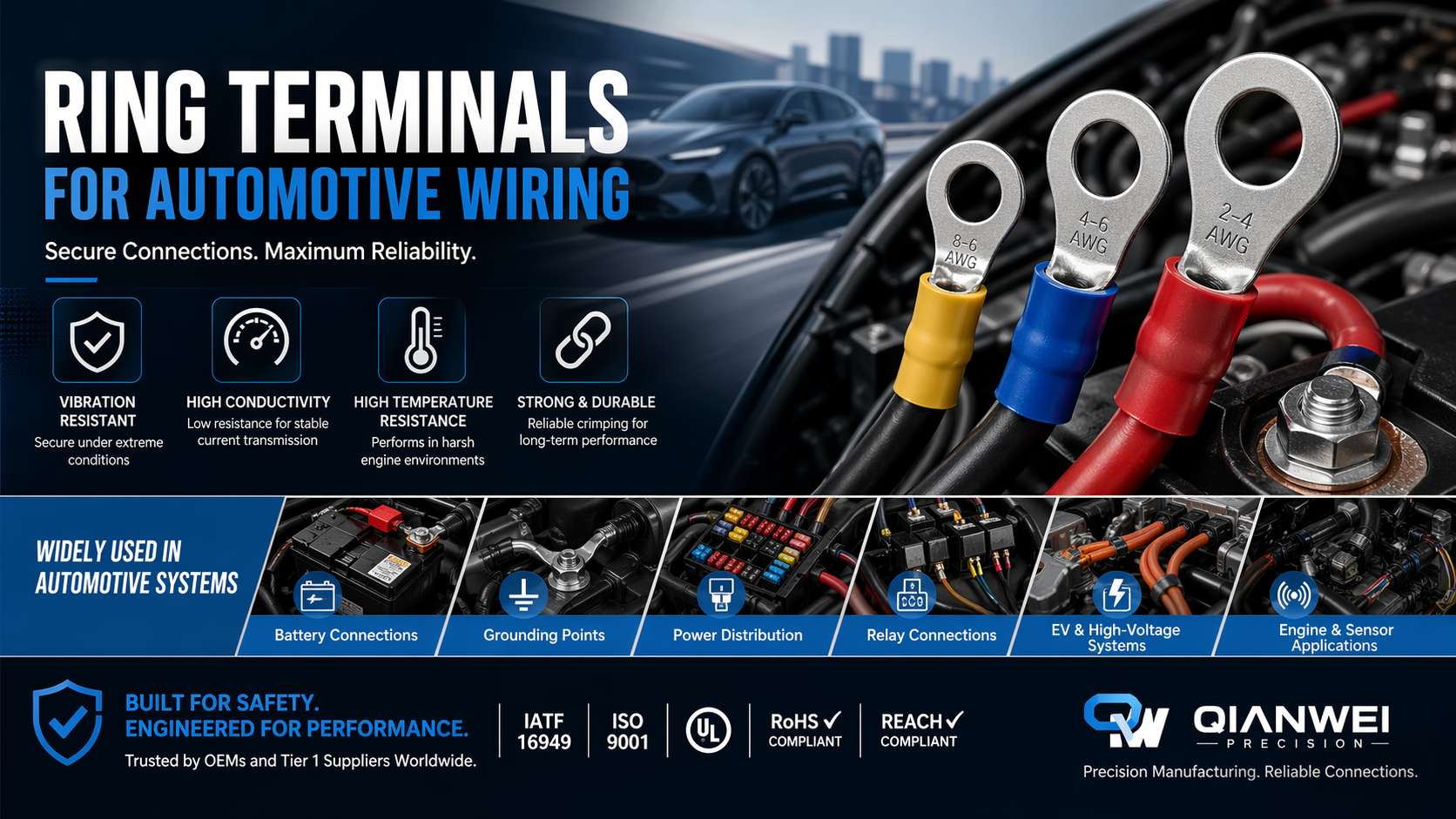
In automotive electrical systems, connection reliability is non-negotiable. From battery connections to ECU grounding points, ring terminals are widely used because they provide secure, vibration-resistant, and low-resistance connections.
Unlike spade or quick-disconnect terminals, ring terminals form a closed-loop connection, ensuring the wire remains firmly attached even under extreme mechanical stress—making them essential in modern vehicles, EVs, and heavy-duty applications.
What Are Ring Terminals?
A ring terminal is a type of electrical connector with a circular (ring-shaped) lug designed to be fastened onto a stud or bolt.

Key Structure:
- Barrel – where the wire is crimped or soldered
- Ring (eyelet) – connects to a threaded stud
- Insulation (optional) – PVC, nylon, or heat shrink
Why Automotive Systems Prefer Ring Terminals
- Cannot disconnect unless the bolt is removed
- Excellent resistance to vibration and shock
- Provides consistent electrical contact
- Ideal for grounding and power distribution
Applications in Automotive Wiring
In modern vehicles, ring terminals are not limited to simple battery connections—they are deeply integrated into critical electrical architecture, where reliability, mechanical stability, and current-carrying capacity are essential. Their closed-loop design makes them the preferred solution in scenarios where connection failure is unacceptable.
1. Battery & Starting System (High-Current Backbone)
Ring terminals play a foundational role in the vehicle’s primary power loop, where current levels are the highest.
Typical applications include:
- Battery positive and negative terminals
- Starter motor connections
- Alternator output terminals
- Main fuse links
In these circuits, current can reach hundreds of amperes, especially during engine start. Ring terminals ensure:
- Maximum contact surface area → lower contact resistance
- Secure fastening under torque → prevents arcing
- Resistance to thermal cycling (engine start-stop conditions)
Engineering Insight:
Any micro-loosening in these connections can lead to localized overheating, voltage drop, or even starting failure.
2. Grounding Systems (Vehicle Electrical Stability Core)
Grounding is often underestimated, but it is critical for signal integrity and system stability.
Ring terminals are widely used in:
- Chassis grounding points
- Engine-to-body ground straps
- ECU and sensor grounding
- Shielded cable terminations
Modern vehicles—especially those with advanced electronics—require low-impedance, noise-free grounding paths.
Why ring terminals dominate here:
- Fixed mechanical locking prevents intermittent ground
- Maintains stable contact under vibration
- Reduces electromagnetic interference (EMI) risks
Failure Risk:
Poor grounding can result in:
- Sensor signal distortion
- ECU malfunction
- Random electrical faults (hard to diagnose)
3. Power Distribution Units (PDUs) & Fuse Boxes
Inside fuse boxes and power distribution modules, ring terminals are used to connect:
- Busbars
- Relay terminals
- High-load circuits (fans, heaters, lighting systems)
These environments require:
- High connection density
- Long-term thermal stability
- Resistance to oxidation
Ring terminals provide consistent torque-based connections, which are more reliable than push-on connectors in high-load nodes.
Trend:
In EVs and smart vehicles, PDUs are becoming more complex, increasing the demand for precision-stamped, high-consistency terminals.
4. Engine Bay Applications (Extreme Environment Use)
The engine compartment represents one of the harshest environments in a vehicle:
- Temperatures up to 150°C+
- Exposure to oil, fuel, and chemicals
- Continuous vibration
Ring terminals are used in:
- Sensor connections (temperature, pressure)
- Ignition system grounding
- Cooling fan circuits
- Engine control modules
Material & design requirements:
- Tinned copper or nickel-plated surfaces
- Heat-resistant insulation (or non-insulated + heat shrink)
- High pull-out strength
Key Advantage:
Unlike quick connectors, ring terminals do not loosen over time, even under thermal expansion and contraction cycles.
5. Electric Vehicles (EV) & High-Voltage Systems
With the rapid growth of EVs, ring terminals are evolving into high-performance connection components.
Applications include:
- Battery pack interconnections
- Inverter and motor controller terminals
- DC fast charging interfaces
- High-voltage junction boxes
These systems demand:
- High current capacity (often >200A)
- Excellent conductivity
- Strict safety and insulation standards
Design evolution:
- Thick-wall copper lugs
- Seamless barrels for minimal resistance
- Advanced plating (e.g., silver for critical paths)
Engineering Note:
In EVs, connection reliability directly impacts:
- Energy efficiency
- Thermal management
- Overall vehicle safety
6. Auxiliary Systems & Interior Electronics
Beyond high-power systems, ring terminals are also used in:
- Lighting systems
- HVAC units
- Audio systems
- Seat control modules
Although current levels are lower, these applications still require:
- Stable long-term connections
- Easy assembly in wiring harness production
Types of Automotive Ring Terminals
1. By Insulation Type
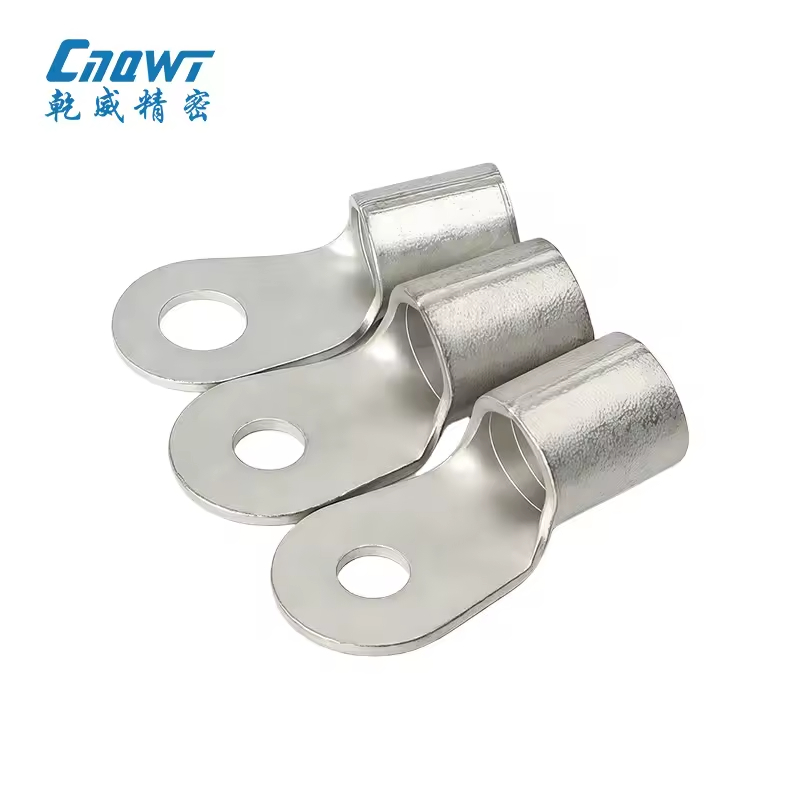
Non-Insulated Ring Terminals
- Used in OEM harness production
- Suitable for heat shrink applications
- Preferred for high-temperature environments
Insulated Ring Terminals
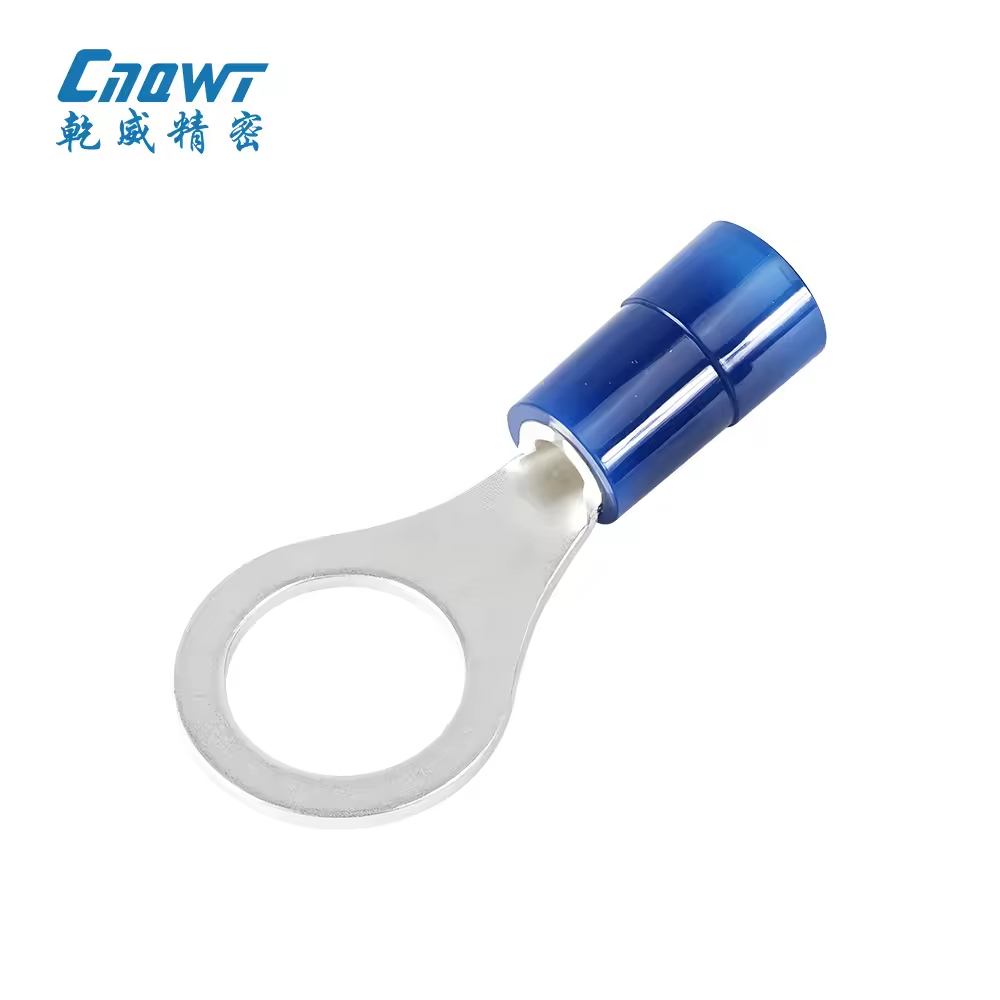
- PVC (cost-effective)
- Nylon (higher durability, vibration resistance)
2. By Barrel Type
Standard Barrel
- For general automotive wiring
Heavy-Duty / Thick-Wall Barrel
- High current applications (battery cables)
Seamless (Closed Barrel)
- Superior conductivity and mechanical strength
- Preferred in critical automotive systems
3. By Ring Type
Standard Ring
- Fully closed for maximum security
Flanged Ring
- Increased contact area
Narrow Tongue Ring
- For tight installation spaces
 Materials Used in Automotive Ring Terminals
 Materials Used in Automotive Ring Terminals
Material selection directly impacts conductivity, corrosion resistance, and lifespan.
1. Copper (Cu)
- Excellent electrical conductivity
- Ideal for most automotive applications
2. Tinned Copper
- Corrosion-resistant
- Performs well in humid or harsh environments
3. Brass
- Lower conductivity but good mechanical strength
- Used in cost-sensitive applications
Surface Treatments
- Tin Plating – standard for automotive (anti-corrosion)
- Nickel Plating – high-temperature environments
- Silver Plating – high-performance / EV applications
Key Standards & Certifications
Automotive-grade ring terminals must comply with:
- UL (Underwriters Laboratories) – safety compliance
- RoHS / REACH – environmental regulations
- IATF 16949 – automotive quality management
- ISO 9001 – general quality systems
- CQC – China quality certification
These certifications ensure consistent performance under harsh automotive conditions.
How to Select the Right Ring Terminal
1. Wire Size Matching
- Must match AWG or mm² precisely
- Oversized → weak crimp
- Undersized → wire damage
2. Stud Size Compatibility
Common sizes:
- M4 / M5 / M6 / M8 / M10
Incorrect sizing leads to:
- Loose connection
- Increased resistance
- Potential overheating
3. Current Rating
Evaluate:
- Conductor cross-section
- Material conductivity
- Operating temperature
High-current automotive circuits (e.g., battery cables) require heavy-duty copper lugs.
4. Environmental Conditions
Consider:
- Temperature range (engine bay vs cabin)
- Exposure to moisture, oil, chemicals
- Vibration intensity
5. Crimping Method
- Use professional crimping tools
- Ensure proper compression ratio
- Pull-out force must meet automotive standards
Poor crimping is one of the top failure causes in wiring harnesses.
Common Failure Modes (and How to Avoid Them)
1. Loose Connections
Cause: Incorrect stud size or improper torque
Solution: Match ring ID precisely + torque control
2. Overheating
Cause: Undersized terminal or poor crimp
Solution: Use correct current-rated terminal
3. Corrosion
Cause: Exposure to moisture/salt
Solution: Use tinned copper + sealing
4. Wire Pull-Out
Cause: Poor crimp quality
Solution: Use calibrated crimp tools + QC testing
Why OEMs Prefer Ring Terminals Over Other Types
| Feature | Ring Terminal | Spade Terminal | Quick Disconnect |
|---|---|---|---|
| Vibration Resistance | ★★★★★ | ★★★ | ★★ |
| Connection Security | ★★★★★ | ★★★ | ★★ |
| Ease of Maintenance | ★★ | ★★★★ | ★★★★★ |
| Automotive Suitability | ★★★★★ | ★★★ | ★★★ |
Conclusion:
Ring terminals are the default choice for critical automotive connections.
Qianwei Precision: Automotive-Grade Ring Terminal Manufacturer
For automotive OEMs and Tier 1 suppliers, consistency and compliance are key.
Qianwei Precision delivers:
- 1800+ existing tooling sets (fast customization)
- Automotive-grade production (IATF 16949)
- High-precision stamping & injection molding
- Strict QC for crimp performance & conductivity
- Custom solutions for EV, battery, and high-current systems
Value for Buyers:
- Faster project turnaround
- Reduced tooling cost
- Stable long-term supply
Conclusion
Ring terminals are a small component with a massive impact on vehicle reliability. Selecting the right type, material, and crimping process ensures:
- Stable electrical performance
- Long service life
- Safety under extreme automotive conditions
For engineers and procurement teams, investing in high-quality automotive-grade ring terminals is not optional—it’s essential.
FAQs
What are ring terminals used for in cars?
They are used for battery connections, grounding, and power distribution, providing secure and vibration-resistant electrical connections.
Are ring terminals better than spade terminals?
Yes, for automotive use. Ring terminals offer higher security and reliability, especially in high-vibration environments.
What material is best for automotive ring terminals?
Tinned copper is the most widely used due to its balance of conductivity and corrosion resistance.
Can ring terminals handle high current?
Yes, when properly sized. Heavy-duty copper ring terminals are commonly used for battery and starter motor connections.
If you want, I can next:
- Build an internal SEO link matrix across all your terminal articles
- Design a conversion-focused industrial banner
- Or create a downloadable B2B white paper (lead generation asset)

