

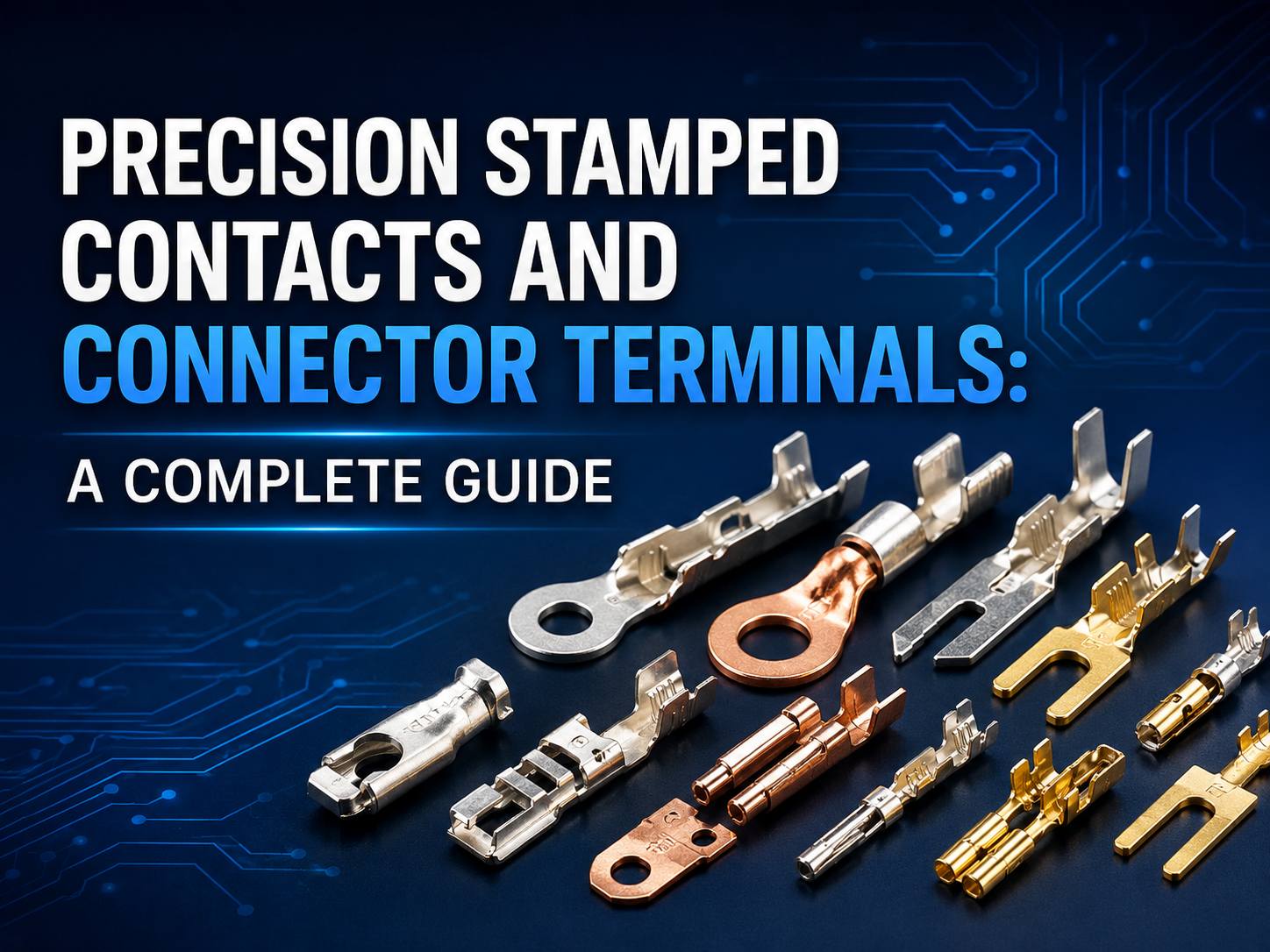
Modern electrical and electronic systems rely on thousands of small components working together flawlessly. Among them, precision stamped contacts and connector terminals are some of the most critical. Although they are often hidden inside connectors, wiring harnesses, control panels, batteries, and electronic devices, these components are responsible for delivering reliable electrical conductivity, stable mechanical connections, and long-term durability.
From electric vehicles and energy storage systems to AI data centers and industrial automation, precision stamped contacts play a key role in ensuring power and signal transmission remains safe and efficient.
As industries continue moving toward miniaturization, higher current capacity, and smarter electrical systems, manufacturers require contact terminals that offer tighter tolerances, better conductivity, and consistent performance under demanding conditions.
In this complete guide, you’ll learn what precision stamped contacts are, how they are manufactured, the different types available, material and plating options, common applications, and how to choose the right manufacturing partner for your project.
What Are Precision Stamped Contacts?
Precision stamped contacts are metal components manufactured through high-speed precision stamping processes. They serve as the conductive interface inside electrical connectors, allowing electrical current or signals to pass from one component to another.
Unlike machined contacts, stamped contacts are produced using progressive dies that shape metal strips into complex geometries with extremely tight tolerances. This process enables high-volume production while maintaining excellent consistency and lower manufacturing costs.
These contacts are widely used in:
- Automotive connectors
- Battery packs
- Energy storage systems (ESS)
- Consumer electronics
- Medical equipment
- Telecommunications
- Industrial automation
- AI server power systems
Because electrical connections directly affect system performance, every stamped contact must maintain low contact resistance, sufficient spring force, and excellent durability throughout its service life.
How Precision Stamped Contacts Work
When two connector halves are mated, the stamped contacts create a mechanical and electrical interface.
The contact design generates a controlled contact force that ensures:
- Stable electrical conductivity
- Low electrical resistance
- Reliable signal transmission
- Resistance to vibration
- Long insertion life
Proper contact pressure is one of the most important factors in connector reliability. Too little pressure increases resistance and heat generation, while excessive pressure accelerates wear.
This is why precision manufacturing is essential.
Why Precision Matters
Electrical contacts often measure only a few millimeters, yet dimensional tolerances may be controlled within microns.
High manufacturing precision ensures:
- Consistent contact force
- Better mating performance
- Lower insertion force variation
- Stable electrical resistance
- Improved product lifespan
- Better compatibility with automated assembly
For industries such as automotive, aerospace, medical devices, and AI infrastructure, precision is not optional—it is a fundamental requirement.
What Are Connector Terminals?
Connector terminals are conductive metal components designed to connect wires, cables, circuit boards, batteries, or electrical devices.
They provide both:
- Mechanical retention
- Electrical conductivity
Depending on the application, connector terminals may be crimped, soldered, welded, or mechanically fastened.
They are available in thousands of shapes and configurations to meet different current ratings, wire sizes, and installation methods.
Precision Stamped Contacts vs. Connector Terminals
Although these terms are often used interchangeably, they have different functions.
Precision stamped contacts are usually the conductive elements inside a connector housing.
Connector terminals are the complete termination points that connect wires or cables to electrical equipment.
For example:
- A wire harness may use crimp terminals.
- Inside the connector housing, stamped contacts provide the electrical interface.
- Together, they create a complete connection system.
Understanding this difference helps engineers choose the appropriate solution for each application.
How They Work Together
A complete electrical connection generally includes:
- Wire
- Crimp terminal
- Connector housing
- Precision stamped contact
- Mating connector
- Electrical equipment
Each component contributes to overall connection reliability.
If one component fails, the entire electrical system may be compromised.
Common Types of Precision Stamped Contacts
Different electrical systems require different contact designs. Selecting the correct contact type depends on factors such as current, voltage, insertion cycles, mechanical stress, and environmental conditions.
Male Contacts
Male contacts feature a pin-shaped design that inserts into a corresponding female contact.
Advantages include:
- Low insertion resistance
- High conductivity
- Compact structure
- Easy automated assembly
Common applications include automotive connectors, industrial equipment, and battery systems.
Female Contacts
Female contacts receive the male pin while providing controlled spring pressure.
Their design ensures:
- Stable contact force
- Reliable electrical connection
- Multiple mating cycles
- Excellent vibration resistance
They are widely used in wire-to-wire and wire-to-board connectors.
Spring Contacts
Spring contacts use elastic structures to maintain continuous contact pressure.
Benefits include:
- High reliability
- Excellent vibration resistance
- Long service life
- Low contact resistance
Typical applications include medical devices, communication equipment, AI servers, and battery management systems.
Leaf Contacts
Leaf contacts utilize a flexible metal strip to create electrical contact.
Compared with traditional pin contacts, they offer:
- Lower manufacturing cost
- Compact dimensions
- Stable electrical performance
- Easy mass production
They are commonly found in consumer electronics and compact connectors.
Pin Contacts
Pin contacts are one of the most common connector contact types.
Their cylindrical design provides:
- Excellent conductivity
- High mechanical strength
- Low insertion loss
- Reliable mating performance
Pin contacts are widely used in industrial connectors, aviation systems, and medical equipment.
Socket Contacts
Socket contacts work together with pin contacts to complete the electrical circuit.
Their precision spring structure ensures:
- Consistent contact pressure
- Low electrical resistance
- Long mating life
- Stable performance under vibration
Socket contacts are essential for applications requiring repeated connection and disconnection.
High-Current Contacts
As electric vehicles, battery energy storage systems, and AI data centers demand more power, high-current contacts have become increasingly important.
These contacts feature:
- Larger conductive cross-sections
- Higher current capacity
- Optimized heat dissipation
- Strong mechanical support
- Low temperature rise
They are commonly manufactured from high-conductivity copper alloys with tin, silver, or nickel plating.
Applications include:
- Battery packs
- ESS cabinets
- UPS systems
- Power distribution units
- AI data center power systems
Signal Contacts
Signal contacts are specifically designed for transmitting low-current electrical signals rather than power.
Their priorities include:
- Stable signal integrity
- Low insertion loss
- Excellent shielding compatibility
- High-frequency performance
- Reliable long-term operation
Signal contacts are widely used in:
- Communication equipment
- Data transmission connectors
- Industrial sensors
- Medical electronics
- AI computing equipment
Common Types of Connector Terminals
Connector terminals are designed in various shapes and configurations to meet different installation methods, current requirements, and equipment designs. Choosing the right terminal type can improve installation efficiency, increase connection reliability, and reduce maintenance costs.
Ring Terminals
Ring terminals feature a fully enclosed circular opening that fits securely over a screw or stud.
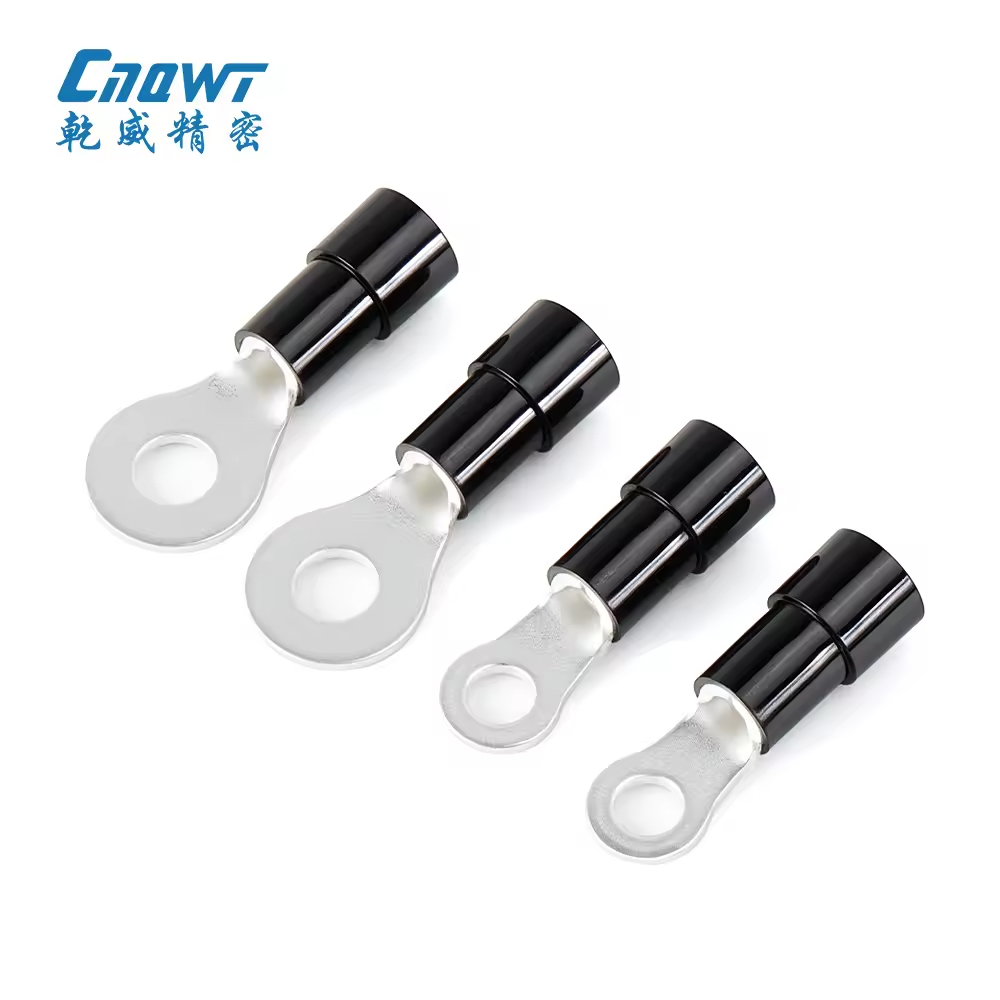
Because the screw passes completely through the ring, accidental disconnection is highly unlikely, even in environments with continuous vibration.
Advantages
- Extremely secure connection
- Excellent vibration resistance
- Suitable for high-current applications
- Long service life
Typical Applications
- Automotive wiring harnesses
- Battery systems
- Energy storage cabinets
- Industrial control equipment
- Grounding connections
(Fork) Terminals
Spade terminals, also called fork terminals, have an open fork-shaped design that allows installation without completely removing the screw.
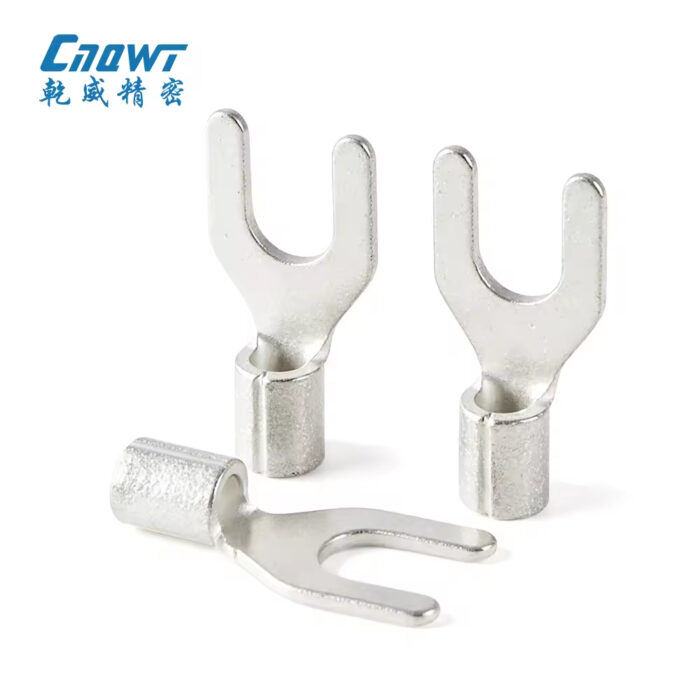
This makes maintenance faster and easier.
Advantages
- Quick installation
- Easy replacement
- Reduced maintenance time
- Good electrical performance
Typical Applications
- Electrical control panels
- Household appliances
- Industrial equipment
- Machinery wiring
Butt Splice Connectors
Butt splice connectors join two wires end-to-end while maintaining electrical continuity.
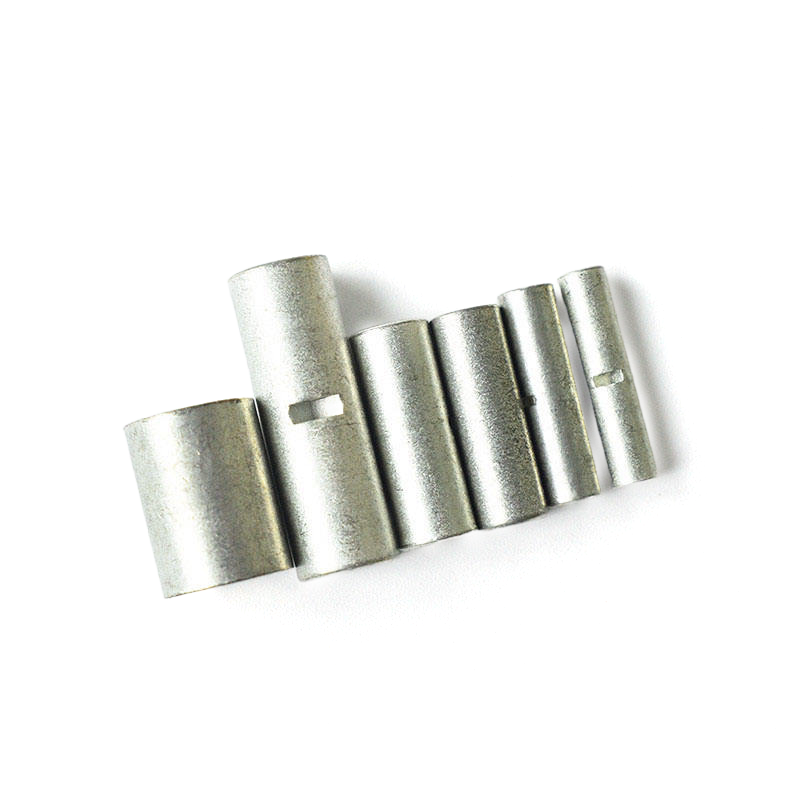
They are commonly used during wire repairs or wiring harness extensions.
Advantages
- Strong mechanical connection
- Low electrical resistance
- Compact design
- Easy installation
Typical Applications
- Automotive repairs
- Industrial maintenance
- Cable extensions
- Wiring harness manufacturing
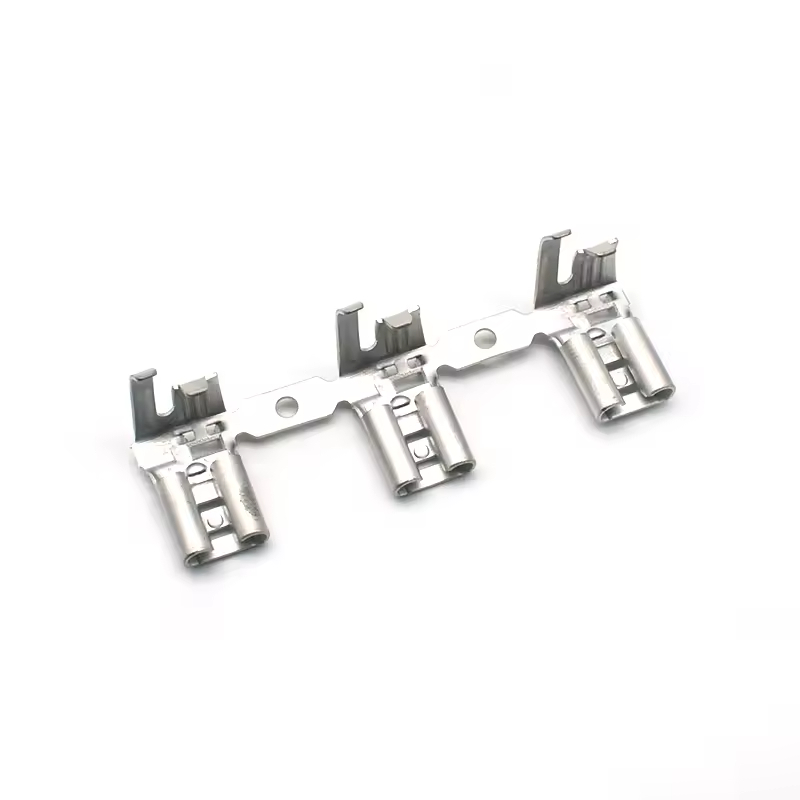
Flag Terminals
Flag terminals position the wire at a 90-degree angle relative to the connection point.
This design helps save installation space and improves cable routing in compact assemblies.
Advantages
- Ideal for confined spaces
- Better cable management
- Reduced wire bending
- Easy installation
Typical Applications
- Consumer electronics
- Automotive dashboards
- Industrial control modules
- Medical equipment
Bullet Terminals
Bullet terminals consist of a male connector and a female connector that quickly connect and disconnect.
They are widely used in wiring harnesses requiring frequent maintenance.
Advantages
- Fast assembly
- Easy maintenance
- Compact structure
- Reliable electrical connection
Typical Applications
- Motorcycles
- Automotive wiring
- Agricultural machinery
- Marine equipment
Pin Terminals
Pin terminals are designed for insertion into terminal blocks and spring-clamp connectors.
Their simple cylindrical shape allows fast installation while maintaining reliable electrical conductivity.
Advantages
- Excellent conductivity
- Easy insertion
- Neat wiring
- Suitable for stranded wire
Typical Applications
- Control cabinets
- PLC systems
- Automation equipment
- Electrical distribution panels
Blade Terminals
Blade terminals provide flat conductive surfaces capable of carrying medium to high current.
They are frequently used in automotive fuse boxes, relays, and power distribution systems.
Advantages
- High contact area
- Low contact resistance
- Reliable power transmission
- Easy assembly
Wire-to-Wire Connector Terminals
Wire-to-wire terminals connect two cable assemblies together, allowing fast installation and replacement.
They are commonly found in automotive harnesses, industrial machinery, and household appliances.
Wire-to-Board Connector Terminals
Wire-to-board terminals connect cables directly to printed circuit boards (PCBs).
Their compact size and precision manufacturing make them essential in modern electronic products.
Applications include:
- Consumer electronics
- Communication devices
- Medical electronics
- Industrial controllers
- AI server modules
Materials Used for Precision Stamped Contacts
Material selection directly determines the electrical, mechanical, and environmental performance of stamped contacts and connector terminals.
The ideal material depends on several factors, including current capacity, conductivity, corrosion resistance, spring characteristics, and manufacturing cost.
Copper
Copper is the most widely used material for electrical contacts because of its exceptional conductivity.
Its advantages include:
- Excellent electrical conductivity
- Low contact resistance
- High current carrying capacity
- Good thermal conductivity
- Easy stamping and forming
Copper is commonly used in:
- Battery terminals
- High-current connectors
- Busbars
- Energy storage terminals
- Power distribution systems
Brass
Brass is an alloy of copper and zinc that offers a balance between conductivity and mechanical strength.
Compared with pure copper, brass provides:
- Higher hardness
- Better wear resistance
- Good machinability
- Lower material cost
Typical applications include:
- Consumer electronics
- Household appliances
- Automotive connectors
- Industrial connectors
Phosphor Bronze
Phosphor bronze contains copper, tin, and phosphorus, providing excellent elasticity and fatigue resistance.
It is widely used for spring contacts.
Advantages include:
- Excellent spring properties
- High fatigue strength
- Good conductivity
- Long service life
Applications include:
- Signal connectors
- Communication equipment
- Medical connectors
- High-cycle electrical contacts
Beryllium Copper
Beryllium copper combines excellent electrical conductivity with outstanding mechanical strength.
Its unique properties include:
- High hardness
- Excellent elasticity
- Long fatigue life
- Stable spring force
- High reliability
Because of its higher cost, it is typically used in:
- Aerospace
- Military equipment
- Medical devices
- Precision instruments
Stainless Steel
Although stainless steel has lower electrical conductivity than copper alloys, it provides excellent corrosion resistance and mechanical strength.
It is often used for:
- Springs
- Shielding components
- Structural parts
- Corrosion-resistant hardware
Choosing the Right Material
Selecting the right material depends on the application’s electrical and mechanical requirements.
| Application | Recommended Material |
|---|---|
| High-current power transmission | T2 Copper |
| Automotive connectors | Brass |
| Signal contacts | Phosphor Bronze |
| High-cycle spring contacts | Beryllium Copper |
| Corrosion-resistant structural parts | Stainless Steel |
A professional manufacturer can help optimize material selection based on current rating, operating environment, and cost objectives.
Surface Plating Options
Even the highest-quality base material requires proper surface treatment to maximize long-term performance.
Surface plating improves:
- Corrosion resistance
- Wear resistance
- Contact reliability
- Electrical conductivity
- Solderability
The choice of plating depends on the application environment and performance requirements.
Tin Plating
Tin plating is the most common surface finish for connector terminals.
It offers:
- Excellent corrosion resistance
- Good conductivity
- Easy soldering
- Cost-effective production
Tin-plated contacts are widely used in:
- Automotive connectors
- Wiring harnesses
- Energy storage systems
- Household appliances
Nickel Plating
Nickel plating provides superior hardness and wear resistance.
It is often used as:
- A protective barrier layer
- A base layer beneath gold or silver plating
- A corrosion-resistant finish
Applications include industrial connectors and harsh environments.
Silver Plating
Silver has the highest electrical conductivity of all metals.
It is commonly used for:
- High-current connectors
- Battery terminals
- Power distribution equipment
- Energy storage systems
Silver plating minimizes contact resistance while improving thermal performance under heavy electrical loads.
Gold Plating
Gold plating delivers exceptional corrosion resistance and signal reliability.
Although more expensive than other finishes, it is ideal for:
- High-speed data connectors
- Medical equipment
- Aerospace electronics
- Communication systems
Gold does not oxidize, ensuring stable performance over thousands of mating cycles.
Selective Plating
Selective plating applies precious metals only to critical contact areas while leaving the remaining surfaces with a lower-cost finish.
This approach offers:
- Reduced production cost
- Improved performance
- Efficient material utilization
- Longer contact life
Selective plating is widely used in automotive and consumer electronic connectors.
Precision Stamping Manufacturing Process
Manufacturing high-quality stamped contacts involves much more than simply pressing metal into shape. Every stage of the production process directly affects the final product’s electrical performance, dimensional accuracy, and long-term reliability.
At Qianwei Precision, advanced automation, precision tooling, and strict quality control ensure that every connector terminal meets customer specifications and industry standards.
Step 1: Product Design and Engineering
Every successful project begins with a thorough engineering review.
Engineers evaluate:
- Current and voltage requirements
- Wire size compatibility
- Connector dimensions
- Contact force requirements
- Operating environment
- Installation method
- Customer drawings or samples
Using 3D CAD software and simulation tools, the design team optimizes the contact geometry before production begins. Early engineering involvement helps reduce manufacturing risks, shorten development time, and improve overall product performance.
Step 2: Material Selection
Choosing the right material is essential for achieving the desired electrical and mechanical properties.
Depending on the application, engineers may recommend:
- T2 Copper for maximum conductivity
- Brass for balanced strength and cost
- Phosphor Bronze for spring contacts
- Beryllium Copper for high-performance applications
Material thickness, hardness, and surface finish are carefully selected to ensure consistent stamping quality and long service life.
Step 3: Progressive Die Design
The progressive die is one of the most valuable assets in precision stamping.
Unlike simple stamping tools, a progressive die performs multiple operations in a single production cycle, including:
- Punching
- Piercing
- Forming
- Coining
- Bending
- Cutting
Each station gradually shapes the metal strip until the finished part is produced.
High-quality die design offers several advantages:
- Excellent dimensional consistency
- Faster production speed
- Lower production costs
- Reduced material waste
- Longer tool life
For custom projects, Qianwei Precision designs and manufactures molds in-house, allowing faster development and better quality control.
Step 4: High-Speed Precision Stamping
Once the tooling is complete, production moves to high-speed stamping.
Modern stamping presses can produce hundreds of parts per minute while maintaining extremely tight tolerances.
The process delivers:
- High production efficiency
- Stable product quality
- Excellent repeatability
- Cost-effective mass production
Advanced automation minimizes manual handling and reduces the risk of human error.
Step 5: Deburring and Cleaning
Freshly stamped parts may have microscopic burrs or residual oils from the manufacturing process.
To improve safety and performance, components undergo:
- Deburring
- Ultrasonic cleaning
- Surface polishing (when required)
Removing burrs helps ensure smooth assembly and prevents damage to connector housings or insulation.
Step 6: Surface Plating
Surface treatment improves both electrical performance and environmental resistance.
Depending on customer requirements, contacts may receive:
- Tin plating
- Nickel plating
- Silver plating
- Gold plating
- Selective plating
Proper plating reduces oxidation, improves solderability, lowers contact resistance, and extends service life.
Step 7: Quality Inspection
Every production batch is inspected before shipment.
Typical inspections include:
- Dimensional measurement
- Visual inspection
- Plating thickness verification
- Contact resistance testing
- Crimp performance testing
- Pull-out force testing
Many manufacturers also implement statistical process control (SPC) to ensure stable production quality over time.
Step 8: Packaging and Delivery
After passing inspection, products are packaged according to customer requirements.
Packaging options may include:
- Reel packaging
- Tape packaging
- Tray packaging
- Bulk packaging
- Custom packaging for automated assembly
Proper packaging protects precision components during transportation and supports efficient production at the customer’s facility.
Key Performance Requirements
Selecting a precision stamped contact involves more than matching dimensions. The component must consistently deliver reliable electrical and mechanical performance throughout its service life.
Below are the key performance characteristics engineers should evaluate.
Electrical Conductivity
Electrical conductivity determines how efficiently current flows through the contact.
High-conductivity materials help:
- Reduce voltage drop
- Minimize power loss
- Improve energy efficiency
- Lower operating temperatures
For high-current applications such as battery packs and energy storage systems, copper and copper alloys are often the preferred choice.
Contact Resistance
Low contact resistance is essential for maintaining reliable electrical performance.
Excessive resistance can lead to:
- Heat buildup
- Voltage loss
- Reduced system efficiency
- Premature connector failure
A well-designed contact maintains stable resistance throughout thousands of mating cycles.
Mechanical Strength
Connector terminals must withstand installation forces, vibration, and repeated use without deforming.
Strong mechanical properties help prevent:
- Loose connections
- Cracked contacts
- Structural failure
- Reduced service life
This is especially important in automotive, industrial, and heavy-duty applications.
Spring Force
For spring contacts and female terminals, maintaining the correct contact force is critical.
Insufficient spring force may result in poor electrical contact, while excessive force increases insertion effort and accelerates wear.
Precision stamping ensures consistent spring characteristics across large production volumes.
Fatigue Resistance
Many connectors experience thousands of connection and disconnection cycles during their lifetime.
Materials with excellent fatigue resistance maintain stable performance even after repeated mechanical stress.
This characteristic is particularly important for:
- Industrial equipment
- Medical devices
- Testing equipment
- Communication systems
Wear Resistance
Repeated insertion and removal gradually wears the contact surface.
High-quality materials and suitable plating reduce wear, maintaining stable conductivity and extending connector lifespan.
Corrosion Resistance
Electrical contacts often operate in humid, dusty, or chemically aggressive environments.
Corrosion-resistant plating protects the contact surface from oxidation and ensures reliable long-term performance.
Industries such as marine equipment, renewable energy, and outdoor electrical systems particularly benefit from enhanced corrosion protection.
Heat Resistance
As current levels increase, connectors generate more heat.
Materials and plating must maintain their electrical and mechanical properties under elevated temperatures without excessive deformation or oxidation.
Reliable heat resistance is essential for:
- Electric vehicles
- Battery energy storage systems
- AI server power supplies
- Industrial power distribution
Industries and Applications
Precision stamped contacts are used in almost every industry that depends on reliable electrical connections.
Some of the most common applications include:
Automotive
Modern vehicles contain hundreds of electrical connectors supporting lighting, engine control, infotainment, sensors, and advanced driver assistance systems (ADAS).
Precision stamped contacts ensure reliable performance even under continuous vibration and temperature changes.
Electric Vehicles (EVs)
Electric vehicles require high-current terminals capable of safely transferring large amounts of power.
Applications include:
- Battery packs
- Battery Management Systems (BMS)
- Charging connectors
- Power distribution units
- Electric drive systems
Battery Energy Storage Systems (ESS)
As renewable energy adoption grows, ESS installations demand durable, high-current connector terminals.
Stamped contacts are widely used in:
- Battery modules
- Battery racks
- Inverters
- Power conversion systems
- Energy storage cabinets
AI Data Centers
AI computing infrastructure requires stable and uninterrupted power delivery.
Precision stamped contacts help ensure reliable electrical performance in:
- AI servers
- High-power power supply units
- UPS systems
- Rack power distribution
- Liquid-cooled server systems
Industrial Automation
Factories increasingly rely on automated production equipment that operates continuously.
Reliable connector terminals are essential for:
- PLC systems
- Industrial robots
- Motion control equipment
- Sensors
- Servo motors
Medical Equipment
Medical devices demand extremely reliable electrical connections where failure is not an option.
Stamped contacts are commonly found in:
- Diagnostic equipment
- Patient monitoring systems
- Surgical instruments
- Imaging systems
Consumer Electronics
Smartphones, laptops, wearable devices, and household appliances all use miniature stamped contacts to achieve compact, reliable electrical connections.
Telecommunications
Telecommunication infrastructure requires connectors capable of maintaining signal integrity over long operating periods.
Applications include:
- Network switches
- Base stations
- Fiber communication equipment
- High-speed data transmission systems
How to Choose the Right Precision Stamped Contact
Selecting the right precision stamped contact is about more than finding a component that fits. The right choice directly affects electrical performance, product reliability, manufacturing efficiency, and long-term maintenance costs.
Below are the key factors engineers and purchasing managers should consider.
Current Rating
The first step is determining how much current the contact needs to carry.
A contact that is too small may generate excessive heat, leading to:
- Increased contact resistance
- Voltage drop
- Reduced efficiency
- Premature failure
For example:
- Signal connectors typically carry less than 5A.
- Industrial connectors may require 10A–50A.
- Battery energy storage systems (ESS) often require contacts rated above 100A.
Always select a contact with sufficient current capacity and an appropriate safety margin.
Voltage Rating
Voltage requirements are equally important.
Higher voltages require:
- Greater insulation distances
- Improved creepage and clearance design
- Enhanced safety features
Applications such as EV charging stations, renewable energy systems, and industrial equipment often operate at hundreds of volts, making proper voltage selection essential.
Material Selection
Different materials provide different advantages.
| Material | Best For |
|---|---|
| T2 Copper | High-current applications |
| Brass | General-purpose connectors |
| Phosphor Bronze | Spring contacts |
| Beryllium Copper | High-performance connectors |
| Stainless Steel | Structural components |
The material should match both the electrical and mechanical requirements of the application.
Surface Plating
Surface treatment greatly influences connector performance.
Common plating options include:
- Tin plating for cost-effective corrosion protection
- Silver plating for high-current applications
- Gold plating for signal transmission and high mating cycles
- Nickel plating for wear resistance
Choosing the correct plating helps improve conductivity and extend product life.
Operating Environment
Environmental conditions can significantly affect connector reliability.
Consider factors such as:
- Temperature
- Humidity
- Dust
- Chemicals
- Salt spray
- Continuous vibration
Outdoor equipment, marine systems, and off-road vehicles generally require higher corrosion resistance than indoor electronic devices.
Mating Cycles
Some connectors are installed once and rarely disconnected, while others may be connected and disconnected thousands of times.
High-cycle applications require:
- Better spring performance
- Wear-resistant plating
- Stable contact force
Understanding the expected mating cycles helps determine the most suitable material and surface finish.
Manufacturing Precision
Even the best material cannot compensate for poor manufacturing quality.
High-precision stamping provides:
- Tight dimensional tolerances
- Consistent contact force
- Better connector compatibility
- Improved assembly efficiency
Choosing an experienced precision stamping manufacturer reduces production risks and ensures consistent product quality.
Certification and Quality Standards
For many industries, compliance is mandatory.
Depending on your application, your supplier should be able to support standards such as:
- UL
- RoHS
- REACH
- ISO 9001
- IATF 16949
- ISO 13485
A manufacturer with a mature quality management system can provide greater confidence in product reliability.
Common Failure Modes and How to Prevent Them
Even high-quality connector terminals can fail if they are improperly designed, manufactured, or used. Understanding the most common failure modes helps engineers improve reliability and extend product life.
Contact Corrosion
Corrosion is one of the leading causes of connector failure.
It increases electrical resistance and may eventually interrupt current flow.
Common causes include:
- Moisture
- Salt spray
- Chemical exposure
- Inadequate plating
Prevention:
- Use corrosion-resistant plating.
- Select suitable materials.
- Ensure proper sealing for outdoor applications.
Poor Crimping
A poorly crimped terminal can create high resistance, overheating, or intermittent electrical connections.
Common issues include:
- Insufficient crimp force
- Incorrect tooling
- Improper wire stripping
- Inconsistent crimp dimensions
Using qualified crimping equipment and validated crimp specifications significantly reduces these risks.
Overheating
Excessive heat is often caused by:
- Undersized contacts
- Loose connections
- High contact resistance
- Overloaded circuits
Overheating accelerates material degradation and shortens connector life.
Selecting the correct contact size and maintaining secure mechanical connections help prevent temperature-related failures.
Oxidation
Even without severe corrosion, oxidation can gradually reduce conductivity.
Proper plating, clean assembly conditions, and suitable storage practices help minimize oxidation.
Loose Connections
Mechanical vibration may loosen electrical connections over time.
This is particularly common in:
- Off-road vehicles
- Construction machinery
- Industrial automation
- Railway systems
Connector designs with optimized contact force and secure locking mechanisms provide better vibration resistance.
Mechanical Fatigue
Repeated bending or insertion cycles may eventually weaken the contact.
Selecting materials with excellent fatigue resistance, such as phosphor bronze or beryllium copper, helps maintain reliable performance throughout the connector’s service life.
Incorrect Material Selection
Choosing the wrong material can result in:
- Poor conductivity
- Reduced spring force
- Premature wear
- Increased maintenance costs
Working with an experienced engineering team ensures that the material matches the application’s electrical and environmental requirements.
Why Precision Stamping Is Better Than Other Manufacturing Methods
Several manufacturing methods can produce electrical contacts, but precision stamping remains the preferred solution for high-volume production.
| Feature | Precision Stamping | CNC Machining | Casting |
|---|---|---|---|
| Production Speed | Excellent | Moderate | Moderate |
| Cost Efficiency | Excellent | Higher | Medium |
| Dimensional Consistency | Excellent | Excellent | Moderate |
| Material Utilization | High | Lower | Moderate |
| High-Volume Production | Excellent | Limited | Moderate |
| Repeatability | Excellent | Good | Moderate |
Precision stamping offers significant advantages for manufacturers requiring consistent quality, fast production, and competitive pricing.
Why Choose Qianwei Precision
Choosing the right manufacturing partner is just as important as selecting the right connector terminal.
At Qianwei Precision, we combine engineering expertise, advanced manufacturing technology, and strict quality control to deliver reliable precision stamped contacts for customers worldwide.
Over 10 Years of Precision Stamping Experience
With more than a decade of industry experience, we specialize in manufacturing precision electrical terminals and connector contacts for automotive, energy storage, industrial automation, consumer electronics, and other demanding industries.
Advanced Progressive Die Technology
Our experienced tooling engineers design and manufacture progressive dies in-house, enabling:
- Faster development
- High dimensional accuracy
- Stable mass production
- Lower manufacturing costs
Custom Connector Terminal Development
Every application is unique.
We support complete customization based on:
- Technical drawings
- Samples
- Performance requirements
- Industry standards
From prototype development to mass production, our engineering team works closely with customers to deliver optimized solutions.
OEM & ODM Manufacturing Services
Whether you need standard components or fully customized products, Qianwei Precision provides flexible OEM and ODM manufacturing services with efficient project management and reliable production capacity.
High-Speed Automated Production
Our automated production lines improve:
- Manufacturing efficiency
- Product consistency
- Delivery reliability
- Cost competitiveness
Automation also reduces human error, ensuring stable quality across large production volumes.
Comprehensive Quality Inspection
Quality is built into every stage of production.
Our inspection capabilities include:
Dimensional Inspection
Critical dimensions are measured to ensure every product meets customer specifications.
Pull-Out Force Testing
Mechanical retention strength is verified to guarantee secure wire connections.
Vibration Testing
Products are evaluated under simulated vibration conditions to ensure long-term reliability.
Thermal Cycling Testing
Contacts are tested under repeated temperature changes to verify electrical stability in demanding operating environments.
Global Industries Served
Our precision stamped contacts and connector terminals are used in:
- Automotive
- Electric vehicles
- Battery energy storage systems
- AI data centers
- Renewable energy
- Industrial automation
- Medical equipment
- Consumer electronics
Future Trends in Precision Stamped Contacts
As electrical systems become more advanced, connector technology continues to evolve.
Several important trends are shaping the future of precision stamped contacts.
AI-Powered Manufacturing
Artificial intelligence is increasingly used to optimize production scheduling, monitor equipment performance, and improve quality inspection.
Miniaturization
Modern electronic devices require smaller, lighter connectors without sacrificing electrical performance.
Higher Current Capacity
The rapid growth of electric vehicles and energy storage systems is driving demand for terminals capable of carrying hundreds of amperes safely.
High-Speed Data Transmission
As communication technologies continue to evolve, connector contacts must support faster data rates with improved signal integrity.
Smart Quality Inspection
Machine vision and automated inspection systems are improving defect detection while increasing production efficiency.
Sustainable Manufacturing
Manufacturers are focusing on environmentally friendly materials, recyclable packaging, and energy-efficient production processes to support global sustainability goals.
Conclusion
Precision stamped contacts and connector terminals are the foundation of reliable electrical connections across countless industries. From automotive wiring harnesses and AI data centers to battery energy storage systems and industrial automation, these small components play a critical role in ensuring safe, efficient, and long-lasting performance.
Selecting the right contact involves more than choosing a material or size. Engineers must consider current capacity, operating environment, plating, manufacturing precision, and long-term reliability. Just as importantly, partnering with an experienced manufacturer ensures consistent quality, faster development, and dependable supply.
At Qianwei Precision, we combine advanced precision stamping technology, in-house tooling expertise, automated production, and comprehensive quality inspection to provide custom connector terminals and stamped contacts that meet the evolving demands of global industries.
Whether you need a standard product or a fully customized solution, our engineering team is ready to support your next project with reliable manufacturing and professional technical assistance. Contact Qianwei Precision today to discuss your requirements and discover how our precision stamping expertise can help power your success.
FAQs
1. What are precision stamped contacts?
Precision stamped contacts are conductive metal components manufactured using high-speed precision stamping technology. They create reliable electrical connections inside connectors by transferring power or signals between electrical devices. Their high dimensional accuracy and consistency make them ideal for automotive, industrial, medical, and energy storage applications.
2. What is the difference between a precision stamped contact and a connector terminal?
Although the terms are often used interchangeably, they serve different purposes.
A precision stamped contact is the conductive element inside a connector that makes electrical contact with its mating counterpart. A connector terminal is the component used to terminate a wire or cable, allowing it to connect securely to a connector, terminal block, or electrical device. In many connector assemblies, both components work together to create a complete electrical connection.
3. What materials are commonly used for precision stamped contacts?
The most common materials include:
- T2 Copper
- Brass
- Phosphor Bronze
- Beryllium Copper
- Stainless Steel
Each material offers different advantages in terms of electrical conductivity, strength, corrosion resistance, and spring performance. The best choice depends on the application’s electrical and mechanical requirements.
4. Which plating is best for connector terminals?
There is no single “best” plating—it depends on the application.
- Tin plating is ideal for general electrical connections and automotive wiring because it offers good conductivity at a competitive cost.
- Silver plating is commonly used for high-current applications due to its excellent electrical conductivity.
- Gold plating is preferred for signal connectors and high-frequency applications because it provides superior corrosion resistance and stable long-term performance.
- Nickel plating improves wear resistance and is often used as an underlayer for precious metal plating.
5. Why is precision stamping preferred over CNC machining?
Precision stamping is generally more suitable for high-volume production because it offers:
- Higher production speed
- Better consistency
- Lower unit cost
- Excellent repeatability
- Reduced material waste
While CNC machining is ideal for prototypes and complex low-volume parts, precision stamping is the preferred manufacturing method for large-scale connector terminal production.
6. What industries use precision stamped contacts?
Precision stamped contacts are widely used across many industries, including:
- Automotive
- Electric vehicles (EV)
- Battery Energy Storage Systems (ESS)
- AI data centers
- Consumer electronics
- Medical equipment
- Industrial automation
- Telecommunications
- Renewable energy
As electrical systems become more advanced, the demand for precision contacts continues to grow.
7. How do I choose the right connector terminal for my application?
When selecting a connector terminal, consider the following factors:
- Current rating
- Voltage rating
- Wire size
- Contact material
- Surface plating
- Operating temperature
- Environmental conditions
- Vibration resistance
- Required mating cycles
Working with an experienced manufacturer can help ensure you select the most suitable solution for your application.
8. Can precision stamped contacts handle high-current applications?
Yes. High-current stamped contacts are specifically designed for demanding applications such as battery systems, electric vehicles, UPS equipment, and energy storage systems.
These contacts are typically manufactured from high-conductivity copper alloys and feature optimized geometries to reduce contact resistance and improve heat dissipation.
9. What quality tests are typically performed on precision stamped contacts?
To ensure product reliability, manufacturers commonly perform:
- Dimensional inspection
- Visual inspection
- Plating thickness measurement
- Contact resistance testing
- Pull-out force testing
- Crimp performance testing
- Salt spray testing
- Vibration testing
- Thermal cycling testing
These tests help verify that the contacts meet customer specifications and industry standards.
10. Can precision stamped contacts be customized?
Yes. Most manufacturers offer custom solutions based on:
- Technical drawings
- 3D models
- Physical samples
- Performance requirements
- Application environments
Customization may include material selection, plating type, terminal geometry, wire size compatibility, and packaging methods.
11. What certifications should a connector terminal manufacturer have?
Depending on the target industry, a reliable manufacturer may provide products manufactured under quality systems such as:
- ISO 9001
- IATF 16949 (Automotive)
- ISO 13485 (Medical Devices)
Products may also comply with environmental regulations including:
- RoHS
- REACH
- UL requirements (where applicable)
These certifications demonstrate a commitment to quality management and regulatory compliance.
12. What is the typical lead time for custom precision stamped contacts?
Lead times vary depending on project complexity.
As a general guide:
- Prototype development: 2–4 weeks
- Tooling and mold manufacturing: 3–6 weeks
- Mass production: 2–5 weeks after sample approval
Projects with existing tooling typically have much shorter delivery times.
13. Do you provide OEM and ODM services?
Yes. Qianwei Precision provides comprehensive OEM and ODM manufacturing services for global customers.
Our capabilities include:
- Custom product design
- In-house mold development
- Precision metal stamping
- Surface plating
- Automated production
- Quality inspection
- Mass production support
Whether you have complete engineering drawings or only a concept, our team can help bring your project to production.
14. How do precision stamped contacts improve connector reliability?
Precision stamped contacts improve reliability by ensuring:
- Stable contact force
- Low contact resistance
- Accurate dimensions
- Consistent electrical performance
- Excellent vibration resistance
- Long service life
High manufacturing precision reduces connection failures and enhances the overall reliability of electrical systems.
15. Why choose Qianwei Precision as your precision stamped contact manufacturer?
Qianwei Precision combines advanced manufacturing technology with years of industry expertise to deliver reliable connector terminal solutions for customers worldwide.
Our advantages include:
- Over 10 years of precision stamping experience
- In-house progressive die design and manufacturing
- High-speed automated production
- Custom OEM & ODM solutions
- Strict quality control throughout production
- Comprehensive testing capabilities
- Fast prototype development and stable mass production
- Experience serving automotive, energy storage, industrial automation, AI data centers, medical devices, and consumer electronics
Whether you require standard connector terminals or fully customized precision stamped contacts, Qianwei Precision is committed to delivering high-quality products, responsive engineering support, and dependable manufacturing services.

