

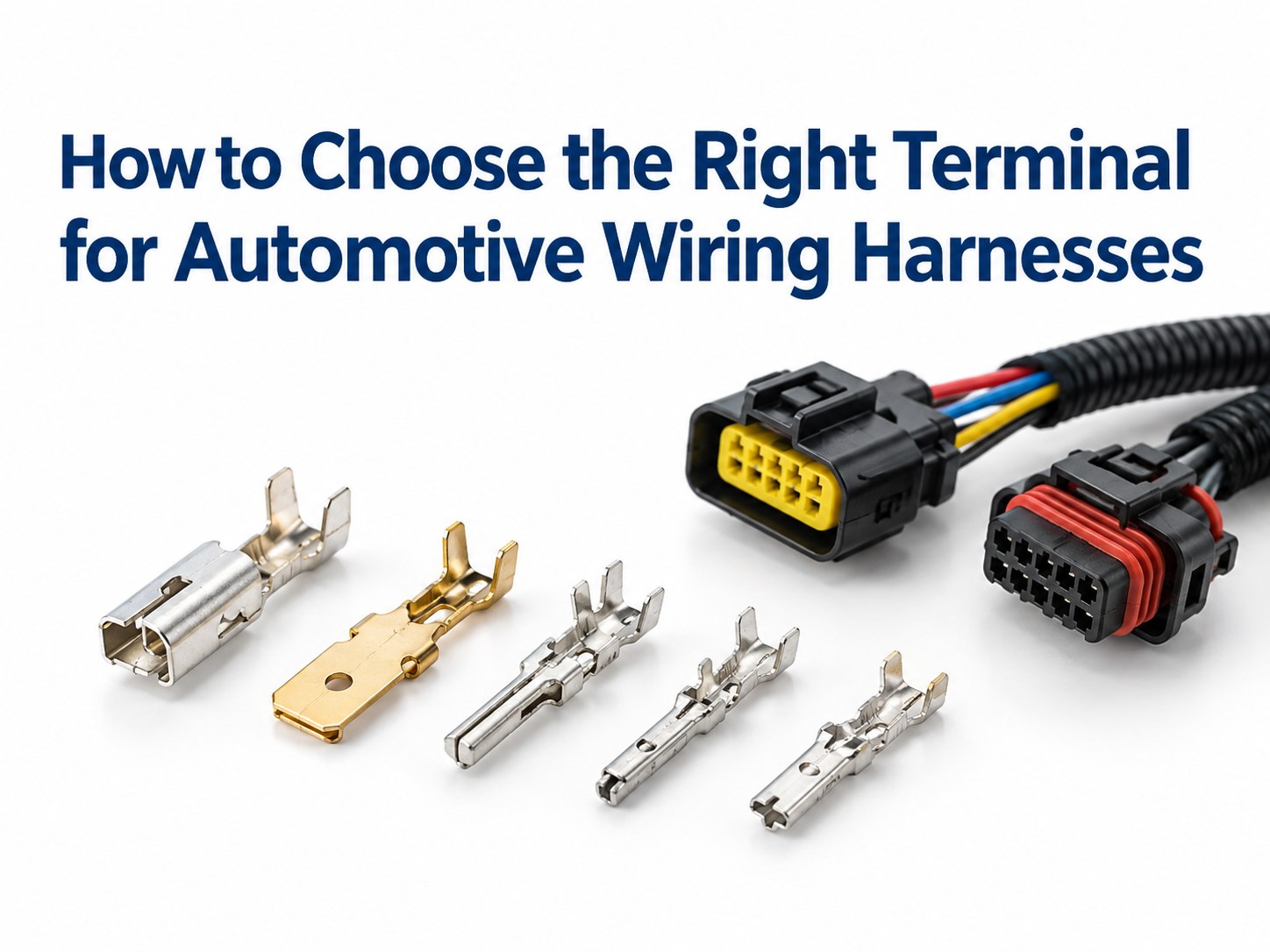
Choosing the right terminal is an important part of designing a reliable automotive wiring harness. The terminal has to carry electrical current, maintain stable contact, withstand vibration and temperature changes, and remain securely connected throughout the vehicle’s service life.
For automotive OEMs and wiring harness manufacturers, terminal selection is not simply about finding a part that fits the wire. Wire size, current load, terminal material, plating, crimping performance, environmental conditions, mating requirements, and production method all need to be considered together.
So, how do you choose the right terminal for an automotive wiring harness?
This guide explains the key factors step by step.
1. Start With Wire Size and Current Requirements
The first step is to understand the electrical requirements of the wiring harness.
Match the Terminal to the Wire Size
Automotive wires are available in different cross-sectional areas and AWG sizes. The terminal must be designed for the specific conductor size and insulation diameter.
When checking compatibility, consider:
- Wire cross-sectional area
- AWG size
- Conductor diameter
- Insulation diameter
- Approved wire range of the terminal
- Required crimp dimensions
A terminal may physically fit a wire but still provide poor electrical or mechanical performance if the conductor range is incorrect.
For example, using a terminal designed for a larger conductor on a smaller wire can result in an insufficient crimp. On the other hand, forcing a larger wire into a terminal designed for a smaller conductor can damage the terminal or produce an inconsistent crimp.
Consider the Current Load
Current capacity is another key consideration.
The terminal needs to handle the required continuous current without excessive temperature rise. Some automotive circuits also experience short periods of higher peak current, so the application should be evaluated accordingly.
Signal circuits, lighting circuits, motors, battery connections, and power distribution systems may require very different terminal designs.
For high-current applications, factors such as contact area, material thickness, electrical resistance, and heat dissipation become especially important.
.jpg)
2. Choose the Right Automotive Terminal Type
Once the electrical requirements are clear, select a terminal structure suitable for the wiring harness.
Male and Female Terminals
Male and female terminals are designed to work as a mating pair inside a connector housing. Their dimensions, contact structure, retention characteristics, and mating force must be compatible.
The terminal should therefore be selected together with the intended housing and mating component rather than treated as an isolated metal part.
Crimp Terminals
Crimp terminals are widely used in automotive wiring harnesses because they can provide a consistent electrical and mechanical connection when properly designed and processed.
A good crimp should securely hold the conductor while maintaining a stable electrical connection.
For high-volume automotive production, the terminal should also be suitable for automated crimping equipment and consistent mass production.
Sealed and Unsealed Terminals
Environmental conditions determine whether a sealed or unsealed terminal system is appropriate.
Sealed terminals are commonly considered for applications exposed to:
- Water
- Moisture
- Dust
- Oil
- Road salt
- Engine compartment conditions
Unsealed terminals may be suitable for protected interior applications where exposure to moisture and contamination is limited.
The terminal, housing, seal and wire should be evaluated as a complete system.
High-Current Automotive Terminals
Electric vehicles and modern vehicles increasingly require terminals capable of handling higher electrical loads.
High-current terminals may be used in:
- Battery connections
- Motor systems
- Power distribution
- EV electrical systems
- Charging systems
- Energy management systems
These applications require particular attention to contact resistance, heat generation, material selection and mechanical stability.
.jpg)
3. Select the Right Terminal Material
Terminal material directly affects conductivity, strength, forming performance and durability.
Copper and Copper Alloys
Copper provides excellent electrical conductivity and is widely used for electrical terminals. However, automotive terminals often require a balance between conductivity and mechanical performance.
Copper alloys can provide additional strength and forming characteristics while maintaining suitable electrical performance.
Brass
Brass can provide a useful combination of electrical conductivity, mechanical strength and manufacturability. It is used in various electrical and terminal applications where these characteristics are required.
Phosphor Bronze
Phosphor bronze is known for its spring properties, strength and resistance to fatigue. These characteristics can be useful in terminals that require stable contact force over repeated mating cycles.
The right material should therefore be selected according to the electrical load, mechanical requirements, forming process and operating environment—not conductivity alone.
4. Pay Attention to Plating and Corrosion Resistance
The base material is only one part of terminal performance. Surface plating also affects contact reliability and environmental resistance.
Tin Plating
Tin plating is commonly used for electrical terminals because it provides good electrical contact performance and corrosion protection while remaining suitable for many cost-sensitive applications.
The plating specification should match the intended application and manufacturing requirements.
Nickel Plating
Nickel plating can provide good corrosion resistance, wear resistance and high-temperature performance. It may be considered for terminals used in more demanding environments.
Why Plating Thickness Matters
Plating should not be evaluated simply by asking whether a terminal is “tin plated” or “nickel plated.”
Important factors include:
- Plating material
- Plating thickness
- Base material
- Operating temperature
- Contact resistance
- Corrosion requirements
- Mating frequency
For automotive applications, the plating system needs to remain stable throughout the expected service conditions.
5. Evaluate Crimping Performance
A well-designed terminal still depends on a reliable crimping process.
There are generally two important areas of an automotive terminal crimp: the conductor crimp and the insulation crimp.
The conductor crimp provides the electrical and mechanical connection to the wire. The insulation crimp provides additional mechanical support and helps reduce movement of the wire near the conductor connection.
Important parameters may include:
- Crimp height
- Crimp width
- Conductor compression
- Insulation support
- Pull-out force
- Crimp consistency
Poor crimping can result in increased contact resistance, wire pull-out, intermittent connections and excessive heat.
For more technical information, see our guide on Electrical Terminal Crimping: Design, Process, and Quality Requirements.
For automotive wiring harness production, terminal design should also take automated crimping into account. A terminal that performs well in a laboratory but produces inconsistent results during high-volume production is not a practical solution.
6. Consider Temperature, Vibration and the Automotive Environment
Automotive terminals operate in environments that can be considerably more demanding than ordinary indoor electrical applications.
Depending on their location, terminals may experience:
- High and low temperatures
- Continuous vibration
- Mechanical shock
- Humidity
- Water exposure
- Salt spray
- Oil and chemicals
Under-Hood Applications
Terminals installed near engines or other heat-generating components may face higher temperatures, vibration and chemical exposure.
Material selection, plating, contact force and terminal structure should therefore be evaluated carefully.
Interior Applications
Interior wiring harnesses may have different priorities, such as compact dimensions, reliable contact, low weight and resistance to vibration.
The important point is that there is no single automotive terminal specification suitable for every vehicle application.
The terminal should be selected according to its actual operating environment.
7. Check Mating and Retention Requirements
Electrical performance is only part of terminal reliability. The terminal also needs to remain securely positioned inside its housing.
Important mechanical factors include:
- Terminal retention force
- Insertion force
- Withdrawal force
- Mating cycles
- Contact force
- Housing compatibility
- Terminal locking structure
The terminal should remain securely locked in the housing while maintaining stable contact with the mating terminal.
This becomes especially important in automotive applications because continuous vibration and mechanical movement can place additional stress on the connection.
For this reason, terminal design should always be evaluated together with the connector housing and complete wiring harness system.
.jpg)
8. Consider Terminal Dimensions and Production Requirements
Space is often limited in modern automotive wiring systems. Terminals therefore need to meet dimensional requirements while still providing the necessary electrical and mechanical performance.
Consider:
- Terminal length and width
- Material thickness
- Contact area
- Terminal pitch
- Housing dimensions
- Wire routing space
- Strip or reel packaging
- Automated crimping compatibility
For high-volume wiring harness production, packaging is also important.
Terminals supplied in reels or strips can support automated processing and improve production efficiency. The terminal design should therefore be compatible with the customer’s actual assembly equipment and production process.
9. Verify Automotive Quality and Testing Requirements
Before approving an automotive terminal, buyers and engineers should confirm how its performance will be evaluated.
Electrical Testing
Typical electrical checks may include:
- Contact resistance
- Voltage drop
- Current carrying capability
- Temperature rise
Mechanical Testing
Mechanical evaluation may include:
- Terminal retention
- Wire pull force
- Insertion and withdrawal force
- Mating and unmating performance
Environmental Testing
Depending on the application, testing may include:
- Temperature cycling
- Humidity
- Corrosion resistance
- Vibration
- Mechanical shock
Automotive customers may also require suppliers to operate under quality management systems such as IATF 16949 and ISO 9001, together with applicable material and environmental requirements such as RoHS and REACH.
For projects involving specific automotive standards, see our article Automotive Terminal Standards: USCAR, LV214 Explained.
10. Decide Between Standard and Custom Automotive Terminals
Standard terminals can be a practical choice when an existing specification already meets the electrical, mechanical and dimensional requirements of the project.
However, automotive wiring harness projects sometimes have requirements that cannot be fully addressed by standard parts.
Custom terminals may be considered when you need:
- Special terminal dimensions
- A specific wire range
- Special locking structures
- Higher current capacity
- Specific plating requirements
- Special material combinations
- Compact terminal designs
- Compatibility with automated assembly
- Application-specific crimping performance
The decision should be based on the actual requirements of the wiring harness rather than simply choosing the lowest-cost terminal.
A custom terminal can also allow the terminal geometry, material and manufacturing process to be developed around the customer’s application.
For more information, see our guide to Custom Electrical Terminals vs. Standard Terminals.
Automotive Terminal Selection Checklist
Before selecting an automotive wiring harness terminal, check the following:
| Selection Factor | What to Check |
|---|---|
| Wire | Wire size, AWG and insulation diameter |
| Current | Continuous and peak current |
| Terminal Type | Crimp, sealed, unsealed, male or female |
| Material | Copper, brass or phosphor bronze |
| Plating | Tin, nickel or other required finish |
| Crimping | Crimp height, pull force and consistency |
| Environment | Temperature, vibration, moisture and corrosion |
| Mating | Housing compatibility and retention |
| Dimensions | Available space and terminal geometry |
| Production | Reel/strip packaging and automated crimping |
| Quality | Electrical, mechanical and environmental testing |
| Customization | Special dimensions or performance requirements |
Using this checklist early in the design process can help engineers and purchasing teams avoid problems later during sample testing and mass production.
Why Choose Qianwei Precision for Custom Automotive Wiring Harness Terminals?
For automotive wiring harness projects, terminal performance depends not only on the final stamped part but also on tooling, material control, production consistency and inspection.
Qianwei Precision supports customers with an integrated manufacturing process covering terminal design, mold development, precision stamping, plating, inspection and mass production.
Our manufacturing capabilities include high-speed stamping, mold manufacturing and automated production processes for precision electrical terminals. This allows terminal specifications to be developed around the customer’s wire size, electrical requirements, dimensions and application conditions.
For OEM and wiring harness projects that require non-standard terminal designs, Qianwei can support the development process from tooling to production.
Conclusion
Choosing the right terminal for an automotive wiring harness requires more than matching a terminal to a wire.
A reliable selection should consider the complete application—from wire size and current to terminal type, material, plating, crimping, environmental conditions, mating performance, quality requirements and production method.
For standard applications, an existing terminal may provide a practical solution. For applications with specific electrical, mechanical or dimensional requirements, a custom terminal can provide greater control over the final wiring harness design.
If you are developing a new automotive wiring harness or looking for a custom terminal manufacturer, provide your wire specifications, application requirements and terminal drawings or samples. Qianwei Precision can support the process from terminal design and tooling to precision stamping, inspection and mass production.
Need a custom automotive wiring harness terminal? Contact Qianwei Precision to discuss your application and terminal requirements.
FAQs
1. What is an automotive wiring harness terminal?
An automotive wiring harness terminal is a conductive metal component used to establish an electrical and mechanical connection between a wire and another electrical component, typically through a mating terminal and housing.
2. How do I choose the right terminal for an automotive wire?
Start with the wire size and current requirement. Then evaluate terminal type, material, plating, crimping performance, environmental conditions, mating requirements and production method.
3. What materials are commonly used for automotive terminals?
Copper and copper alloys are commonly used. Brass and phosphor bronze may also be selected depending on conductivity, strength, spring performance and forming requirements.
4. What is the difference between sealed and unsealed automotive terminals?
Sealed terminal systems are designed for applications requiring greater protection from water, moisture, dust and other contaminants. Unsealed systems are generally used in more protected environments.
5. Why is crimp quality important for automotive terminals?
A poor crimp can increase electrical resistance, reduce mechanical strength and create intermittent electrical connections. Consistent crimping is particularly important in high-volume automotive wiring harness production.
6. Does terminal plating affect automotive performance?
Yes. Plating can affect contact resistance, corrosion resistance, wear resistance and temperature performance. The appropriate plating depends on the application and operating environment.
7. When should I consider a custom automotive terminal?
Custom terminals are worth considering when standard parts cannot meet requirements for dimensions, wire size, current capacity, locking structure, plating, crimping or automated production.
8. Can automotive terminals be supplied in reels or strips?
Yes. Strip or reel packaging can be used for terminals designed for automated crimping and high-volume wiring harness production.
9. What should I provide to an automotive terminal manufacturer?
Useful information includes wire size, current requirements, terminal dimensions, mating housing, operating temperature, environmental conditions, plating requirements, estimated annual volume and any available drawings or samples.
10. Can Qianwei manufacture custom automotive wiring harness terminals?
Yes. Qianwei Precision provides custom terminal development and mass production, including tooling, precision stamping, plating, inspection and production support for OEM applications.

