

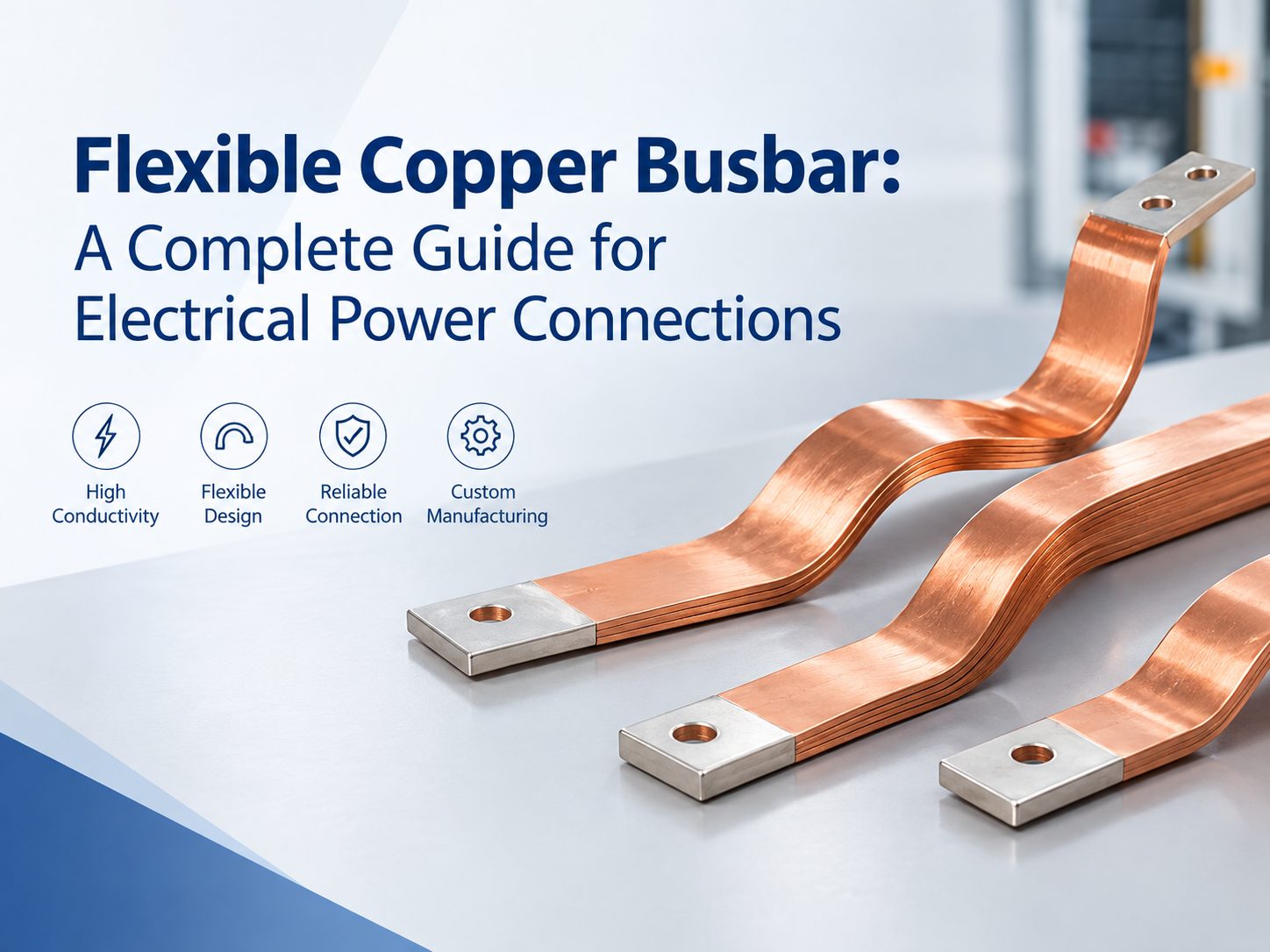
As electrical systems become more compact and power requirements continue to increase, engineers need connection components that can carry high current without taking up unnecessary space. A flexible copper busbar is one solution that combines the electrical conductivity of copper with the mechanical flexibility needed for modern equipment.
Flexible copper busbars are commonly used in battery systems, energy storage equipment, EV applications, power distribution systems, industrial equipment, and other high-current electrical applications. Compared with conventional rigid busbars, their flexible structure makes them easier to install in tight spaces and better able to accommodate movement, vibration, and dimensional tolerances.
For OEM buyers, however, choosing the right flexible copper busbar involves more than selecting a piece of copper with the right dimensions. Material, cross-sectional area, current requirements, bending design, connection holes, surface treatment, and manufacturing tolerances all need to be considered.
This guide explains the structure, advantages, materials, specifications, applications, selection criteria, and manufacturing process of flexible copper busbars.
What Is a Flexible Copper Busbar?
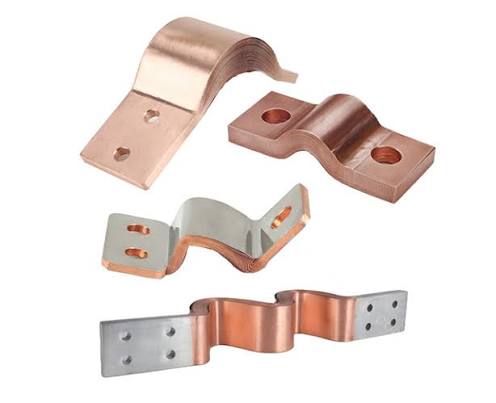
A flexible copper busbar is a high-current electrical connection component made from copper layers or copper strips designed to provide both electrical conductivity and mechanical flexibility.
Unlike a rigid copper busbar, which normally has a fixed shape, a flexible busbar can be bent or formed to match the installation requirements of the electrical system. This makes it particularly useful when two electrical connection points are close together but cannot be connected conveniently with a straight conductor.
A flexible copper busbar typically consists of conductive copper sections, connection areas, and, depending on the design, surface treatments or protective components.
The basic function is straightforward: the copper carries electrical current while the flexible structure allows the connection to accommodate installation tolerances and limited movement.
How Does a Flexible Copper Busbar Work?
A flexible copper busbar connects two or more electrical points while maintaining a low-resistance conductive path.
Its flexibility can help accommodate:
- Installation tolerances
- Equipment vibration
- Thermal expansion and contraction
- Relative movement between components
- Limited installation space
- Non-linear connection paths
This combination of electrical and mechanical performance makes flexible busbars particularly useful in equipment where a rigid connection could create excessive mechanical stress.
Why Use a Flexible Copper Busbar?
The main reason to use a flexible copper busbar is that electrical connections sometimes need to do more than carry current. They also need to fit the physical structure of the equipment.
High Electrical Conductivity
Copper is widely used for electrical power connections because of its high electrical conductivity and good thermal conductivity.
When properly designed, a copper busbar can provide a low-resistance path for high-current applications. This is particularly important in battery systems, power distribution equipment, and other applications where significant amounts of current need to pass through a compact connection.
Mechanical Flexibility
A rigid conductor can be difficult to install when connection points are not perfectly aligned. A flexible copper busbar can be bent or formed to match the required installation path.
This can simplify assembly and reduce the need for additional connection components.
Reduced Mechanical Stress
Electrical equipment can experience vibration, thermal expansion, and mechanical movement during operation.
A flexible connection can absorb some of this movement instead of transferring all of the mechanical stress directly to the connection points.
This can be especially useful in:
- Battery systems
- Automotive and EV equipment
- Industrial machinery
- Power conversion equipment
- Electrical cabinets
Compact Electrical Connections
Space is often limited in modern electrical equipment.
Flexible copper busbars can be designed with specific widths, thicknesses, lengths, hole positions, and bending angles. This allows the connection to follow the available installation space rather than forcing the equipment layout to accommodate a rigid conductor.
Reliable High-Current Performance
A properly designed flexible copper busbar combines three important characteristics:
Electrical conductivity + mechanical flexibility + reliable connection
However, the performance of the complete connection depends on more than the copper itself. Correct dimensions, contact surfaces, connection pressure, plating, and installation all need to be considered.
Flexible Copper Busbar vs. Rigid Copper Busbar
Both flexible and rigid copper busbars are used for electrical power distribution, but they are suited to different installation requirements.
| Feature | Flexible Copper Busbar | Rigid Copper Busbar |
|---|---|---|
| Flexibility | High | Low |
| Installation in tight spaces | Excellent | More difficult |
| Vibration tolerance | Better suited | More limited |
| Thermal movement | Can accommodate movement | Less flexible |
| High-current applications | Suitable | Suitable |
| Complex routing | Suitable | Less suitable |
| Custom bending | Available | Limited |
| Fixed straight connections | Suitable | Excellent |
When Should You Choose a Flexible Copper Busbar?
A flexible copper busbar is worth considering when the connection requires:
- Bending or forming
- Compact installation
- Movement compensation
- Vibration tolerance
- Custom routing
- High-current electrical performance
It is particularly useful when connection points are difficult to align with a straight busbar.
When Is a Rigid Copper Busbar Better?
A rigid copper busbar may be more appropriate for simple, fixed electrical structures where:
- Connection points are accurately positioned
- No bending is required
- There is sufficient installation space
- The conductor can follow a straightforward path
The best choice depends on the electrical and mechanical requirements of the application rather than simply the current rating.
Common Types of Flexible Copper Busbars
Flexible copper busbars can be manufactured in different structures depending on the application and required mechanical performance.
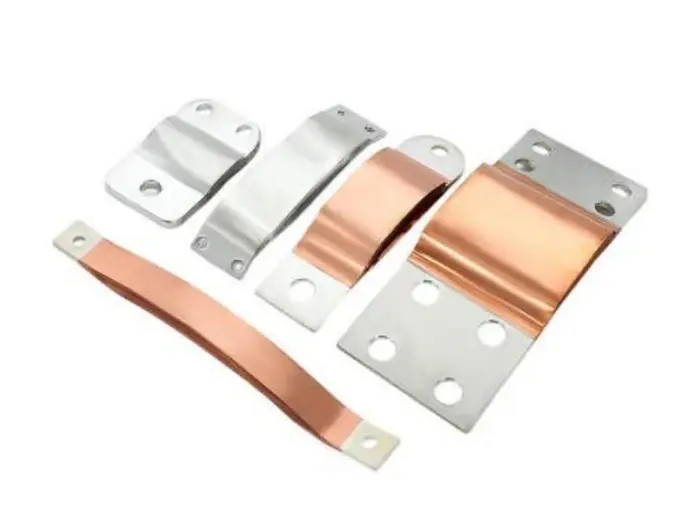
Multi-Layer Flexible Copper Busbars
Multi-layer designs use multiple copper layers to achieve the required electrical cross-sectional area while maintaining flexibility.
The number and thickness of the copper layers can be adjusted according to the electrical and mechanical requirements of the application.
Laminated Flexible Copper Busbars
Laminated busbars can combine conductive layers with insulation or other structural materials depending on the design.
They can help create compact and organized power connections, particularly where several conductors need to be arranged in a limited space.
Tinned Flexible Copper Busbars
Tin plating can be applied when the application requires improved surface protection and stable electrical contact characteristics.
The specific surface treatment should be selected according to the operating environment, connection method, and customer’s technical requirements.
Custom-Shaped Flexible Copper Busbars
Not every electrical system can use a standard straight busbar.
Custom flexible busbars can incorporate:
- Specific lengths
- Different widths and thicknesses
- Custom hole patterns
- Different hole diameters
- Specific bending angles
- Formed connection sections
- Application-specific surface treatments
For OEM projects, these details can make the difference between a component that simply works electrically and one that integrates efficiently into the final equipment.
Materials Used in Flexible Copper Busbars
Material selection has a direct effect on electrical conductivity, flexibility, mechanical performance, and manufacturing requirements.
Copper
Copper is the primary conductive material used in many flexible busbar applications because it provides a good combination of electrical conductivity, thermal conductivity, and formability.
For high-current applications, the required copper grade and thickness should be selected based on the actual operating conditions rather than relying on a standard specification.
Copper Grades
When selecting copper material, engineers may need to consider:
- Electrical conductivity
- Mechanical properties
- Flexibility
- Thickness
- Formability
- Operating temperature
For OEM production, the material specification should be confirmed before tooling and mass production begin.
Tin Plating and Surface Treatment
The surface of a copper busbar can be treated according to the requirements of the application.
Tin plating is commonly considered when improved corrosion resistance and stable contact performance are required.
The appropriate finish depends on factors such as:
- Operating environment
- Connection method
- Temperature
- Corrosion exposure
- Contact requirements
Surface treatment should therefore be considered as part of the overall connection design rather than as an afterthought.
Key Specifications of a Flexible Copper Busbar
When requesting a custom flexible copper busbar, several dimensions and technical specifications should be clearly defined.
Width and Thickness
The width and total copper thickness determine the conductive cross-sectional area and influence current-carrying capability.
They also affect the mechanical flexibility and overall dimensions of the finished component.
Length
The required length depends on the distance between the connection points and the intended routing path.
The design should account for installation tolerances and any required bending.
Number of Copper Layers
For multi-layer designs, the number and thickness of copper layers can influence both electrical performance and flexibility.
A larger conductive cross-section can increase current-carrying capability, but the complete design still needs to consider heat dissipation and installation conditions.
Hole Size and Hole Position
Connection holes need to match the bolts, studs, terminals, or other mounting components used in the final assembly.
Incorrect hole diameter or hole positioning can create assembly problems even when the electrical specifications are correct.
Bending Angle and Bending Radius
The bending design should be established according to the available installation space and the structure of the busbar.
Common requirements may include 90-degree bends or application-specific forming.
The minimum bending radius should also be considered to avoid excessive mechanical stress.
Plating and Surface Finish
The surface finish can affect corrosion resistance, contact performance, and long-term reliability.
The plating specification should therefore be included in the technical drawing or purchasing specification when required.
Flexible Copper Busbar Current Rating: What Determines It?
Current rating is one of the most important considerations when selecting a flexible copper busbar.
There is no single current rating that applies to every flexible busbar. The actual capability depends on the conductor design and operating conditions.
Cross-Sectional Area
The copper cross-sectional area is a major factor in determining current-carrying capability.
In a simplified design, the conductive area is related to the width and total copper thickness.
However, current capacity should not be determined from dimensions alone.
Copper Conductivity
The conductivity of the selected copper material affects electrical resistance and heat generation.
Material specifications should therefore be confirmed before finalizing the design.
Operating Temperature
Ambient temperature and allowable temperature rise both affect the actual current-carrying capability.
A busbar operating inside a high-temperature enclosure may have different thermal requirements from one installed in an open environment with good airflow.
Heat Dissipation
Heat generation and heat dissipation need to be considered together.
Important factors include:
- Copper cross-sectional area
- Surface area
- Ambient temperature
- Airflow
- Installation environment
- Connection resistance
A connection with insufficient contact area or excessive contact resistance can generate localized heat even when the copper conductor itself is adequately sized.
Connection Resistance
The connection points deserve particular attention.
Poor contact, incorrect fastening, surface contamination, or insufficient contact pressure can increase resistance and cause localized heating.
For this reason, a high-current connection should always be evaluated as a complete system rather than by looking at the busbar alone.
Applications of Flexible Copper Busbars
Flexible copper busbars are used across a wide range of electrical and power applications.
Flexible Copper Busbars for Battery Energy Storage Systems (BESS)
Battery energy storage systems require reliable high-current connections between battery modules, racks, power conversion equipment, and distribution components.
Flexible copper busbars can help accommodate compact layouts and connection tolerances while providing a conductive path for high-current applications.
Typical applications include:
- Battery module connections
- Battery rack connections
- Power distribution
- PCS connections
- Energy storage equipment
For energy storage projects, busbar dimensions and current requirements should be designed according to the specific battery architecture and operating conditions.
Flexible Copper Busbars for EV Batteries and Charging Systems
Electric vehicles and charging equipment require compact high-current connections.
Flexible busbars can be used in areas where battery components or electrical modules need a formed connection rather than a straight conductor.
Potential applications include:
- Battery packs
- Power electronics
- Charging equipment
- High-current electrical connections
Flexible Copper Busbars for Power Distribution Systems
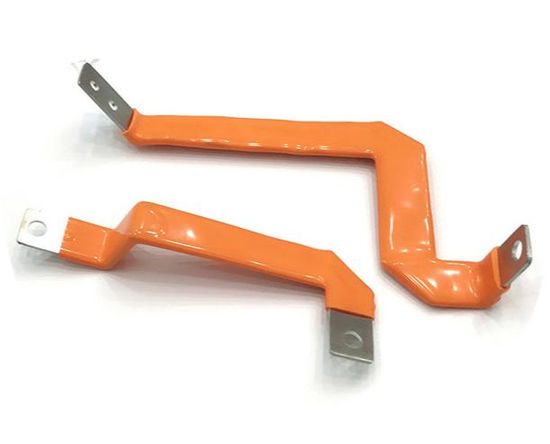
Flexible copper busbars can be used in:
- Electrical panels
- Distribution cabinets
- Switchgear
- Power equipment
- Power conversion systems
Their ability to accommodate installation tolerances can simplify connections in compact electrical assemblies.
Flexible Copper Busbars for Industrial Electrical Equipment
Industrial equipment often combines high electrical loads with vibration and space limitations.
Flexible busbars can be used for connections in:
- Industrial machinery
- Power supplies
- Motors and electrical equipment
- Control systems
- High-current equipment
Flexible Copper Busbars for Renewable Energy Systems
Renewable energy systems frequently combine power generation, energy storage, and power conversion equipment.
Flexible copper busbars may be used in:
- Solar power systems
- Battery storage
- Inverters
- Power conversion equipment
- Electrical distribution systems
How to Choose the Right Flexible Copper Busbar
Choosing a flexible copper busbar should begin with the application requirements rather than a standard product size.
Step 1: Determine the Required Current
Define both continuous and peak current requirements where applicable.
Also consider the operating temperature and installation environment.
Step 2: Define the Available Space
Measure the space available around the connection points.
Consider:
- Maximum width
- Maximum thickness
- Overall length
- Bending direction
- Clearance from surrounding components
Step 3: Select the Copper Material
The material should meet the required electrical and mechanical specifications.
For OEM projects, confirm the material grade and relevant standards before production.
Step 4: Determine the Required Dimensions
Define:
- Length
- Width
- Copper thickness
- Number of layers
- Hole diameter
- Hole position
- Overall shape
Step 5: Consider Plating Requirements
Determine whether the application requires bare copper or a surface treatment such as tin plating.
The choice should be based on the electrical connection and environmental requirements.
Step 6: Check Bending Requirements
Specify:
- Bending angle
- Bending direction
- Bending radius
- Number of bends
- Final three-dimensional shape
Providing a drawing or 3D model can make this stage much more accurate.
Step 7: Confirm the Connection Method
The busbar may need to connect using bolts, studs, terminals, or other connection structures.
The connection method should be considered together with hole dimensions and contact areas.
Custom Flexible Copper Busbar for OEM Applications
Standard busbars do not always fit the requirements of OEM equipment.
A custom flexible copper busbar can be designed around the actual electrical and mechanical requirements of the application.
This is especially useful when the customer needs a specific combination of current capacity, dimensions, bending geometry, mounting holes, and surface treatment.
Why Choose a Custom Flexible Copper Busbar?
Custom manufacturing can help OEM buyers achieve:
- Better space utilization
- More accurate connection geometry
- Simplified assembly
- Reduced installation adjustments
- Consistent production dimensions
- Integration with other electrical components
What Can Be Customized?
| Custom Feature | Typical Requirement |
|---|---|
| Length | Customer-specific |
| Width | Customer-specific |
| Thickness | Based on current and mechanical requirements |
| Hole position | Custom |
| Hole diameter | Custom |
| Bending angle | 90° or application-specific |
| Copper layers | Application-dependent |
| Surface treatment | According to application |
| Connection structure | Custom |
For an OEM project, a technical drawing is the best starting point. If a final drawing is not available, the manufacturer can review the application requirements and help determine the appropriate design parameters.
Flexible Copper Busbar Manufacturing Process
The manufacturing process has a direct impact on dimensional consistency and final product quality.
A typical custom production process includes the following stages.
1. Engineering and Design
The manufacturer reviews the customer’s drawings and requirements, including:
- Material
- Dimensions
- Current requirements
- Hole locations
- Bending geometry
- Surface treatment
- Tolerances
The design should be confirmed before tooling or mass production begins.
2. Tooling Development
For products requiring precision forming or stamping, dedicated tooling may be developed according to the approved design.
Good tooling helps maintain dimensional consistency during production.
3. Copper Cutting and Forming
Copper material is prepared according to the required dimensions and production process.
Depending on the design, cutting, forming, or other processing methods may be used.
4. Stamping and Hole Processing
Precision stamping or machining processes can be used to create mounting holes and other required features.
Hole position and dimensional accuracy are particularly important for bolt-mounted connections.
5. Bending and Forming
The copper busbar is formed according to the required geometry.
The process needs to control bending angle, position, and dimensional consistency across production batches.
6. Plating and Surface Treatment
Where required, the finished copper component receives the specified surface treatment.
Process control is important to maintain consistent surface quality.
7. Inspection
Finished parts can be inspected for:
- Dimensions
- Hole position
- Surface quality
- Plating condition
- Forming accuracy
- Electrical performance where required
8. Mass Production
Once the design and production process have been validated, the component can move into mass production.
For OEM customers, stable production capability is important because a busbar that meets the specification in a prototype but varies significantly between production batches can create assembly and reliability problems.
Quality Control for Flexible Copper Busbars
Quality control should cover both electrical and mechanical characteristics.
Dimensional Inspection
Critical dimensions such as length, width, thickness, and overall shape should be checked against the approved drawing.
Hole Position Inspection
Hole diameter and position need to remain within the specified tolerance to ensure smooth assembly.
Plating Inspection
Where plating is required, surface condition and relevant plating specifications should be verified.
Electrical Performance
Depending on the application, electrical resistance, conductivity, or other electrical characteristics may need to be evaluated.
Mechanical and Bending Inspection
The finished busbar should maintain the required shape and bending geometry without unwanted deformation.
Final Inspection Before Shipment
A final inspection helps ensure that the finished components match the customer’s approved specifications before shipment.
For applications such as energy storage, EVs, industrial power equipment, and other high-current systems, quality control should be established according to the actual product requirements rather than relying only on general inspection procedures.
Flexible Copper Busbar vs. Copper Cable
Copper cable and flexible copper busbars can both be used for high-current connections, but they have different characteristics.
| Feature | Flexible Copper Busbar | Copper Cable |
|---|---|---|
| Conductive material | Copper | Copper |
| Shape | Custom formed | Flexible cable |
| Space efficiency | High in compact assemblies | Depends on cable routing |
| Custom geometry | Excellent | More limited |
| Fixed connection | Excellent | Requires suitable termination |
| Complex routing | Suitable | Very suitable |
| High-current applications | Suitable | Suitable |
| Integration with mounting holes | Excellent | Requires terminals or lugs |
A copper cable may be preferable when the connection needs to follow a long or highly flexible route.
A flexible copper busbar can be a better choice when the connection is relatively short and needs a compact, formed, and accurately positioned structure.
The right solution depends on the equipment layout, current requirements, installation method, and mechanical conditions.
Common Problems When Using Flexible Copper Busbars
Even a well-designed busbar can perform poorly if the component is incorrectly selected or installed.
Excessive Heat
Possible causes include:
- Insufficient conductive cross-section
- Excessive current
- High contact resistance
- Poor connection
- Inadequate heat dissipation
The complete electrical path should be evaluated when investigating overheating.
Incorrect Bending
Excessive or incorrectly positioned bending can create unnecessary mechanical stress.
The required bending radius and forming geometry should therefore be considered during design.
Poor Hole Alignment
If mounting holes do not match the equipment connection points, assembly can become difficult or require additional force.
Accurate hole positioning is especially important for OEM production.
Surface Oxidation or Corrosion
Copper surfaces can be affected by environmental conditions.
Where required, an appropriate surface treatment can provide additional protection and help maintain stable contact performance.
Inconsistent Dimensions
Variation between batches can cause assembly problems, particularly when the busbar is designed to fit a compact electrical assembly.
For this reason, tooling accuracy and production process control are important considerations when selecting a supplier.
Why Work with an Experienced Flexible Copper Busbar Manufacturer?
For standard components, price may appear to be the main purchasing consideration. For custom OEM busbars, however, manufacturing capability can have a much greater impact on the final result.
An experienced manufacturer should be able to support:
- Engineering and drawing review
- Material selection
- Custom tooling
- Precision stamping
- Bending and forming
- Surface treatment
- Dimensional inspection
- Prototype development
- Mass production
- Batch consistency
The supplier should also understand that the busbar is part of a larger electrical connection system.
The goal is not simply to manufacture a copper component. It is to produce a component that fits the customer’s equipment, meets its electrical requirements, and can be manufactured consistently at the required volume.
Why Choose Qianwei Precision for Custom Electrical Connection Components?
Qianwei Precision provides custom electrical connection component manufacturing for OEM and industrial applications.
Our production capabilities cover multiple stages of the manufacturing process, including:
Design → Tooling → Stamping → Forming → Plating → Inspection → Mass Production
With experience in precision metal stamping and electrical connection components, Qianwei can work with customer drawings and application requirements to develop components for different electrical systems.
Our manufacturing capabilities include processing copper, brass, and phosphor bronze materials, as well as custom tooling and precision production.
For customers developing high-current electrical systems, battery equipment, energy storage systems, EV applications, and industrial equipment, the design of the electrical connection component needs to consider both electrical performance and mechanical integration.
Qianwei Precision can support OEM projects from design and tooling through production and quality inspection.
Need a Custom Flexible Copper Busbar?
Every electrical system has different requirements for current, dimensions, mounting, bending, and installation space.
If you are looking for a custom flexible copper busbar, you can provide your drawing, dimensions, current requirements, material specifications, or application details for evaluation.
Qianwei Precision can review your requirements and provide a customized solution for prototype development and mass production.
Request a Quote for Your Custom Flexible Copper Busbar
FAQs
1. What is a flexible copper busbar?
A flexible copper busbar is a copper electrical conductor designed to provide high-current transmission while allowing the connection to bend or accommodate limited mechanical movement.
2. What are flexible copper busbars used for?
They are commonly used in battery systems, BESS, EV equipment, charging systems, power distribution equipment, industrial machinery, inverters, and other high-current electrical applications.
3. Are flexible copper busbars suitable for high-current applications?
Yes. Copper provides high electrical conductivity, making flexible copper busbars suitable for many high-current applications. The actual current capacity depends on conductor dimensions, copper material, temperature, heat dissipation, and connection conditions.
4. What is the difference between a flexible and rigid copper busbar?
A rigid copper busbar maintains a fixed shape, while a flexible copper busbar can be bent or formed to accommodate installation requirements, movement, and dimensional tolerances.
5. How do I calculate the current rating of a flexible copper busbar?
Current capacity depends on factors such as copper cross-sectional area, conductivity, operating temperature, allowable temperature rise, heat dissipation, and installation conditions. For a custom design, these factors should be evaluated together rather than relying only on conductor dimensions.
6. Can flexible copper busbars be customized?
Yes. Custom flexible busbars can be manufactured according to requirements for length, width, thickness, hole diameter, hole position, bending angle, number of copper layers, and surface treatment.
7. What copper materials are used for flexible busbars?
Copper is the primary conductive material. The appropriate copper grade should be selected according to the required conductivity, flexibility, mechanical performance, and application requirements.
8. Can flexible copper busbars be bent to a specific angle?
Yes. Custom busbars can be formed according to the required bending angle and installation geometry. The bending radius and forming method should be considered during the design stage.
9. Can flexible copper busbars be tin plated?
Yes, tin plating can be used for applications that require a suitable surface finish and improved corrosion protection. The appropriate surface treatment depends on the operating environment and connection requirements.
10. How can I order a custom flexible copper busbar from a manufacturer?
The best starting point is to provide a technical drawing or product requirements, including current, dimensions, copper material, hole locations, bending geometry, surface treatment, quantity, and application information. A manufacturer can then review the requirements and develop the appropriate production solution.


2 thoughts on “Flexible Copper Busbar: A Complete Guide for Electrical Power Connections”