

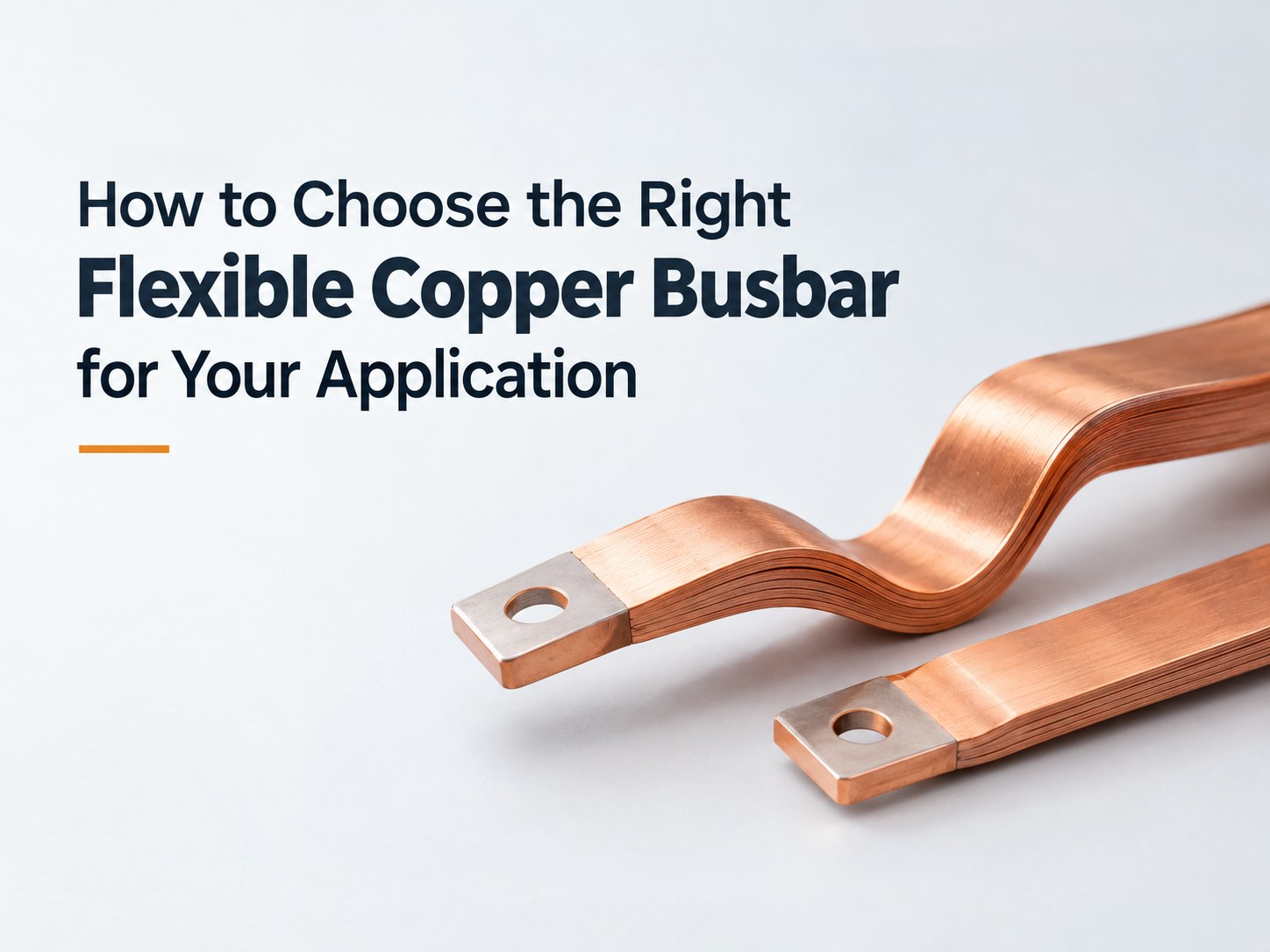
Choosing the right flexible copper busbar is not simply a matter of selecting a piece of copper that can carry the required current. The busbar also needs to fit the available space, handle heat, accommodate movement, provide a reliable connection, and work consistently in the actual operating environment.
This becomes especially important in battery systems, energy storage equipment, EVs, power distribution systems, industrial equipment, and other high-current applications. As electrical equipment becomes more compact and power density increases, there is often less room for rigid conductors and traditional cable connections.
A flexible copper busbar can provide a practical solution, but the design needs to match the application.
In this guide, we will look at the key factors to consider when selecting a flexible copper busbar, including current rating, copper material, dimensions, flexibility, connection design, surface treatment, operating environment, and customization requirements.
What Is a Flexible Copper Busbar?
A flexible copper busbar is a current-carrying electrical conductor designed to provide both high electrical conductivity and mechanical flexibility.
Unlike a conventional rigid copper busbar, a flexible busbar can bend or accommodate a certain amount of movement. This makes it useful when electrical connection points are not perfectly aligned or when the equipment is exposed to vibration, thermal expansion, or limited installation space.
Flexible copper busbars can be produced in different structures depending on the application. Common designs include laminated copper layers, thin copper strips, braided copper conductors, and other flexible copper assemblies.
The basic advantages of a flexible copper busbar include:
- High electrical conductivity
- Compact installation
- Better flexibility than rigid busbars
- Reduced mechanical stress on connection points
- Easier routing in limited spaces
- Good suitability for high-current applications
- Customizable dimensions and connection configurations
However, flexibility should not be considered separately from electrical performance. The correct design must balance current capacity, resistance, heat generation, mechanical movement, and connection reliability.
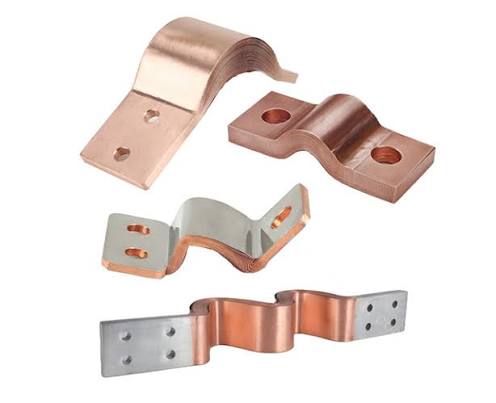
Flexible Copper Busbar vs. Rigid Copper Busbar
The choice between a flexible and rigid copper busbar depends mainly on the application.
A rigid copper busbar is suitable when connection points are fixed and there is little mechanical movement. It can provide a stable and relatively simple current path.
A flexible copper busbar becomes more useful when the connection needs to accommodate movement or installation tolerances.
| Feature | Flexible Copper Busbar | Rigid Copper Busbar |
|---|---|---|
| Flexibility | High | Low |
| Space requirements | Suitable for compact layouts | Requires more fixed routing |
| Vibration tolerance | Better suited to movement | More sensitive to mechanical stress |
| Thermal expansion | Can accommodate movement | Requires careful mechanical design |
| Installation | Easier around obstacles | Better for fixed layouts |
| Customization | Highly customizable | Highly customizable |
| Typical applications | Batteries, EVs, BESS, power equipment | Switchgear, panels, fixed distribution |
Neither solution is universally better. The right choice depends on the electrical and mechanical requirements of the system.
7 Key Factors When Choosing a Flexible Copper Busbar
1. Determine the Required Current Rating
Current capacity should be one of the first considerations when selecting a flexible copper busbar.
The required current is not determined by copper width and thickness alone. Actual performance can also be affected by:
- Continuous operating current
- Peak current
- Ambient temperature
- Allowable temperature rise
- Installation orientation
- Airflow and heat dissipation
- Insulation
- Duty cycle
- Nearby heat sources
- Connection resistance
For example, a busbar installed inside a compact battery cabinet may operate under different thermal conditions from one installed in an open electrical cabinet.
This is why there is no single current rating that applies to every flexible copper busbar with the same dimensions.
A good design starts with the actual operating conditions. For high-current applications, current capacity should be validated through appropriate electrical and thermal calculations and, where necessary, prototype or temperature-rise testing.
The basic principle is straightforward: higher current produces more heat when resistance remains the same. Therefore, the busbar needs to provide a sufficiently low-resistance current path while keeping the operating temperature within the application’s requirements.
2. Select the Right Copper Material
Copper is widely used for busbars because of its excellent electrical conductivity and good manufacturing characteristics.
Depending on the application, manufacturers may use different copper grades, such as high-conductivity copper or commonly specified grades such as C1100 or T2 copper.
Material selection should consider:
- Electrical conductivity
- Mechanical properties
- Formability
- Flexibility
- Manufacturing process
- Plating requirements
- Cost
For a high-current electrical connection, conductivity is particularly important because electrical resistance directly affects voltage drop and heat generation.
However, choosing the highest-conductivity material is not always the only consideration. The material also needs to work with the required bending, stamping, forming, plating, welding, or assembly processes.
For OEM applications, it is usually better to discuss the complete application with the manufacturer rather than specifying the copper grade based on conductivity alone.
3. Choose the Right Thickness and Width
Copper thickness and width determine the cross-sectional area of the conductor and therefore have a major influence on electrical performance.
A simplified way to think about the relationship is:
Cross-sectional area = Copper thickness × Copper width
Increasing the cross-sectional area can help reduce electrical resistance and support higher current. However, making a busbar larger is not always the best solution.
A thicker or wider copper section can affect:
- Flexibility
- Bending requirements
- Installation space
- Product weight
- Manufacturing cost
- Terminal dimensions
For this reason, busbar design should balance electrical requirements with mechanical requirements.
For example, a battery application may require a relatively compact connection with a specific bending direction. Simply increasing the copper thickness could improve current capacity but make the component difficult to install.
The best flexible copper busbar is therefore not necessarily the largest one. It is the one with the appropriate dimensions for the actual application.
4. Consider Flexibility and Bending Requirements
Flexibility is one of the main reasons to choose a flexible copper busbar instead of a rigid conductor.
However, “flexible” does not mean that the busbar can be bent without limits.
The design should consider:
- Required bending direction
- Minimum bending radius
- Number of bends
- Installation movement
- Vibration
- Thermal expansion
- Available installation space
- Distance between connection points
In battery packs and energy storage systems, for example, components may experience dimensional changes during operation. A flexible connection can help accommodate small movements and reduce mechanical stress on terminals and mounting points.
For automotive applications, vibration and mechanical shock are additional considerations.
When requesting a custom flexible copper busbar, providing the required bend angle, installation direction, and available space can help the manufacturer develop a more suitable design.
5. Choose the Right Connection and Terminal Design
A flexible copper busbar is only as reliable as its connection points.
The interface between the busbar and the connected equipment needs to provide stable electrical contact and sufficient mechanical strength.
Depending on the application, the busbar may include:
- Mounting holes
- Punching holes
- Formed ends
- Flat connection areas
- Crimped connections
- Copper terminals
- Customized terminal configurations
Hole diameter, hole position, terminal dimensions, and connection thickness should all be considered during the design stage.
This is especially important for high-current applications. Even if the copper conductor itself has low resistance, a poorly designed connection can create additional resistance and localized heat.
For applications requiring both a flexible copper busbar and a customized electrical terminal, working with a manufacturer that understands both components can simplify the development process.
6. Consider Plating and Surface Treatment
Surface treatment can also affect the performance and service life of a copper busbar.
Depending on the application, possible surface treatments include:
- Bare copper
- Tin plating
- Nickel plating
- Other application-specific finishes
The selection may depend on:
- Corrosion resistance
- Contact performance
- Environmental conditions
- Oxidation resistance
- Assembly requirements
- Electrical requirements
For example, a surface treatment may be considered when the busbar will operate in an environment where oxidation or corrosion could affect the connection.
The plating specification should be discussed together with the operating environment and connection method rather than selected independently.
7. Check the Operating Environment
The final factor is the environment in which the flexible copper busbar will operate.
Important conditions include:
- Operating temperature
- Humidity
- Vibration
- Mechanical movement
- Corrosive environments
- Installation space
- Exposure to chemicals
- Indoor or outdoor use
Different applications create different challenges.
An EV battery system may experience vibration, temperature cycling, and limited packaging space. A stationary energy storage system may experience continuous thermal cycling and high current inside a relatively compact enclosure.
Industrial power equipment may have different requirements again.
Understanding the actual operating environment allows the manufacturer to recommend an appropriate copper structure, insulation, plating, dimensions, and connection configuration.
Flexible Copper Busbars for Different Applications
Flexible copper busbars are used in a wide range of electrical systems where high-current conduction and mechanical flexibility are both important.
Battery Packs and Energy Storage Systems
Battery systems are one of the important applications for flexible copper busbars.
They can be used to connect:
- Battery modules
- Battery packs
- Busbars
- Contactors
- Fuses
- Power distribution components
- Inverters
- Power conversion systems
In compact battery systems, flexible connections can help accommodate installation tolerances and thermal movement while keeping the current path compact.
For BESS applications, the design may also need to consider insulation, serviceability, enclosure conditions, and long-term operating temperature.
Electric Vehicles and Automotive Applications
EV battery packs require compact, reliable, high-current electrical connections.
Flexible copper busbars can be used where the electrical connection needs to accommodate:
- Vibration
- Thermal expansion
- Limited installation space
- Module movement
- Assembly tolerances
They can also help reduce the amount of flexible cable required in some applications and provide a more structured current path.
Power Distribution Equipment
Flexible copper busbars can also be used in:
- Electrical cabinets
- Switchgear
- Distribution systems
- Transformers
- Power supplies
- UPS equipment
- Industrial electrical equipment
They are particularly useful when two connection points are close together but difficult to align with a rigid conductor.
Renewable Energy and Power Electronics
Solar power systems, inverters, energy storage equipment, and other renewable energy systems can involve high current and compact electrical layouts.
Flexible copper busbars can provide a practical connection between components while accommodating installation constraints and thermal movement.
Flexible Copper Busbar vs. Copper Cable
Copper cable and flexible copper busbars can both be used for high-current connections, but they have different characteristics.
| Factor | Flexible Copper Busbar | Copper Cable |
|---|---|---|
| Shape | Flat/custom formed | Round or stranded |
| Space efficiency | High | Depends on cable size |
| Routing | Controlled and compact | More flexible routing |
| Connection interface | Often customized | Usually uses terminals/lugs |
| Heat dissipation | Can be favorable due to broad surface area | Depends on cable construction |
| Customization | High | High |
| Installation | Good for defined connection points | Good for longer or more complex routes |
A flexible copper busbar can be particularly attractive when the connection path is short and the mounting points are clearly defined.
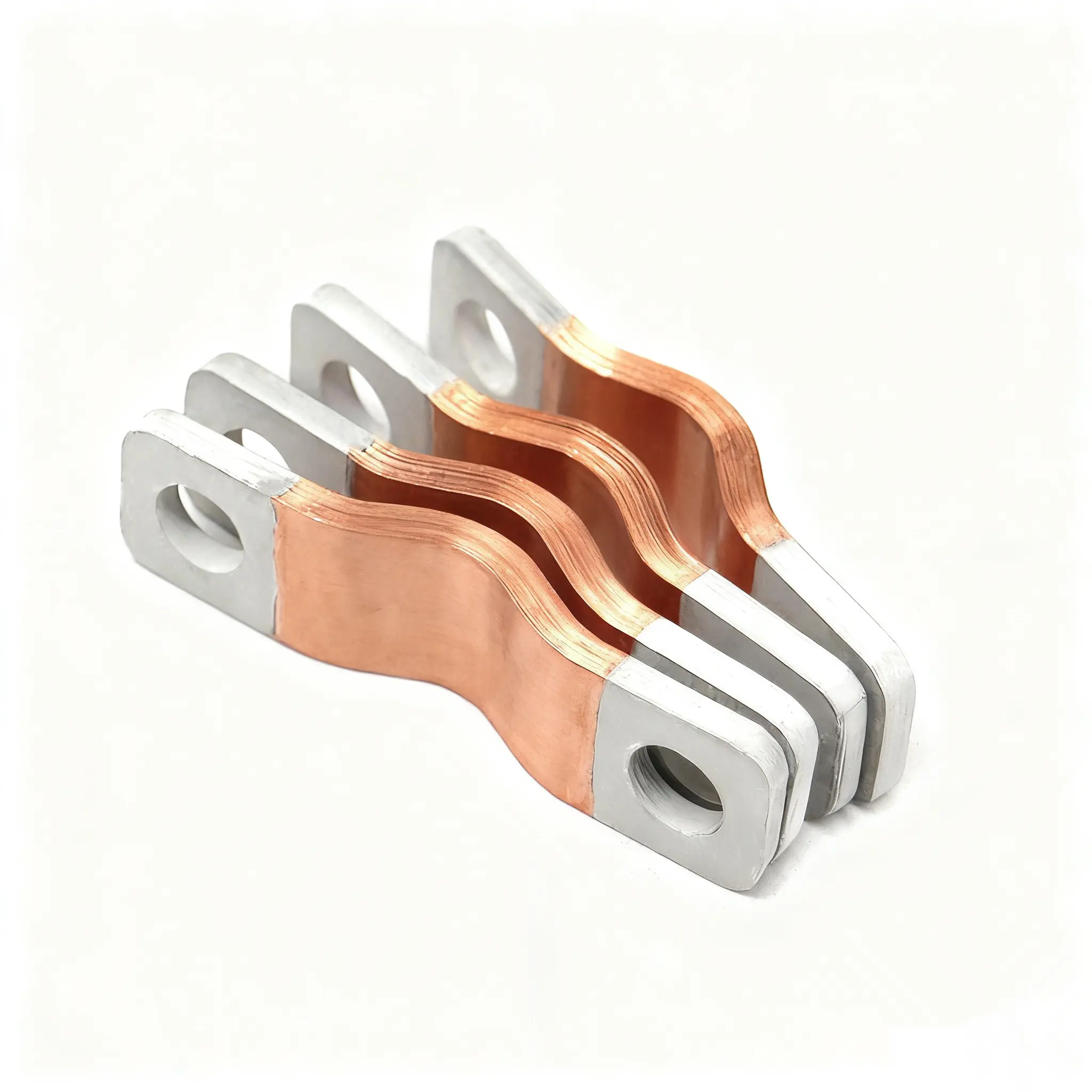
When Should You Choose a Custom Flexible Copper Busbar?
Standard products may be sufficient for simple applications. However, OEM equipment often has requirements that cannot be met by an off-the-shelf part.
A custom flexible copper busbar may be appropriate when you require:
- Non-standard dimensions
- Specific copper thickness
- Custom width
- Special hole patterns
- Defined bending angles
- Specific terminal configurations
- Special plating
- Insulation
- Tight installation tolerances
- High-current performance
- Integration with other copper terminals
Customization can also reduce assembly problems. Instead of modifying a standard component during installation, the busbar can be designed around the actual equipment layout.
For OEM projects, providing a drawing or sample is often the most efficient starting point.
What Information Should You Provide to a Flexible Copper Busbar Manufacturer?
When requesting a quotation, providing complete technical information can significantly reduce communication time.
A flexible copper busbar manufacturer may need the following information:
- Required continuous current
- Peak current, if applicable
- Operating voltage
- Copper material or preferred grade
- Copper thickness
- Copper width
- Overall length
- Hole diameter and hole position
- Bending angle or bending radius
- Terminal configuration
- Plating requirements
- Insulation requirements
- Operating temperature
- Installation environment
- Expected annual quantity
A 2D drawing, 3D model, sample, or even a detailed sketch can also help the manufacturer understand the application.
If the final design has not yet been completed, provide the electrical and mechanical requirements instead. An experienced manufacturer can often help evaluate the basic construction before mass production.
How to Choose a Flexible Copper Busbar Manufacturer
Choosing the right supplier is just as important as choosing the right busbar design.
For OEM buyers, consider the following areas.
Manufacturing Capability
Check whether the manufacturer can handle the required processes, such as:
- Copper processing
- Precision stamping
- Bending and forming
- Hole punching
- Plating
- Insulation
- Assembly
- Inspection
Having multiple processes available can make it easier to control dimensional consistency and production quality.
Customization Capability
A capable manufacturer should be able to work from:
- Engineering drawings
- Samples
- Specifications
- 3D models
- Application requirements
This is particularly important for non-standard flexible copper busbars.
Quality Control
Quality control should cover more than visual inspection.
Depending on the application, manufacturers may need to control:
- Dimensional accuracy
- Material specifications
- Surface treatment
- Hole position
- Connection quality
- Electrical performance
- Mechanical strength
- Product consistency
Mass Production Capability
Prototype development is only one part of an OEM project.
Before selecting a supplier, consider whether the manufacturer can maintain consistent quality and delivery when the product moves into mass production.
This is particularly important for automotive, energy storage, electrical equipment, and other applications where the same component may be produced in large quantities over an extended period.
Why Choose Qianwei Precision for Custom Copper Components?
Qianwei Precision provides customized electrical terminal and copper component manufacturing for OEM customers.
With experience in precision stamping, mold manufacturing, and electrical terminal production, Qianwei can support customers who require customized copper components based on drawings, samples, dimensions, and application requirements.
For projects involving flexible copper busbars and related electrical connections, key considerations can include:
- Custom dimensions
- Copper material selection
- Precision stamping and forming
- Customized connection holes
- Terminal configurations
- Surface treatment
- High-current electrical connections
- OEM production requirements
Qianwei can also support projects that require customized electrical terminals together with copper connection components, helping customers reduce the need to coordinate multiple suppliers.
For OEM buyers, the most useful starting point is usually a drawing, sample, or clear specification of the required current, dimensions, connection structure, and operating environment.
Conclusion
Choosing the right flexible copper busbar requires more than selecting the correct copper size. Current capacity, heat management, material, flexibility, connection design, surface treatment, operating environment, and production requirements all need to work together.
For battery systems, EVs, energy storage equipment, power distribution, and other high-current applications, a well-designed flexible copper busbar can provide a compact and reliable electrical connection while accommodating mechanical movement and installation constraints.
For OEM projects, customization is often the most practical approach. By working with a manufacturer that understands copper processing, precision manufacturing, electrical terminals, and mass production, buyers can develop a busbar that fits the actual equipment rather than adapting the equipment around a standard component.
If you are looking for a custom flexible copper busbar for a battery system, energy storage project, EV application, power equipment, or other high-current application, contact Qianwei Precision with your drawing, sample, or technical requirements. Our team can evaluate the application and discuss a suitable custom solution.
Frequently Asked Questions
1. What is a flexible copper busbar?
A flexible copper busbar is a copper electrical conductor designed to carry current while allowing a certain degree of bending or mechanical movement. It is commonly used where rigid busbars are difficult to install or where vibration and thermal expansion need to be accommodated.
2. What are flexible copper busbars used for?
Common applications include battery packs, energy storage systems, EVs, power distribution equipment, UPS systems, industrial equipment, renewable energy systems, and other high-current electrical applications.
3. How do I choose the right flexible copper busbar size?
Start with the required current, operating temperature, installation environment, allowable temperature rise, and available space. Then determine an appropriate copper cross-sectional area and mechanical structure.
4. How much current can a flexible copper busbar carry?
There is no universal current rating. Current capacity depends on copper material, thickness, width, length, temperature, installation conditions, insulation, airflow, and the allowable temperature rise of the application.
5. What copper is used for flexible busbars?
High-conductivity copper grades such as C1100 or T2 may be used depending on the application and manufacturing requirements. The appropriate material should be selected according to electrical, mechanical, and processing requirements.
6. Are flexible copper busbars suitable for battery systems?
Yes. They can be used in battery packs, EV batteries, BESS, UPS systems, and other battery-related equipment where compact high-current connections and mechanical flexibility are required.
7. What is the difference between a flexible and rigid copper busbar?
A rigid copper busbar is designed for fixed connections, while a flexible copper busbar is designed to accommodate bending, movement, vibration, or thermal expansion.
8. Can flexible copper busbars be customized?
Yes. Flexible copper busbars can be customized in terms of material, thickness, width, length, hole pattern, bending configuration, terminal design, plating, and insulation according to the application.
9. Can flexible copper busbars be plated?
Yes. Depending on the application, copper busbars may be supplied with surface treatments such as tin or nickel plating, or with a bare copper surface.
10. How do I order a custom flexible copper busbar?
Provide the manufacturer with your drawing, sample, dimensions, current requirements, connection details, operating environment, and expected quantity. If a final drawing is not available, the basic application requirements can be used as the starting point for technical discussion.


One thought on “How to Choose the Right Flexible Copper Busbar for Your Application”