

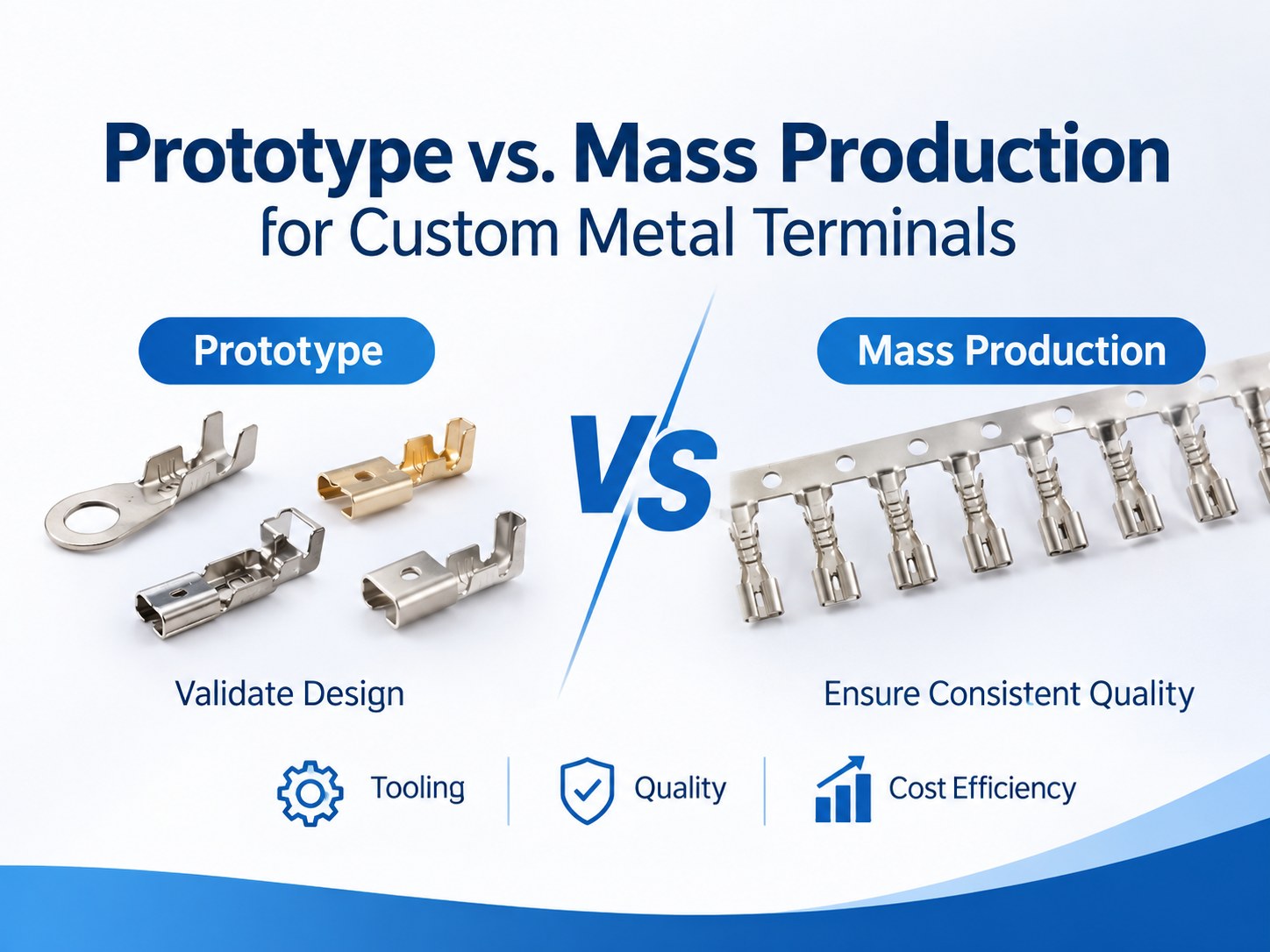
Developing a custom metal terminal involves more than creating a design and producing a sample. Before a product reaches commercial manufacturing, it must go through several important stages, including design validation, prototype testing, tooling development, and production process optimization.
For OEM manufacturers and electrical equipment companies, understanding the differences between prototype manufacturing and mass production is essential. A prototype helps verify whether a terminal meets the required specifications, while mass production focuses on manufacturing efficiency, product consistency, and cost control.
However, a design that works well in a prototype may require adjustments before it can be manufactured reliably at high volumes. Material behavior, stamping processes, tooling design, dimensional tolerances, and production capacity all influence the transition.
This article explains the key differences between prototype and mass production for custom metal terminals, covering manufacturing methods, tooling costs, quality control, and the steps involved in moving from initial samples to stable production.
1. What Is Prototype Manufacturing for Custom Metal Terminals?
Prototype manufacturing is the initial production stage in which a small number of custom metal terminals are manufactured to verify a design before investing in full-scale production.
It allows engineers and manufacturers to evaluate the product’s dimensions, structure, material properties, and functional performance. Any design issues can be identified and corrected before permanent production tooling is developed.
1.1 The Purpose of Prototype Development
The main objective of prototype development is to confirm that the proposed terminal design meets technical and application requirements.
Typical evaluation points include:
- Dimensional accuracy: Checking terminal length, width, thickness, hole positions, and critical tolerances.
- Mechanical performance: Evaluating contact retention, insertion force, pull-out force, and structural strength where applicable.
- Electrical performance: Verifying conductivity and electrical contact performance according to application requirements.
- Assembly compatibility: Confirming that the terminal fits the customer’s housing, connector system, or wiring assembly.
- Manufacturability: Identifying potential issues with stamping, bending, forming, and plating.
For example, a custom automotive terminal may need to meet specific dimensional requirements and retention-force targets before it can be integrated into a wiring harness.
Prototype testing helps identify potential problems early, reducing the risk of expensive modifications during mass production.
1.2 Common Prototype Manufacturing Methods
The manufacturing method depends on the terminal’s geometry, material, required accuracy, and development schedule.
Common methods include:
- Laser Cutting: Suitable for producing flat metal profiles and evaluating basic geometries without manufacturing dedicated stamping dies.
- CNC Machining: Used for specific geometries, precision features, and components that require material removal.
- Simple Stamping Tools: Suitable for producing prototype parts with basic punching and forming operations.
- Manual or Semi-Automatic Processing: Sometimes used for small quantities or design verification.
These methods offer flexibility during early development. However, they do not always reproduce the exact material behavior, forming conditions, or dimensional consistency of a production stamping process.
For this reason, prototype samples should be evaluated with consideration for the intended mass production method.
1.3 When Is a Metal Terminal Prototype Needed?
Prototype development is particularly useful when:
- Developing a new electrical terminal design.
- Customizing ring terminals, spade terminals, or other stamped metal components.
- Developing terminals for automotive wiring harnesses.
- Designing high-current terminals or special electrical connections.
- Modifying an existing terminal to fit a new application.
- Validating customer drawings before tooling investment.
When a project involves complex forming structures or tight tolerances, early technical evaluation can significantly reduce development risks.
2. What Is Mass Production for Custom Metal Terminals?
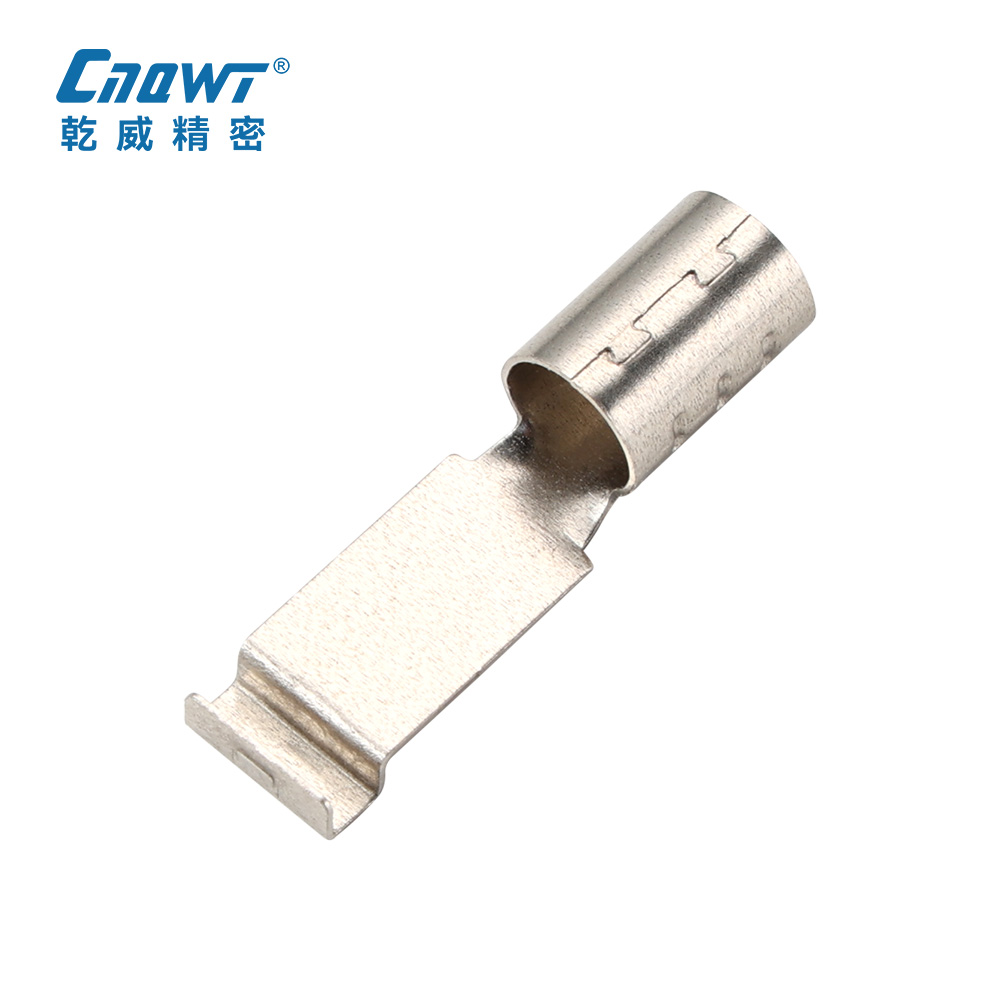
Mass production is the manufacturing stage in which approved terminal designs are produced in larger quantities using dedicated tooling, standardized processes, and controlled production equipment.
Unlike prototype manufacturing, which prioritizes design verification and flexibility, mass production focuses on repeatability, manufacturing efficiency, and consistent product quality.
For precision metal terminals, progressive die stamping is one of the most commonly used manufacturing methods.
2.1 Production Tooling and Progressive Die Stamping
Progressive die stamping uses a series of integrated stations to perform operations such as punching, blanking, bending, and forming.
Metal strip material moves through the die in a continuous process, with each station completing a specific operation until the finished terminal is produced.
This method offers several advantages:
- High production efficiency.
- Consistent dimensions across production batches.
- Reduced manual handling.
- Lower unit costs at higher production volumes.
- Suitability for complex terminal geometries.
The quality of the stamping die directly affects product accuracy, forming consistency, and production stability.
For this reason, tooling design and manufacturing are critical parts of custom terminal production.
2.2 Material Selection for Large-Scale Production
Material selection must consider both product performance and manufacturing requirements.
Common materials used for custom metal terminals include:
Copper
Copper offers excellent electrical conductivity and is widely used in electrical terminals, grounding components, and high-current applications.
Brass
Brass provides a useful combination of strength, machinability, and corrosion resistance. It is commonly used in various electrical connection components.
Phosphor Bronze
Phosphor bronze offers good elasticity, fatigue resistance, and mechanical strength, making it suitable for terminals that require reliable contact performance.
Material thickness, temper, and mechanical properties should be confirmed before production tooling is finalized. These factors influence forming behavior, springback, and dimensional accuracy.
2.3 Consistency and Quality Control
In mass production, quality control must extend beyond inspecting individual samples.
Manufacturers need to maintain stable production conditions and monitor critical product characteristics throughout the manufacturing process.
Typical quality control activities include:
- Dimensional inspection and tolerance verification.
- Burr height and edge quality inspection.
- Plating thickness and surface appearance checks.
- Pull-out force and retention-force testing where required.
- Electrical performance testing according to product specifications.
- Batch inspection and production traceability.
A reliable quality control system helps ensure that terminals meet agreed specifications across repeated production runs.
3. Prototype vs. Mass Production: Key Differences
Although prototype manufacturing and mass production are closely connected, they serve different purposes and require different manufacturing approaches.
The following table summarizes their major differences.
| Comparison | Prototype Manufacturing | Mass Production |
|---|---|---|
| Main Purpose | Design validation | Commercial manufacturing |
| Production Volume | Small quantities | Large quantities |
| Tooling | Simple or temporary tooling | Dedicated production tooling |
| Manufacturing Methods | CNC, laser cutting, simple stamping | Progressive die stamping |
| Unit Cost | Generally higher | Lower at scale |
| Lead Time | Depends on design complexity | Optimized for repeat production |
| Quality Control | Design and functional validation | Continuous process control |
| Flexibility | High | More limited after tooling approval |
| Consistency | Depends on the process used | Designed for batch consistency |
The most important difference is the manufacturing objective.
Prototype production allows greater flexibility because the design may still change. Mass production requires a more controlled process because tooling, materials, and production parameters must remain stable.
A successful transition requires more than approving a sample. The manufacturer must also confirm that the product can be manufactured consistently using the intended production process.
4. How Do Tooling Costs and Unit Prices Differ?
Cost is one of the main considerations when moving from prototype manufacturing to mass production.
Although prototypes generally have higher unit costs, mass production often requires a larger initial investment in tooling and production preparation.
4.1 Prototype Manufacturing Costs
Prototype costs are influenced by:
- Material quantity and specifications.
- Part geometry and manufacturing complexity.
- Machining or cutting requirements.
- Surface treatment and plating.
- Inspection and testing requirements.
- Number of design revisions.
Because prototype quantities are relatively small, setup and processing costs are distributed across fewer parts.
As a result, the unit price is usually higher than that of mass-produced terminals.
4.2 Mass Production Tooling Investment
Mass production may require dedicated stamping dies designed for the specific terminal geometry.
The initial investment can include:
- Tooling design and engineering.
- Die manufacturing and assembly.
- Trial stamping and adjustments.
- Production setup and process validation.
- Tool maintenance and spare parts.
Although tooling increases the initial project cost, it can improve production efficiency and reduce the unit cost over time.
4.3 Why Higher Initial Tooling Costs Can Reduce Long-Term Costs
For recurring orders, investing in dedicated production tooling can be more economical than repeatedly using low-volume manufacturing methods.
Consider a simplified example:
A manufacturer produces 1,000 prototype terminals using a flexible manufacturing process. The unit cost may be relatively high because each part requires more individual processing.
For an annual requirement of 500,000 terminals, a dedicated progressive stamping die can significantly improve production efficiency and reduce processing costs per unit.
However, the actual economic benefit depends on part complexity, material costs, tooling life, production volume, and order frequency.
When comparing quotations, buyers should consider the total cost of ownership rather than focusing only on the initial unit price.
5. How to Transition from Prototype to Mass Production
Moving from an approved prototype to stable mass production requires a structured manufacturing process.
Each stage should be evaluated carefully to minimize design changes, tooling risks, and production delays.
5.1 Design Review and Engineering Evaluation
The process begins with reviewing the customer’s drawings, samples, or technical specifications.
Engineers evaluate:
- Overall dimensions and critical tolerances.
- Material type and thickness.
- Bending and forming structures.
- Plating and surface treatment requirements.
- Application-specific mechanical and electrical requirements.
At this stage, manufacturers can identify design features that may create difficulties during stamping or assembly.
Early communication between the customer and manufacturer helps prevent avoidable modifications later.
5.2 Prototype Sampling and Testing
After the initial design review, prototype samples are manufactured for evaluation.
Depending on the project, testing may include:
- Dimensional measurements.
- Fit and assembly verification.
- Mechanical strength testing.
- Contact retention testing.
- Electrical performance evaluation.
- Surface finish inspection.
The customer should review the samples against the agreed technical requirements and provide feedback before the next development stage.
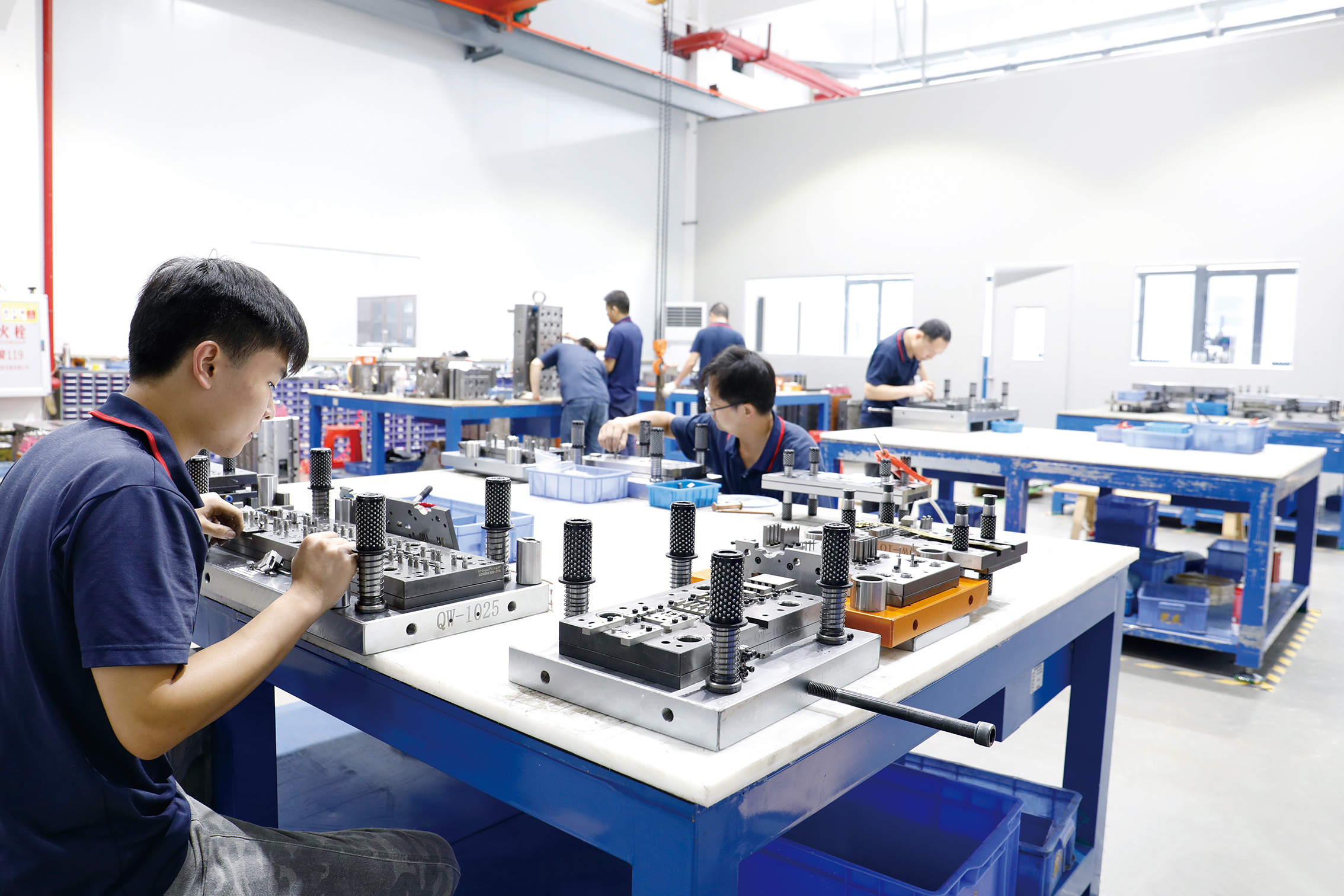
5.3 Tooling Development and Optimization
Once the design is approved, dedicated production tooling can be developed.
For stamped metal terminals, this may involve designing progressive dies based on the material, strip layout, forming sequence, and required production output.
Tooling engineers must consider:
- Punching and forming sequence.
- Material feeding and positioning.
- Die clearance.
- Springback compensation.
- Burr direction and control.
- Tool durability and maintenance requirements.
Trial stamping is then performed to evaluate the die and identify areas requiring adjustment.
5.4 Pilot Production and Process Validation
Before full-scale production, a pilot run can help verify whether the tooling and manufacturing process consistently produce parts that meet specifications.
This stage may include:
- Producing a limited batch using production tooling.
- Inspecting critical dimensions.
- Evaluating stamping consistency.
- Checking plating quality.
- Confirming production cycle time.
- Reviewing inspection and packaging procedures.
Any remaining issues should be addressed before the project moves into regular production.
5.5 Full-Scale Mass Production
After process validation and customer approval, the project can proceed to regular mass production.
At this stage, the manufacturer focuses on production scheduling, equipment efficiency, process control, and delivery management.
For terminals supplied in strip form or on reels, additional attention should be given to strip continuity, terminal orientation, pitch accuracy, and compatibility with automatic crimping equipment.
Stable production processes help ensure that customers receive consistent products across different order batches.
6. Common Challenges When Moving from Prototype to Production
A prototype may pass initial inspection but still encounter problems when transferred to a high-speed stamping process.
Understanding these challenges helps manufacturers and customers prepare for a smoother transition.
6.1 Design Issues During Stamping
Some terminal structures are difficult to produce using progressive stamping without modifications.
Narrow features, complex bends, and insufficient forming space can create tooling difficulties.
A design-for-manufacturing review helps identify these issues before production tooling is completed.
6.2 Material Forming and Springback Problems
Metal materials may behave differently during forming depending on their thickness, temper, and mechanical properties.
Springback can affect bend angles and final dimensions, particularly in terminals with multiple forming operations.
Tooling adjustments and process optimization are often necessary to achieve the required geometry.
6.3 Dimensional Tolerance and Burr Control
High-speed stamping requires precise control of die clearance, material positioning, and tool condition.
Excessive burrs or dimensional variations can affect terminal assembly, electrical contact, and operator safety.
Regular tooling maintenance and dimensional inspections help control these risks.
6.4 Plating Consistency and Surface Quality
Surface treatment is another important consideration for electrical terminals.
Depending on the application, terminals may require tin, nickel, or other specified plating finishes.
Plating thickness, coverage, adhesion, and surface appearance should be evaluated according to customer requirements.
6.5 Production Capacity and Delivery Reliability
A manufacturer may be capable of producing prototype samples but lack the equipment or tooling capacity required for large orders.
Before selecting a supplier, buyers should evaluate its stamping equipment, tooling capabilities, production planning, and quality management system.
The ability to produce samples is only one part of a manufacturer’s overall capability.
7. How to Choose the Right Custom Metal Terminal Manufacturer
Choosing the right manufacturing partner is essential for maintaining product quality throughout development and mass production.
A capable supplier should offer more than sample processing. It should have the engineering resources, production equipment, and quality management systems required to support the entire manufacturing process.
Consider the following factors:
In-House Tooling Design and Manufacturing
Internal tooling capabilities allow manufacturers to manage die development, trial production, and tooling adjustments more efficiently.
Precision Metal Stamping Capabilities
Evaluate the manufacturer’s stamping equipment, production experience, and ability to manufacture terminals with consistent dimensions.
Material and Plating Options
A qualified manufacturer should understand different copper alloys, material thicknesses, and surface treatment requirements.
Quality Inspection and Testing Equipment
Check whether the supplier can perform dimensional inspections, mechanical testing, and other product-specific quality evaluations.
Prototype and Mass Production Experience
Experience in both stages helps reduce the risks associated with transferring a product from initial development to commercial production.
Production Capacity and Delivery Management
Evaluate the supplier’s equipment resources, production planning, and ability to support recurring orders.
Certifications such as ISO 9001 and IATF 16949 may also provide useful evidence of established quality management practices, particularly for automotive-related projects.
8. Applications of Custom Metal Terminals in Different Industries
Custom metal terminals are used across a wide range of industries. Each application may involve different electrical, mechanical, and manufacturing requirements.
8.1 Automotive Wiring Harnesses
Automotive terminals must meet specific requirements for dimensional accuracy, contact reliability, vibration resistance, and mechanical retention.
Prototype validation helps confirm compatibility with connector housings and wiring harness assemblies before large-scale production.
8.2 Industrial Electrical Equipment
Industrial electrical equipment uses various terminal types for power distribution, grounding, and electrical connections.
Custom stamped terminals can be designed to meet specific installation requirements and mechanical specifications.
8.3 New Energy and EV Charging Systems
Electric vehicles and charging equipment require reliable electrical connections that can support demanding operating conditions.
Depending on the application, manufacturers may develop custom copper terminals, high-current connection components, and other precision stamped metal parts.
8.4 HVAC and Home Appliances
HVAC systems and household appliances use electrical terminals for internal wiring, power connections, and control circuits.
Consistent terminal dimensions and reliable contact performance are important for assembly efficiency and long-term product operation.
8.5 Battery Energy Storage Systems
Battery energy storage systems require electrical connection components capable of handling specified current loads and installation conditions.
Custom metal terminals and flexible copper busbars may be developed to meet different power distribution requirements.
9. FAQs
Q1: What Is the Difference Between Prototype and Mass Production?
Prototype manufacturing produces a small number of parts to verify design, dimensions, and functionality. Mass production uses dedicated tooling and standardized processes to manufacture larger quantities with consistent quality and lower unit costs.
Q2: How Many Prototypes Are Usually Needed Before Mass Production?
There is no fixed number. Some simple terminal designs may require only one sampling round, while more complex components may need several revisions to verify dimensions, forming structures, and functional performance.
Q3: Can Metal Terminals Be Manufactured Without Production Tooling?
Yes. Small quantities of prototype terminals can be produced using laser cutting, CNC machining, or simple stamping tools. However, dedicated production tooling is generally more suitable for high-volume manufacturing.
Q4: How Much Does Custom Metal Terminal Tooling Cost?
Tooling costs depend on terminal geometry, material thickness, die complexity, required precision, and production volume. A manufacturer normally needs to review the drawings and technical requirements before providing an accurate quotation.
Q5: How Long Does It Take to Move from Prototype to Mass Production?
The timeline depends on design complexity, material availability, testing requirements, and tooling development. Simple products may move through development relatively quickly, while complex stamped terminals may require additional design revisions and tooling trials.
Q6: Can Prototype Samples Be Used for Mass Production?
Prototype samples can be used to verify design and functionality, but they are not necessarily representative of the final production process. Production tooling and manufacturing parameters should be validated before commercial manufacturing begins.
Q7: What Information Should I Provide When Requesting a Custom Metal Terminal Prototype?
Customers should ideally provide:
- 2D engineering drawings or 3D CAD files.
- Material specifications and thickness.
- Plating or surface treatment requirements.
- Critical dimensional tolerances.
- Intended application and operating conditions.
- Required sample quantity.
- Estimated annual production volume.
If complete drawings are unavailable, physical samples and application details can also help manufacturers evaluate the project.
Q8: Why Should I Choose a Manufacturer with In-House Tooling Capabilities?
In-house tooling capabilities can improve communication between engineering and production teams, accelerate tooling modifications, and provide better control over manufacturing quality. They are particularly valuable for custom terminals that require specialized stamping dies.
10. Conclusion: From Prototype Development to Reliable Mass Production
Prototype manufacturing and mass production are two essential stages in the development of custom metal terminals.
Prototypes help validate designs, identify potential problems, and reduce development risks. Mass production transforms approved designs into commercially viable products through dedicated tooling, optimized stamping processes, and systematic quality control.
For OEM buyers, selecting a manufacturer with both engineering and production capabilities can make the transition more efficient and predictable.
At Qianwei Precision, we provide custom electrical terminal manufacturing solutions supported by in-house mold design, precision stamping, and production capabilities. Established in 2012, our manufacturing facility covers 15,000 m² and includes more than 1,800 stamping and injection molds.
From custom terminal development to repeat mass production, we work with customers to evaluate drawings, select suitable materials, develop tooling, and manufacture precision metal components according to project requirements.
Looking for a manufacturing partner for your next custom metal terminal project?
Send us your drawings, samples, or technical specifications. Our team can help evaluate your requirements and provide a suitable solution for prototype development and mass production.
Contact Qianwei Precision to discuss your custom terminal project.

