

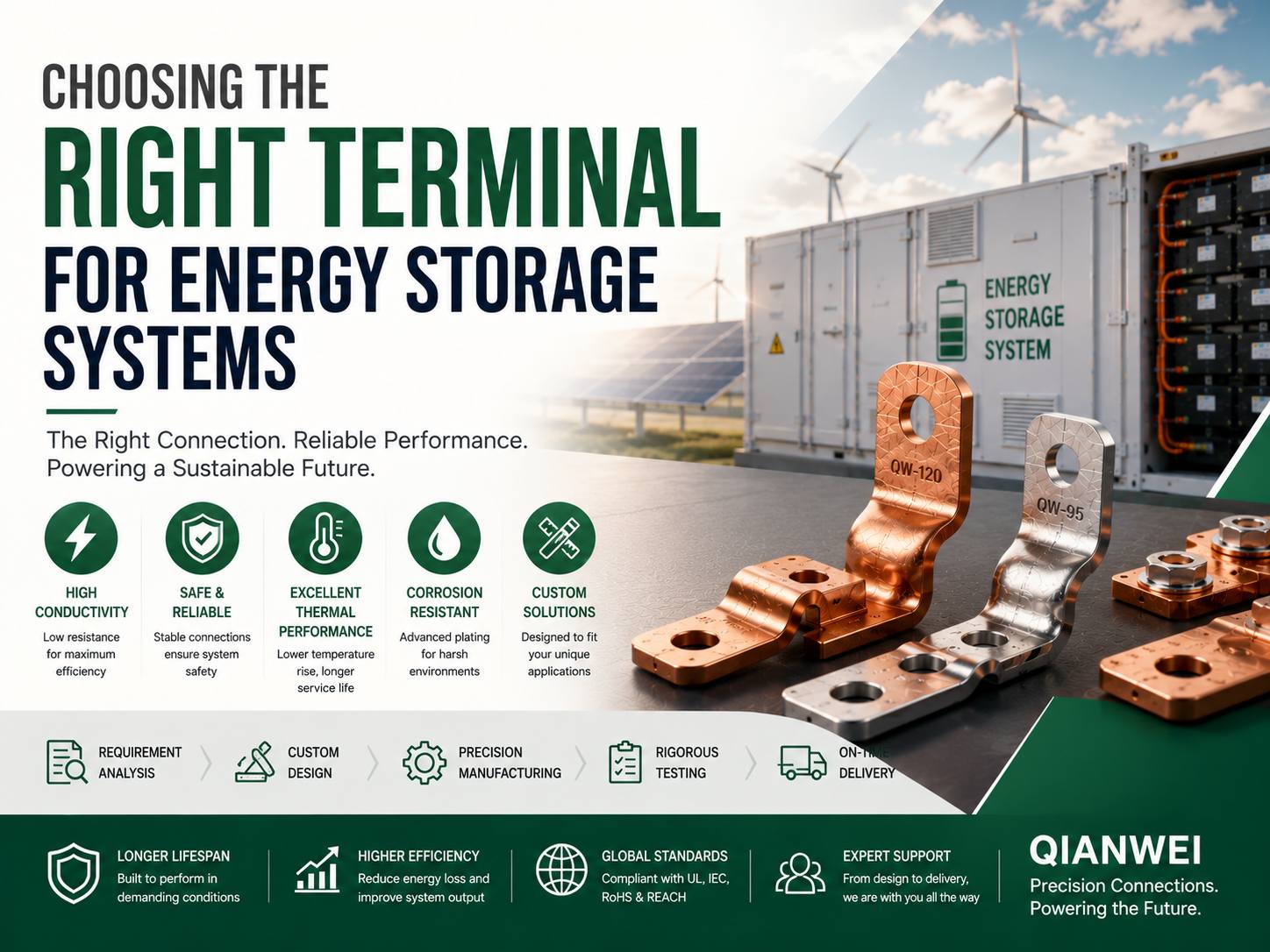
As energy storage systems become larger, smarter, and more powerful, every component inside the system plays a critical role in overall performance. While batteries often receive the most attention, electrical terminals are equally important because they provide the connection pathways that allow energy to flow safely and efficiently throughout the system.
A poorly selected terminal can lead to excessive heat, energy loss, premature failure, and costly maintenance. On the other hand, choosing the right terminal can improve system efficiency, enhance safety, and extend equipment lifespan.
Whether you are designing a utility-scale Battery Energy Storage System (BESS), a commercial storage project, a residential battery system, or an AI data center backup power solution, understanding how to select the right terminal is essential.
This guide explains the key factors engineers, procurement teams, and system integrators should consider when choosing terminals for energy storage applications.
What Is an Energy Storage Terminal?
An energy storage terminal is a conductive connection component used to transfer electrical power between batteries, busbars, cables, inverters, and other electrical equipment within an energy storage system.
Although terminals may seem like simple metal parts, they perform several important functions:
- Conduct electrical current safely
- Maintain stable electrical contact
- Reduce energy loss
- Withstand mechanical stress
- Ensure long-term reliability
In high-power ESS applications, terminal quality can directly impact system efficiency and operational safety.
Where Are ESS Terminals Used?
Energy storage terminals are commonly found in:
- Battery modules
- Battery packs
- Battery racks
- Busbar connections
- Power Conversion Systems (PCS)
- Inverters
- Distribution cabinets
- Energy storage containers
Every major power connection inside an ESS relies on properly designed terminals.
Why Choosing the Wrong Terminal Can Cause Problems
Many system failures originate from poor electrical connections rather than battery failures.
Selecting the wrong terminal can create several issues.
Increased Contact Resistance
When a connection is not properly designed, electrical resistance increases.
This results in:
- Power loss
- Reduced efficiency
- Higher operating costs
Even small resistance increases become significant when large currents are involved.
Excessive Heat Generation
Heat is one of the biggest threats to electrical systems.
Poor terminal selection can lead to:
- Localized overheating
- Insulation damage
- Accelerated aging
- Connection failure
In severe cases, overheating may create fire risks.
Reduced Service Life
A terminal that is not suitable for the operating environment may suffer from:
- Corrosion
- Oxidation
- Fatigue cracking
- Loosening
These issues shorten system lifespan and increase maintenance costs.
Safety Risks
Loose or damaged terminals may cause:
- Arcing
- Short circuits
- Unexpected shutdowns
- Equipment damage
This is especially critical in large-scale energy storage projects where downtime can be extremely expensive.
Factor #1 – Current Carrying Requirements
The first step in terminal selection is understanding the amount of current the terminal must carry.
Understanding Current Ratings
There are generally three current conditions to consider:
Continuous Current
The current that flows during normal operation.
Peak Current
Temporary current spikes during charging or discharging.
Surge Current
Short-duration high-current events.
A terminal should be capable of handling all three conditions safely.
Why Undersized Terminals Fail
If a terminal is too small for the application, it may experience:
- Excessive heating
- Increased voltage drop
- Reduced lifespan
- Premature failure
Choosing a terminal based solely on cost often leads to long-term problems.
Match Terminal Size to Application
As a general rule:
- Small residential systems require moderate current capacity
- Commercial ESS projects require higher current ratings
- Utility-scale projects demand heavy-duty high-current terminals
Always select a terminal with sufficient safety margin.
Factor #2 – Selecting the Right Material
The material used in a terminal significantly affects its performance.
Electrolytic Copper
Electrolytic copper is the most widely used material for energy storage terminals.
Benefits include:
- Excellent conductivity
- Low electrical resistance
- Superior thermal performance
- Long service life
For most ESS applications, copper remains the preferred choice.
Copper Alloys
Copper alloys provide:
- Increased strength
- Better wear resistance
- Improved vibration performance
These materials are often used when mechanical durability is especially important.
Aluminum Alternatives
Aluminum terminals are lighter and less expensive.
However, they offer:
- Lower conductivity
- Higher resistance
- More complex connection requirements
For high-current energy storage systems, copper is generally the better option.
Factor #3 – Choosing the Right Surface Plating
Surface treatment has a major impact on terminal performance.
Why Plating Matters
Plating protects the terminal from:
- Corrosion
- Oxidation
- Environmental damage
It also affects electrical performance.
Tin-Plated Terminals
Tin plating is the most common choice for ESS terminals.
Advantages include:
- Excellent corrosion resistance
- Stable conductivity
- Cost effectiveness
- Good solderability
This makes tin-plated copper terminals a popular solution in the energy storage industry.
Silver-Plated Terminals
Silver plating provides:
- Lower contact resistance
- Better conductivity
- Superior high-current performance
Silver-plated terminals are often used in premium applications.
Nickel-Plated Terminals
Nickel plating offers:
- High-temperature resistance
- Improved wear resistance
- Enhanced durability
It is commonly used in specialized environments.
Factor #4 – Environmental Conditions
Operating conditions should always influence terminal selection.
Indoor Energy Storage Systems
Indoor installations generally experience:
- Stable temperatures
- Lower humidity
- Reduced contamination
Standard corrosion protection is often sufficient.
Outdoor ESS Installations
Outdoor systems face:
- Rain
- Humidity
- UV exposure
- Temperature fluctuations
These environments require stronger corrosion protection.
Coastal Applications
Salt air is highly corrosive.
For coastal projects, selecting appropriate materials and plating is essential for long-term reliability.
Industrial Environments
Factories and industrial facilities may expose terminals to:
- Dust
- Chemicals
- Contaminants
Additional protection may be required.
Factor #5 – Thermal Performance
Heat management is becoming increasingly important as ESS power density increases.
Why Heat Matters
Every electrical connection generates heat.
Poor thermal performance can result in:
- Efficiency loss
- Accelerated aging
- Safety concerns
Temperature Rise Control
A properly designed terminal should:
- Minimize resistance
- Distribute current evenly
- Dissipate heat efficiently
These factors help maintain stable operating temperatures.
Thermal Cycling Resistance
Battery systems constantly charge and discharge.
This creates repeated heating and cooling cycles.
Terminals must withstand these cycles without performance degradation.
Factor #6 – Mechanical Strength Requirements
Electrical performance alone is not enough.
Terminals must also survive physical stresses.
Cable Pull Forces
Heavy cables can place significant loads on terminals.
The connection must remain secure throughout the system’s lifetime.
Installation Torque
Many terminals are fastened using bolts or screws.
The terminal must tolerate tightening forces without deformation.
Vibration Resistance
Energy storage systems may experience vibration during:
- Transportation
- Installation
- Operation
Strong mechanical design helps prevent loosening.
Factor #7 – Space Constraints and Terminal Design
Modern ESS systems are becoming more compact.
This creates new challenges for connection design.
High-Density Battery Packs
Manufacturers are constantly trying to increase energy density.
As space becomes limited, terminals must be carefully designed to fit within smaller assemblies.
Custom Shapes and Configurations
Common designs include:
- Bent terminals
- Flag terminals
- Busbar terminals
- Multi-hole terminals
Custom geometries often simplify installation and improve system layout.
Factor #8 – Reliability and Service Life Expectations
Most energy storage projects are expected to operate for many years.
Long-Term Operation Requirements
Many systems are designed for:
- 10-year lifecycles
- 15-year lifecycles
- 20-year lifecycles
Terminals must support these expectations.
Common Failure Causes
Failures often result from:
- Corrosion
- Thermal stress
- Mechanical fatigue
- Poor installation
Selecting high-quality terminals helps minimize these risks.
Factor #9 – Compliance and Certification
Compliance ensures products meet industry requirements.
Important Standards
Common certifications include:
UL Standards
Widely used in North America.
IEC Standards
Commonly required in international projects.
RoHS Compliance
Limits hazardous substances.
REACH Compliance
Addresses chemical safety regulations.
Why Certification Matters
Certified products help:
- Improve project acceptance
- Meet customer requirements
- Reduce compliance risks
Factor #10 – Testing Before Final Selection
Testing provides confidence that a terminal can perform under real-world conditions.
Essential Tests
Contact Resistance Testing
Measures connection quality.
Current Carrying Capacity Testing
Verifies electrical performance.
Pull-Out Force Testing
Evaluates mechanical strength.
Thermal Cycling Testing
Simulates long-term operation.
Vibration Testing
Measures resistance to movement and shock.
Salt Spray Testing
Evaluates corrosion resistance.
These tests help validate product reliability before deployment.
Standard vs. Custom ESS Terminals
Not every project can use standard products.
When Standard Terminals Work
Standard terminals are often suitable for:
- Residential systems
- Small commercial projects
- Common battery configurations
When Custom Terminals Are Better
Custom solutions may be required for:
- Utility-scale ESS projects
- AI data centers
- EV charging infrastructure
- High-current battery systems
Custom designs can improve performance and simplify installation.
Future Trends in Energy Storage Terminal Selection
The energy storage industry continues to evolve rapidly.
Future terminal technologies are expected to include:
- Higher current ratings
- Smart terminals with sensors
- Real-time temperature monitoring
- AI-assisted predictive maintenance
- More compact designs
- Sustainable materials
- Advanced plating technologies
As ESS systems become more sophisticated, terminal selection will become even more important.
Why Choose Qianwei Precision for ESS Terminal Solutions?
Selecting the right manufacturing partner is just as important as selecting the right terminal.
Qianwei supports energy storage customers through:
Precision Copper Terminal Manufacturing
Specialized production of:
- Copper terminals
- High-current terminals
- Energy storage connectors
Custom Development Services
Support for:
- OEM projects
- ODM projects
- Customized terminal solutions
In-House Mold Design
Providing:
- Faster development
- Better quality control
- Reduced lead times
Advanced Testing Capabilities
Including:
- Dimensional Inspection
- Contact Resistance Testing
- Pull-Out Force Testing
- Thermal Cycling Testing
- Vibration Testing
- Salt Spray Testing
These capabilities help ensure product reliability under demanding ESS conditions.
Conclusion
Choosing the right terminal for an energy storage system is about much more than selecting a piece of metal.
The right terminal improves:
- Efficiency
- Reliability
- Safety
- Service life
Key considerations include current capacity, material selection, plating, environmental conditions, thermal performance, mechanical strength, testing, and compliance.
As energy storage systems continue to grow in scale and complexity, selecting high-quality terminals from an experienced manufacturer becomes increasingly important.
A reliable terminal may be a small component, but it can have a significant impact on the long-term success of an energy storage project.
FAQs
What type of terminal is best for energy storage systems?
Copper terminals are generally considered the best choice because they offer excellent conductivity, low resistance, and strong thermal performance.
Why are copper terminals commonly used in ESS applications?
Copper provides superior electrical conductivity and heat dissipation, making it ideal for high-current energy storage systems.
How do I determine the correct current rating for a terminal?
The terminal should be selected based on continuous current, peak current, ambient temperature, and safety margins specified by the system design.
What plating is best for energy storage terminals?
Tin plating is the most widely used due to its balance of conductivity, corrosion resistance, and cost. Silver plating is preferred for premium high-current applications.
How long do ESS terminals typically last?
High-quality ESS terminals can often operate reliably for 15–20 years when properly installed and maintained.
What causes energy storage terminals to fail?
Common causes include corrosion, overheating, loose connections, excessive vibration, and poor installation practices.
How are ESS terminals tested?
Manufacturers typically perform contact resistance testing, current carrying capacity testing, pull-out force testing, vibration testing, thermal cycling testing, and salt spray testing.
Can ESS terminals be customized?
Yes. Custom terminals can be designed to meet specific requirements for current capacity, space limitations, mounting methods, and battery configurations.
What certifications should ESS terminals have?
Depending on the target market, UL, IEC, RoHS, and REACH compliance are commonly required.
What should I look for in an ESS terminal supplier?
Look for a supplier with strong engineering capabilities, precision stamping expertise, in-house tooling development, comprehensive testing services, and experience in energy storage applications.

