

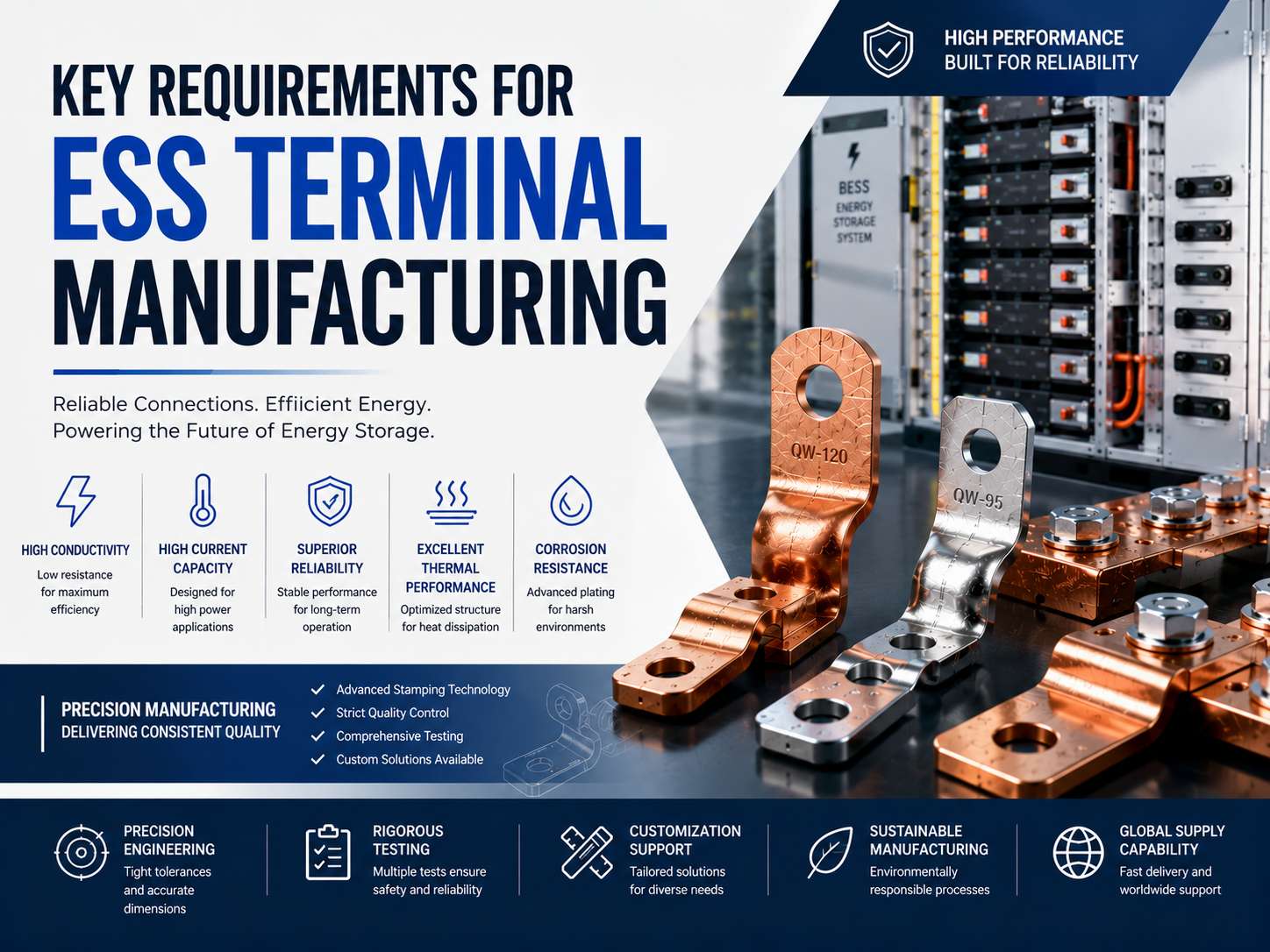
As the global energy storage industry continues to expand, Battery Energy Storage Systems (BESS) are becoming a critical part of modern energy infrastructure. From renewable energy projects and utility-scale storage stations to AI data centers and EV charging networks, energy storage systems are helping balance electricity supply and demand more efficiently than ever before.
Behind every successful energy storage system is a reliable electrical connection. While batteries often receive the most attention, the terminals that connect batteries, busbars, inverters, and power distribution equipment are equally important.
A poorly designed terminal can lead to excessive heat, energy loss, equipment failure, and even safety risks. On the other hand, a high-quality ESS terminal helps ensure efficient power transmission, long-term reliability, and stable system performance.
So, what exactly makes a good energy storage terminal? In this article, we’ll explore the key requirements for ESS terminal manufacturing and explain why these factors matter for modern energy storage projects.
What Are ESS Terminals?
ESS terminals are electrical connection components used within battery energy storage systems.
Their primary role is to transfer electrical power safely and efficiently between different parts of the system, including:
- Battery modules
- Battery packs
- Busbars
- Inverters
- Power conversion systems (PCS)
- Distribution equipment
Although they may look like simple metal parts, ESS terminals are designed to handle large amounts of current under demanding operating conditions.
Typical Applications of ESS Terminals
Today, ESS terminals can be found in a wide range of applications:
- Utility-scale battery energy storage systems
- Commercial and industrial energy storage projects
- Residential battery storage systems
- Solar-plus-storage installations
- Wind energy storage systems
- AI data centers
- EV charging infrastructure
As these industries continue to grow, the demand for reliable terminal solutions is increasing rapidly.
Why ESS Terminals Are Different from Standard Terminals
Unlike ordinary electrical terminals, ESS terminals face much tougher requirements.
They often need to handle:
- Higher currents
- Longer operating lifespans
- Frequent charging and discharging cycles
- Harsh environmental conditions
- Stricter safety standards
Because of these challenges, manufacturing ESS terminals requires advanced materials, precision production processes, and rigorous quality control.
.jpg)
Requirement #1 – High Electrical Conductivity
One of the most important requirements for any ESS terminal is electrical conductivity.
The better the conductivity, the more efficiently electricity can flow through the connection.
Why Low Resistance Matters
Whenever electrical current passes through a connection point, some resistance is created.
High resistance can cause:
- Energy loss
- Heat generation
- Reduced efficiency
- System instability
Even a small increase in contact resistance can become a serious issue when hundreds or thousands of amperes are flowing through a connection.
This is why low-resistance design is critical for energy storage terminals.
Material Selection Is Critical
The material used for a terminal directly affects its conductivity.
Electrolytic Copper
Electrolytic copper is the most common material used in ESS terminals because it offers:
- Excellent conductivity
- Low resistance
- Superior thermal performance
- Long-term reliability
It remains the preferred choice for high-current applications.
High-Conductivity Copper Alloys
In some applications, copper alloys are used to improve mechanical strength while maintaining good conductivity.
These materials provide a balance between electrical performance and structural durability.
Aluminum Alternatives
Aluminum is lighter and less expensive than copper, but its conductivity is lower.
For most high-current ESS applications, copper remains the preferred solution.
Requirement #2 – High Current Carrying Capacity
As energy storage systems become larger, terminals must be able to carry more current safely.
Growing Power Demands
Modern battery energy storage systems are significantly larger than those installed just a few years ago.
Large-scale ESS projects often operate at:
- Hundreds of amperes
- Thousands of amperes
- Megawatt-scale power levels
Terminals must be designed to support these increasing electrical loads.
Optimized Conductor Design
A terminal’s current-carrying capability depends largely on its design.
Important factors include:
- Material thickness
- Width
- Contact area
- Current path geometry
Increasing conductor cross-section helps reduce resistance and improve current capacity.
Preventing Overheating
High current levels naturally generate heat.
Proper design helps control temperature rise and ensures safe operation over long periods.
Requirement #3 – Excellent Mechanical Strength
Electrical performance is important, but mechanical strength is equally critical.
Terminals must maintain stable connections throughout the system’s lifetime.
Structural Reliability
ESS terminals experience various mechanical stresses during:
- Transportation
- Installation
- Operation
- Maintenance
Weak structures can lead to connection failures and safety risks.
Resistance to Pulling and Torque Forces
Cables attached to terminals can exert significant forces.
A high-quality terminal must withstand:
- Pull-out forces
- Tightening torque
- Mechanical vibration
without losing connection integrity.
Balancing Strength and Conductivity
Manufacturers must carefully balance:
- Electrical conductivity
- Mechanical strength
- Formability
to achieve optimal performance.
Requirement #4 – Superior Thermal Performance
Heat is one of the biggest enemies of electrical connections.
As current levels increase, thermal management becomes increasingly important.
Heat Generation at Connection Points
Every electrical connection generates some heat.
Poor contact quality increases resistance, which leads to:
- Higher temperatures
- Reduced efficiency
- Faster component degradation
Thermal Management Challenges
Modern ESS cabinets are becoming more compact.
This means:
- Higher power density
- Less airflow
- More concentrated heat
Terminal design must help manage these thermal challenges.
Better Heat Dissipation
Future ESS terminals are increasingly designed to improve heat flow.
Common design improvements include:
- Larger contact areas
- Optimized current paths
- Improved conductor geometry
These features help reduce operating temperatures.
Thermal Cycling Resistance
Energy storage systems experience constant heating and cooling cycles.
Over time, these temperature changes can stress materials and connections.
High-quality terminals must maintain performance after thousands of thermal cycles.
Requirement #5 – Corrosion Resistance and Surface Protection
ESS terminals often operate in challenging environments.
Without proper protection, corrosion can reduce performance and shorten service life.
Environmental Challenges
Terminals may be exposed to:
- Humidity
- Condensation
- Coastal environments
- Industrial pollution
All of these factors can accelerate corrosion.
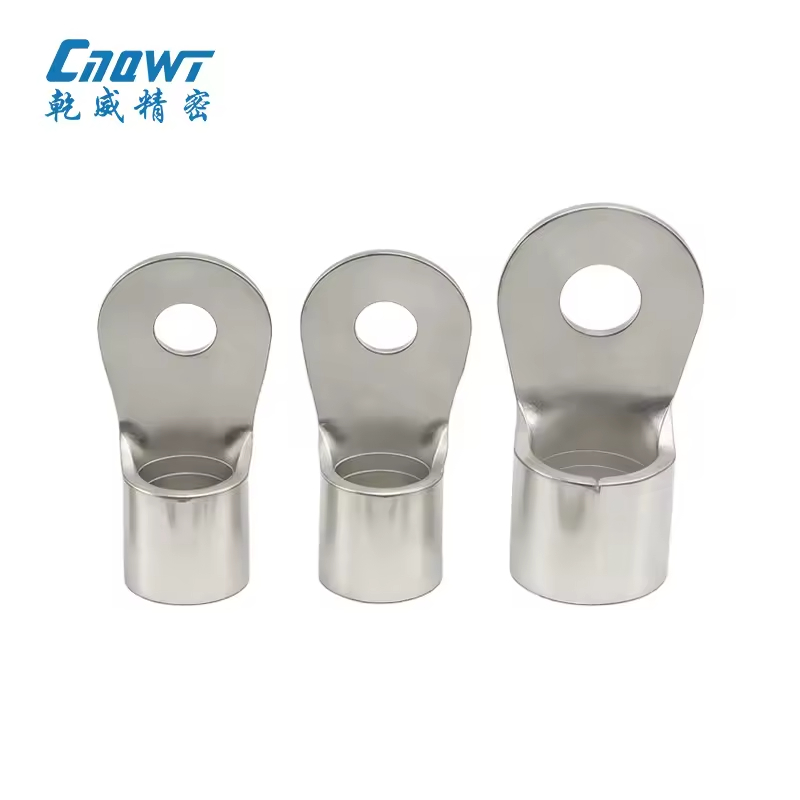
Common Surface Plating Options
Tin Plating
Tin plating is the most common surface treatment for ESS terminals.
Benefits include:
- Corrosion resistance
- Stable conductivity
- Good solderability
- Cost effectiveness
Silver Plating
Silver plating provides:
- Excellent conductivity
- Low contact resistance
- High-current performance
It is often used in premium applications.
Nickel Plating
Nickel plating offers excellent resistance to high-temperature environments.
Why Surface Treatment Matters
Proper plating helps ensure:
- Stable electrical performance
- Long service life
- Reduced maintenance requirements
Requirement #6 – Precision Manufacturing and Tight Tolerances
In energy storage systems, even small dimensional variations can affect connection quality.
Precision manufacturing is essential.
Why Accuracy Matters
Precise dimensions help achieve:
- Better contact pressure
- Stable electrical performance
- Consistent assembly quality
Poor accuracy can lead to loose connections and increased resistance.
Progressive Stamping Technology
Progressive die stamping is widely used to manufacture ESS terminals.
Advantages include:
- High production efficiency
- Excellent consistency
- Complex geometries
- Lower production costs
Automated Inspection Systems
Modern manufacturers increasingly use automated inspection equipment to verify:
- Dimensions
- Surface quality
- Product consistency
This helps maintain high quality standards.
Requirement #7 – Long-Term Reliability
Most energy storage projects are designed to operate for many years.
Terminals must deliver reliable performance throughout the entire system lifecycle.
Long Service Life Expectations
Many ESS installations are expected to operate for:
- 15 years
- 20 years
- Or even longer
Terminal reliability becomes extremely important over these long periods.
Common Failure Risks
Potential issues include:
- Connection loosening
- Oxidation
- Fatigue cracking
- Thermal damage
Proper design and manufacturing help minimize these risks.
Reliability-Oriented Engineering
Reliable ESS terminals are designed with long-term performance in mind from the beginning.
This includes careful attention to:
- Material selection
- Structural design
- Manufacturing quality
- Testing procedures
Requirement #8 – Compliance with Industry Standards
Industry standards help ensure safety and consistency across energy storage projects.
Important Standards
Common requirements include:
UL Standards
Widely used in North America.
IEC Standards
Commonly used in international markets.
RoHS Compliance
Restricts hazardous substances.
REACH Compliance
Addresses chemical safety requirements.
Why Compliance Matters
Certified products help:
- Improve customer confidence
- Facilitate market access
- Meet project requirements
Compliance is increasingly becoming a purchasing requirement.
.jpg)
Requirement #9 – Comprehensive Testing Capabilities
Testing is one of the most important parts of ESS terminal manufacturing.
Without proper testing, long-term performance cannot be guaranteed.
Key Testing Methods
Dimensional Inspection
Verifies manufacturing accuracy.
Contact Resistance Testing
Measures electrical performance.
Current Carrying Capacity Testing
Confirms current-handling capability.
Pull-Out Force Testing
Evaluates mechanical strength.
Thermal Cycling Testing
Simulates long-term operating conditions.
Vibration Testing
Ensures stability under movement and shock.
Salt Spray Testing
Measures corrosion resistance.
Environmental Reliability Testing
Validates performance under challenging conditions.
Requirement #10 – Customization Capability
No two energy storage projects are exactly the same.
Customization is becoming increasingly important.
Why Standard Solutions Are Not Always Enough
Different projects have different requirements regarding:
- Current ratings
- Installation space
- Cable sizes
- Mounting methods
Standard products cannot always meet these needs.
Rapid Prototyping and Development
Customers increasingly expect:
- Fast engineering support
- Rapid prototyping
- Short development cycles
Manufacturers with in-house tooling capabilities can respond more quickly.
OEM and ODM Support
The ability to provide customized manufacturing solutions has become a major competitive advantage in the ESS industry.
Smart Manufacturing Requirements for Future ESS Terminals
The future of terminal manufacturing is becoming increasingly intelligent.
Automated Production Lines
Automation improves:
- Productivity
- Quality consistency
- Manufacturing efficiency
Digital Quality Control
Advanced inspection systems provide real-time quality monitoring throughout production.
Traceability Systems
Modern manufacturers increasingly implement traceability systems that allow products to be tracked throughout the manufacturing process.
AI-Assisted Manufacturing
Artificial intelligence is helping manufacturers improve:
- Process control
- Quality management
- Production planning
Smart Warehousing and Logistics
Automated warehouses help improve:
- Inventory management
- Delivery speed
- Supply chain efficiency
Why Choose Qianwei Precision for ESS Terminal Manufacturing
As the energy storage industry continues to grow, choosing the right manufacturing partner becomes increasingly important.
Qianwei offers comprehensive support for energy storage terminal projects.
Extensive Experience in Precision Copper Terminals
We specialize in manufacturing:
- Copper terminals
- High-current terminals
- Energy storage connection solutions
In-House Tooling and Mold Development
Our internal tooling capabilities enable:
- Faster development
- Better quality control
- Reduced lead times
Advanced Progressive Stamping Technology
High-speed stamping equipment ensures:
- Consistent quality
- High production efficiency
- Cost-effective manufacturing
Comprehensive Testing Capabilities
Our testing services include:
- Dimensional Inspection
- Contact Resistance Testing
- Pull-Out Force Testing
- Thermal Cycling Testing
- Vibration Testing
- Salt Spray Testing
These tests help ensure product reliability under demanding operating conditions.
Fast Delivery and Global Supply Support
We support customers worldwide with responsive service and dependable manufacturing capacity.
Conclusion
As battery energy storage systems continue to expand globally, the demands placed on ESS terminals are increasing rapidly.
Modern energy storage terminals must deliver:
- High conductivity
- High current capacity
- Excellent mechanical strength
- Superior thermal performance
- Corrosion resistance
- Precision manufacturing quality
- Long-term reliability
At the same time, customization, comprehensive testing, and smart manufacturing capabilities are becoming increasingly important.
Although ESS terminals represent only a small portion of an energy storage system, their impact on performance, efficiency, and safety is significant. Choosing a manufacturer with strong engineering expertise and advanced production capabilities can help ensure the long-term success of any energy storage project.
FAQs
What is an ESS terminal?
An ESS terminal (Energy Storage System terminal) is a conductive connection component used to transfer electrical power between batteries, busbars, inverters, and other equipment within a battery energy storage system. It ensures safe, stable, and efficient power transmission.
Why are ESS terminals important in battery energy storage systems?
ESS terminals directly affect:
- Electrical efficiency
- System reliability
- Heat generation
- Operational safety
A high-quality terminal minimizes resistance, reduces energy loss, and improves the long-term performance of the entire storage system.
What materials are commonly used for ESS terminals?
The most common materials include:
- Electrolytic Copper
- High-Conductivity Copper Alloys
- Aluminum Alloys
Among these materials, electrolytic copper is widely preferred because of its excellent electrical conductivity and thermal performance.
Why is copper the preferred material for energy storage terminals?
Copper offers several advantages:
- High electrical conductivity
- Low contact resistance
- Excellent heat dissipation
- Strong corrosion resistance
- Long service life
These characteristics make copper ideal for high-current ESS applications.
How much current can an ESS terminal handle?
Current capacity depends on:
- Material type
- Terminal size
- Cross-sectional area
- Surface plating
- Operating temperature
Custom ESS terminals can be designed to support hundreds or even thousands of amperes for large-scale energy storage projects.
What causes ESS terminals to overheat?
Overheating is typically caused by:
- Excessive contact resistance
- Loose connections
- Undersized terminal design
- Poor material conductivity
- High operating currents
Proper engineering and manufacturing help prevent these issues.
What is contact resistance and why is it important?
Contact resistance is the resistance that occurs where two conductive surfaces meet.
Low contact resistance helps:
- Improve electrical efficiency
- Reduce heat generation
- Extend component lifespan
- Increase system reliability
For energy storage systems, maintaining low contact resistance is critical.
What plating is commonly used on ESS terminals?
The most common plating options include:
Tin Plating
- Cost-effective
- Corrosion resistant
- Excellent for most ESS applications
Silver Plating
- Highest conductivity
- Lower contact resistance
- Suitable for premium high-current systems
Nickel Plating
- Excellent high-temperature resistance
- Enhanced durability
Why is tin plating popular for ESS terminals?
Tin plating provides an excellent balance of:
- Conductivity
- Corrosion protection
- Solderability
- Cost efficiency
This makes it the most widely used surface treatment in the energy storage industry.
How long do ESS terminals typically last?
A properly designed and manufactured ESS terminal can often operate reliably for:
- 15 years
- 20 years
- Or even longer
Actual lifespan depends on operating conditions, environmental exposure, and maintenance practices.
What tests are performed on ESS terminals?
Common testing procedures include:
- Dimensional Inspection
- Contact Resistance Testing
- Pull-Out Force Testing
- Current Carrying Capacity Testing
- Temperature Rise Testing
- Thermal Cycling Testing
- Vibration Testing
- Salt Spray Testing
These tests verify electrical, mechanical, and environmental performance.
Why is thermal cycling testing important?
Energy storage systems constantly experience charging and discharging cycles, which create temperature fluctuations.
Thermal cycling testing evaluates a terminal’s ability to maintain reliable performance under repeated heating and cooling conditions.
What is pull-out force testing?
Pull-out force testing measures the mechanical strength of a terminal connection.
This test helps ensure that wires remain securely attached during installation, transportation, and long-term operation.
How does vibration affect ESS terminals?
Vibration can cause:
- Connection loosening
- Increased resistance
- Electrical instability
- Premature failure
Vibration testing helps verify that terminals can withstand real-world operating conditions.
Can ESS terminals be customized?
Yes. Many energy storage projects require customized terminals based on:
- Current requirements
- Battery configuration
- Installation space
- Cable size
- Mounting method
Custom solutions often improve efficiency and simplify assembly.
What industries use ESS terminals?
ESS terminals are widely used in:
- Utility-scale energy storage
- Solar energy systems
- Wind energy storage
- Commercial and industrial ESS
- Residential battery storage
- EV charging infrastructure
- AI data centers
- Telecommunications backup power systems
What certifications should ESS terminal manufacturers comply with?
Depending on the target market, manufacturers may comply with:
- UL Standards
- IEC Standards
- RoHS Requirements
- REACH Regulations
- ISO 9001 Quality Management Systems
These certifications help ensure product safety and quality.
What should buyers look for when choosing an ESS terminal manufacturer?
Key factors include:
- Material expertise
- Precision stamping capabilities
- In-house tooling development
- Quality testing capabilities
- Production capacity
- Customization support
- Industry experience
- Delivery reliability
Selecting the right supplier can significantly reduce project risk and improve product performance.
Why is precision manufacturing important for ESS terminals?
Even small dimensional deviations can affect:
- Contact pressure
- Electrical conductivity
- Assembly consistency
Precision manufacturing ensures reliable performance and long-term durability.
What are the future trends in ESS terminal manufacturing?
Emerging trends include:
- High-current terminal designs
- Smart terminals with integrated sensors
- AI-assisted predictive maintenance
- Advanced surface plating technologies
- Automated manufacturing systems
- Smart warehousing and logistics
- Sustainable and environmentally friendly materials
These innovations are helping energy storage systems become safer, more efficient, and more reliable.
How can Qianwei support ESS terminal projects?
Qianwei provides:
- Precision copper terminal manufacturing
- Custom ESS terminal development
- OEM & ODM services
- In-house mold design and tooling
- Progressive stamping production
- Comprehensive testing services
- Global supply support
Our experience in precision metal stamping and electrical terminal manufacturing helps customers develop reliable connection solutions for modern energy storage applications.

