


If you’re new to the world of electrical terminals, you’ve probably come across technical terms like crimping, AWG, contact resistance, male terminal, or plating. While these terms are common in the electrical and electronics industries, they can be confusing for beginners, purchasing managers, or even engineers working with terminals for the first time.
Understanding terminal terminology is more than just learning industry jargon. It helps you communicate clearly with suppliers, interpret product specifications correctly, choose suitable components, and avoid costly mistakes during product design or purchasing.
Whether you’re sourcing terminals for an automotive wiring harness, designing industrial control equipment, or simply trying to understand a product datasheet, this guide explains the most common electrical terminal terms in simple language. By the end of this article, you’ll have a solid foundation in the vocabulary used throughout the terminal and connector industry.
What Is an Electrical Terminal?
An electrical terminal is a conductive metal component used to connect a wire to another electrical device or conductor. It provides a secure electrical and mechanical connection, allowing electricity to flow safely and efficiently.
Electrical terminals are found in almost every electrical system, including:
- Automotive wiring harnesses
- Household appliances
- Industrial control cabinets
- Consumer electronics
- Renewable energy systems
- Telecommunications equipment
Many beginners confuse terminals, connectors, and contacts, but they are not exactly the same.
- A terminal is the metal piece attached to a wire.
- A connector is the complete assembly that joins two electrical circuits.
- A contact is the conductive element inside a connector that transfers electrical current.
Understanding these distinctions makes reading technical documents much easier.
Why Learning Terminal Terminology Matters
Knowing the correct terminology offers several practical benefits.
Better Communication
Using the correct terms helps you communicate effectively with manufacturers, suppliers, and engineers.
Easier Product Selection
Understanding specifications allows you to choose the right terminal for your application instead of relying on guesswork.
Faster Troubleshooting
When electrical problems occur, knowing the meaning of terms like contact resistance or retention force helps identify the root cause more quickly.
Fewer Purchasing Errors
Incorrect terminology can lead to ordering incompatible parts, causing delays and additional costs.
Essential Terminal Terms Every Beginner Should Know
Terminal
A terminal is the metal component that creates an electrical connection between a wire and another conductor.
Most terminals are attached to wires through crimping or soldering.
Connector
A connector joins two electrical circuits together.
A connector usually consists of:
- Housing
- Male or female contacts
- Locking mechanism
- Seals (for waterproof designs)
While every connector contains contacts or terminals, not every terminal is part of a connector.
Contact
A contact is the conductive element inside a connector that touches another contact to transfer electricity.
High-quality contacts provide:
- Stable electrical performance
- Low contact resistance
- Long service life
Pin
A pin is usually the protruding conductive part of a connector.
Pins are often referred to as male contacts because they insert into female sockets.
Socket
A socket receives the pin.
It is commonly called the female contact and is designed to hold the pin securely while maintaining consistent electrical contact.
Male Terminal
A male terminal has a projecting shape that inserts into a corresponding female terminal.
Common examples include:
- Blade terminals
- Bullet terminals
- Pin terminals
Female Terminal
A female terminal is designed to receive a male terminal.
Its spring structure maintains pressure against the male contact to ensure a reliable electrical connection.
Wire Gauge (AWG)
AWG (American Wire Gauge) is the standard system used to describe wire diameter.
One important rule is:
The smaller the AWG number, the larger the wire.
For example:
| AWG | Typical Application |
|---|---|
| 22 | Electronic devices |
| 20 | Signal wiring |
| 18 | Control circuits |
| 16 | Automotive wiring |
| 12 | Power distribution |
Choosing a terminal compatible with the correct wire gauge ensures proper crimp quality and current-carrying capacity.
Crimping
Crimping is the process of mechanically compressing a terminal onto a wire using a crimping tool or automated crimping machine.
Unlike soldering, crimping creates both:
- Mechanical strength
- Electrical conductivity
A proper crimp provides:
- Low resistance
- High pull-out strength
- Long-term reliability
- Resistance to vibration
Poor crimping is one of the leading causes of electrical failures.
Insulation
Some terminals include an insulating sleeve around the crimp area.
Common insulation materials include:
- PVC
- Nylon
- Heat-shrink tubing
Insulation helps prevent short circuits and improves user safety.
Barrel
The barrel is the section of the terminal where the wire is attached.
There are two common types:
Open Barrel
Uses two sets of wings that wrap around the conductor and insulation.
Common in automotive wiring harnesses.
Closed Barrel
Has a cylindrical shape that completely surrounds the wire.
Frequently used in industrial power applications.
Plating
Electrical terminals are often coated with another metal to improve performance.
Common plating materials include:
Tin Plating
- Excellent corrosion resistance
- Cost-effective
- Easy to solder
Nickel Plating
- High temperature resistance
- Better wear resistance
Gold Plating
- Extremely low contact resistance
- Excellent corrosion resistance
- Used in high-reliability electronics
Silver Plating
- Highest electrical conductivity
- Common in high-current applications
Contact Resistance
Contact resistance measures the resistance where two conductive surfaces meet.
Lower contact resistance means:
- Less heat generation
- Better electrical efficiency
- Improved reliability
Contamination, corrosion, and poor crimping can all increase contact resistance.
Current Rating
The current rating indicates the maximum electrical current a terminal can safely carry without overheating.
Current capacity depends on several factors:
- Material
- Wire size
- Terminal design
- Ambient temperature
- Cooling conditions
Always choose a terminal with a suitable current rating for your application.
Voltage Rating
The voltage rating specifies the maximum voltage a terminal can safely withstand without insulation breakdown or electrical arcing.
Using a terminal beyond its rated voltage can compromise safety and reliability.
Mating Cycle
A mating cycle refers to one complete insertion and removal of a connector.
For example, a connector rated for 500 mating cycles can be connected and disconnected approximately 500 times while maintaining acceptable performance.
Industrial connectors generally have much higher mating cycle ratings than consumer electronics.
Pitch
Pitch is the center-to-center distance between adjacent terminals or pins.
It is commonly measured in millimeters.
Common connector pitches include:
- 1.27 mm
- 2.00 mm
- 2.54 mm
- 3.96 mm
Selecting the correct pitch ensures compatibility between connectors and circuit boards.
Retention Force
Retention force measures how securely a terminal stays inside a connector housing.
Higher retention force helps prevent terminals from backing out during vibration, pulling, or repeated use.
This property is especially important in automotive and industrial applications.
Locking Mechanism
Many connectors include locking features that prevent accidental disconnection.
Common locking methods include:
- Snap locks
- Latches
- Secondary locks
- CPA (Connector Position Assurance) locks
Proper locking improves connection reliability in harsh environments.
Housing
The housing is the plastic body that holds the terminals in place.
It provides:
- Mechanical protection
- Electrical insulation
- Terminal positioning
- Environmental sealing
Most housings are made from engineering plastics such as nylon or PBT.
IDC (Insulation Displacement Contact)
An IDC terminal connects a wire without stripping its insulation.
The terminal’s sharp metal blades cut through the insulation and make direct contact with the conductor.
IDC technology is commonly used in:
- Ribbon cables
- Data communication equipment
- Telecommunications
- Consumer electronics
Wire Harness
A wire harness is an organized assembly of wires, terminals, connectors, protective sleeves, and other components.
Rather than installing individual wires separately, manufacturers bundle them into a harness to improve installation, protection, and maintenance.
Wire harnesses are widely used in automobiles, industrial equipment, medical devices, and household appliances.
Common Terminal Materials
The material used for a terminal directly affects its electrical performance, durability, and cost.
Brass
Brass is one of the most widely used terminal materials.
Advantages include:
- Good conductivity
- Easy stamping
- Affordable price
- Good corrosion resistance
Phosphor Bronze
Phosphor bronze offers better spring performance than brass.
Benefits include:
- Higher fatigue resistance
- Excellent elasticity
- Longer contact life
It is commonly used for connector contacts requiring repeated insertion and removal.
Copper
Copper provides excellent electrical conductivity.
It is often selected for high-current applications where minimizing energy loss is critical.
Stainless Steel
Although stainless steel has lower electrical conductivity, it offers exceptional mechanical strength and corrosion resistance.
It is typically used in retaining clips, springs, and mechanical support components.
Beryllium Copper
Beryllium copper combines excellent conductivity with outstanding mechanical strength and elasticity.
Because of its higher cost, it is usually reserved for aerospace, military, and other high-performance applications.
Common Types of Electrical Terminals
Several terminal types are widely used across industries.
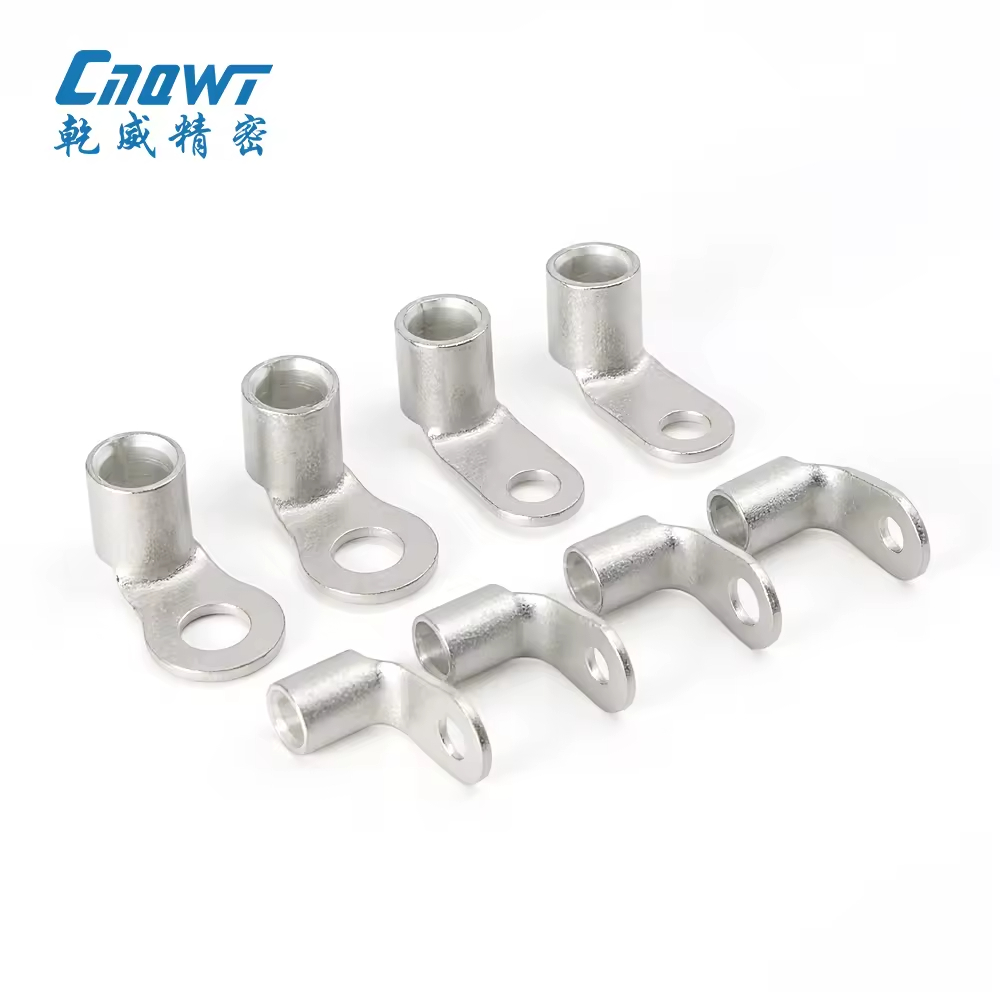
Ring Terminal
Provides a secure connection using a screw or bolt and is ideal for high-vibration environments.
Spade (Fork) Terminal
Allows quick installation and removal without completely removing the screw.
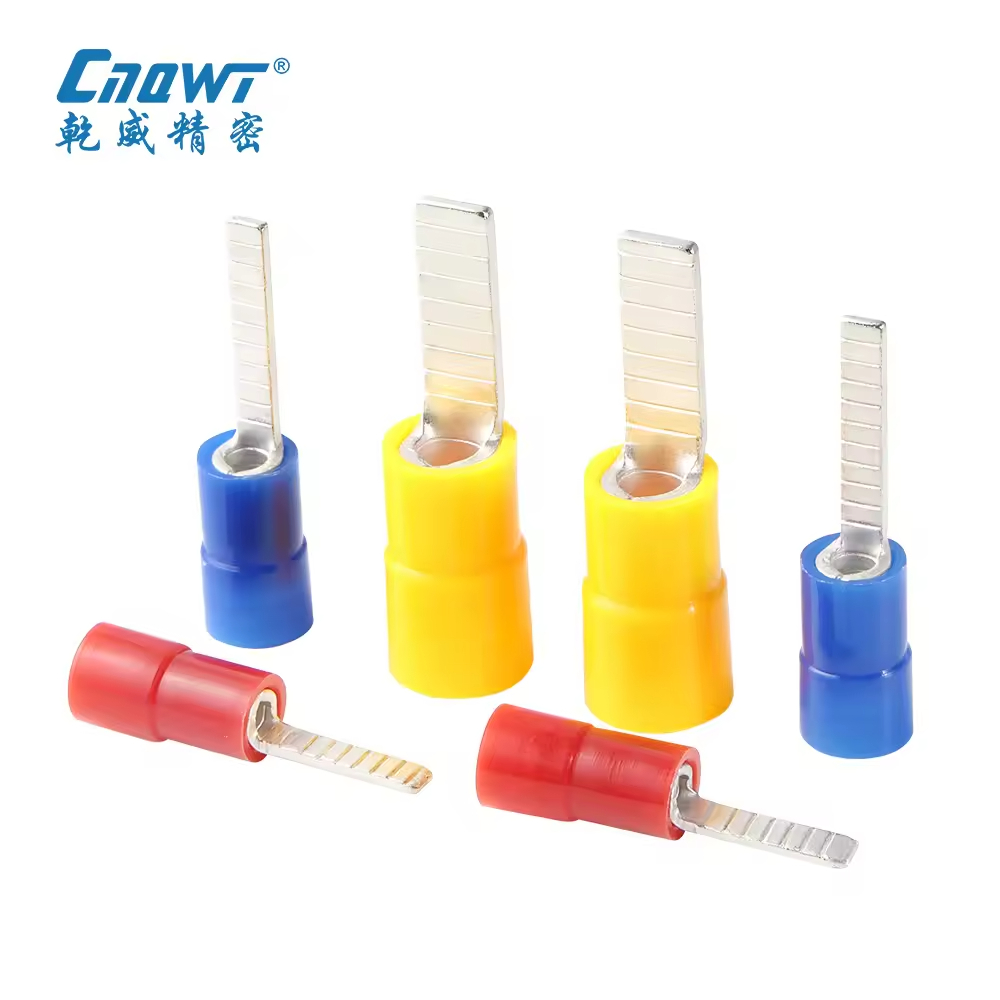
Blade Terminal
Often used in automotive electrical systems for quick disconnect applications.
Pin Terminal
Designed for insertion into terminal blocks or connector housings.
Butt Connector
Used to join two wires end to end.
Bullet Terminal
Provides quick connection and disconnection in automotive wiring.
Quick Disconnect Terminal
Allows tools-free installation and maintenance.
Each terminal type is designed for different installation methods and electrical requirements.
Common Manufacturing Terms
Understanding manufacturing terminology can also help when communicating with suppliers.
Progressive Stamping
A high-speed manufacturing process where multiple forming operations occur in one continuous die.
Precision Stamping
A process that produces highly accurate metal components with tight tolerances.
Injection Molding
Used to manufacture plastic connector housings and insulating components.
Electroplating
Applies a thin metal coating to improve conductivity, corrosion resistance, and wear resistance.
Tooling
Custom molds and dies used to manufacture terminals efficiently.
Tolerance
The allowable variation from a specified dimension.
Smaller tolerances generally indicate higher manufacturing precision.
Burr
A small, unwanted metal edge left after stamping.
High-quality terminals undergo deburring or precision stamping to minimize burrs.
Reel Packaging
Many terminals are supplied on reels for automated crimping and assembly lines.
Common Abbreviations
When reading datasheets, you’ll often encounter abbreviations like these:
| Abbreviation | Meaning |
|---|---|
| AWG | American Wire Gauge |
| UL | Underwriters Laboratories |
| RoHS | Restriction of Hazardous Substances |
| REACH | Registration, Evaluation, Authorisation and Restriction of Chemicals |
| IDC | Insulation Displacement Contact |
| PCB | Printed Circuit Board |
| OEM | Original Equipment Manufacturer |
| ODM | Original Design Manufacturer |
| IP | Ingress Protection |
| AC | Alternating Current |
| DC | Direct Current |
Learning these abbreviations makes technical documents much easier to understand.
Common Mistakes Beginners Make
Even experienced buyers sometimes misunderstand terminal specifications.
Some of the most common mistakes include:
- Confusing connectors with terminals
- Selecting the wrong wire gauge
- Ignoring current ratings
- Choosing unsuitable plating materials
- Using incorrect crimping tools
- Overlooking environmental conditions such as temperature, moisture, or vibration
Taking time to understand product specifications before purchasing can prevent many of these issues.
.jpg)
Conclusion
Learning common terminal terminology is the first step toward understanding electrical connection systems. Whether you’re an engineer, purchaser, technician, or student, knowing terms like AWG, crimping, contact resistance, pitch, and retention force will help you read specifications with confidence, communicate more effectively with suppliers, and choose the right components for your projects.
As your experience grows, this terminology will become second nature, making it easier to evaluate products, troubleshoot electrical issues, and understand industry standards. Keep this glossary as a reference whenever you work with electrical terminals or connectors, and you’ll build a stronger foundation for successful electrical system design and procurement.
FAQs
Is a terminal the same as a connector?
No. A terminal is the conductive metal component attached to a wire, while a connector is the complete assembly that joins electrical circuits together.
What does AWG mean?
AWG stands for American Wire Gauge, a standard used to specify wire diameter.
Why are terminals plated?
Plating improves corrosion resistance, reduces contact resistance, increases durability, and extends service life.
What is contact resistance?
It is the electrical resistance at the point where two conductive surfaces meet. Lower contact resistance generally means better electrical performance.
Which material is best for electrical terminals?
There is no single best material. Brass offers a good balance of cost and performance, phosphor bronze provides excellent spring properties, copper delivers superior conductivity, and beryllium copper is ideal for demanding, high-reliability applications.

