

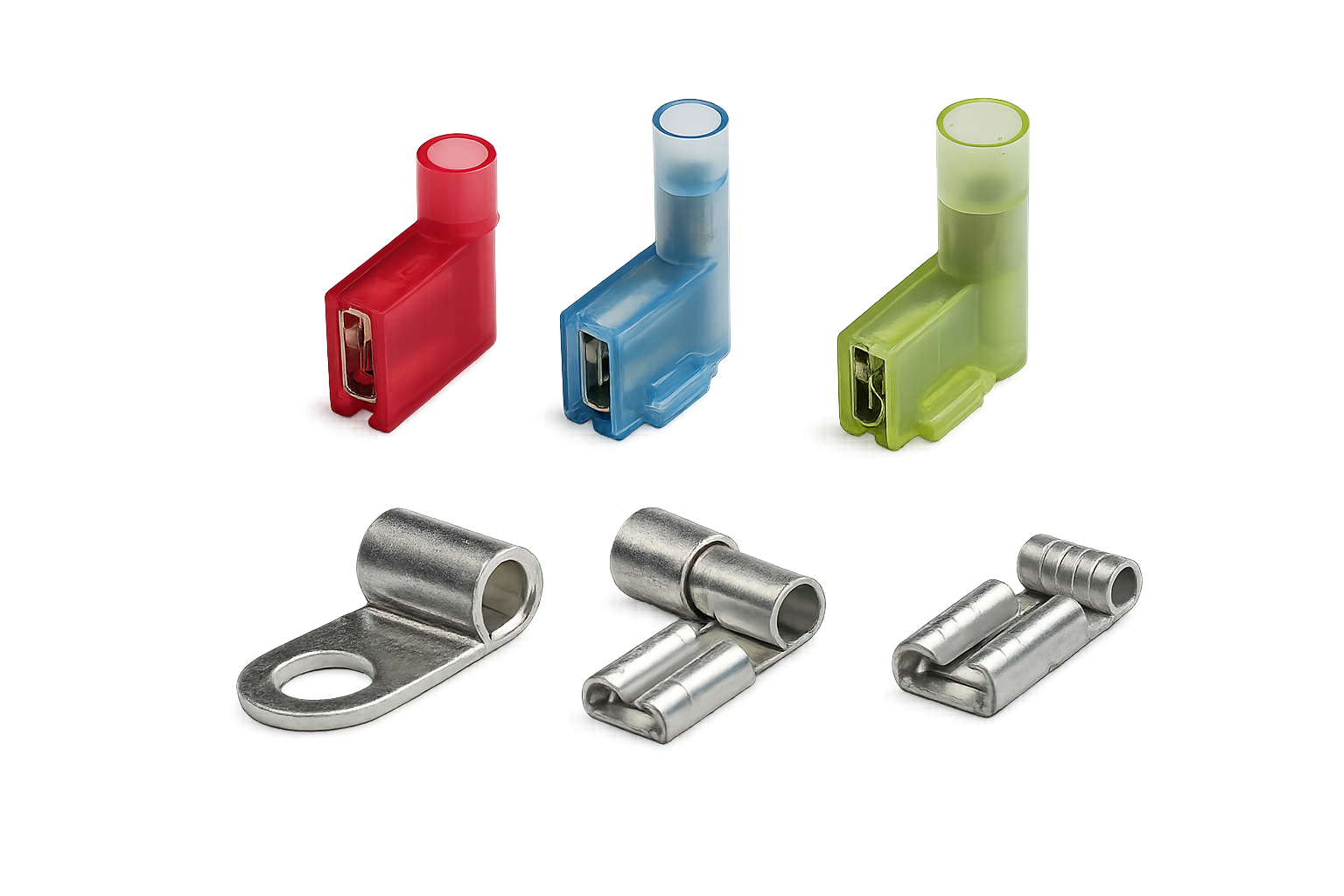
When electrical components are installed in a compact enclosure, there is often very little room for wires to bend and route normally. A standard straight terminal may work electrically, but its orientation can make installation difficult or create excessive stress on the wire.
This is where flag terminals can provide a practical solution.
Also known as 90-degree terminals, right-angle terminals, or flag-style crimp terminals, these terminals are designed to change the direction of a wire connection so that the wire can exit horizontally or at an angle instead of extending straight from the connection point.
For wiring harnesses, household appliances, automotive components, industrial equipment, and other compact electrical assemblies, this simple change in terminal orientation can make a significant difference.
This guide explains what flag terminals are, how they work, where they are used, and how to choose the right 90-degree crimp terminal for your application.
What Is a Flag Terminal?
A flag terminal is an electrical terminal with an angled connection structure that allows the wire to be routed approximately 90 degrees from the mating or mounting direction.
Unlike a conventional straight terminal, where the wire typically extends in line with the connection point, a flag terminal redirects the wire to improve routing in confined spaces.
Most flag terminals are designed as crimp terminals. The conductor is inserted into the terminal barrel and mechanically crimped to create an electrical and mechanical connection.
Depending on the design, flag terminals may be available as:
- Flag spade terminals
- Flag quick-disconnect terminals
- Flag blade terminals
- Flag receptacles
- Right-angle wire terminals
- Custom stamped flag terminals
The exact structure depends on the mating component, wire size, installation space, and electrical requirements.
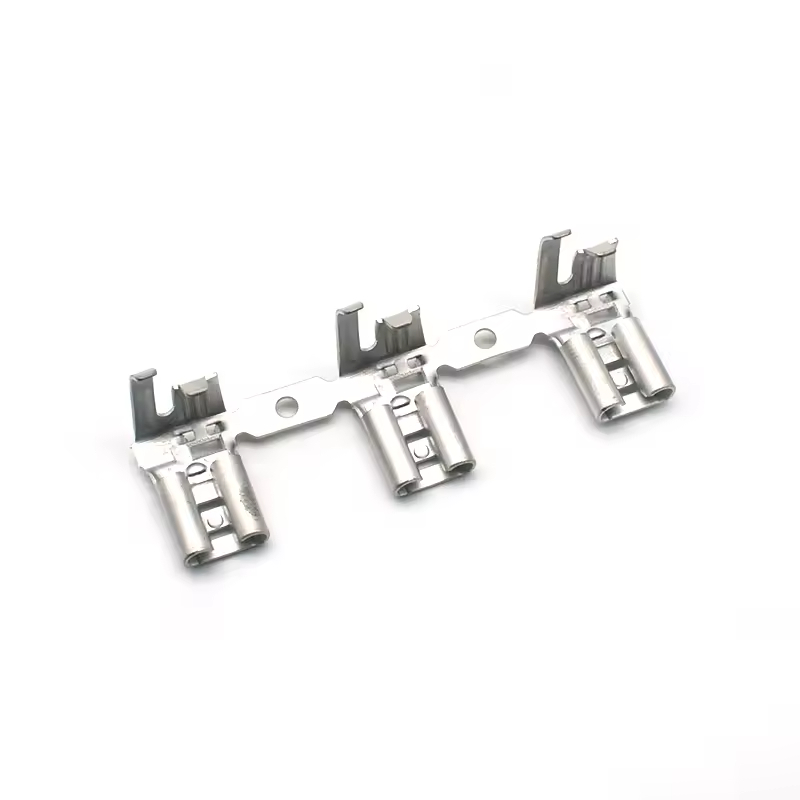
Why Use a 90-Degree Terminal?
The main reason to use a flag terminal is space management.
A standard terminal may require the wire to extend directly outward from the connection. In a compact electrical assembly, that can create several problems.
The wire may:
- Interfere with nearby components
- Require a larger bending radius
- Put mechanical stress on the terminal
- Make assembly more difficult
- Increase the overall space required for the wiring harness
A 90-degree terminal changes the wire routing direction.
This can allow the harness to follow the enclosure wall, move around a component, or fit into a narrow installation area without requiring the wire to make a sharp bend immediately after the connection.
Flag Terminals vs. Straight Terminals
The difference between the two is primarily the orientation of the wire exit.
| Feature | Flag Terminal | Straight Terminal |
|---|---|---|
| Wire direction | Approximately 90° | Straight/in-line |
| Space requirement | Suitable for compact layouts | Requires more linear space |
| Wire routing | Easier around obstacles | More direct |
| Tight-space applications | Excellent | May be limited |
| Crimping | Common | Common |
| Customization | Available | Available |
| Typical applications | Appliances, automotive, compact wiring | General electrical wiring |
Neither design is universally better.
A straight terminal may be preferable when there is sufficient space and a direct wire path is required.
A flag terminal becomes more useful when terminal orientation and wire routing are important design constraints.
Common Types of Flag Terminals
Flag terminals are available in different configurations depending on the mating interface.
Flag Spade Terminals
Flag spade terminals combine a spade-style connection with a 90-degree wire exit.
They can be used where the terminal needs to connect to a stud or compatible male tab while routing the wire sideways.
Flag Quick-Disconnect Terminals
Flag quick-disconnect terminals are designed for applications using quick-connect interfaces.
The 90-degree orientation allows the wire to run parallel to the equipment surface instead of extending directly away from the connection.
These terminals can be useful in household appliances and compact electrical assemblies.
Flag Receptacle Terminals
A flag receptacle is designed to mate with a compatible male tab while directing the wire at an angle.
Depending on the design, the receptacle may incorporate additional locking or retention features.
Custom Flag Terminals
Standard products cannot always meet the requirements of a specific wiring harness.
Custom flag terminals can be designed around:
- Wire size
- Terminal orientation
- Mating interface
- Mounting requirements
- Material
- Plating
- Crimp geometry
- Available installation space
For OEM applications, custom stamping can be particularly useful when the terminal needs to fit a specific component or housing.
Where Are Flag Terminals Used?
Flag terminals are particularly useful where wiring space is restricted or the wire needs to change direction immediately after the connection.
Household Appliances
Appliances often contain electrical components installed close together inside compact enclosures.
Flag terminals can help route wires around motors, switches, heating elements, control components, and other parts.
They can be found in applications such as:
- Air conditioners
- Refrigerators
- Washing machines
- Ovens
- Water heaters
- Other electrical appliances
Automotive Wiring
Automotive electrical systems have strict space constraints.
Wiring harnesses may need to pass around brackets, motors, sensors, control modules, and other components.
A right-angle terminal can help optimize the harness layout while reducing unnecessary wire bending.
Industrial Equipment
Industrial equipment and control systems can also have limited wiring space.
Flag terminals may be used where conventional straight terminals would interfere with adjacent components or make assembly inconvenient.
Compact Electrical Assemblies
Flag terminals can also be useful in motors, switches, relays, power supplies, and other assemblies where the available installation space is limited.
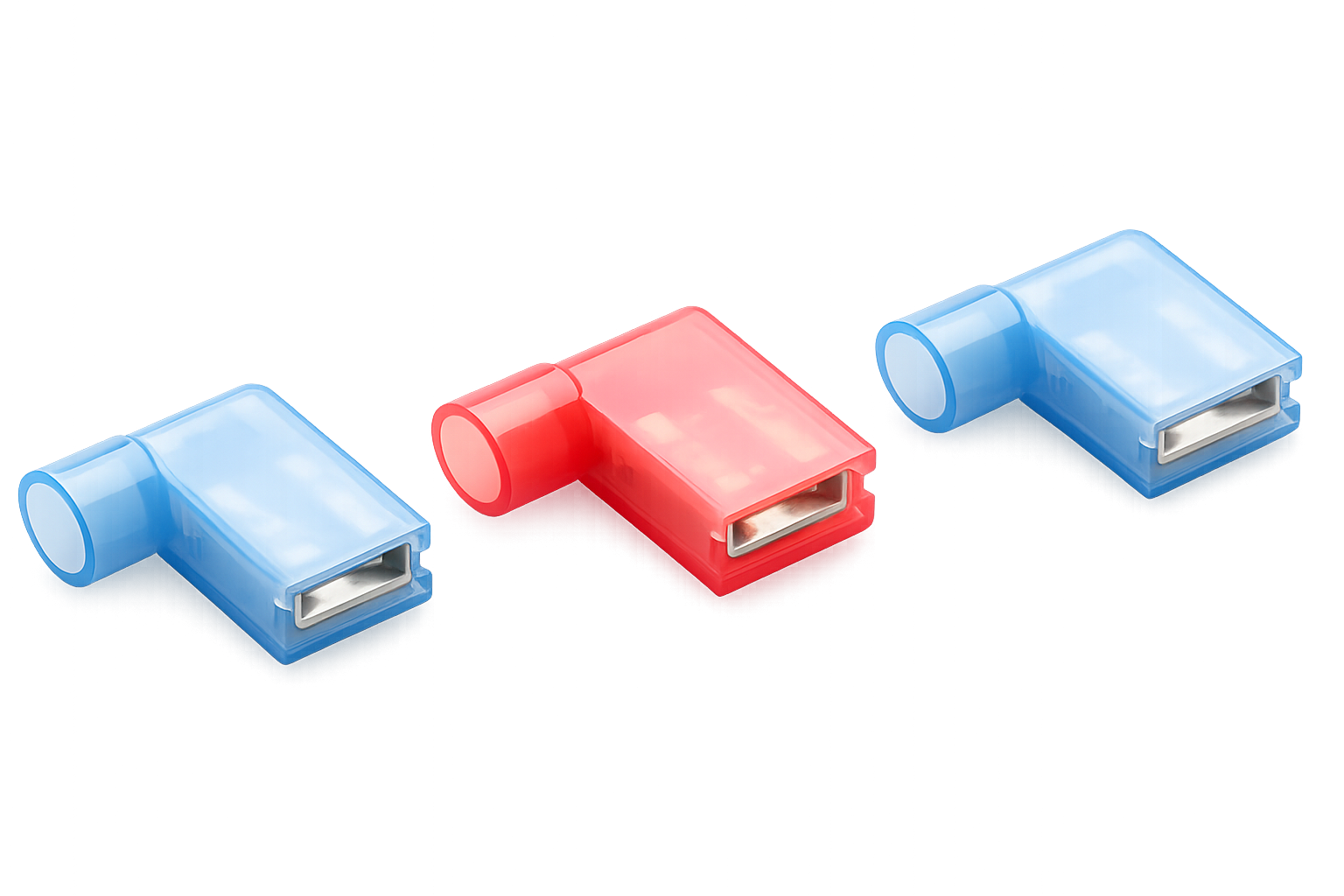
What Wire Sizes Can Flag Terminals Handle?
The appropriate wire size depends on the terminal design.
A flag terminal should always be matched to the conductor size specified by the manufacturer.
Important specifications may include:
- AWG or mm² wire range
- Conductor diameter
- Insulation diameter
- Terminal material
- Crimp barrel dimensions
- Recommended crimping tooling
- Current rating
Using a terminal outside its specified wire range can result in poor crimp quality and unreliable electrical performance.
For example, using a terminal designed for a small conductor on a significantly larger wire may prevent the crimp from forming correctly.
The opposite problem can also occur when the conductor is too small for the terminal barrel.
How Are Flag Terminals Manufactured?
Many flag terminals are produced through precision metal stamping.
A typical manufacturing process can include:
Material Preparation → Progressive Stamping → Forming → Plating → Inspection → Packaging
For custom flag terminals, tooling design is particularly important.
The stamping die must accurately control features such as:
- Terminal dimensions
- Contact geometry
- Crimp barrel shape
- Bending angle
- Material thickness
- Mating area
After stamping and forming, the terminal may receive surface treatment such as tin plating depending on the application requirements.
Dimensional inspection and functional testing are then used to verify production consistency.
Why Material and Plating Matter
The material and surface finish of a flag terminal can affect its electrical and mechanical performance.
Copper and copper alloys are commonly used for electrical terminals because they provide a combination of electrical conductivity, formability, and mechanical properties.
Plating can provide additional protection and improve the terminal’s suitability for the intended application.
For example, tin plating is widely used for many electrical terminal applications because it can help improve corrosion resistance and provide a suitable contact surface.
The correct material and plating should be selected according to:
- Current requirements
- Operating temperature
- Environmental conditions
- Corrosion exposure
- Mating requirements
- Cost targets
Crimp Quality Is Critical
Because many flag terminals are crimp terminals, the quality of the crimp connection is just as important as the terminal design itself.
A properly crimped connection should provide sufficient:
- Electrical conductivity
- Wire retention
- Mechanical strength
- Contact stability
- Production consistency
Important crimping parameters can include:
- Crimp height
- Crimp width
- Crimp force
- Conductor positioning
- Insulation support
- Tooling condition
An improperly crimped terminal may result in excessive resistance, weak wire retention, conductor damage, or intermittent electrical connections.
For high-volume production, controlled tooling and inspection are therefore essential.
How to Choose the Right Flag Terminal
Before selecting a 90-degree terminal, consider the complete application rather than looking only at the terminal shape.
Check the Wire Size
Confirm the terminal’s recommended wire range.
The conductor should fit properly inside the crimp barrel and produce the required crimp after processing.
Check the Mating Interface
Determine whether the terminal needs to connect to:
- Male tabs
- Female receptacles
- Studs
- Screws
- Switches
- Relays
- Custom components
The mating dimensions must be compatible.
Check the Available Space
Measure the installation area carefully.
Consider not only the terminal itself but also:
- Wire bending space
- Adjacent components
- Housing walls
- Connector clearance
- Assembly tools
A 90-degree terminal can reduce routing space, but the complete wire path still needs to be considered.
Consider Current Requirements
The terminal must be suitable for the expected electrical load.
Higher-current applications may require larger conductor sizes, different materials, or specialized terminal designs.
Consider Environmental Conditions
For automotive, appliance, and industrial applications, consider:
- Temperature
- Humidity
- Vibration
- Corrosion
- Chemical exposure
The terminal material and plating should be selected accordingly.
Flag Terminal vs. Other Wire Terminals
Flag terminals are only one option within the larger category of wire terminals.
Depending on the application, other designs may be more suitable.
Ring terminals are commonly used for secure stud or screw connections.
Fork terminals allow convenient installation around a screw or stud.
Blade terminals provide a compact flat connection.
Pin terminals are useful where a pin-style interface is required.
Butt terminals are designed to join two wires together.
Flag terminals are particularly useful when the wire needs to exit at approximately 90 degrees from the connection point.
The best choice depends on the mating interface, installation space, wire size, and electrical requirements.
When Should You Use a Custom Flag Terminal?
A standard flag terminal may not always fit a customer’s specific assembly.
Custom terminals can be considered when you need:
- A specific 90-degree orientation
- Non-standard dimensions
- A particular wire range
- Custom crimp geometry
- Special material
- Special plating
- Specific mating dimensions
- Higher current capacity
- Integration with a custom housing
For high-volume applications, custom tooling can also provide better control over dimensional consistency and production efficiency.
Qianwei Precision for Custom Flag Terminals
For OEM and high-volume applications, terminal performance depends heavily on manufacturing consistency.
Qianwei Precision manufactures electrical terminals using integrated processes covering:
Design → Tooling → Stamping → Plating → Inspection → Mass Production
Our manufacturing capabilities support custom terminal requirements involving different materials, dimensions, plating specifications, crimp structures, and terminal geometries.
For applications requiring custom flag terminals, crimp terminals, stamped terminals, wire terminals, or other precision electrical terminals, customers can provide a drawing, sample, wire specification, or application requirement for evaluation.
This approach allows the terminal design to be developed around the actual wiring and installation requirements rather than forcing the application to fit a standard component.
Conclusion
Flag terminals are a practical solution when a conventional straight terminal does not provide enough room for proper wire routing.
By redirecting the wire approximately 90 degrees, these right-angle crimp terminals can help simplify installation in compact electrical assemblies while maintaining a reliable wire connection.
They are commonly considered for automotive wiring harnesses, household appliances, industrial equipment, motors, switches, and other space-constrained applications.
However, terminal selection should go beyond shape. Wire size, current requirements, mating interface, material, plating, crimp geometry, operating environment, and production requirements should all be evaluated.
For standard and custom applications, an experienced electrical terminal manufacturer can help determine the appropriate terminal structure and manufacturing process.
If your application requires a custom flag terminal or other precision crimp terminal, Qianwei Precision can support the project from tooling and stamping through plating, inspection, and mass production.
FAQs
What is a flag terminal?
A flag terminal is an electrical terminal designed with an angled structure, typically around 90 degrees, to allow the wire to exit sideways from the connection point. It is commonly used where installation space is limited.
Are flag terminals crimp terminals?
Many flag terminals are designed as crimp terminals. The conductor is inserted into a crimp barrel and mechanically compressed using appropriate tooling.
What is a 90-degree terminal used for?
A 90-degree terminal is mainly used to improve wire routing in compact electrical assemblies. It can help prevent interference with nearby components and reduce the space required for the wiring connection.
Are flag terminals suitable for automotive applications?
Yes. Flag terminals can be used in automotive wiring applications where the terminal orientation helps accommodate tight installation spaces. The material, plating, crimp design, and environmental requirements must be matched to the specific application.
Can flag terminals be customized?
Yes. Custom flag terminals can be manufactured with specific dimensions, materials, plating, wire ranges, crimp structures, and connection geometries.
What is the difference between a flag terminal and a standard terminal?
The main difference is the wire exit orientation. A standard terminal typically routes the wire straight from the connection point, while a flag terminal redirects the wire, usually by approximately 90 degrees.

