

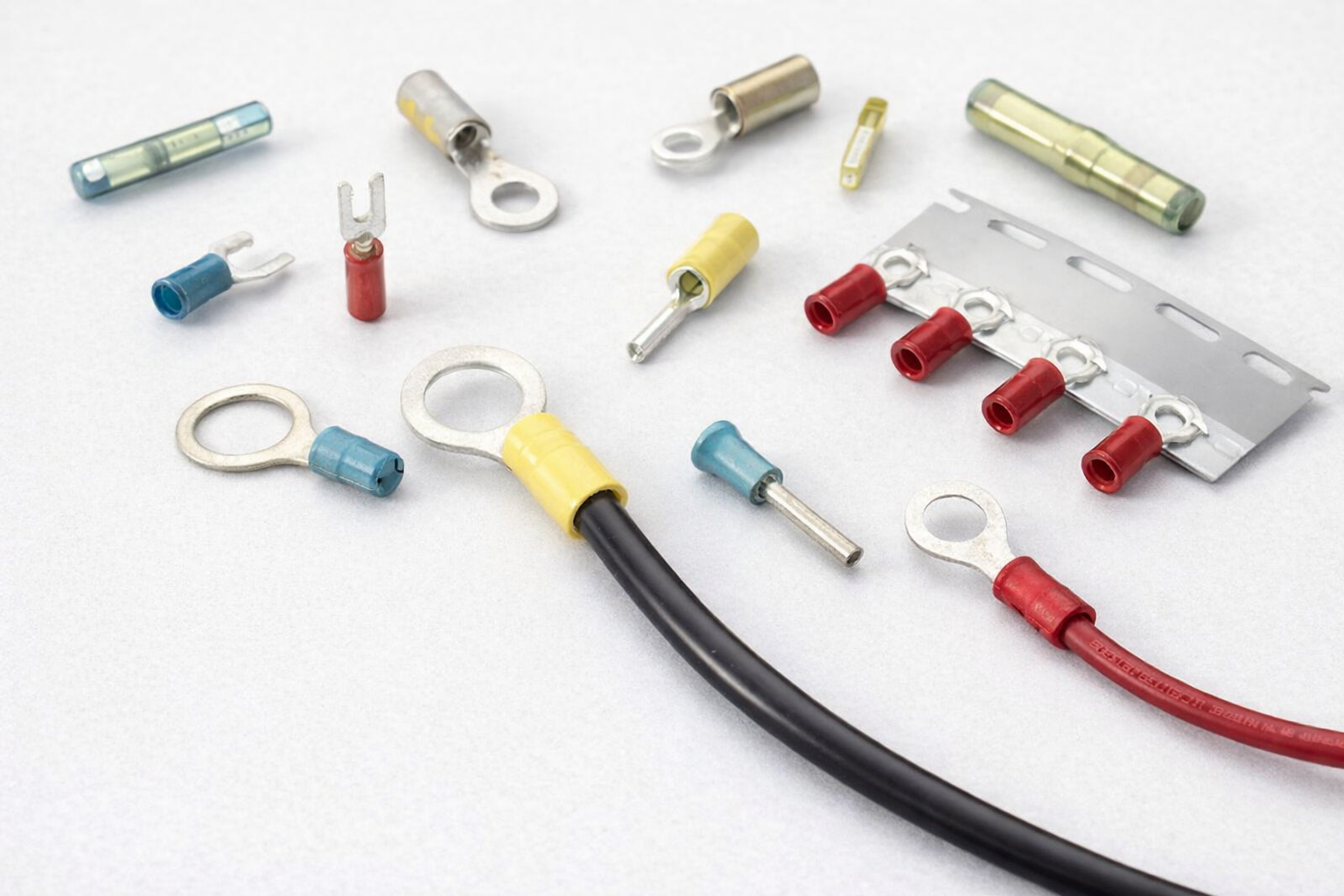
Electrical terminals provide a reliable connection between wires, cables, circuit components, and electrical equipment. Depending on the application, terminals can be connected to conductors through different methods, with crimping and soldering being two of the most common.
Among them, crimp terminals are widely used in automotive wiring harnesses, household appliances, industrial equipment, new energy systems, and other high-volume electrical applications. Solder terminals, meanwhile, remain useful where a soldered connection is preferred or required.
So, which connection method is better?
The answer depends on the application, production volume, electrical requirements, mechanical conditions, and manufacturing process.
This guide compares crimp terminals and solder terminals, explains their differences, and shows how to choose the right terminal for your application.
What Is a Crimp Terminal?
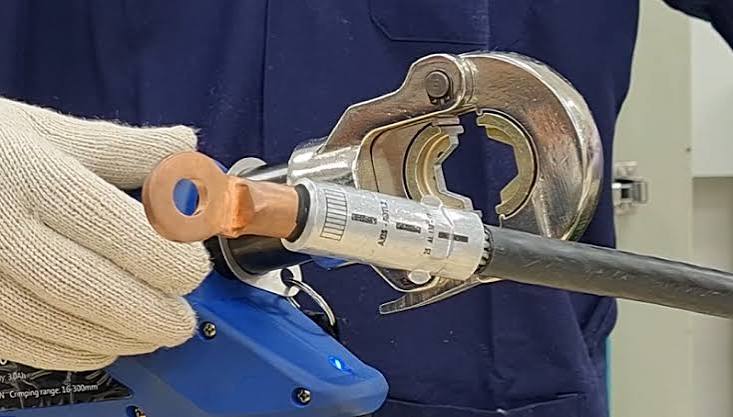
A crimp terminal is an electrical terminal designed to connect a wire to another electrical component through mechanical crimping.
The terminal typically includes a conductor barrel that is crimped around the exposed conductor. Some terminals also include an insulation barrel that provides additional mechanical support around the wire insulation.
During the crimping process, a properly selected crimping tool compresses the terminal around the wire to create a secure electrical and mechanical connection.
Crimp terminals are available in many configurations, including:
The specific design depends on the wire size, connection method, current requirements, installation environment, and application.
Why Are Crimp Terminals Widely Used?
One of the biggest advantages of crimp terminals is repeatability.
When the terminal, wire, tooling, and crimping parameters are correctly matched, manufacturers can produce a large number of consistent connections.
This makes crimp terminals particularly suitable for:
- Automotive wiring harnesses
- Household appliances
- Industrial control systems
- Battery systems
- New energy equipment
- Communication equipment
- Consumer electronics
- Electrical cabinets
For manufacturers producing thousands or millions of wire connections, repeatable crimping is an important advantage.
What Are Solder Terminals?
Solder terminals are electrical terminals designed to be connected to wires or conductors through soldering.
Instead of mechanically compressing the terminal around the conductor, solder is heated until it melts and bonds the conductor to the terminal.
Common solder terminal designs include solder lugs, solder cups, solder tabs, and certain PCB terminals.
Solder connections can provide good electrical conductivity when the soldering process is properly controlled.
However, soldering requires additional process control, including solder temperature, solder amount, heating time, and operator or equipment consistency.
Solder terminals can be useful in applications where soldering is already part of the manufacturing process or where a specific soldered connection is required.
Crimp vs. Solder Terminals: Key Differences
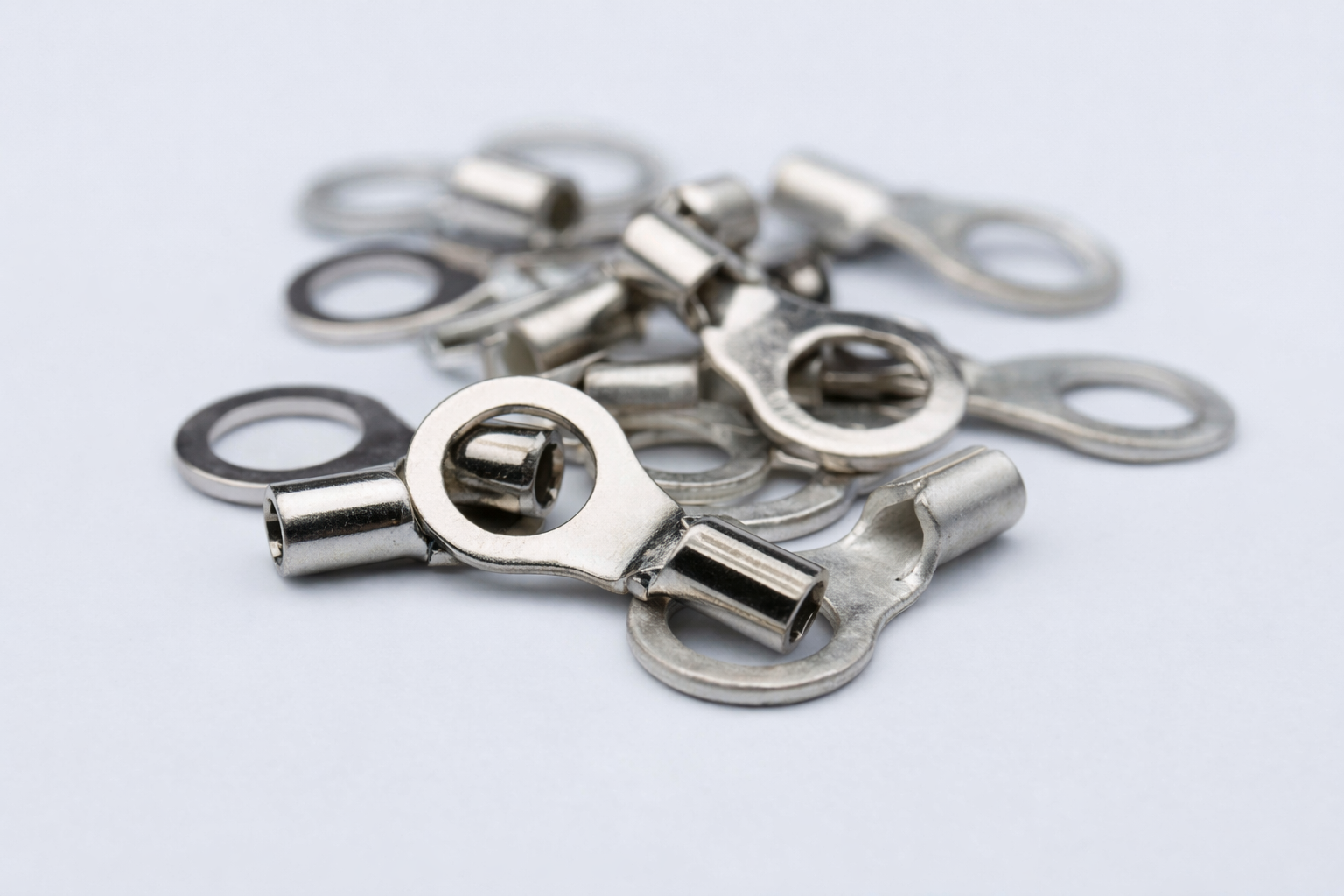
The main difference is the way the conductor is attached to the terminal.
Crimp terminals use mechanical deformation, while solder terminals use a soldered joint.
| Feature | Crimp Terminal | Solder Terminal |
|---|---|---|
| Connection method | Mechanical crimping | Soldering |
| Production speed | High | Generally lower |
| Automation | Highly suitable | Suitable but process-dependent |
| Repeatability | High with controlled tooling | Depends on soldering process |
| High-volume production | Excellent | Less efficient in many applications |
| Wire harness applications | Widely used | Less common |
| Process control | Crimp height, force, tooling | Temperature, time, solder amount |
| Field installation | Convenient with proper tooling | Requires soldering equipment |
| Customization | Highly flexible | Available depending on design |
Neither method is universally better. The right choice depends on what the terminal needs to accomplish.
When Should You Choose Crimp Terminals?
For most high-volume wire connection applications, crimp terminals are an excellent starting point.
High-volume manufacturing
If a product requires hundreds, thousands, or millions of wire connections, production efficiency becomes important.
Crimping can be integrated into semi-automatic or fully automatic production equipment, allowing manufacturers to achieve consistent results at high production volumes.
Automotive wiring harnesses
Crimp terminals are widely used in automotive wiring harnesses because they can provide repeatable mechanical and electrical connections.
Automotive applications may also require terminals to withstand vibration, temperature changes, moisture, and long-term mechanical stress.
Terminal geometry, material, plating, crimp design, and tooling therefore need to be carefully controlled.
Household appliances
Washing machines, refrigerators, air conditioners, ovens, and other appliances can contain numerous wire connections.
Crimp terminals can simplify assembly and provide a repeatable connection method suitable for mass production.
Industrial equipment
Industrial control systems and electrical equipment often require reliable wire termination combined with efficient assembly.
Depending on the application, manufacturers may use ring, fork, blade, pin, or custom terminals.
When Are Solder Terminals a Better Choice?
Solder terminals still have their place.
They may be considered when:
- The design specifically requires a soldered connection
- Soldering equipment is already available
- Production volume is relatively low
- The terminal is designed specifically for soldering
- The application requires a particular soldering process
- The product architecture makes mechanical crimping impractical
For example, some electronic assemblies and specialized electrical components may incorporate solder cups or solder tabs as part of their connection design.
However, choosing soldering simply because it appears to create a strong connection is not enough. The complete application and manufacturing process should be considered.
Crimping vs. Soldering for Wire Harnesses
For modern wire harness production, crimping is often preferred because of its speed, repeatability, and compatibility with automated equipment.
A typical wire harness production process may include:
Wire Cutting → Stripping → Terminal Crimping → Inspection → Assembly → Testing
The quality of the final connection depends on more than the terminal itself.
The wire size, conductor material, terminal material, plating, crimp geometry, and tooling all need to be compatible.
A poorly matched terminal and wire can result in:
- Insufficient mechanical retention
- High electrical resistance
- Conductor damage
- Loose connections
- Terminal deformation
- Inconsistent crimping
This is why selecting a suitable terminal manufacturer is important for production applications.
What Other Types of Electrical Terminals Are Available?
Crimp and solder describe connection methods, but terminals can also be classified according to their structure, material, and application.
Wire Terminals
Wire terminals are designed to terminate electrical wires and provide a reliable interface with another component.
They can include ring, fork, blade, pin, and other configurations.
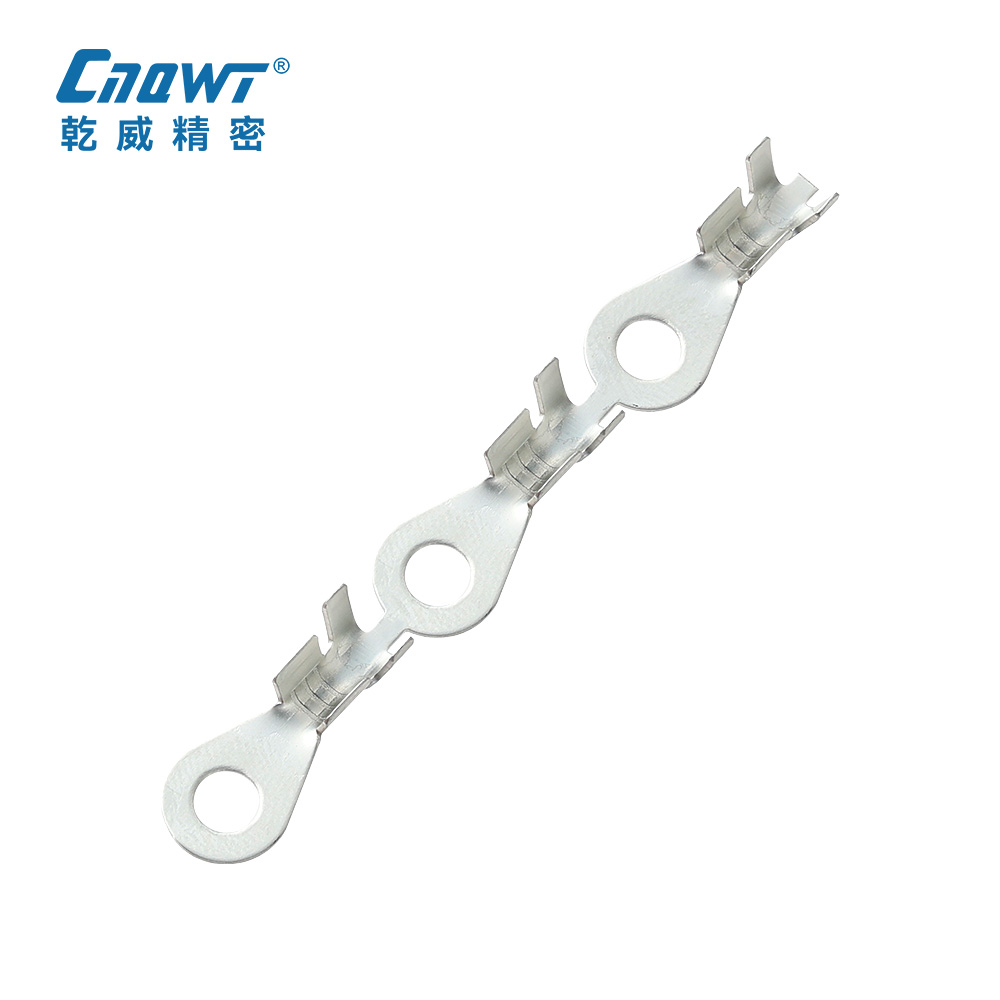
Stamped Terminals
Stamped terminals are manufactured from metal strip using precision stamping processes.
They are particularly suitable for high-volume production because stamping allows manufacturers to produce large quantities of terminals with consistent dimensions.
Stamped terminals are commonly used inside connectors and wiring harness systems.
Copper Terminals
Copper is widely used for electrical terminals because of its good electrical conductivity and suitable mechanical properties.
Depending on the application, copper terminals can also receive plating treatments such as tin plating to improve corrosion resistance and connection performance.
High-Current Terminals
High-current terminals are designed for applications where electrical loads are significantly higher than those found in conventional signal or low-current circuits.
They may be used in:
- Battery systems
- New energy equipment
- Power distribution
- Industrial machinery
- EV-related systems
- Energy storage equipment
The terminal design must consider current capacity, conductor size, temperature rise, contact resistance, and mechanical requirements.
Custom Terminals
Not every application can use a standard terminal.
Custom terminals may be required when a customer has specific requirements for:
- Dimensions
- Material
- Plating
- Wire range
- Current capacity
- Mounting method
- Contact geometry
- Crimp structure
- Packaging
In these cases, working directly with a terminal manufacturer can simplify the transition from product design to mass production.
How to Choose the Right Terminal
When selecting a terminal, do not focus only on the connection method.
Consider the complete application.
Wire Size
The terminal must be compatible with the conductor size.
A terminal designed for a small wire should not be used for a significantly larger conductor simply because the physical dimensions appear similar.
Current Requirement
The expected current affects the terminal’s required cross-sectional area, material, contact design, and temperature performance.
High-current applications generally require terminals designed specifically for higher electrical loads.
Material
Copper and copper alloys are common choices for electrical terminals.
The appropriate material depends on electrical conductivity, mechanical strength, forming requirements, corrosion resistance, and application conditions.
Plating
Plating can affect corrosion resistance, electrical performance, and long-term reliability.
Tin plating is commonly used for many electrical terminal applications, while other plating systems may be selected for specific requirements.
Connection Method
Determine whether the application requires:
- Crimping
- Soldering
- Welding
- PCB mounting
- Other mechanical connection methods
For high-volume wire harness production, crimping is often an efficient option.
Operating Environment
Temperature, humidity, vibration, chemicals, and other environmental factors should also be considered.
Automotive and new energy applications, for example, may require terminals capable of maintaining reliable performance under demanding operating conditions.
Why Manufacturing Quality Matters
A terminal may look simple, but its performance depends heavily on manufacturing precision.
Small differences in dimensions can affect:
- Crimp quality
- Contact force
- Wire retention
- Mating performance
- Electrical resistance
- Assembly consistency
For stamped terminals, tooling quality is particularly important.
A capable manufacturer should be able to control the complete production process rather than simply purchase finished terminals from another supplier.
At Qianwei Precision, terminal manufacturing can be integrated across several key processes:
Design → Tooling → Stamping → Plating → Inspection → Mass Production
This integrated approach allows manufacturers to control tooling accuracy, stamping consistency, surface treatment, dimensional quality, and production efficiency.
For custom terminal projects, this can also simplify communication between product design and mass production.
Crimp or Solder: Which One Is Right for Your Application?
There is no single answer for every application.
Choose crimp terminals when you need:
- High-volume production
- Repeatable wire connections
- Fast assembly
- Automated or semi-automated production
- Automotive or wire harness applications
- Consistent mechanical and electrical performance
Consider solder terminals when:
- Soldering is already part of your production process
- The terminal is specifically designed for soldering
- The application requires a soldered connection
- Production volume and assembly requirements make soldering practical
For many modern industrial and wire harness applications, crimping provides an efficient and repeatable solution. However, the final choice should always be based on the specific electrical, mechanical, environmental, and manufacturing requirements.
Why Work With a Terminal Manufacturer?
When you are sourcing terminals for a production project, buying a standard part is not always enough.
A manufacturer with stamping, tooling, plating, inspection, and production capabilities can provide more control over the complete process.
This becomes particularly important when you need:
- Custom terminal dimensions
- Specific materials
- Special plating
- High-current designs
- Custom crimp structures
- Large-volume production
- OEM or ODM support
Qianwei Precision focuses on electrical terminal manufacturing and precision metal stamping, supporting standard and custom terminal requirements for automotive, new energy, household appliances, industrial equipment, and other applications.
If you have a terminal drawing, sample, wire specification, or project requirement, a professional terminal manufacturer can evaluate the design and recommend an appropriate manufacturing solution.
Conclusion
Crimp and solder terminals serve different purposes, and the best choice depends on the application, production process, wire specifications, electrical requirements, and operating environment.
For high-volume wire harnesses, automotive components, appliances, industrial equipment, and other production applications, crimp terminals offer strong advantages in repeatability, production efficiency, and automation.
Solder terminals remain useful for applications where soldering is required or already integrated into the assembly process.
For more demanding projects, the terminal itself is only one part of the solution. Material selection, terminal geometry, tooling, stamping, plating, inspection, and production control all contribute to the final connection quality.
For standard or custom electrical terminals, crimp terminals, stamped terminals, wire terminals, copper terminals, and high-current terminals, working directly with an experienced manufacturer can help ensure that the terminal design matches both the electrical requirements and the production process.
FAQs
Are crimp terminals better than solder terminals?
Not in every application. Crimp terminals are often more suitable for high-volume wire harness and automated production, while solder terminals can be appropriate when a soldered connection is specifically required.
Are crimp terminals reliable?
Yes. When the terminal, wire, tooling, and crimping parameters are properly matched, crimp connections can provide reliable electrical and mechanical performance.
Can terminals be customized?
Yes. Custom terminals can be developed according to requirements such as dimensions, material, plating, wire size, mounting structure, and crimp design.
What materials are commonly used for electrical terminals?
Copper and copper alloys are commonly used because of their electrical conductivity and suitable mechanical properties. The final material depends on the application’s electrical, mechanical, and environmental requirements.
What is the difference between a crimp terminal and a wire terminal?
A crimp terminal describes a terminal connected through a crimping process, while wire terminal is a broader term describing terminals designed to terminate wires. Many wire terminals are crimp terminals.
Can Qianwei manufacture custom terminals?
Yes. Qianwei Precision supports custom terminal manufacturing and integrates tooling, precision stamping, plating, inspection, and mass production for customized terminal projects.

