


Battery energy storage systems (BESS) rely on reliable electrical connections to transfer power between battery modules, battery racks, and power conversion equipment. As energy storage installations become larger and more compact, manufacturers need connection solutions that can handle high currents while accommodating limited space, mechanical movement, and demanding operating conditions.
Flexible copper busbars are one option for meeting these requirements. Their conductive copper layers provide an electrical path, while their flexible construction allows them to accommodate installation constraints that may be difficult to manage with rigid busbars alone.
However, selecting a flexible copper busbar for a battery energy storage system involves more than choosing a suitable size. Current requirements, temperature rise, connection resistance, mounting dimensions, insulation, and manufacturing quality all influence the final design.
This guide explains where flexible copper busbars are used in BESS applications, what to consider when selecting them, and how customized busbar solutions can support battery system manufacturers and OEM projects.
1. What Are Flexible Copper Busbars in BESS?
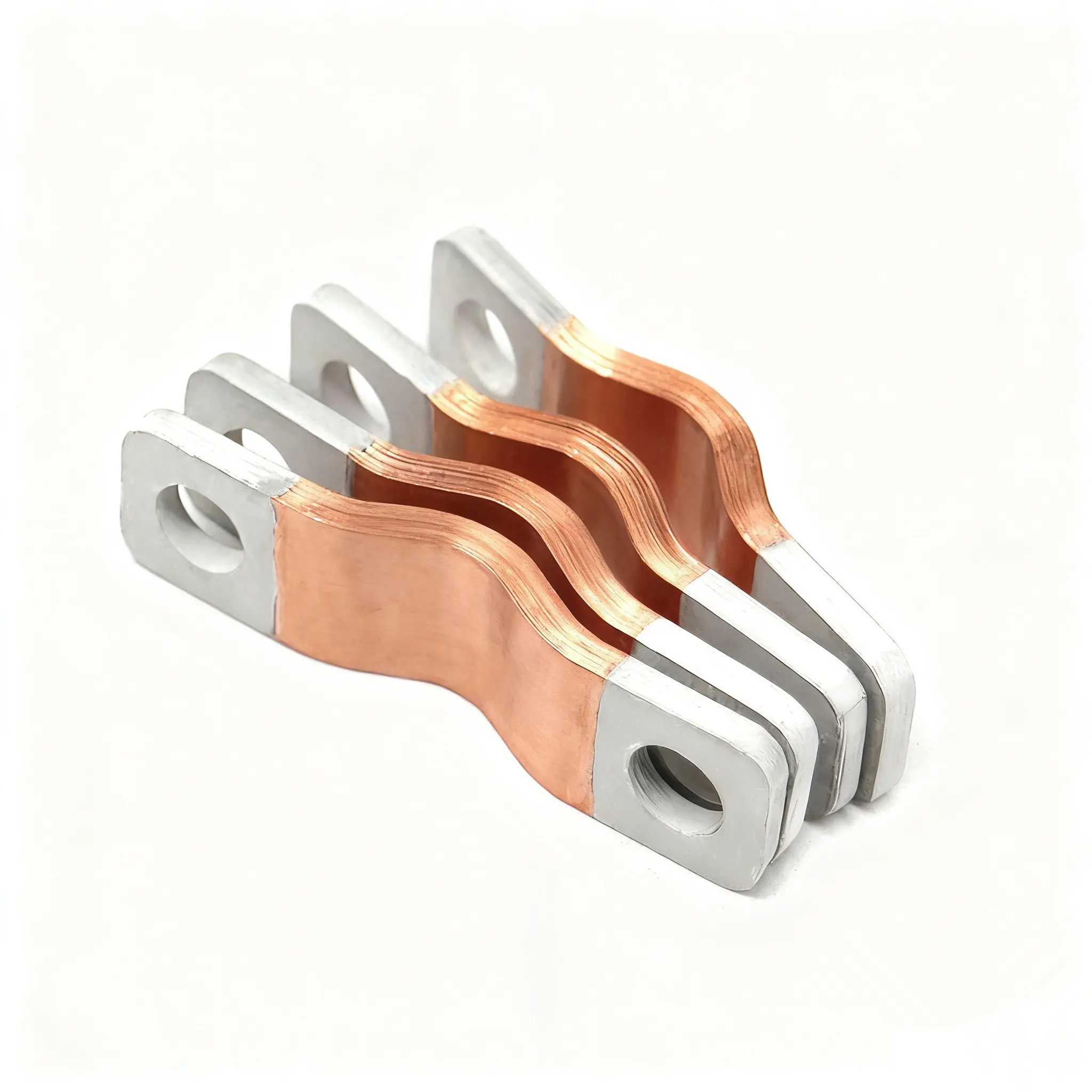
A flexible copper busbar is an electrical conductor designed to provide a conductive connection while allowing a degree of movement or bending. Depending on the construction, it may consist of multiple thin copper foils, laminated copper layers, or other bonded copper configurations with defined connection ends.
Unlike a rigid copper bar, which maintains a relatively fixed shape, a flexible busbar can accommodate certain dimensional differences and installation constraints between connection points.
In battery energy storage systems, this flexibility can be useful when connecting components arranged in compact enclosures or modular assemblies.
Where Are Flexible Copper Busbars Used in Battery Energy Storage Systems?
Flexible copper busbars may be used in several parts of a BESS, depending on the system architecture and electrical design.
Battery module connections: Flexible conductors can connect adjacent modules where the installation layout requires some tolerance for positioning differences.
Battery rack connections: In suitable designs, flexible busbars can connect electrical interfaces within a battery rack, helping accommodate restricted space or mechanical movement.
Battery-to-power conversion connections: Some systems use flexible copper connections between battery assemblies and power conversion equipment, subject to current, voltage, and insulation requirements.
Energy storage cabinets: Compact cabinets may benefit from flexible connections where rigid busbars would require complicated routing or additional installation space.
High-current DC connections: Flexible copper busbars can be considered for high-current paths when the conductor dimensions, connection interfaces, temperature rise, and fault-current requirements are properly evaluated.
Not every BESS connection needs a flexible busbar. The appropriate solution depends on the current path, system layout, operating conditions, and applicable electrical safety requirements.
2. Why BESS Manufacturers Use Flexible Copper Busbars
Flexible copper busbars offer several potential advantages in battery energy storage applications. Their actual performance depends on the design, materials, manufacturing process, and installation conditions.
2.1 High Electrical Conductivity
Copper is widely used in electrical power distribution because of its high electrical conductivity. A properly designed copper busbar can provide a low-resistance current path while supporting compact electrical assemblies.
Conductor resistance depends on factors such as copper resistivity, conductor length, cross-sectional area, and operating temperature. For a given material and temperature, a longer conductor generally has higher resistance, while a larger cross-sectional area generally reduces resistance.
This matters in BESS applications because electrical losses generate heat. Even a small amount of additional resistance at a connection interface can contribute to localized heating under high-current operation.
When specifying a flexible copper busbar, engineers should evaluate both the conductor itself and the resistance of the complete connection, including its contact surfaces and fasteners.
2.2 Flexibility for Compact System Layouts
Battery racks and energy storage cabinets often contain numerous electrical and mechanical components within a limited enclosure.
Flexible copper busbars can help accommodate connection points that are not perfectly aligned or that require a specific routing path. They may also reduce the need to force rigid conductors into position during installation.
This can simplify assembly when the busbar is designed around the actual mounting geometry.
Nevertheless, flexibility should not be treated as unlimited. Minimum bend radius, bending direction, available clearance, and the position of the connection ends must be considered during design. Repeated bending or excessive mechanical loading can damage the conductor or its joints.
2.3 Managing Mechanical Stress
Battery systems may experience mechanical vibration, thermal expansion, and dimensional changes during operation.
A properly designed flexible busbar can accommodate some relative movement between connection points and help reduce the mechanical stress transmitted through the electrical connection.
This is particularly relevant when components have different mounting structures or operating temperatures.
The busbar must still be supported appropriately. Flexible conductors should not be expected to carry excessive external loads or compensate for poor mounting alignment. The connection design should account for the expected movement throughout the system’s service life.
2.4 Supporting Efficient Assembly
For BESS manufacturers, installation efficiency is an important part of the overall connection design.
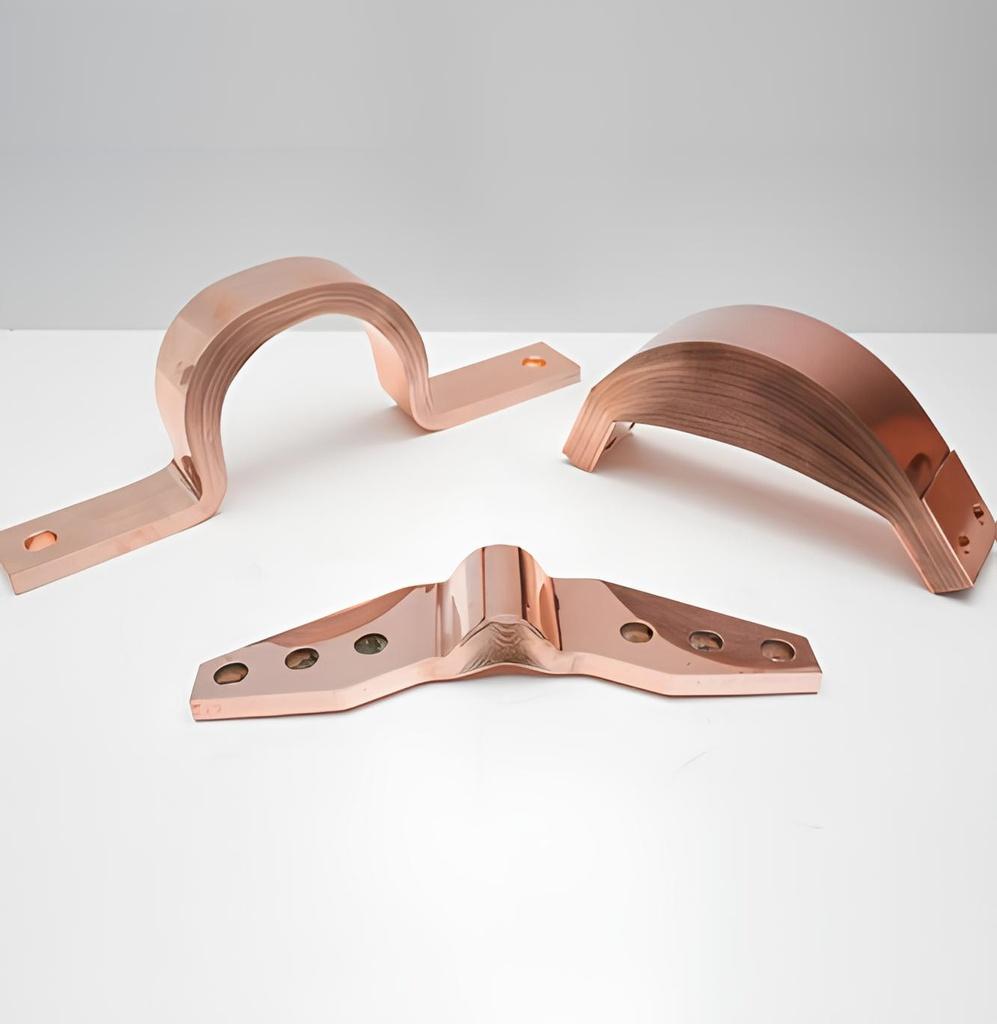
Custom flexible copper busbars can be manufactured to specified lengths, widths, thicknesses, mounting-hole positions, and connection geometries. Where suitable, this can reduce on-site modification and help make assembly more consistent across production batches.
For OEM projects, developing the busbar around the equipment drawing can also help ensure that the connection fits the intended enclosure and mounting arrangement.
3. Flexible Copper Busbar vs. Rigid Busbar vs. Cable in BESS
Flexible copper busbars, rigid copper busbars, and power cables all have a place in battery energy storage systems. The best choice depends on the electrical and mechanical requirements of each connection.
| Comparison factor | Flexible copper busbar | Rigid copper busbar | Power cable |
|---|---|---|---|
| Conductor material | Typically copper | Commonly copper; aluminum is also used in some designs | Copper or aluminum |
| Mechanical flexibility | Flexible section allows bending within design limits | Limited flexibility after forming | Generally flexible |
| Installation geometry | Useful for compact or misaligned interfaces | Suitable for stable, defined layouts | Useful for routed connections |
| Space requirements | Can fit specific connection geometries | May require clearance for bends and mounting | Requires routing space and suitable bend radius |
| Connection interface | Often uses formed or bonded ends with mounting holes or other interfaces | Commonly bolted or busbar-joint connections | Often uses lugs, terminals, or designated cable interfaces |
| Thermal performance | Depends on conductor dimensions, joints, cooling, and installation | Depends on cross-section, joints, and cooling | Depends on conductor size, insulation, installation, and cooling |
| Typical selection priority | Adaptable geometry and compact connections | Structural rigidity and defined routing | Flexible routing over longer distances |
A flexible busbar is not automatically more efficient or more compact than every alternative. For a connection between two fixed points with ample space, a rigid busbar may be simpler. For a longer route with several changes in direction, a suitably rated cable may be more practical.
The important question is not which product is universally better, but which connection solution best meets the system’s electrical, thermal, mechanical, and assembly requirements.
4. Key Design Considerations for BESS Flexible Copper Busbars
A reliable flexible copper busbar starts with a clear understanding of the application. Several design parameters should be reviewed before finalizing the specification.
4.1 Current Rating and Cross-Sectional Area
Rated current is one of the first parameters to establish.
The required conductor cross-section depends on continuous current, peak current, allowable temperature rise, conductor length, cooling conditions, and the temperature limits of nearby components.
A larger cross-section generally reduces conductor resistance, but simply increasing the copper dimensions does not guarantee an acceptable design. Layer arrangement, surface area, enclosure conditions, and contact resistance also affect thermal performance.
For BESS projects, engineers should identify both normal operating current and relevant overload or fault-current conditions. Short-circuit withstand capability must be evaluated separately from continuous current-carrying capacity.
There is no single current rating that applies to all flexible copper busbars of a particular width or thickness. The final rating should be established using appropriate calculations, design standards, and testing under representative installation conditions.
4.2 Operating Temperature and Heat Dissipation
Heat management is essential in battery energy storage systems because excessive temperatures can affect connection reliability and surrounding components.
The temperature of a flexible copper busbar is influenced by:
- Electrical resistance of the copper conductor.
- Resistance at bolted or bonded interfaces.
- Continuous and intermittent current levels.
- Ambient temperature inside the enclosure.
- Airflow and available heat-dissipation surfaces.
- Insulation materials and nearby heat sources.
Connection interfaces deserve particular attention. An inadequately prepared contact surface, incorrect fastening torque, or poorly controlled joint can increase resistance and create localized hot spots.
Thermal evaluation should therefore consider the complete installed connection rather than the copper conductor in isolation. Temperature-rise testing under representative operating conditions can help validate the design.
4.3 Dimensions and Installation Space
The busbar should be designed around the actual equipment layout.
Important dimensional parameters include:
- Overall length and width.
- Copper thickness and layer configuration.
- Mounting-hole diameter and center-to-center distance.
- Connection-end dimensions.
- Required bending direction and minimum bend radius.
- Clearance from the enclosure and adjacent conductors.
For OEM applications, a drawing or physical sample is often the most effective starting point. It allows the manufacturer to assess the intended connection geometry before confirming manufacturability.
Dimensional tolerances should be defined for critical interfaces, particularly mounting holes and contact surfaces. Consistent dimensions help reduce assembly difficulties and variation between production batches.
4.4 Connection Interface and Contact Resistance
The electrical connection between the busbar and the mating component can have a significant effect on overall performance.
Design considerations include contact area, surface finish, flatness, fastener selection, mounting pressure, and the specified tightening torque.
Surface treatment may be required to support contact performance or environmental durability. The appropriate finish depends on the application, mating materials, operating environment, and relevant specifications.
For bolted connections, the assembly procedure should be clearly defined. Excessive or insufficient torque can create mechanical or electrical problems, depending on the joint design.
Where the application requires it, contact resistance and temperature-rise testing should be included in the qualification process.
4.5 Insulation and Electrical Clearance
Flexible copper busbars used in battery systems may require insulation or protective coverings, depending on their voltage level, installation location, and exposure to accidental contact.
The design should account for electrical clearance, creepage distance, dielectric requirements, and the compatibility of insulation materials with operating temperatures and environmental conditions.
Insulation should not be selected solely on the basis of appearance or nominal voltage. Its performance must suit the complete application, including temperature, mechanical wear, contamination, and the enclosure design.
The final configuration should comply with the electrical safety requirements applicable to the specific BESS product and installation.
5. Materials and Manufacturing of Flexible Copper Busbars
Material selection and manufacturing consistency influence the electrical, mechanical, and dimensional performance of a flexible copper busbar.
5.1 Choosing the Right Copper Material
Copper is commonly selected for flexible busbars because it combines high electrical conductivity with useful forming and joining characteristics.
The appropriate copper grade depends on conductivity requirements, mechanical properties, manufacturing processes, and the intended operating environment.
When evaluating material options, buyers should consider:
- Electrical conductivity and resistivity.
- Material thickness and dimensional consistency.
- Formability and compatibility with the selected joining process.
- Surface condition and finishing requirements.
- Traceability and applicable material specifications.
The chosen material should be confirmed against the project’s technical requirements rather than selected on conductivity alone.
5.2 Copper Foil Thickness and Layer Configuration
Many flexible busbars use multiple thin copper layers to provide flexibility while maintaining an adequate conductive cross-section.
Layer thickness, number of layers, overall dimensions, and the construction of the connection ends affect the finished product’s behavior.
A design with thin layers may accommodate bending differently from a design using thicker copper sections. However, the final performance also depends on the overall geometry and joining method.
Manufacturers should evaluate the proposed layer configuration against current requirements, temperature rise, bending conditions, and available installation space.
5.3 Surface Treatment and Contact Performance
Copper surfaces can oxidize when exposed to the environment. Depending on the application, an appropriate surface finish may help meet contact-interface, corrosion-resistance, or assembly requirements.
Possible finishes should be evaluated according to the operating environment and the materials used at the mating interface. The choice should also account for manufacturing feasibility and the customer’s specifications.
For BESS connections, surface treatment should be considered alongside contact design and fastening requirements, not as a substitute for proper joint engineering.
5.4 Manufacturing Processes and Quality Control
Depending on the product construction, flexible copper busbar manufacturing may involve cutting, stacking, forming, bonding or joining, terminal-end processing, surface finishing, and dimensional inspection.
Each stage can affect the final product.
For example, inaccurate mounting-hole positions may cause installation problems, while inconsistent joining quality may affect electrical resistance or mechanical integrity.
A suitable quality-control plan may include:
- Incoming material verification.
- Dimensional inspection.
- Visual inspection of conductor surfaces and connection ends.
- Verification of joining quality where applicable.
- Electrical resistance or temperature-rise testing when required.
- Batch identification and traceability.
The inspection plan should be agreed upon according to the product design, customer specifications, and intended application.
6. Standard vs. Custom Flexible Copper Busbars for BESS
Standard and customized busbars can both be suitable for energy storage projects. The choice depends on how closely an available design matches the equipment requirements.
6.1 When Standard Busbars May Be Suitable
Standard products can be practical when connection dimensions, mounting arrangements, and electrical requirements are already established.
They may help reduce development time for applications that do not require unusual geometry or project-specific interfaces.
Before selecting a standard busbar, buyers should verify its dimensions, current-carrying capability under the intended operating conditions, connection configuration, and insulation requirements.
A standard product should not be assumed suitable simply because its nominal dimensions appear correct.
6.2 When Custom Busbars Are the Better Choice
Custom flexible copper busbars can be useful when the BESS design has specific electrical or mechanical requirements.
Typical examples include:
High-current battery connections: The conductor dimensions and connection interfaces can be developed around the project’s current and thermal requirements.
Compact energy storage cabinets: Customized geometry can help accommodate limited installation space and neighboring components.
Non-standard mounting interfaces: Hole positions, connection-end dimensions, and overall length can be matched to the equipment drawing.
OEM battery modules and racks: Project-specific designs can support repeatable assembly across multiple units.
Special insulation or finishing requirements: Material and surface-treatment options can be evaluated according to the intended environment and customer specifications.
For OEM buyers, customization is most effective when electrical requirements and mechanical drawings are reviewed together.
6.3 What to Provide When Requesting a Custom BESS Busbar
To obtain a meaningful technical evaluation and quotation, prepare as much of the following information as possible:
- Technical drawing or sample: Include critical dimensions, mounting holes, connection interfaces, and tolerances.
- Electrical requirements: Specify continuous current, peak current, operating voltage, and relevant fault-current conditions.
- Installation conditions: Describe the enclosure, available space, cooling conditions, and expected mechanical movement.
- Material and construction: Indicate preferred copper material, layer configuration, and any joining requirements if already specified.
- Surface treatment and insulation: State required finishes, protective coverings, and applicable electrical safety requirements.
- Quantity and project stage: Provide prototype requirements, estimated order quantities, and expected production demand.
If some parameters have not yet been finalized, an initial drawing and a description of the application can still provide a useful starting point.
7. How to Select a Flexible Copper Busbar Supplier for BESS
A supplier should be evaluated on more than unit price. The product must meet the electrical and mechanical requirements of the system and remain consistent during production.
7.1 Material and Manufacturing Capabilities
Ask how the supplier controls incoming materials, dimensions, joining processes, and surface finishing.
The manufacturer should be able to explain how its processes support the specific busbar construction being proposed.
7.2 Customization and OEM Support
For a custom BESS connection, assess whether the supplier can work from drawings or samples and coordinate design details before production.
A useful supplier should identify manufacturability concerns, clarify missing specifications, and confirm the agreed requirements before mass production.
7.3 Quality Inspection and Traceability
Review the inspection methods used for critical dimensions and connection features.
Depending on the application, the quality plan may include resistance testing, temperature-rise validation, joining inspection, material documentation, and batch traceability.
Ask for test reports or other supporting records where required by the project.
7.4 Production Capacity and Delivery Reliability
For OEM projects, repeatability matters as much as prototype quality.
Evaluate tooling and process capabilities, production planning, lead-time communication, and the supplier’s ability to maintain consistent specifications across repeat orders.
Clear communication during sample approval and production changes can help reduce avoidable delays.
8. Custom Flexible Copper Busbar Solutions from Qianwei Precision
For battery energy storage manufacturers and electrical equipment OEMs, selecting a busbar supplier that understands custom electrical connection requirements can help simplify product development.
Qianwei Precision supports the development and manufacture of customized electrical connection components. For projects requiring non-standard dimensions or connection interfaces, technical drawings and samples can be used to assess the proposed manufacturing approach.
When evaluating a flexible copper busbar project, key discussion points include:
- Copper material and conductor dimensions.
- Overall length, width, thickness, and layer configuration.
- Mounting-hole positions and connection-end geometry.
- Surface treatment and insulation requirements.
- Production quantity and dimensional consistency.
- Inspection and documentation requirements.
The final specification should be based on the project’s electrical design and installation conditions. Current rating, temperature rise, connection resistance, and other critical performance requirements need appropriate engineering evaluation and validation.
Qianwei Precision can work with OEM buyers to review project requirements and assess customized electrical connection solutions.
Looking for a custom flexible copper busbar for your battery energy storage system?
Contact Qianwei Precision with your drawings, samples, or application requirements to discuss a suitable manufacturing solution for your project.
Conclusion
Flexible copper busbars can help BESS manufacturers address demanding electrical connection requirements, particularly where installation space is limited or connection points need to accommodate some mechanical movement.
A successful design requires more than selecting a copper conductor with the right nominal dimensions. Current rating, temperature rise, contact resistance, connection geometry, insulation, and manufacturing consistency all contribute to the performance of the installed connection.
For OEMs and battery system manufacturers, a customized busbar developed around the actual equipment layout can provide a practical alternative to modifying a standard product.
If your project requires a custom flexible copper busbar for a battery energy storage system, contact Qianwei Precision to discuss your drawings, specifications, and manufacturing requirements.
FAQs
1. What is a flexible copper busbar used for in a BESS?
A flexible copper busbar provides an electrical connection between selected components in a battery energy storage system. Depending on the system design, it may connect battery modules, rack assemblies, or power conversion equipment where flexible geometry is beneficial.
2. Why are flexible copper busbars preferred for some battery connections?
They can accommodate certain installation constraints, positional differences, and mechanical movements while providing a conductive copper path. Their suitability depends on current, temperature, mounting geometry, and the required degree of flexibility.
3. How do I select the right copper busbar for a battery energy storage system?
Start with the continuous and peak current, operating voltage, allowable temperature rise, connection dimensions, cooling conditions, and installation environment. Then evaluate conductor size, connection interfaces, insulation, and the relevant qualification requirements.
4. Can flexible copper busbars handle high current?
Yes, appropriately designed flexible copper busbars can be used in high-current applications. However, current-carrying capacity depends on conductor dimensions, material, joint resistance, ambient conditions, cooling, and installation details. It should be validated for the actual application.
5. What affects the temperature rise of a BESS copper busbar?
Important factors include conductor resistance, current level, contact resistance, ambient temperature, airflow, insulation, and the busbar’s installed geometry. Poorly designed or assembled joints can create localized hot spots.
6. Can flexible copper busbars be customized for battery modules?
Yes. Depending on manufacturing capabilities, custom options may include conductor dimensions, overall length, mounting-hole positions, connection-end geometry, layer configuration, and surface treatment. Technical drawings and samples help define the requirements.
7. What is the difference between a flexible copper busbar and a copper cable?
A flexible copper busbar generally uses a flat or laminated conductive structure and is often designed for compact connections. A copper cable uses stranded or solid conductors within a cable construction and is often more suitable for routed connections. Selection depends on current, installation space, bend requirements, insulation, and connection interfaces.
8. What information is needed to obtain a custom busbar quotation?
Provide a technical drawing or sample, material requirements, dimensions, current and voltage specifications, surface-treatment or insulation requirements, and estimated quantity. If the design is still under development, the application details can help establish the initial specification.
9. Do BESS flexible copper busbars require insulation?
Not all busbars require the same insulation configuration. Requirements depend on system voltage, accessibility, electrical clearances, enclosure design, and applicable safety standards. The insulation specification should be confirmed during system design.
10. How can I evaluate a flexible copper busbar manufacturer?
Review material control, manufacturing capabilities, dimensional accuracy, joining quality, testing methods, traceability, customization support, and production consistency. For critical BESS applications, confirm that the supplier can meet the project’s documented technical and quality requirements.

