

When selecting electrical terminals for a wire harness or electrical connection, the terminal structure can have a major impact on connection reliability, assembly efficiency, and overall system performance. Two common designs are open barrel terminals and closed barrel terminals.
Although both are designed to create a secure electrical and mechanical connection between a wire and a terminal, they use different crimping structures and are commonly found in different applications.
Open barrel terminals are widely used in automotive wiring harnesses, compact connectors, and high-volume automated assembly. Closed barrel terminals, on the other hand, are commonly used for power connections, industrial wiring, electrical panels, and battery applications.
So, which type should you choose?
The answer depends on your wire size, electrical requirements, available space, production process, and application environment. This guide explains the differences between open barrel and closed barrel terminals and provides practical guidance for choosing the right option.
What Is an Open Barrel Terminal?
An open barrel terminal is a crimp terminal with an open metal barrel or crimping wings. Instead of inserting the wire into a completely enclosed tube, the conductor is placed between the open crimp wings.
During the crimping process, the wings are mechanically compressed around the conductor. A second section may also grip the wire insulation to provide strain relief.
How Open Barrel Terminals Work
A typical open barrel terminal has two main crimping areas:
- Conductor crimp: Secures the exposed wire strands and creates the electrical connection.
- Insulation crimp: Holds the wire insulation and provides mechanical support.
When properly crimped, the conductor section creates a strong connection with low electrical resistance, while the insulation section reduces stress on the conductor caused by bending or vibration.
This design makes open barrel terminals particularly suitable for compact connector systems and wire harnesses.
Common Applications
Open barrel terminals are frequently used in:
- Automotive wiring harnesses
- Automotive connectors
- Electronic equipment
- Industrial control systems
- PCB connector assemblies
- Consumer appliances
- Communication equipment
- High-volume wire harness production
Their compact structure and compatibility with automated crimping equipment make them especially popular in automotive and electronics manufacturing.
What Is a Closed Barrel Terminal?
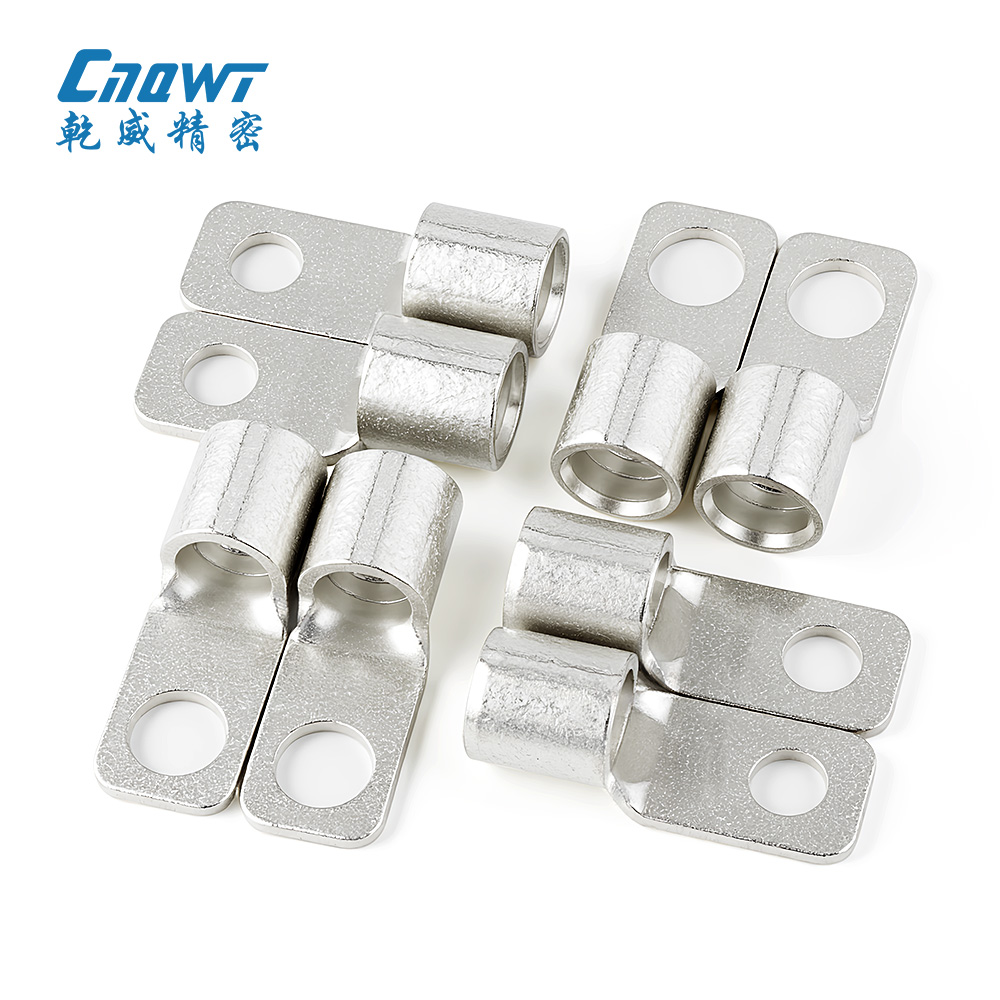
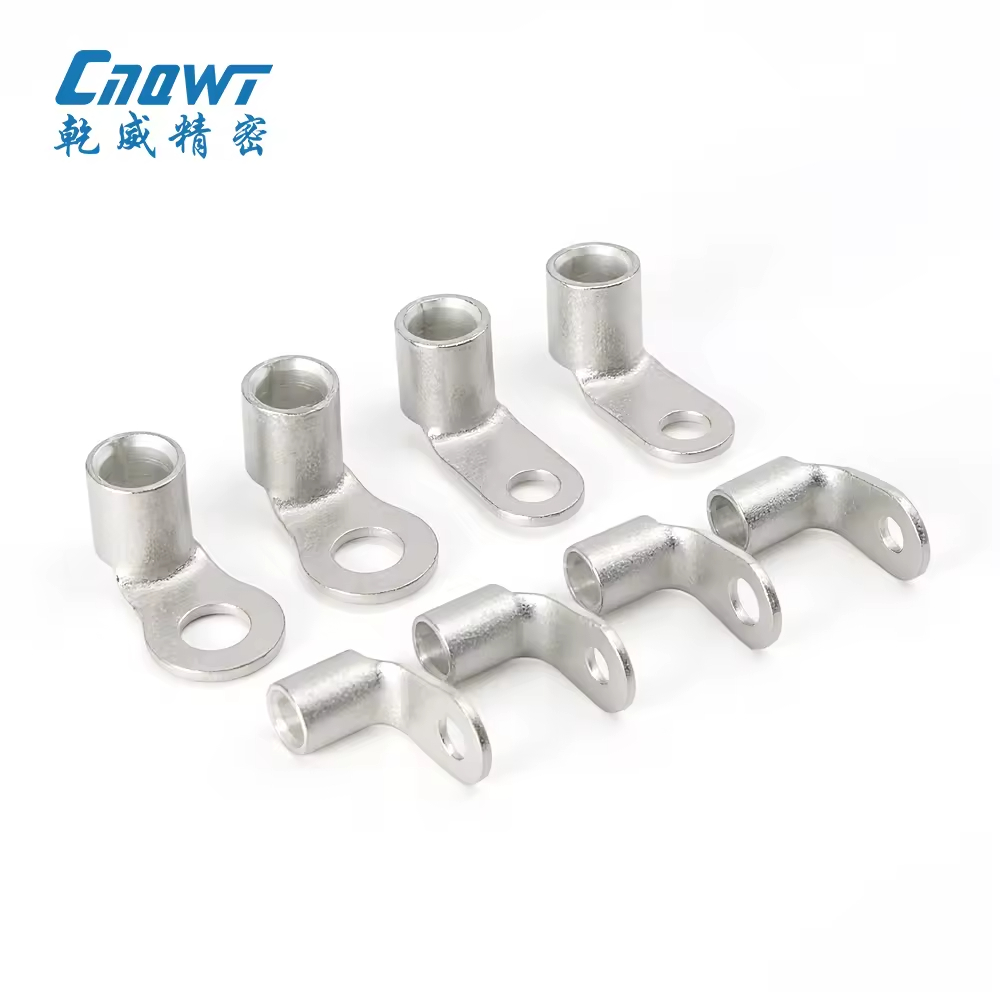
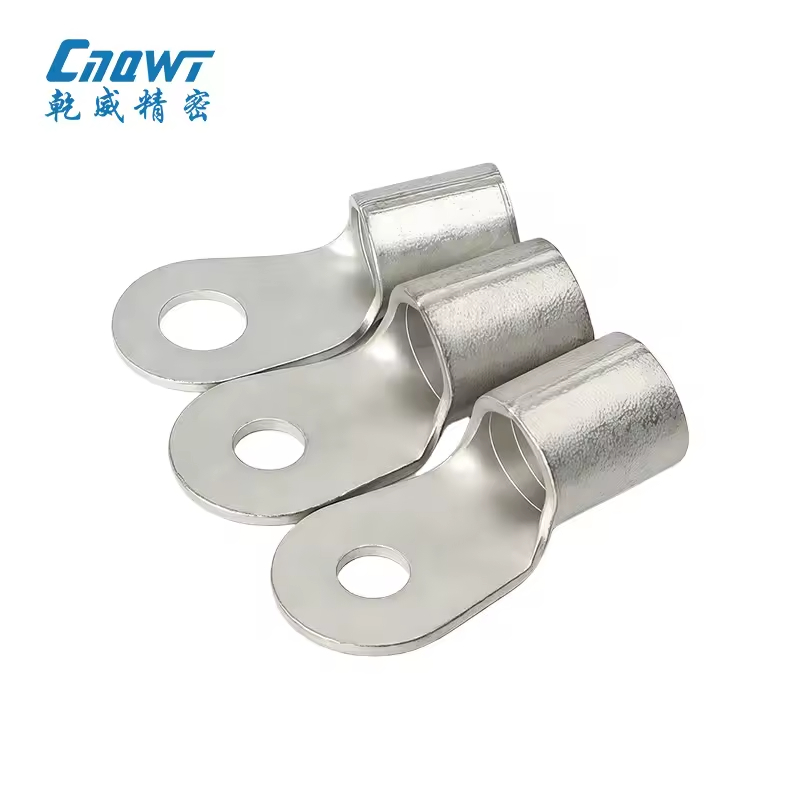
A closed barrel terminal has a tubular or enclosed barrel into which the stripped conductor is inserted.
Instead of folding open wings around the wire, a crimping tool compresses the barrel from the outside. The resulting deformation locks the conductor inside the terminal and creates a reliable electrical and mechanical connection.
Common closed barrel designs include:
- Ring terminals
- Fork or spade terminals
- Pin terminals
- Butt connectors
- Cable lugs
- Heavy-duty power terminals
How Closed Barrel Terminals Work
The wire is first stripped to the specified length and inserted into the terminal barrel. A suitable crimping tool then compresses the barrel around the conductor.
The finished crimp should hold the conductor securely while maintaining a stable electrical path.
Closed barrel terminals are often preferred when mechanical strength, cable termination, and power distribution are important considerations.
Common Applications
Closed barrel terminals are widely used in:
- Electrical control cabinets
- Industrial equipment
- Power distribution systems
- Battery connections
- Motor wiring
- Automotive power circuits
- Electrical panels
- Heavy-duty cable assemblies
They are particularly useful for applications where the terminal must provide a robust connection to a larger wire or cable.
Open Barrel vs Closed Barrel Terminals: Key Differences
Although both terminal types perform the same basic function, their structures and manufacturing processes are quite different.
Structural Difference
The most obvious difference is the barrel design.
An open barrel terminal uses metal wings that remain open before crimping. The wire is placed between these wings, which are then folded or compressed around the conductor.
A closed barrel terminal has an enclosed tubular section. The wire is inserted into the barrel before the barrel is compressed.
This structural difference affects the required crimping tooling, terminal size, and typical applications.
Crimping Difference
Open barrel terminals typically require dedicated crimping dies or applicators designed to form the wings correctly.
They are particularly suitable for automated wire processing equipment used in high-volume production.
Closed barrel terminals can often be crimped using hand crimpers, pneumatic tools, hydraulic crimpers, or other application-specific equipment.
The correct tooling is important for both designs. A terminal that is improperly crimped can have excessive contact resistance, insufficient pull-out strength, or unreliable long-term performance.
Wire Size Compatibility
Both terminal types are available for different wire sizes, so wire gauge alone should not determine which design to use.
However, open barrel terminals are particularly common for smaller wires used in compact connectors and automotive harnesses.
Closed barrel terminals are available in a much wider range of sizes, including terminals designed for relatively large cables and high-current applications.
Always check the manufacturer’s specified wire range rather than assuming that two terminals with similar dimensions can accommodate the same conductor.
Mechanical Strength
Mechanical strength depends on the terminal material, terminal geometry, conductor size, crimp dimensions, and crimping process.
A properly crimped open barrel terminal can provide excellent conductor retention and vibration resistance.
Closed barrel terminals can also provide high mechanical strength, particularly when used with larger conductors and properly matched crimping tools.
Therefore, the terminal design itself does not automatically determine which type is stronger. The complete crimp system matters.
Electrical Performance
Both designs can provide reliable electrical performance when correctly specified and crimped.
Important parameters include:
- Contact resistance
- Current-carrying capacity
- Voltage drop
- Temperature rise
- Conductor retention
- Material conductivity
- Plating quality
For high-current applications, terminal material, cross-sectional area, contact interface, and heat dissipation become particularly important.
Production Efficiency
Open barrel terminals have a major advantage in automated wire harness manufacturing.
They can be fed through applicators and processed at high speed, making them suitable for large-scale automotive and electronics production.
Closed barrel terminals are also compatible with automated equipment, but many common closed barrel terminals are used in applications where manual or semi-automatic assembly is acceptable.
For high-volume harness production, open barrel designs are often the more efficient choice.
Open Barrel vs Closed Barrel: Quick Comparison
| Feature | Open Barrel Terminal | Closed Barrel Terminal |
|---|---|---|
| Barrel design | Open crimping wings | Enclosed barrel |
| Crimping method | Wing crimp | Barrel compression |
| Typical applications | Wire harnesses, connectors | Power and industrial wiring |
| Automotive use | Very common | Common |
| High-volume production | Excellent | Good |
| Automated crimping | Excellent | Available depending on design |
| Compact connector systems | Excellent | More limited |
| Large cable applications | Available, but less typical | Very common |
| Common tools | Applicators, automatic crimpers | Hand, pneumatic, hydraulic tools |
| Typical products | Automotive terminals, connector terminals | Ring terminals, cable lugs, butt connectors |
The comparison shows that neither design is universally better. Each is optimized for different connection requirements.
Advantages and Disadvantages of Open Barrel Terminals
Advantages
Excellent for Automated Crimping
Open barrel terminals are widely used in automated wire processing because they can be supplied on carrier strips and processed efficiently.
Compact Design
Their structure allows manufacturers to develop compact connector systems where space is limited.
Suitable for Wire Harnesses
Open barrel terminals are a common choice for automotive and electronic wire harnesses because they combine electrical connection, conductor retention, and insulation support.
High Production Efficiency
For manufacturers producing thousands or millions of wire connections, automated open barrel crimping can significantly improve production consistency.
Disadvantages
Open barrel terminals can require more specialized tooling and careful setup.
The crimp geometry must be controlled accurately. If the wings are not formed correctly, the conductor may not be adequately secured.
For low-volume applications, the tooling requirements may also make them less convenient than simple closed barrel terminals.
Advantages and Disadvantages of Closed Barrel Terminals
Advantages
Robust Construction
The enclosed barrel provides a strong structure for securing the conductor.
Wide Range of Applications
Closed barrel terminals are available for everything from small electrical wires to large power cables.
Suitable for Power Connections
Ring terminals, cable lugs, and similar closed barrel products are widely used in batteries, electrical panels, power systems, and industrial equipment.
Flexible Crimping Options
Depending on the terminal design, closed barrel terminals can be installed using manual, pneumatic, or hydraulic crimping tools.
Disadvantages
Closed barrel terminals can require more installation space than compact open barrel designs.
They may also be less suitable for certain high-density connector systems where terminal size and connector packaging are critical.
Open Barrel vs Closed Barrel: Which Is Better?
There is no universal answer.
The better terminal is the one that matches the electrical, mechanical, environmental, and manufacturing requirements of the application.
Choose Open Barrel Terminals When:
- You are manufacturing automotive wiring harnesses.
- You need compact connector terminals.
- You are producing large quantities of wire harnesses.
- Automated crimping is required.
- Space inside the connector is limited.
- You are working with small or medium wire sizes.
- Consistent high-speed production is important.
Choose Closed Barrel Terminals When:
- You are making power connections.
- You are working with battery cables.
- You are wiring electrical panels or control cabinets.
- Larger conductors are required.
- A robust cable termination is needed.
- Manual or hydraulic crimping is acceptable.
- The application requires ring, fork, pin, or cable lug configurations.
The most important point is to select the terminal based on the complete application rather than simply choosing the terminal that appears mechanically stronger.
Open Barrel vs Closed Barrel Crimping: What Matters?
Regardless of terminal design, crimp quality is critical.
Correct Wire Stripping
The insulation should be removed to the correct length without cutting or damaging the conductor strands.
Too much exposed conductor can create a safety or insulation problem, while insufficient stripping can prevent the conductor from reaching the correct crimp area.
Correct Crimp Height
Crimp height is an important quality parameter.
If the crimp is too loose, the conductor may move inside the terminal and electrical resistance may increase.
If the crimp is too tight, the conductor strands can be damaged and the terminal may be unnecessarily deformed.
Conductor Crimp Quality
The conductor must be properly captured by the terminal.
A good crimp should provide both electrical conductivity and mechanical retention without excessive deformation.
Insulation Crimp Quality
For terminals with an insulation crimp section, the insulation should be held securely without being excessively compressed.
The goal is to provide strain relief and reduce mechanical stress on the conductor crimp.
Pull Force Testing
Pull force testing is commonly used to evaluate crimp quality.
The required pull-out force depends on the terminal design, conductor size, material, and applicable specifications.
For high-volume production, regular crimp inspection and pull-force testing can help identify process problems before they affect finished wire harnesses.
Common Problems With Open and Closed Barrel Terminals
Several crimping problems can occur with either terminal design.
Loose Crimp
A loose crimp can result in poor conductor retention and increased electrical resistance.
Common causes include incorrect tooling, unsuitable terminal size, incorrect crimp height, or an improperly prepared conductor.
Over-Crimping
Excessive compression can damage conductor strands or deform the terminal beyond its intended geometry.
This may negatively affect both mechanical and electrical performance.
Under-Crimping
An under-crimped terminal may allow the wire to move or pull out from the terminal.
This is especially concerning in applications exposed to vibration or repeated mechanical stress.
Incorrect Terminal and Wire Size
Using a terminal outside its specified wire range can compromise the connection.
Always match the terminal specification with the actual conductor cross-sectional area and application requirements.
How to Choose the Right Terminal for Your Application
When selecting between open barrel and closed barrel terminals, consider at least six factors.
Wire Size
Determine the conductor size first and select a terminal designed for that specific range.
Current and Voltage
The terminal must be capable of handling the required electrical load without excessive temperature rise or voltage drop.
Connector Design
For compact multi-position connectors, open barrel terminals may provide a better solution because of their compact geometry.
Mechanical and Vibration Requirements
Automotive and industrial environments can expose connections to vibration, thermal cycling, and mechanical stress.
Production Volume
High-volume manufacturing often favors terminals designed for automated crimping.
Crimping Equipment
Make sure the selected terminal is compatible with your existing tooling or production equipment.
Open Barrel vs Closed Barrel for Automotive Applications
Open barrel terminals are particularly common in automotive wiring harnesses.
Modern vehicles contain large numbers of electrical connections, and manufacturers need terminals that can fit inside compact connectors while supporting automated high-volume production.
Open barrel terminals can provide a practical combination of:
- Compact dimensions
- Reliable conductor retention
- Insulation support
- Automated processing
- Consistent crimp quality
They are therefore widely used in automotive connector systems and wire harness assemblies.
However, closed barrel terminals are also used in vehicles, particularly in battery connections, power distribution, grounding, and applications requiring larger cable sizes.
The appropriate choice depends on the specific electrical and mechanical requirements of the vehicle system.
Open Barrel vs Closed Barrel for Industrial Applications
Industrial applications cover a much wider range of electrical requirements.
Control cabinets, automation equipment, motors, power supplies, and machinery may use different terminal designs depending on the voltage, current, conductor size, and installation method.
Closed barrel terminals are frequently selected for power and industrial wiring because they can accommodate larger conductors and provide robust cable termination.
Open barrel terminals can still be useful for control signals, compact connectors, sensors, and internal equipment wiring.
For industrial applications, terminal selection should therefore start with the electrical and mechanical requirements rather than the terminal category alone.
How to Select an Open Barrel or Closed Barrel Terminal Manufacturer
For OEMs, distributors, and wire harness manufacturers, choosing the right terminal supplier is just as important as choosing the terminal design.
A reliable terminal manufacturer should have capabilities in:
- Precision metal stamping
- Terminal mold and tooling development
- Material selection
- Surface plating
- Dimensional inspection
- Crimp performance testing
- Pull-force testing
- Electrical testing
- High-volume production
- Custom terminal development
For custom applications, the manufacturer should also be able to work from drawings, samples, or specific application requirements.
Qianwei Precision provides electrical terminal manufacturing services covering precision stamping, tooling, injection molding, plating, inspection, and assembly. With in-house manufacturing capabilities, the company can support both standard terminal production and customized terminal development for different wire and connector applications.
For customers developing automotive, industrial, appliance, communication, or other electrical products, working directly with a manufacturer can also simplify communication between terminal design, tooling, production, and quality control.
Conclusion: Choosing the Right Terminal Design
Open barrel and closed barrel terminals are both reliable solutions when they are correctly designed, specified, and crimped.
Open barrel terminals are particularly suitable for compact connectors, automotive wiring harnesses, electronic equipment, and high-volume automated production.
Closed barrel terminals are commonly used for power connections, batteries, industrial wiring, electrical panels, and larger cable applications.
The right choice ultimately depends on several factors, including wire size, current capacity, connector dimensions, mechanical requirements, operating environment, production volume, and crimping equipment.
Instead of asking which terminal is universally better, ask which terminal is better suited to your application.
If you are unsure whether an open barrel or closed barrel terminal is right for your project, a qualified terminal manufacturer can help evaluate the wire size, application requirements, crimping method, and production conditions.
Qianwei Precision can provide customized electrical terminal solutions based on your drawings, samples, wire specifications, and application requirements. Contact our team to discuss your terminal requirements and request a suitable solution.
FAQs
What is the difference between an open barrel and closed barrel terminal?
An open barrel terminal uses open metal wings that are crimped around the conductor, while a closed barrel terminal uses an enclosed tubular section that is compressed around the inserted conductor.
Are open barrel terminals better than closed barrel terminals?
Neither is universally better. Open barrel terminals are often better for compact connectors, automotive wiring harnesses, and automated production, while closed barrel terminals are commonly preferred for power, industrial, and larger cable applications.
Can open barrel terminals be used for automotive wiring?
Yes. Open barrel terminals are widely used in automotive wiring harnesses because they offer compact dimensions, reliable crimping, and good compatibility with automated wire processing.
Are closed barrel terminals suitable for high-current applications?
Yes. Many closed barrel terminals, particularly cable lugs and heavy-duty terminals, are designed for high-current applications. However, the terminal must be selected according to the conductor size, current rating, material, and application requirements.
What type of crimper is used for open barrel terminals?
Open barrel terminals generally require a crimping tool or applicator designed specifically for the terminal’s geometry. Automated applicators are commonly used in high-volume wire harness production.
Can I crimp a closed barrel terminal with a hand tool?
Many closed barrel terminals can be crimped with hand tools, but the correct tool depends on the terminal design and conductor size. Larger cable lugs may require hydraulic or powered crimping equipment.
Which terminal is better for wire harnesses?
Open barrel terminals are often the preferred choice for compact automotive and electronic wire harnesses, particularly when high-volume automated production is required. The final selection should still be based on the connector and application specifications.
Which terminal is better for industrial applications?
It depends on the application. Closed barrel terminals are common for power wiring, batteries, control cabinets, and larger cables, while open barrel terminals can be suitable for compact connectors, control signals, and equipment wiring.
How do I choose the correct terminal size?
Start with the conductor cross-sectional area or AWG size, then check the terminal manufacturer’s specified wire range, current rating, connector requirements, and crimping specifications. The terminal should be matched to the actual wire and application rather than selected based only on physical appearance.

