

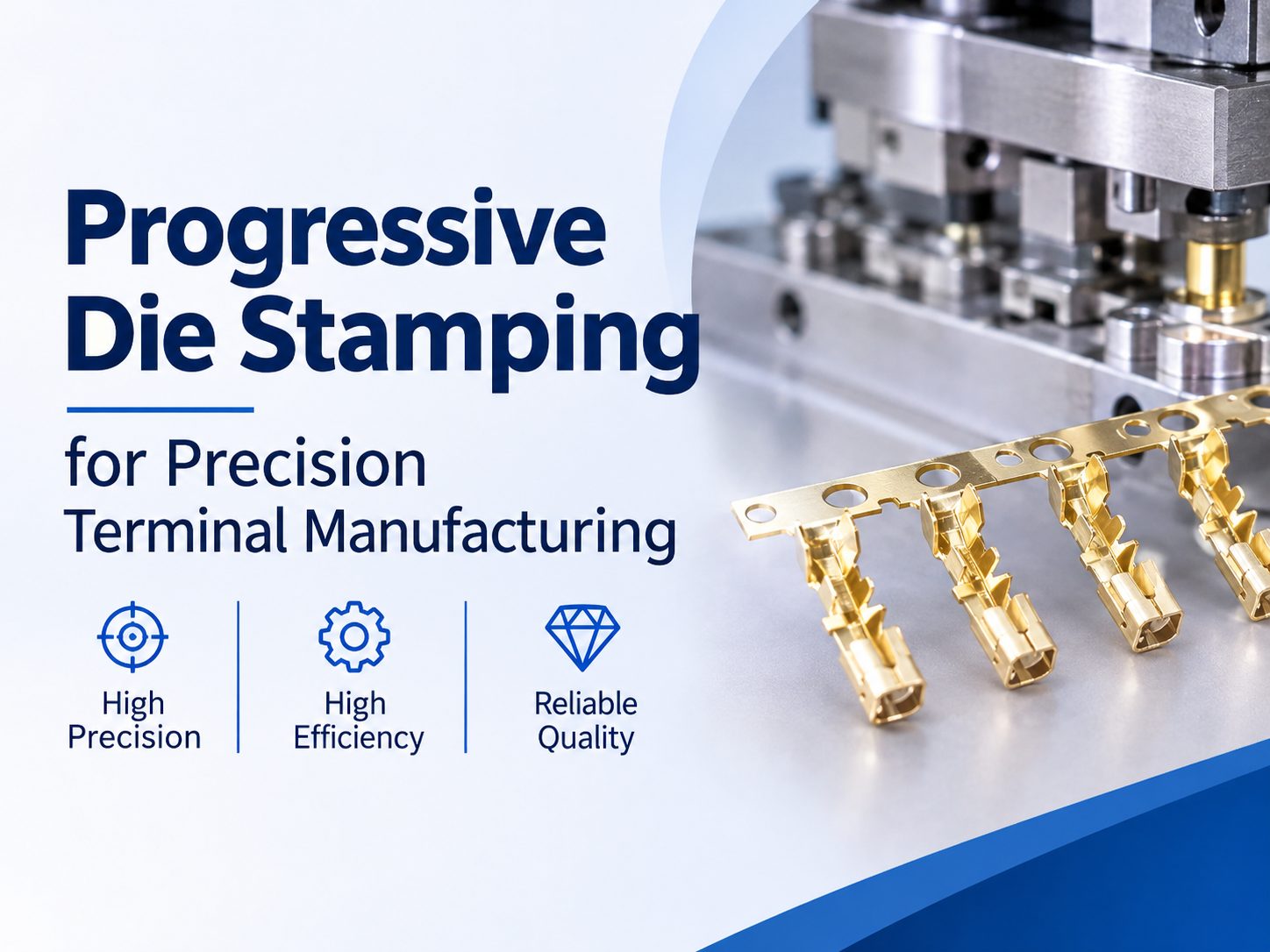
Progressive die stamping is one of the most efficient manufacturing processes for producing high-precision metal components in large quantities. In electrical terminal manufacturing, it enables manufacturers to produce complex metal parts with consistent dimensions, reliable forming quality, and excellent production efficiency.
As electrical systems become more demanding, manufacturers need terminals that meet strict requirements for dimensional accuracy, electrical conductivity, mechanical strength, and long-term reliability. Progressive die stamping helps meet these requirements by integrating multiple forming operations into a continuous production process.
For electrical terminal manufacturers, this technology is particularly valuable when producing copper, brass, and phosphor bronze components for automotive wiring harnesses, industrial electrical equipment, home appliances, and new energy applications.
In this guide, we explore how progressive die stamping works, why it is suitable for precision terminal manufacturing, which materials are commonly used, and what buyers should consider when selecting a stamping manufacturer.
1. What Is Progressive Die Stamping?
Progressive die stamping is a metal forming process in which a metal strip moves through multiple stations within a single stamping die. Each station performs a specific operation, such as punching, piercing, bending, forming, or cutting.
As the strip advances through the die, each station progressively shapes the material until the finished component is produced.
Unlike conventional stamping methods that require separate operations for different features, progressive die stamping combines multiple processes into one continuous production cycle.
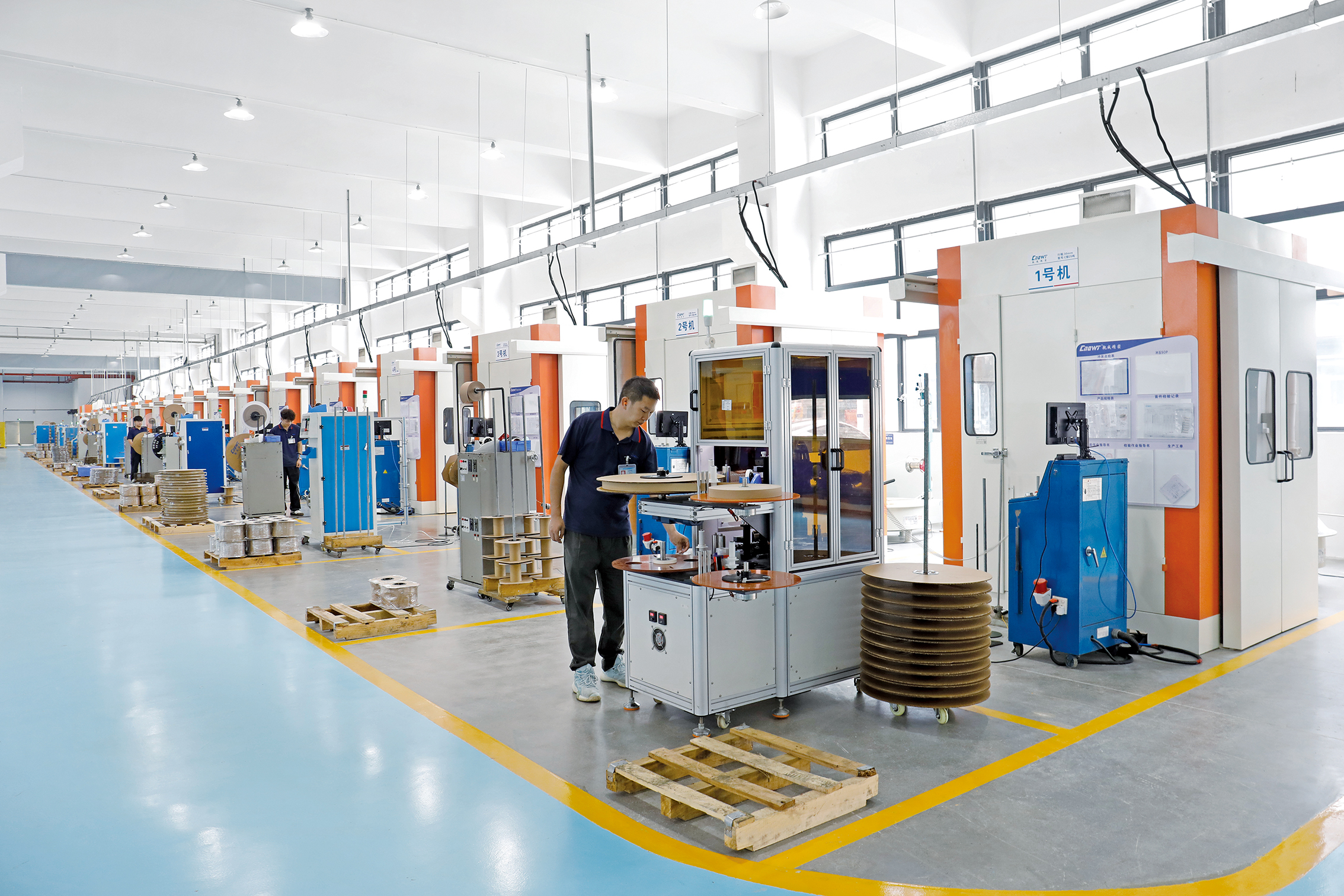
How Does a Progressive Die Work?
The process typically begins with a metal coil mounted on a decoiler. A feeding system moves the metal strip through the stamping die at a controlled distance during each press stroke.
At every station, a specific operation is performed. When the strip reaches the final station, the finished parts are separated from the remaining material.
The main components of a progressive stamping system include:
- Metal Coil: The raw material supplied in continuous strip form.
- Feeding System: Controls the movement and positioning of the metal strip.
- Progressive Die: Contains multiple stations for different stamping operations.
- Stamping Press: Provides the force required to perform the forming operations.
- Scrap Removal System: Removes excess material generated during stamping.
This integrated process allows manufacturers to produce large quantities of metal components with repeatable quality and minimal manual intervention.
2. Why Progressive Die Stamping Is Ideal for Precision Terminal Manufacturing
Electrical terminals often have relatively small dimensions but complex structural features. Their performance depends on accurate geometry, reliable contact areas, and consistent forming quality.
Progressive die stamping provides several advantages for manufacturing these components.
High Dimensional Accuracy and Repeatability
Electrical terminals must meet specific dimensional requirements to ensure proper installation and electrical connections.
Features such as terminal width, hole diameter, contact geometry, and bending angles need to remain consistent throughout production.
A properly designed progressive die helps maintain these dimensions across repeated production cycles, reducing variations between individual parts.
Consistent Terminal Geometry and Contact Performance
For terminals used in automotive wiring harnesses and industrial electrical systems, structural consistency is essential.
Variations in terminal geometry may affect insertion, retention, and connection reliability.
Progressive die stamping allows multiple forming operations to be controlled within one integrated tooling system, helping maintain consistent product geometry.
High Production Efficiency for Large Volumes
Progressive stamping is particularly suitable for mass production.
Because multiple operations are completed within one press cycle, manufacturers can produce large quantities without repeatedly transferring components between separate machines.
This makes the process suitable for electrical terminal orders requiring stable, continuous production.
Improved Material Utilization
Metal strip layout is an important part of progressive die design.
By optimizing the arrangement of components on the strip, manufacturers can reduce unnecessary material waste while maintaining sufficient structural support during stamping.
For copper and other metal materials, improved material utilization can contribute to lower production costs.
Lower Unit Costs in Mass Production
Progressive die stamping usually requires a higher initial investment in tooling compared with simpler stamping methods.
However, once the tooling is developed and production is stable, the process can reduce labor requirements, handling operations, and unit manufacturing costs.
For customers with consistent and relatively high-volume requirements, this can provide significant long-term cost advantages.
3. The Progressive Die Stamping Process for Electrical Terminals
Manufacturing precision electrical terminals requires more than simply running metal through a stamping press. Proper engineering, tooling design, and quality control are necessary at every stage.
Step 1: Material Selection and Coil Preparation
The first step is selecting a suitable metal according to the terminal’s electrical and mechanical requirements.
Common materials include copper, brass, and phosphor bronze.
The material is supplied in coil form, with its thickness, width, mechanical properties, and surface condition checked before production.
Step 2: Strip Layout and Engineering Design
Engineers develop a strip layout to determine how the metal strip will move through the progressive die.
The layout defines:
- The number and sequence of stamping stations.
- The position of punching and piercing features.
- Bending and forming directions.
- Material feeding distance.
- Part separation methods.
- Material utilization.
A well-designed strip layout helps ensure stable production and efficient use of raw materials.
Step 3: Progressive Die Design and Manufacturing
The progressive die is designed according to the product drawing, material specifications, dimensional tolerances, and production requirements.
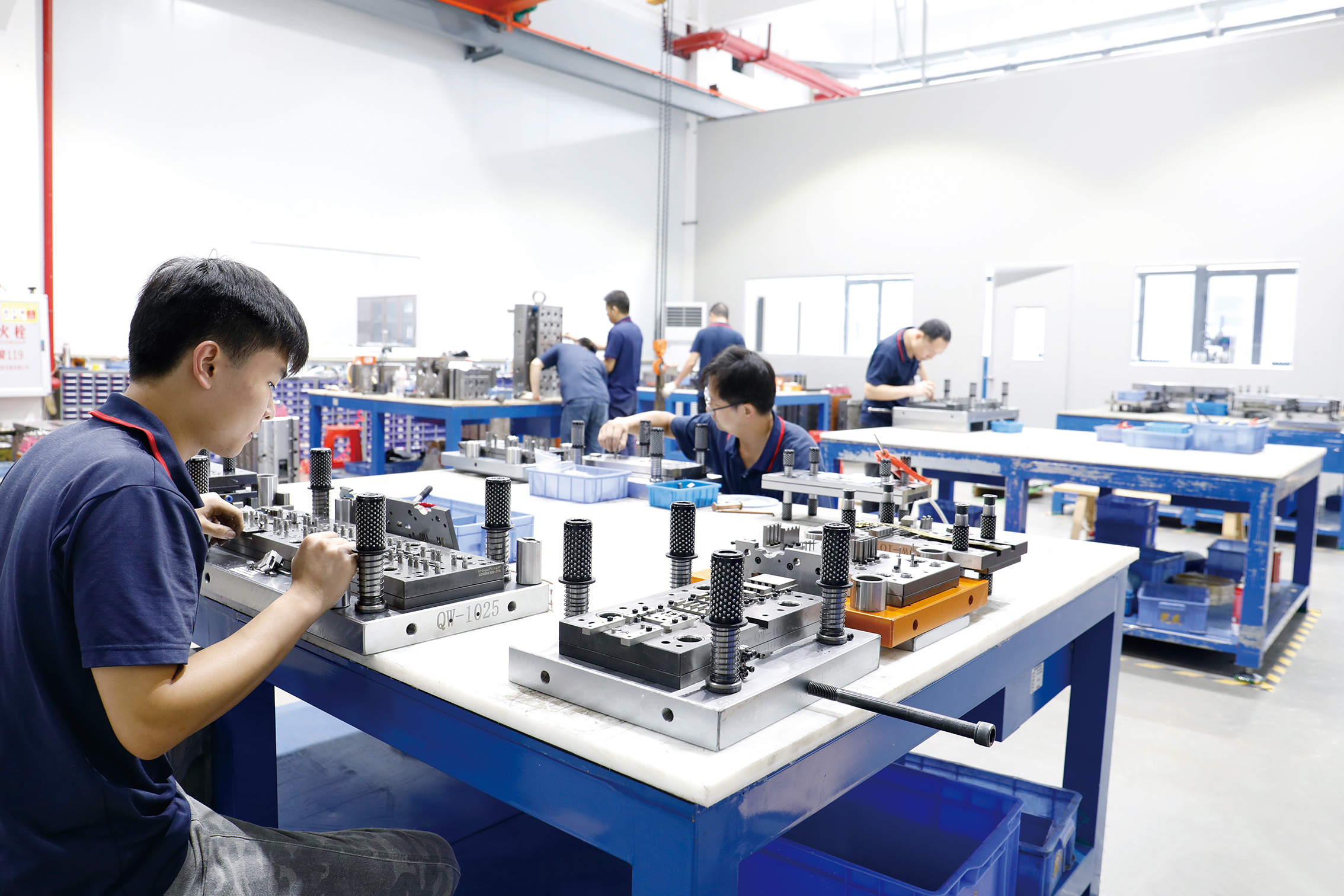
Each station is assigned a specific operation. Tooling components must be accurately manufactured and assembled to maintain alignment and consistent forming results.
For complex electrical terminals, die design is particularly important because even small structural variations may affect the finished product.
Step 4: Punching and Piercing
Punching and piercing operations create the required openings, slots, and external profiles.
These features may be used for mounting, electrical connections, positioning, or subsequent forming operations.
The accuracy of these operations directly affects the final terminal geometry.
Step 5: Bending and Forming
The metal strip passes through forming stations where the material is shaped into its required structure.
Depending on the terminal design, operations may include:
- Straight bending.
- Right-angle bending.
- Contact section forming.
- Curved profile forming.
- Structural reinforcement.
Springback must also be considered during tooling design to help achieve the required final dimensions.
Step 6: Cutting and Part Separation
At the final stage, completed terminals are separated from the metal strip according to the product design.
Some terminals can be supplied individually, while others may remain connected in continuous strip form for automated assembly applications.
For terminals supplied on reels, maintaining consistent strip pitch and carrier structure is particularly important.
Step 7: Inspection and Quality Control
Finished terminals undergo inspection according to their technical specifications.
Typical inspection items include dimensional accuracy, burr condition, forming quality, surface appearance, and other application-specific requirements.
This ensures that products meet the agreed quality standards before shipment.
4. Materials Used in Progressive Die Stamping for Electrical Terminals
Material selection has a direct influence on terminal performance and stamping manufacturability.
Different applications require different combinations of electrical conductivity, mechanical strength, formability, and corrosion resistance.
Copper
Copper offers excellent electrical conductivity and is commonly used in electrical components that require efficient current transmission.
It is particularly suitable for high-current electrical terminals and other conductive components.
Brass
Brass provides a practical balance of electrical conductivity, mechanical strength, and formability.
Its processing characteristics make it suitable for many general-purpose electrical terminals and stamped metal components.
Phosphor Bronze
Phosphor bronze offers good spring properties, fatigue resistance, and mechanical stability.
It is commonly used in terminal designs where contact pressure and elastic recovery are important.
Other Material Selection Considerations
Beyond material type, several additional factors should be evaluated:
- Material Thickness: Influences forming behavior, strength, and final dimensions.
- Mechanical Properties: Affect bending, deformation, and springback.
- Surface Treatment: Tin or nickel plating may be required depending on electrical and environmental conditions.
- Application Requirements: Operating temperature, current load, corrosion exposure, and contact performance should all be considered.
The appropriate material should always be selected according to the terminal’s actual working conditions and engineering specifications.
5. Progressive Die Stamping vs. Other Metal Stamping Methods
Progressive die stamping is not the only method available for producing precision metal components. Depending on product complexity, production volume, and tooling requirements, other stamping processes may also be suitable.
Progressive Die Stamping vs. Single-Stage Stamping
Single-stage stamping performs a specific operation during each press cycle.
When a component requires several operations, additional processing or handling may be necessary.
Progressive die stamping combines multiple operations into one continuous process, making it more suitable for complex parts requiring high-volume production.
Progressive Die Stamping vs. Transfer Die Stamping
Both methods use multiple stations to complete a series of forming operations.
However, progressive stamping generally keeps the component connected to the metal strip as it moves between stations.
Transfer stamping uses a mechanical transfer system to move individual workpieces from one station to another.
Progressive stamping is often suitable for smaller strip-fed components, while transfer stamping may be advantageous for larger or more complex parts requiring independent workpiece positioning.
Progressive Die Stamping vs. Compound Die Stamping
Compound dies perform multiple cutting operations within a single press stroke at one station.
Progressive dies distribute different operations across multiple stations.
The appropriate choice depends on the component’s geometry, forming requirements, production volume, and tooling economics.
| Comparison | Progressive Die Stamping | Single-Stage Stamping |
|---|---|---|
| Production Method | Multiple sequential stations | Individual operations |
| Production Efficiency | High for continuous production | Depends on the number of operations |
| Automation | Highly suitable | Varies by process |
| Tooling Investment | Generally higher | Generally lower |
| Mass Production | Excellent | Less efficient for complex multi-step parts |
| Unit Cost | Competitive at higher volumes | May increase with additional operations |
There is no universal solution for every component. A manufacturing assessment should consider product design, annual demand, material, and total production cost.
6. Key Design Considerations for Precision Terminal Stamping
A successful progressive die stamping project begins with a well-engineered product design.
For electrical terminals, design decisions affect not only manufacturability but also electrical and mechanical performance.

Terminal Geometry and Structural Design
Terminal geometry determines how the component fits into its intended assembly.
Important features may include contact areas, mounting holes, connection sections, locking structures, and bending profiles.
These features must be carefully evaluated during the tooling design stage.
Material Thickness and Dimensional Tolerances
Material thickness affects the final geometry, bending behavior, and mechanical properties of the terminal.
Engineers should establish realistic dimensional tolerances based on the material characteristics, stamping process, and functional requirements.
Bend Radius and Forming Requirements
Bend radius influences material deformation during forming.
An unsuitable bend design may increase the risk of cracking, excessive deformation, or dimensional inconsistency.
Proper consideration of material properties and forming conditions helps improve production stability.
Burr Control and Edge Quality
Burrs may affect terminal assembly, electrical contact, and operator safety.
Punching clearance, cutting conditions, tooling condition, and material properties all influence burr formation.
Regular tooling maintenance and appropriate inspection procedures are essential.
Springback and Forming Accuracy
Metal materials may partially recover after bending because of their elastic properties.
This phenomenon, known as springback, can affect final bending angles and dimensions.
Progressive die design should account for material behavior and appropriate compensation measures.
Strip Layout and Material Utilization
An optimized strip layout helps balance material efficiency, part stability, and production performance.
The spacing between components, carrier design, and feeding structure must be considered together.
Early engineering evaluation can help avoid unnecessary tooling modifications and production difficulties.
7. Quality Control in Progressive Die Stamping
Precision terminal manufacturing requires consistent quality throughout production, rather than relying only on final inspection.
An effective quality control system should cover incoming materials, tooling conditions, production parameters, and finished components.
Dimensional Inspection
Critical product dimensions should be checked against approved engineering drawings.
Depending on the component, inspection tools may include calipers, micrometers, optical measuring systems, and projectors.
Burr Height and Edge Quality Inspection
Burrs and sharp edges should be evaluated according to the product’s specifications.
Excessive burr formation may indicate tooling wear, incorrect clearance, or other process issues.
Material Thickness Verification
Incoming material thickness should be verified to ensure consistency with the approved material specifications.
Material variations may affect forming results and final terminal dimensions.
Plating and Surface Finish Inspection
Surface treatment is important for electrical terminals that require corrosion resistance, solderability, or specific contact characteristics.
Depending on the application, inspection may include plating appearance, coating thickness, and surface condition.
Tooling Maintenance and Production Monitoring
Progressive dies operate through repeated mechanical cycles.
Regular inspection and maintenance of punches, dies, guides, and other critical components help prevent unexpected production interruptions and quality variations.
Batch Consistency and Traceability
Production records and inspection data help manufacturers monitor product consistency across different batches.
For automotive and industrial customers, traceability and documented quality procedures may also be important supplier requirements.
8. Applications of Progressive Die Stamped Electrical Terminals
Progressive die stamping supports the production of various electrical terminal designs used in different industries.
Automotive and Wire Harness Industry
Automotive wiring harnesses contain numerous electrical terminals used to connect wires, sensors, control units, and electrical systems.
Progressive stamping is suitable for producing:
- Automotive wire terminals.
- Ring and spade terminals.
- Connector contact terminals.
- Custom stamped harness terminals.
- Terminals supplied in continuous strips or on reels.
Dimensional consistency and mechanical retention characteristics are particularly important for these applications.
New Energy and EV Charging
Electric vehicles and charging systems require reliable electrical connections for power transmission and control.
Stamped copper components and precision terminals may be used in charging assemblies, battery-related electrical systems, and other power connection applications.
Material selection and terminal geometry should be matched to the required current-carrying capacity and operating environment.
Industrial Electrical Equipment
Industrial electrical equipment relies on metal terminals for internal wiring, control circuits, and power distribution.
Progressive die stamping can support the production of custom electrical terminals with specific dimensions and structural requirements.
Home Appliances and HVAC Systems
Air conditioners, refrigerators, motors, and other household appliances use electrical terminals for internal connections.
Manufacturers often require terminals that combine consistent dimensions, stable electrical connections, and cost-effective mass production.
Progressive die stamping is a practical solution for many of these applications.
9. Why Choose Qianwei Precision for Progressive Die Stamped Terminals?
Selecting the right manufacturing partner is essential for achieving stable quality, reliable production, and long-term cost efficiency.
Qianwei Precision specializes in electrical terminal manufacturing and precision metal stamping, providing customized manufacturing solutions for customers across automotive, industrial electrical, home appliance, and other application markets.
Established in 2012, Qianwei Precision operates a manufacturing facility covering approximately 15,000 square meters in Dongguan, Guangdong, China.
Its manufacturing capabilities include high-speed stamping, plastic injection molding, mold manufacturing, and cable assembly.
In-House Progressive Die Design and Manufacturing
Qianwei has an in-house mold manufacturing capability and an automated mold processing center.
With more than 1,800 stamping and injection molds for mass production, the company has accumulated experience in tooling development and precision component manufacturing.
Custom tooling can be developed according to customer drawings, samples, material specifications, and production requirements.
Precision Metal Stamping and Automated Production
High-speed stamping equipment supports continuous production of metal terminals and stamped components.
Integrated tooling and production capabilities help maintain manufacturing consistency and support customers with ongoing volume requirements.
Multiple Material Options
Qianwei works with several commonly used conductive materials, including:
- Copper.
- Brass.
- Phosphor bronze.
Material selection is evaluated according to product structure, electrical requirements, mechanical performance, and customer specifications.
Custom Electrical Terminal Manufacturing
Different applications require different terminal structures and technical specifications.
Qianwei supports OEM and customized electrical terminal manufacturing, including:
- Custom stamped electrical terminals.
- Automotive terminals.
- Ring and spade terminals.
- Terminals on Reel.
- Copper electrical terminals.
- High-current electrical components.
Customers can provide drawings, samples, or technical requirements for manufacturing evaluation.
Quality Management and Certifications
Qianwei’s quality management systems include ISO 9001, ISO 13485, and IATF 16949 certifications.
The company also maintains relevant product and environmental compliance qualifications, including UL, CQC, RoHS, and REACH, depending on the applicable products and requirements.
For customers seeking a long-term electrical terminal manufacturing partner, engineering support, production capabilities, and quality management are important factors in supplier evaluation.
10. How to Start a Custom Progressive Die Stamping Project
If you are planning to develop a custom electrical terminal, providing complete technical information can help the manufacturer evaluate the project more efficiently.
Before requesting a quotation, prepare the following information:
1. Product Drawings or 3D CAD Files
Provide 2D engineering drawings or 3D models showing the terminal geometry and critical dimensions.
2. Material Specifications and Thickness
Identify the required material, such as copper, brass, or phosphor bronze, along with the specified thickness.
3. Dimensional Tolerances
Highlight critical dimensions and functional tolerances that must be maintained during production.
4. Surface Treatment Requirements
Specify whether the product requires tin plating, nickel plating, or another surface treatment.
5. Estimated Production Volume
Provide your expected monthly or annual demand. Production volume is an important factor when evaluating progressive die tooling investment and manufacturing costs.
6. Application and Performance Requirements
Explain how the terminal will be used, including electrical, mechanical, environmental, and assembly requirements.
With this information, the manufacturer can evaluate product manufacturability, tooling requirements, production methods, and estimated costs.
Conclusion: Finding the Right Progressive Die Stamping Partner
Progressive die stamping plays an important role in modern precision terminal manufacturing. By combining multiple stamping operations into one continuous process, it helps manufacturers achieve consistent product dimensions, efficient production, and competitive unit costs for high-volume applications.
However, successful production depends on more than stamping equipment. Proper material selection, tooling engineering, process control, and quality inspection are equally important.
If you are looking for a reliable manufacturer for custom electrical terminals or precision stamped metal components, Qianwei Precision can evaluate your drawings, samples, and technical requirements to support your project from tooling development to mass production.
Contact Qianwei Precision today to discuss your custom electrical terminal manufacturing requirements.
11. FAQs
Q1: What is progressive die stamping used for?
Progressive die stamping is used to manufacture metal components through multiple operations performed in a continuous stamping process. It is widely applied to precision electrical terminals, automotive components, and other metal parts requiring consistent quality and high production volumes.
Q2: What types of electrical terminals can be manufactured using progressive die stamping?
Depending on their design and structural requirements, progressive stamping can produce ring terminals, spade terminals, flag terminals, automotive terminals, and various custom stamped electrical terminals.
Q3: What materials are suitable for progressive die stamping?
Copper, brass, and phosphor bronze are commonly used in electrical terminal manufacturing. The appropriate material depends on conductivity, mechanical strength, formability, and the intended application.
Q4: Is progressive die stamping suitable for small production runs?
It can be used for smaller production quantities, but the initial tooling investment may make it less economical. For low-volume projects, manufacturers should compare tooling costs, production requirements, and expected future demand before selecting a process.
Q5: How accurate is progressive die stamping?
Accuracy depends on material properties, tooling design, press conditions, product geometry, and inspection standards. Critical dimensions and tolerances should be evaluated during the engineering and tooling development stages.
Q6: What is the difference between progressive die stamping and transfer stamping?
Progressive stamping generally moves the metal strip through multiple stations while keeping the parts connected to the strip. Transfer stamping moves individual workpieces between stations using a transfer mechanism. The appropriate method depends on component size, geometry, and production requirements.
Q7: Can progressive die stamping be used for custom electrical terminals?
Yes. Progressive die stamping is widely used for customized electrical terminals. Manufacturers can develop tooling based on customer drawings, samples, material specifications, and production requirements.
Q8: What information is needed to get a progressive die stamping quote?
Customers should provide product drawings or samples, material type, thickness, dimensional tolerances, surface treatment requirements, and estimated order quantities. Application details are also helpful for evaluating the appropriate manufacturing process.

