

Introduction
Electrical terminals are essential components in modern electrical and electronic systems. From automotive wiring harnesses and industrial machinery to renewable energy systems and consumer electronics, terminals provide the electrical connection points that enable stable power and signal transmission.
Although electrical terminals may appear simple, manufacturing high-quality terminals requires advanced engineering, precision tooling, automated production systems, and strict quality control.
The manufacturing process directly affects:
- Electrical conductivity
- Crimp reliability
- Corrosion resistance
- Mechanical strength
- Product lifespan
- Safety performance
As industries move toward higher power density, miniaturization, and automation, terminal manufacturing has become increasingly sophisticated.
This article explains the complete electrical terminal manufacturing process, including:
- Raw material selection
- Precision metal stamping
- Surface plating
- Insulation molding
- Quality inspection
- Reliability testing
What Are Electrical Terminals?
Electrical terminals are conductive connectors used to join wires, cables, or electrical devices together.
They help ensure:
- Stable electrical transmission
- Secure mechanical connection
- Safe operation of electrical systems
Electrical terminals are widely used in:
- Automotive wiring harnesses
- Power distribution systems
- Industrial equipment
- Consumer electronics
- Renewable energy systems
Common Types of Electrical Terminals
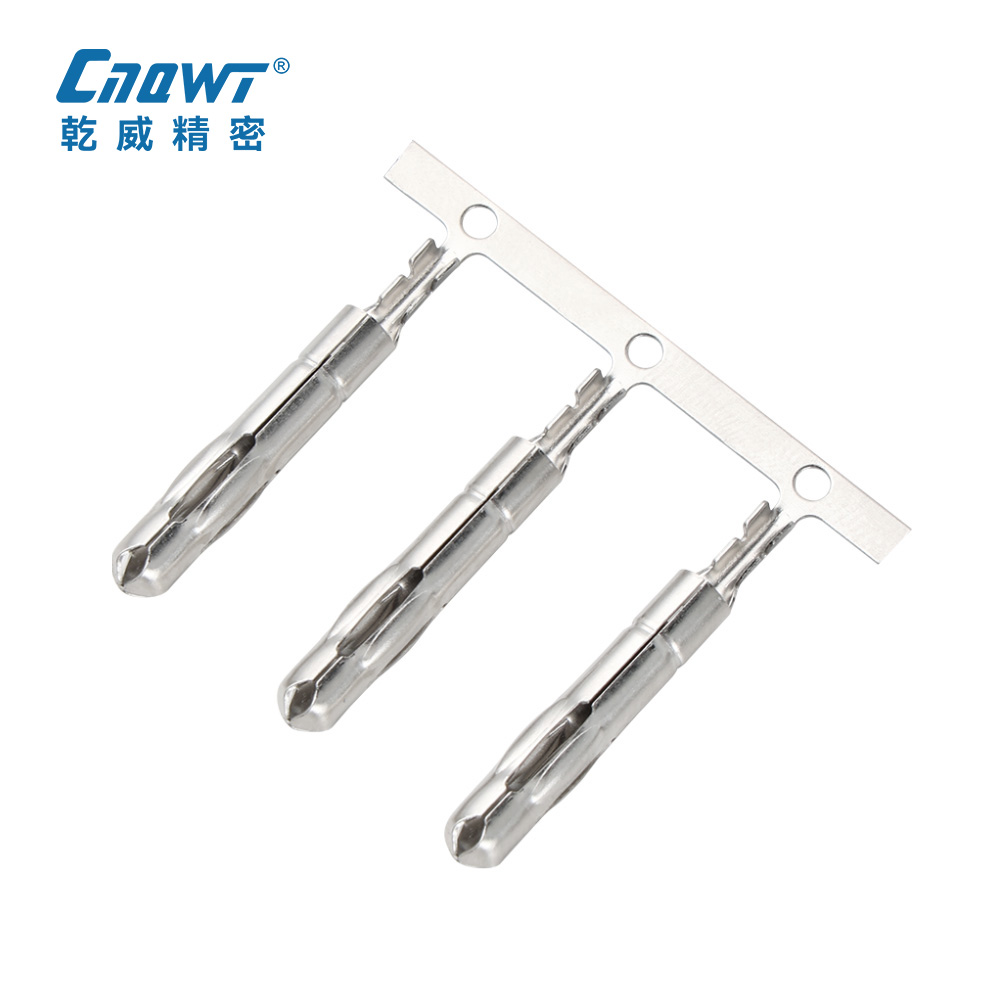
Several terminal types are commonly used in electrical systems.
Ring Terminals
Provide secure screw-mounted electrical connections.
Spade Terminals
Allow quick installation and removal.
Pin Terminals
Used for compact terminal blocks and connectors.
Butt Connectors
Join two wires together end-to-end.
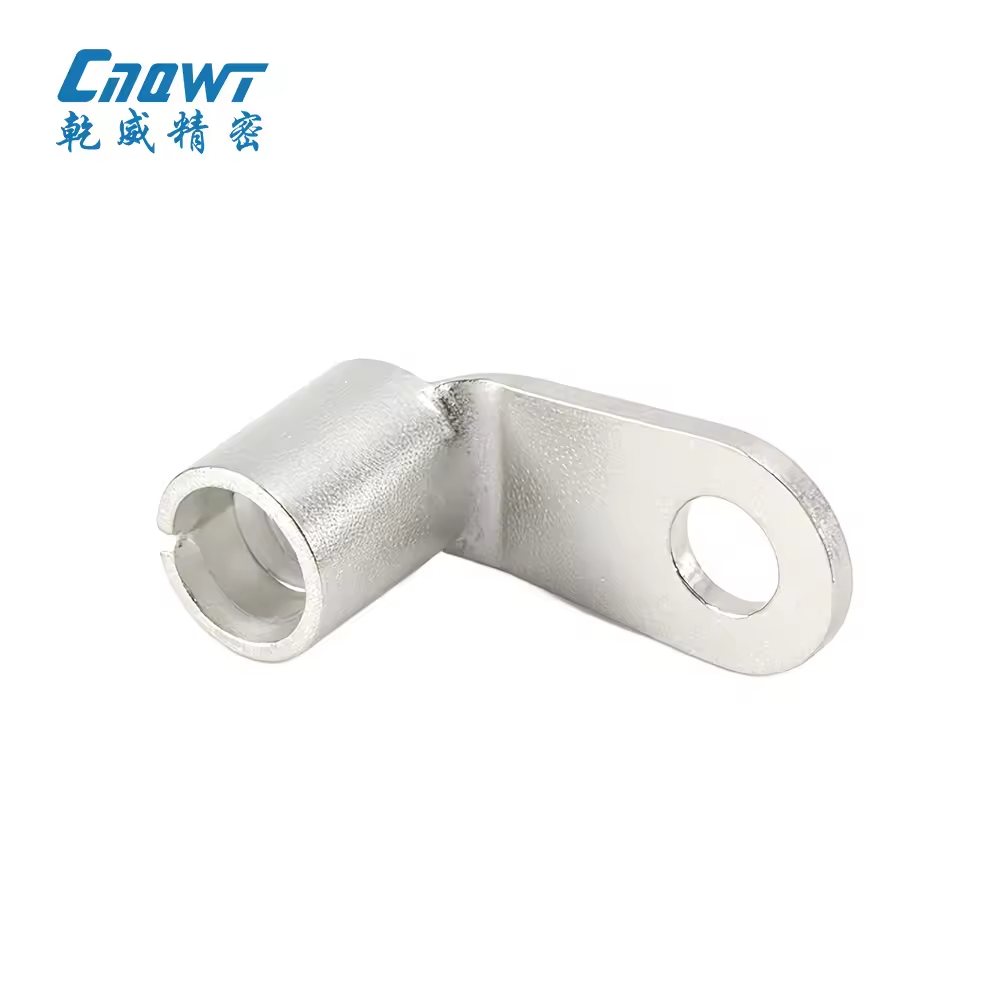
Cable Lugs
Used for high-current power connections.
Different terminal structures require different manufacturing methods and tooling designs.
Overview of the Electrical Terminal Manufacturing Process
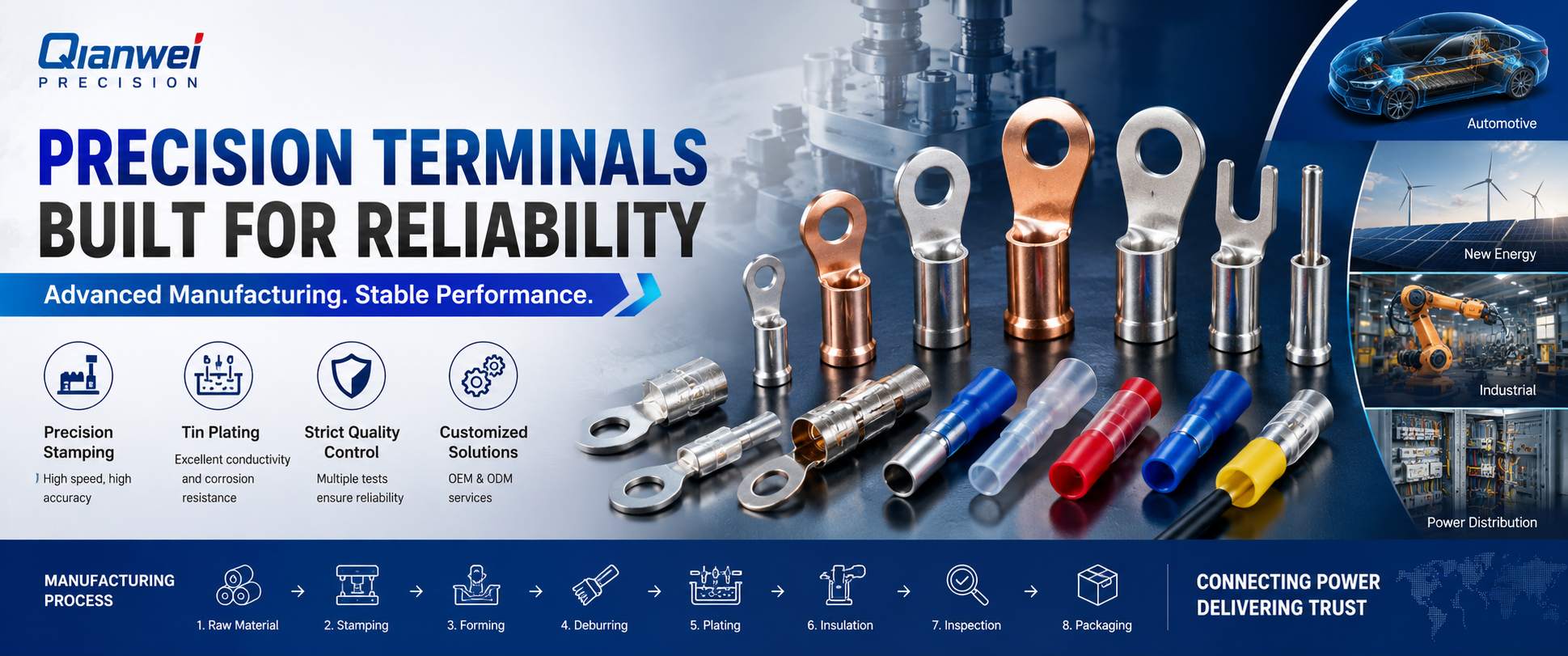
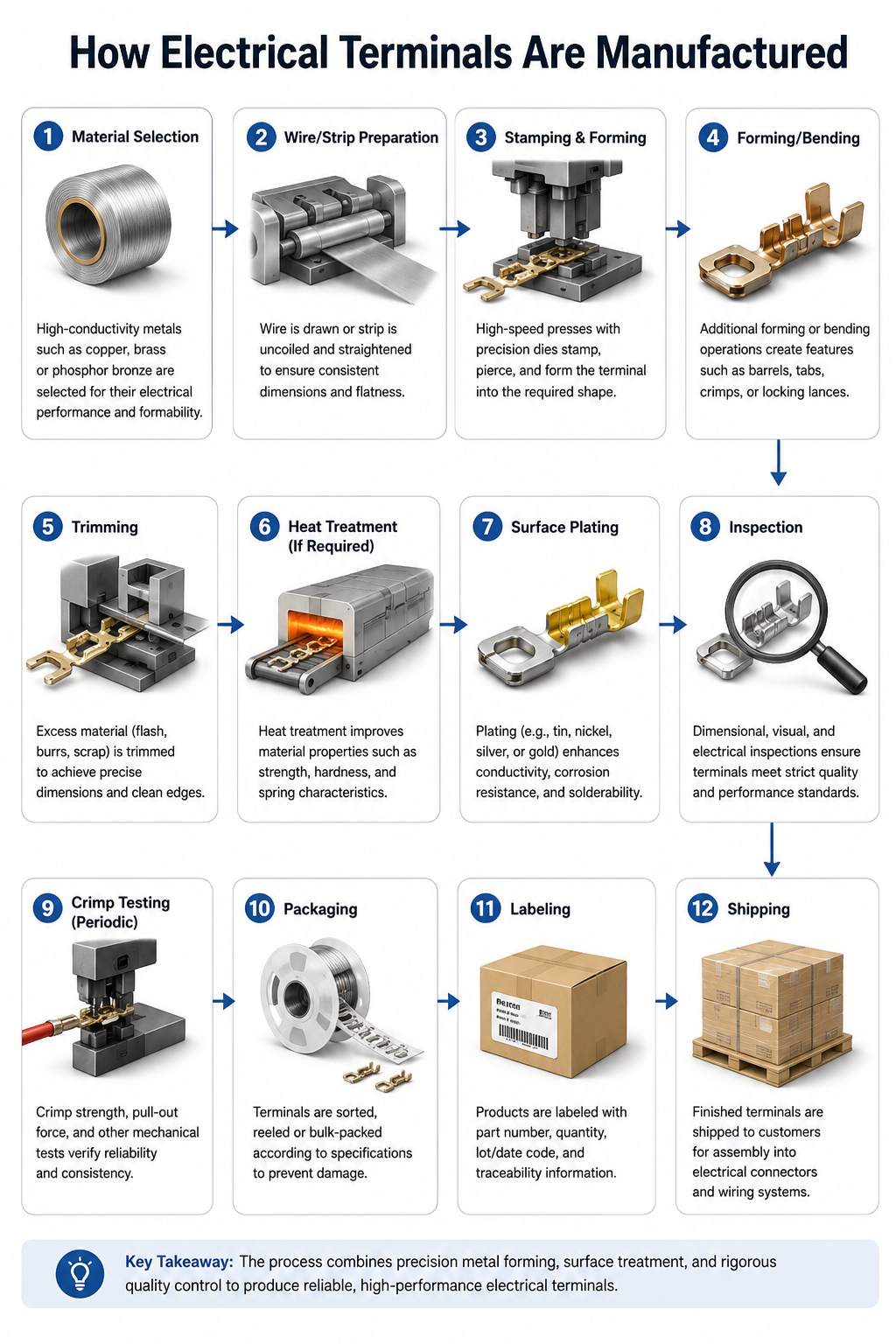
The manufacturing process generally includes the following stages:
- Raw Material Selection
- Metal Stamping
- Forming & Bending
- Deburring
- Heat Treatment (if required)
- Surface Plating
- Insulation & Injection Molding
- Quality Inspection & Testing
- Packaging & Delivery
Each process directly affects terminal quality and long-term reliability.
Step 1: Raw Material Selection
Material selection is one of the most important stages in terminal manufacturing.
The material determines:
- Electrical conductivity
- Mechanical strength
- Corrosion resistance
- Crimp performance
- Manufacturing cost
Common Materials Used for Electrical Terminals
Copper
Copper is the most widely used terminal material because it offers:
- Excellent electrical conductivity
- Low resistance
- Good thermal performance
Copper terminals are commonly used in:
- Automotive wiring
- Power distribution
- Industrial systems
Brass
Brass provides:
- Higher mechanical strength
- Better wear resistance
- Good machinability
Brass terminals are often used in applications requiring stronger structural durability.
Phosphor Bronze
Phosphor bronze offers:
- Excellent elasticity
- Fatigue resistance
- Stable spring performance
It is commonly used in connector terminals and spring-contact applications.
Material Thickness Selection
Terminal thickness is selected according to:
- Current carrying requirements
- Mechanical strength needs
- Crimp structure design
Higher current applications typically require thicker materials to reduce heat buildup and resistance.
Step 2: Metal Stamping Process
Metal stamping is the core manufacturing process for most electrical terminals.
High-speed stamping machines combined with precision progressive dies allow manufacturers to produce terminals efficiently and consistently.
What Is Terminal Stamping?
Terminal stamping is a manufacturing process where metal strips are continuously fed through precision molds that:
- Punch
- Cut
- Shape
- Form
the terminal structure.
Modern stamping systems can produce thousands of terminals per minute.
Progressive Stamping Dies
Most electrical terminals are manufactured using progressive stamping dies.
A progressive die performs multiple operations continuously in one production cycle.
How Progressive Dies Work
The process generally includes:
- Material feeding
- Hole punching
- Outline cutting
- Barrel forming
- Bending
- Final separation
Each station performs one specific operation until the finished terminal is produced.
Advantages of Precision Stamping
Precision stamping offers several advantages:
- High production speed
- Excellent consistency
- Low manufacturing cost
- High dimensional accuracy
- Suitable for mass production
This process is essential for automotive and industrial terminal manufacturing.
Step 3: Forming and Bending
After stamping, the terminal enters the forming stage.
This process shapes the terminal into its final structure.
Crimp Barrel Forming
The crimp barrel must be precisely formed to ensure:
- Proper wire compression
- Stable conductivity
- Strong pull-out force
Poor barrel forming can lead to unreliable electrical connections.
Precision Angle Bending
Some terminals require complex bending angles for installation compatibility.
Precision bending ensures:
- Proper fit
- Assembly consistency
- Stable mechanical performance
Maintaining Dimensional Accuracy
Modern terminal manufacturing requires extremely tight tolerances.
Even small dimensional variations may affect:
- Crimp quality
- Connector fit
- Electrical reliability
Step 4: Deburring Process
Stamping may generate small sharp metal edges called burrs.
Burrs are dangerous because they can:
- Damage wire insulation
- Create poor crimps
- Cause installation difficulties
- Increase short-circuit risk
Therefore, deburring is a critical manufacturing step.
Deburring Methods
Mechanical Deburring
Mechanical polishing removes sharp edges from the terminal surface.
Vibratory Finishing
Vibratory systems smooth terminal surfaces using abrasive media.
Precision Edge Treatment
High-end terminals may undergo additional edge finishing to improve safety and reliability.
Step 5: Heat Treatment
Some terminals require heat treatment to improve mechanical properties.
Heat treatment may:
- Increase hardness
- Improve spring performance
- Enhance fatigue resistance
This process is especially important for:
- Spring terminals
- Connector contacts
- High-vibration applications
Step 6: Surface Plating Process
Surface plating is essential for improving terminal performance.
Without proper plating, terminals may oxidize and lose conductivity over time.
Why Electrical Terminals Need Plating
Plating improves:
- Corrosion resistance
- Conductivity stability
- Solderability
- Appearance
- Long-term durability
Common Terminal Plating Types
Tin Plating
Tin plating is the most widely used terminal plating solution.
Advantages:
- Excellent corrosion resistance
- Stable conductivity
- Cost efficiency
- Good solderability
Tin-plated terminals are commonly used in:
- Automotive wiring harnesses
- Industrial systems
- Consumer electronics
Nickel Plating
Nickel plating provides:
- High-temperature resistance
- Better wear resistance
- Chemical protection
Silver Plating
Silver plating offers:
- Extremely low resistance
- Excellent conductivity
It is commonly used in high-performance electrical systems.
Gold Plating
Gold plating is mainly used in:
- Precision electronics
- Signal transmission systems
because of its superior oxidation resistance.
Tin Plating Process for Electrical Terminals
Tin plating is usually performed using electroplating technology.
The process includes:
- Surface cleaning
- Chemical preparation
- Electroplating
- Rinsing
- Drying
Plating Thickness Control
Plating thickness directly affects:
- Corrosion resistance
- Conductivity stability
- Product lifespan
Strict thickness control is essential for stable quality.
Why Tin-Plated Terminals Are Widely Used
Tin plating provides a balance between:
- Performance
- Cost
- Durability
This makes it ideal for large-scale industrial applications.
Step 7: Insulation & Injection Molding
Many terminals require insulation for electrical protection.
PVC Insulated Terminals
PVC insulation offers:
- Low cost
- Easy identification
- Basic electrical protection
Nylon Insulated Terminals
Nylon insulation provides:
- Better heat resistance
- Stronger mechanical durability
- Improved flexibility
Heat Shrink Terminals
Heat shrink terminals provide:
- Waterproof sealing
- Corrosion protection
- Better strain relief
They are widely used in outdoor systems.
Insert Molding Technology
Some terminals use insert molding technology where metal terminals are combined with molded plastic structures.
This process improves:
- Assembly integration
- Waterproof performance
- Structural stability
Step 8: Quality Inspection & Testing
Quality inspection is critical in terminal manufacturing.
Even small defects can cause electrical failures.
Dimensional Inspection
Manufacturers verify:
- Hole size
- Barrel dimensions
- Thickness
- Bending angle
using precision measurement equipment.
Pull-Out Force Testing
This test evaluates crimp strength and wire retention reliability.
Plating Thickness Inspection
Specialized instruments measure plating consistency.
Salt Spray Testing
Salt spray testing evaluates corrosion resistance under harsh environmental conditions.
Electrical Conductivity Testing
Manufacturers verify:
- Resistance levels
- Current carrying capability
- Heat generation performance
Crimp Reliability Testing
Crimp testing ensures:
- Stable compression
- Proper conductor deformation
- Long-term reliability
Automated Vision Inspection
Modern factories increasingly use AI vision systems to detect:
- Burrs
- Cracks
- Deformation
- Surface defects
Step 9: Packaging & Final Delivery
Packaging protects terminals during transportation and storage.
Reel Packaging
Automated assembly applications often require reel packaging.
Bulk Packaging
Bulk packaging is commonly used for industrial terminal supply.
Moisture Protection
Anti-moisture packaging helps protect plated terminals from oxidation during shipping.
How Automation Improves Terminal Manufacturing
Automation greatly improves:
- Production speed
- Consistency
- Quality control
- Manufacturing efficiency
Modern factories use:
- High-speed stamping machines
- Automated plating lines
- Robotic inspection systems
- Automated packaging equipment
Challenges in Electrical Terminal Manufacturing
Terminal manufacturing requires solving many technical challenges.
Tight Tolerance Control
Small dimensional errors can affect performance.
Burr Control
Sharp edges must be minimized.
Plating Consistency
Uneven plating can reduce durability.
High-Speed Production Stability
Maintaining consistency at high speed is difficult.
Why Precision Tooling Matters
Precision tooling is the foundation of stable terminal manufacturing.
High-quality molds improve:
- Accuracy
- Production consistency
- Tool lifespan
- Surface quality
Progressive die design is especially important for complex terminals.
.jpg)
Common Manufacturing Defects in Electrical Terminals
Manufacturers must control defects such as:
- Burrs
- Cracks
- Uneven plating
- Deformation
- Weak crimp structures
Strict quality systems help minimize these risks.
Industries That Use Precision Electrical Terminals
High-quality terminals are widely used in:
- Automotive wiring harnesses
- Renewable energy systems
- Industrial automation
- Consumer electronics
- Power distribution equipment
Each industry has different performance and reliability requirements.
Why Choose Qianwei Precision
Qianwei Precision specializes in precision electrical terminal manufacturing.
Our Advantages
- 1800+ production molds
- Advanced precision stamping technology
- Stable tin plating processes
- Strict quality control systems
- OEM & ODM support
- Fast prototype development
Product Range
We manufacture:
- Ring terminals
- Cable lugs
- Spade terminals
- Butt connectors
- Pin terminals
Our products are widely used in:
- Automotive systems
- Industrial equipment
- Renewable energy systems
- Consumer electronics
Conclusion
Electrical terminal manufacturing is a highly specialized process that combines:
- Precision stamping
- Advanced plating technology
- Strict quality control
- Automated production systems
Every manufacturing stage directly affects:
- Conductivity
- Reliability
- Corrosion resistance
- Product lifespan
As electrical systems become more advanced, high-quality manufacturing processes are increasingly important for ensuring stable and safe electrical connections.
Reliable electrical systems start with precision-manufactured terminals.
Looking for Reliable Terminal Manufacturing Solutions?
Qianwei Precision provides professional terminal manufacturing services for automotive, industrial, and power distribution applications.
- Request free samples
- Get engineering support
- Customize your terminal solution
Contact Qianwei Precision today for high-quality electrical terminal solutions.
FAQs
What materials are commonly used to manufacture electrical terminals?
Electrical terminals are commonly manufactured using:
- Copper
- Brass
- Phosphor bronze
Copper is the most widely used material because of its excellent electrical conductivity and low resistance.
How are electrical terminals manufactured?
The typical manufacturing process includes:
- Raw material selection
- Precision metal stamping
- Forming and bending
- Deburring
- Surface plating
- Insulation molding
- Quality inspection and testing
Modern terminals are usually produced using high-speed automated stamping systems.
What is progressive stamping in terminal manufacturing?
Progressive stamping is a high-speed manufacturing process where metal strips move through multiple die stations.
Each station performs a different operation such as:
- Punching
- Cutting
- Forming
- Bending
This method allows efficient mass production with high precision and consistency.
Why is tin plating important for electrical terminals?
Tin plating improves:
- Corrosion resistance
- Conductivity stability
- Solderability
- Long-term durability
Tin-plated terminals are widely used in automotive, industrial, and outdoor electrical applications.
How are burrs removed from electrical terminals?
Manufacturers use several deburring methods including:
- Mechanical polishing
- Vibratory finishing
- Precision edge treatment
Removing burrs is important because sharp edges may damage wires or affect crimp quality.
Why is quality inspection important in terminal manufacturing?
Quality inspection helps ensure:
- Stable electrical performance
- Accurate dimensions
- Reliable crimping
- Corrosion resistance
- Long-term durability
Even small defects can lead to electrical failure or overheating.
What testing methods are used for electrical terminals?
Common testing methods include:
- Pull-out force testing
- Salt spray testing
- Plating thickness inspection
- Electrical conductivity testing
- Temperature rise testing
- Crimp reliability testing
These tests help verify terminal safety and reliability.
Can electrical terminals be customized?
Yes. Manufacturers can customize terminals according to:
- Wire size
- Current requirements
- Installation space
- Environmental conditions
- Special structures
Custom terminals are widely used in automotive, renewable energy, and industrial systems.
What industries use precision electrical terminals?
Precision terminals are widely used in:
- Automotive wiring harnesses
- Industrial automation
- Renewable energy systems
- Consumer electronics
- Power distribution equipment
- Agricultural machinery
Different industries require different terminal structures and performance characteristics.
How does automation improve terminal manufacturing?
Automation improves:
- Production speed
- Dimensional consistency
- Quality control
- Manufacturing efficiency
Modern factories use:
- High-speed stamping machines
- Automated plating lines
- Robotic inspection systems
- Automated packaging equipment
What causes electrical terminal failure during manufacturing?
Common manufacturing-related failures include:
- Burr defects
- Poor plating quality
- Incorrect crimp structures
- Material cracking
- Dimensional inaccuracies
Strict process control is essential to minimize these issues.
How long does electrical terminal production take?
Production time depends on:
- Product complexity
- Tooling requirements
- Order quantity
- Surface treatment processes
Standard terminals can often be produced quickly, while custom terminals may require additional tooling and testing time.

