

Introduction
Electrical terminals are used in almost every modern electrical system, including automotive wiring harnesses, renewable energy equipment, industrial automation systems, consumer electronics, and power distribution applications. These components are responsible for carrying electrical current safely and reliably over long periods of time.
However, electrical terminals are constantly exposed to environmental factors such as:
- Moisture
- Humidity
- Salt
- Chemicals
- Temperature changes
- Outdoor weather conditions
These factors can cause corrosion, which may lead to:
- Increased contact resistance
- Overheating
- Voltage drop
- Poor conductivity
- Connection failure
- Safety hazards
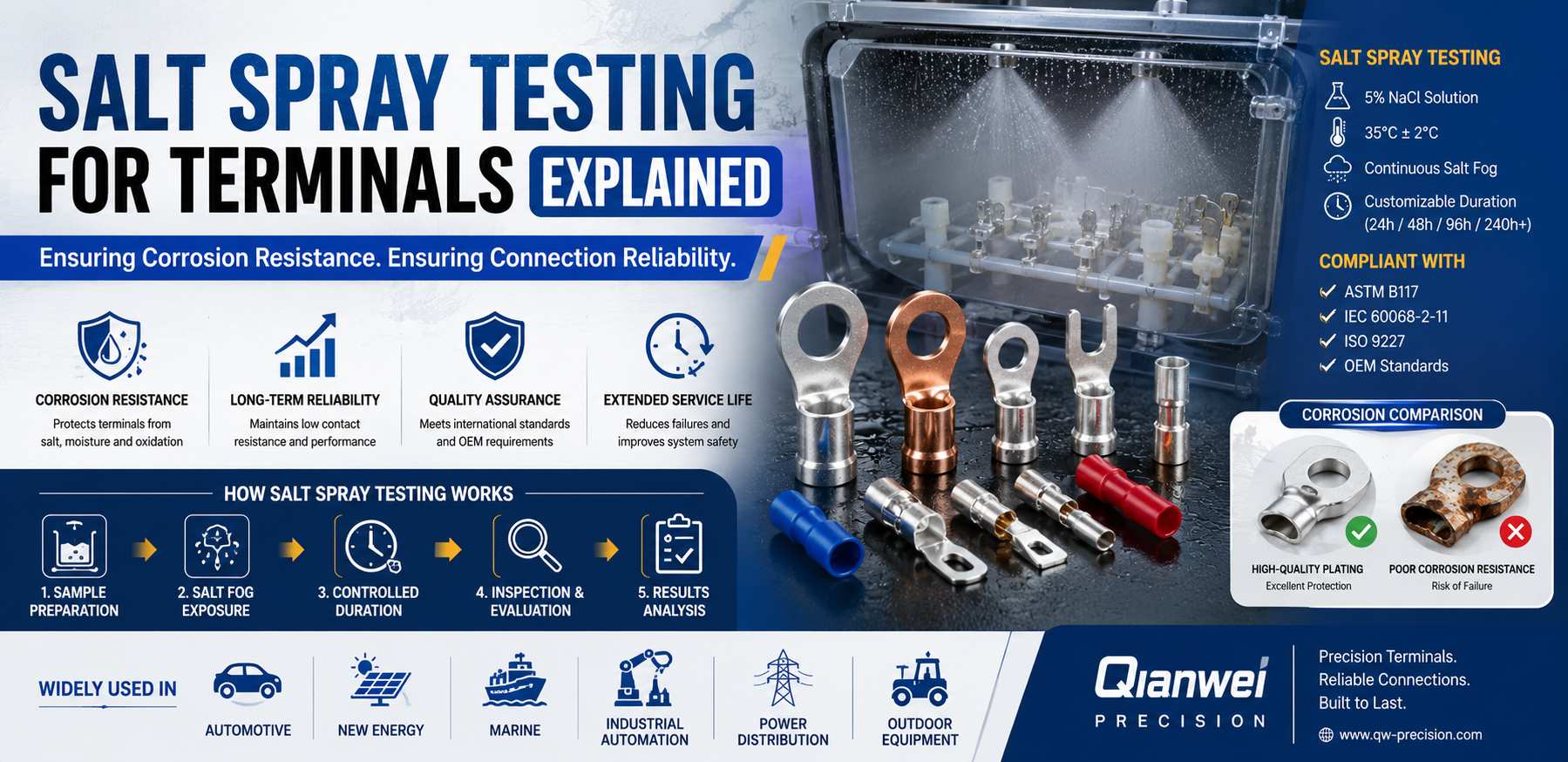
To evaluate corrosion resistance performance, manufacturers use salt spray testing, also known as salt fog testing. This accelerated corrosion test is one of the most widely used reliability tests in the electrical terminal industry.
Salt spray testing helps manufacturers verify:
- Plating quality
- Surface protection performance
- Long-term durability
- Product reliability under harsh conditions
This article explains how salt spray testing works, why it matters for electrical terminals, and how manufacturers improve corrosion resistance for automotive, industrial, and outdoor applications.
What Is Salt Spray Testing?
Salt spray testing is an accelerated corrosion test used to evaluate how well metal parts resist corrosion in harsh environments.
The test exposes products to a controlled salt fog environment inside a sealed chamber for a specified period of time.
For electrical terminals, salt spray testing is mainly used to evaluate:
- Surface plating quality
- Corrosion resistance
- Protective coating performance
- Long-term durability
Because corrosion in real-world environments may take months or years to develop, salt spray testing accelerates the process so manufacturers can quickly evaluate product reliability.
Why Electrical Terminals Need Salt Spray Testing
Electrical terminals rely on stable metal-to-metal contact for proper conductivity.
When corrosion develops, it can:
- Increase electrical resistance
- Reduce conductivity
- Generate excessive heat
- Damage the crimp connection
- Cause system failure
In severe cases, corrosion may even create fire risks in high-current systems.
Industries such as automotive, marine, renewable energy, and outdoor power equipment require strict corrosion resistance because terminals are exposed to:
- Rain
- Road salt
- Humidity
- Coastal environments
- Industrial chemicals
Salt spray testing helps ensure terminals can survive these harsh conditions.
How Salt Spray Testing Works
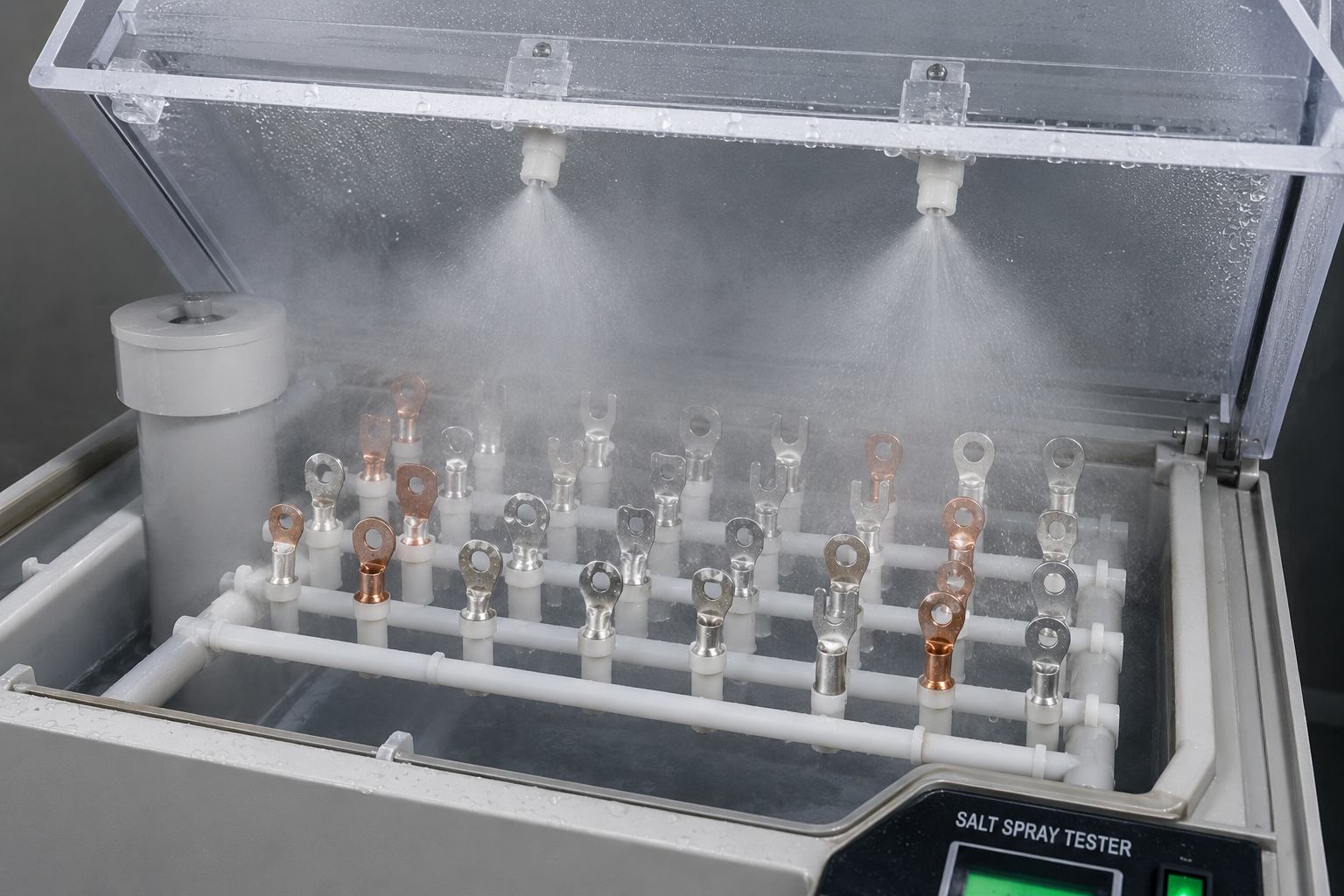
Salt spray testing is performed inside a special environmental chamber called a salt fog chamber.
The chamber creates a continuous fine mist of salt solution under controlled conditions.
Standard Test Conditions
Typical salt spray testing conditions include:
- 5% sodium chloride (NaCl) solution
- Chamber temperature around 35°C
- Continuous salt fog exposure
- Controlled pH level
The environment simulates long-term exposure to corrosive conditions.
Salt Fog Chamber Overview
The salt spray chamber includes:
- Salt solution tank
- Spray nozzles
- Temperature control system
- Humidity control
- Sample racks
Compressed air atomizes the salt solution into a fine fog that continuously covers the test samples.
The terminals remain exposed for a specified testing period.
Common Salt Spray Testing Standards
Several international standards define salt spray testing procedures.
ASTM B117
ASTM B117 is the most widely used salt spray testing standard worldwide.
It specifies:
- Salt concentration
- Chamber conditions
- Temperature requirements
- Testing procedures
Many automotive and industrial customers require ASTM B117 compliance.
IEC Standards
IEC standards are commonly used in electrical and electronic industries.
These standards help evaluate environmental durability and corrosion resistance.
ISO Salt Spray Standards
ISO standards provide international guidelines for corrosion testing and quality evaluation.
Automotive OEM Standards
Many automotive manufacturers have their own corrosion testing requirements.
OEM standards may specify:
- Longer testing hours
- Additional humidity cycling
- Combined environmental testing
Automotive terminals typically require much stricter corrosion resistance performance.
Why Corrosion Resistance Matters for Electrical Terminals
Corrosion directly affects electrical connection quality.
Increased Contact Resistance
Corrosion layers reduce metal conductivity and increase resistance.
Higher resistance generates heat during operation.
Overheating Problems
Poor conductivity can cause localized overheating, especially in high-current systems.
This may damage:
- Wire insulation
- Connector housings
- Electrical components
Reduced Product Lifespan
Corrosion gradually weakens terminal structures and reduces operational lifespan.
Safety Risks
Severe corrosion can lead to:
- Power failure
- Intermittent connections
- Electrical arcing
- Fire hazards
This is especially dangerous in automotive and industrial applications.
Types of Corrosion in Electrical Terminals
Several types of corrosion may affect terminals.
Oxidation
Oxidation occurs when metal reacts with oxygen and moisture.
Copper oxidation can increase electrical resistance significantly.
Galvanic Corrosion
Galvanic corrosion occurs when different metals contact each other in the presence of moisture.
This may accelerate material degradation.
Fretting Corrosion
Fretting corrosion develops under vibration conditions where micro-movement damages the contact surface.
This is common in automotive systems.
Moisture-Induced Corrosion
High humidity environments accelerate corrosion on exposed metal surfaces.
Outdoor equipment is especially vulnerable.
Terminal Materials and Corrosion Resistance
Material selection greatly affects salt spray performance.
Copper Terminals
Copper offers excellent conductivity but oxidizes relatively easily without proper plating.
Brass Terminals
Brass provides:
- Better mechanical strength
- Moderate corrosion resistance
It is commonly used in industrial applications.
Phosphor Bronze Terminals
Phosphor bronze provides:
- Good elasticity
- Better fatigue resistance
- Improved corrosion performance
It is often used in connector terminals.
How Surface Plating Affects Salt Spray Performance
Surface plating is one of the most important factors in corrosion resistance.
Tin Plating
Tin plating is the most common plating solution for electrical terminals.
Advantages of Tin Plating
- Excellent corrosion resistance
- Cost-effective protection
- Stable conductivity
- Good solderability
Tin-plated terminals are widely used in:
- Automotive wiring harnesses
- Industrial systems
- Consumer electronics
Nickel Plating
Nickel plating offers:
- Better wear resistance
- High-temperature performance
- Chemical resistance
Silver Plating
Silver plating provides:
- Extremely low resistance
- Excellent conductivity
It is used in high-performance electrical systems.
Gold Plating
Gold plating provides superior oxidation resistance and is commonly used in precision electronics and signal transmission applications.
Tin-Plated Terminals and Salt Spray Testing
Tin plating is widely used because it balances:
- Performance
- Cost
- Reliability
However, salt spray performance depends on several factors.
Factors Affecting Corrosion Resistance
- Plating thickness
- Surface preparation quality
- Base material
- Electroplating process
- Environmental exposure conditions
Poor plating control can lead to premature corrosion.
White Rust vs Red Rust
During salt spray testing, corrosion results are carefully evaluated.
White Rust
White rust usually appears on zinc or tin-plated surfaces during early corrosion stages.
Minor white rust may be acceptable depending on customer standards.
Red Rust
Red rust indicates severe corrosion and exposure of the base metal.
This is usually considered test failure.
Common Salt Spray Test Durations
Different industries require different corrosion resistance levels.
| Test Hours | Typical Application |
|---|---|
| 24 Hours | Basic indoor products |
| 48 Hours | Commercial electronics |
| 96 Hours | Automotive systems |
| 240+ Hours | Outdoor & marine equipment |
Higher testing hours generally indicate better corrosion resistance.
Salt Spray Testing Procedure for Electrical Terminals
Manufacturers follow a controlled testing process.
Step 1: Sample Preparation
Samples are selected according to production specifications.
Step 2: Surface Cleaning
The terminals are cleaned to remove contaminants that could affect test results.
Step 3: Chamber Placement
Samples are placed at specific angles inside the chamber to ensure consistent exposure.
Step 4: Salt Fog Exposure
The chamber continuously sprays salt fog throughout the testing period.
Step 5: Inspection & Evaluation
After testing, inspectors evaluate:
- Corrosion appearance
- Rust formation
- Surface damage
- Functional performance
Step 6: Recording Results
Results are documented for quality control and customer verification.
How Salt Spray Test Results Are Evaluated
Manufacturers use several methods to evaluate corrosion resistance.
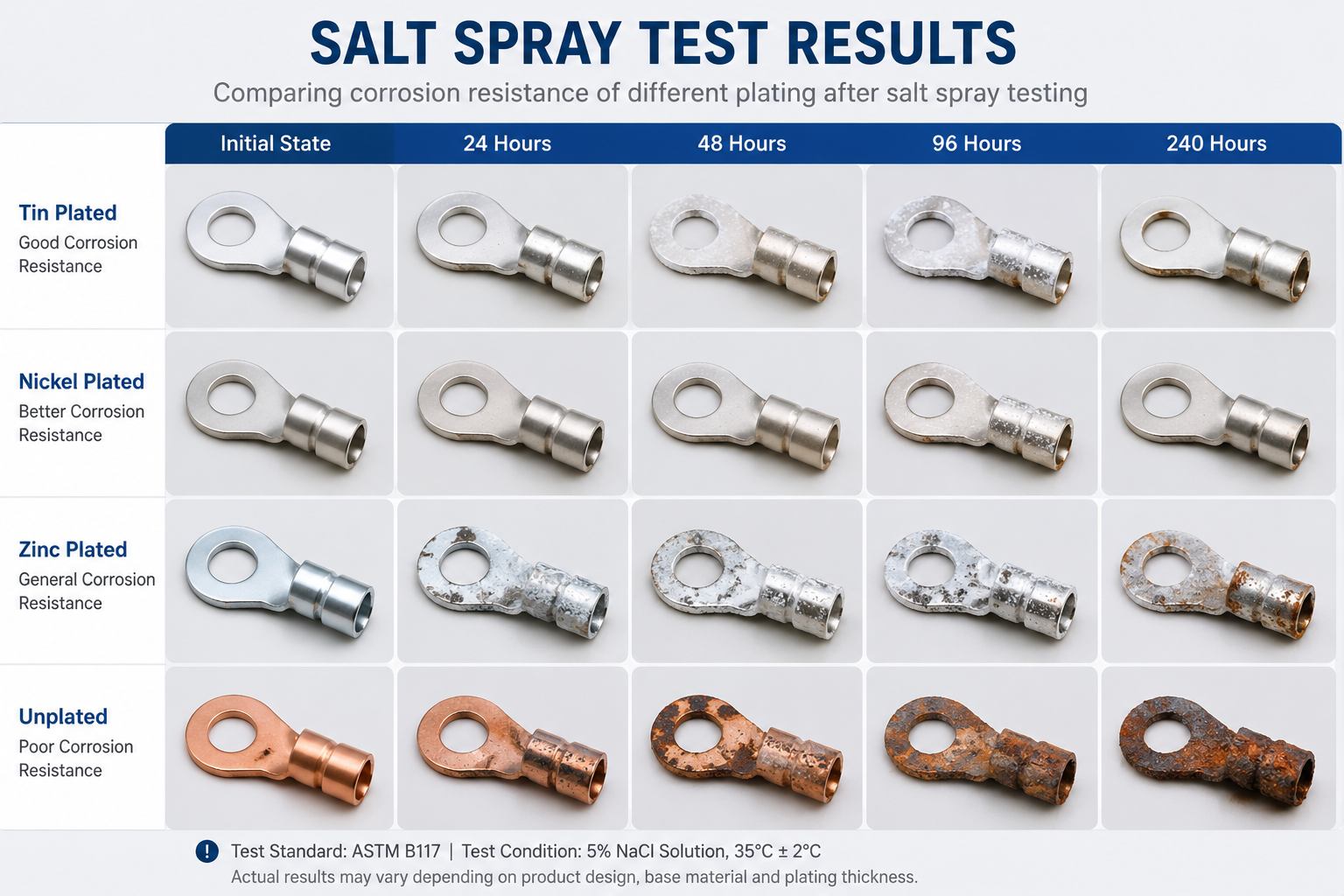
Appearance Inspection
Inspectors visually check for:
- White rust
- Red rust
- Surface discoloration
- Plating damage
Corrosion Area Measurement
The percentage of corroded area may be measured according to testing standards.
Contact Resistance Testing
Electrical resistance is measured before and after testing.
Crimp Reliability Inspection
Manufacturers verify whether corrosion affected crimp strength or mechanical stability.
Industries That Require Salt Spray Testing
Many industries require corrosion-resistant terminals.
Automotive Wiring Harnesses
Automotive systems are exposed to:
- Rain
- Humidity
- Road salt
- Engine heat
Salt spray testing is essential for automotive reliability.
EV Battery Systems
Electric vehicle battery systems require long-term stable conductivity under harsh conditions.
Renewable Energy Equipment
Solar and energy storage systems often operate outdoors for many years.
Marine Electrical Systems
Marine environments contain extremely high salt exposure.
Industrial Automation
Industrial factories may expose terminals to chemicals and moisture.
Common Causes of Salt Spray Test Failure
Several manufacturing issues can cause test failure.
Insufficient Plating Thickness
Thin plating provides inadequate corrosion protection.
Poor Surface Cleaning
Surface contamination weakens plating adhesion.
Defective Electroplating Process
Poor process control may cause uneven plating coverage.
Low-Quality Base Materials
Inferior materials may corrode more quickly.
Surface Scratches
Scratches may expose the base metal and accelerate corrosion.
How Manufacturers Improve Corrosion Resistance
Manufacturers use several methods to improve salt spray performance.
Better Plating Technology
Advanced electroplating improves coating consistency.
Thicker Tin Coating
Optimized plating thickness increases durability.
Improved Surface Preparation
Proper cleaning improves plating adhesion.
Strict Quality Control
Consistent process monitoring reduces manufacturing defects.
Salt Spray Testing vs Real-World Corrosion
Salt spray testing is an accelerated laboratory test.
However, real-world environments may involve:
- Temperature cycling
- Vibration
- UV exposure
- Mechanical stress
Therefore, salt spray testing alone cannot perfectly predict actual lifespan.
Manufacturers often combine salt spray testing with:
- Vibration testing
- Thermal cycling
- Conductivity testing
- Pull-out force testing
to evaluate overall reliability.
.jpg)
Why Quality Control Matters in Salt Spray Performance
Stable corrosion resistance depends heavily on manufacturing quality.
Manufacturers must control:
- Plating thickness
- Material quality
- Surface cleanliness
- Process consistency
Even small process variations may affect salt spray performance.
Why Choose Qianwei Precision
Qianwei Precision specializes in high-quality electrical terminal manufacturing with strict corrosion resistance standards.
Our Advantages
- Stable tin plating technology
- Advanced electroplating processes
- Precision manufacturing capability
- Strict salt spray quality testing
- OEM & ODM support
- Reliable automotive & industrial solutions
Product Applications
We manufacture:
- Automotive terminals
- Cable lugs
- Ring terminals
- Spade terminals
- Waterproof connectors
Our products are widely used in:
- Automotive systems
- Renewable energy equipment
- Industrial automation
- Outdoor electrical systems
Conclusion
Salt spray testing is one of the most important methods for evaluating corrosion resistance in electrical terminals.
Corrosion directly affects:
- Conductivity
- Reliability
- Product lifespan
- Electrical safety
As industries demand longer-lasting and more reliable electrical systems, high-quality plating processes and strict corrosion testing have become increasingly important.
Reliable electrical connections begin with corrosion-resistant terminal manufacturing.
Looking for Reliable Corrosion-Resistant Terminal Solutions?
Qianwei Precision provides professional terminal manufacturing solutions with stable plating quality and strict salt spray testing standards.
- Request free samples
- Get engineering support
- Customize your terminal solution
Contact Qianwei Precision today for high-reliability electrical terminal solutions.
FAQs
What is salt spray testing for electrical terminals?
Salt spray testing is an accelerated corrosion test used to evaluate how well electrical terminals resist corrosion in harsh environments.
The test exposes terminals to a continuous salt fog inside a controlled chamber to simulate long-term exposure to moisture and salt.
Why is salt spray testing important for terminals?
Salt spray testing helps manufacturers verify:
- Corrosion resistance
- Plating quality
- Long-term durability
- Electrical reliability
Corrosion can increase contact resistance, cause overheating, and reduce terminal lifespan.
What is ASTM B117?
ASTM B117 is the most widely used international standard for salt spray testing.
It defines:
- Salt concentration
- Chamber temperature
- Testing conditions
- Exposure procedures
Many automotive and industrial customers require compliance with ASTM B117.
How long should terminals pass salt spray testing?
The required testing duration depends on the application.
Typical requirements include:
| Application | Typical Salt Spray Requirement |
|---|---|
| Indoor electronics | 24–48 hours |
| Commercial equipment | 48–72 hours |
| Automotive systems | 96 hours or more |
| Outdoor & marine equipment | 240+ hours |
Higher test hours generally indicate stronger corrosion resistance.
What causes terminals to fail salt spray testing?
Common causes include:
- Insufficient plating thickness
- Poor surface cleaning
- Defective electroplating
- Low-quality materials
- Surface scratches or damage
Manufacturing quality directly affects corrosion performance.
Is tin plating good for corrosion resistance?
Yes. Tin plating is one of the most widely used and cost-effective corrosion protection methods for electrical terminals.
Tin plating provides:
- Stable conductivity
- Oxidation resistance
- Good solderability
- Reliable long-term performance
It is commonly used in automotive and industrial applications.
What is white rust in salt spray testing?
White rust is an early-stage corrosion product that may appear on tin-plated or zinc-plated surfaces during salt spray testing.
Minor white rust may be acceptable depending on customer standards and testing requirements.
What is red rust in salt spray testing?
Red rust indicates that corrosion has reached the base metal.
This usually means the protective plating has failed and is commonly considered a test failure.
Do automotive terminals require salt spray testing?
Yes. Automotive terminals are frequently exposed to:
- Humidity
- Rain
- Road salt
- Temperature changes
- Engine compartment conditions
Salt spray testing is essential for validating automotive terminal reliability and durability.
Can salt spray testing predict real-world product lifespan?
Salt spray testing helps evaluate corrosion resistance, but it cannot perfectly predict actual service life.
Real-world environments may also involve:
- Vibration
- Thermal cycling
- UV exposure
- Mechanical stress
Manufacturers often combine salt spray testing with additional reliability tests.
How can manufacturers improve corrosion resistance?
Manufacturers improve corrosion resistance through:
- Better plating processes
- Thicker coating layers
- Improved surface preparation
- High-quality base materials
- Strict quality control systems
Stable electroplating quality is especially important.
What industries require corrosion-resistant terminals?
Corrosion-resistant terminals are widely used in:
- Automotive wiring harnesses
- EV battery systems
- Renewable energy equipment
- Marine electrical systems
- Industrial automation
- Outdoor power equipment
These industries require long-term reliability under harsh environmental conditions.


5 thoughts on “Salt Spray Testing for Terminals Explained”