

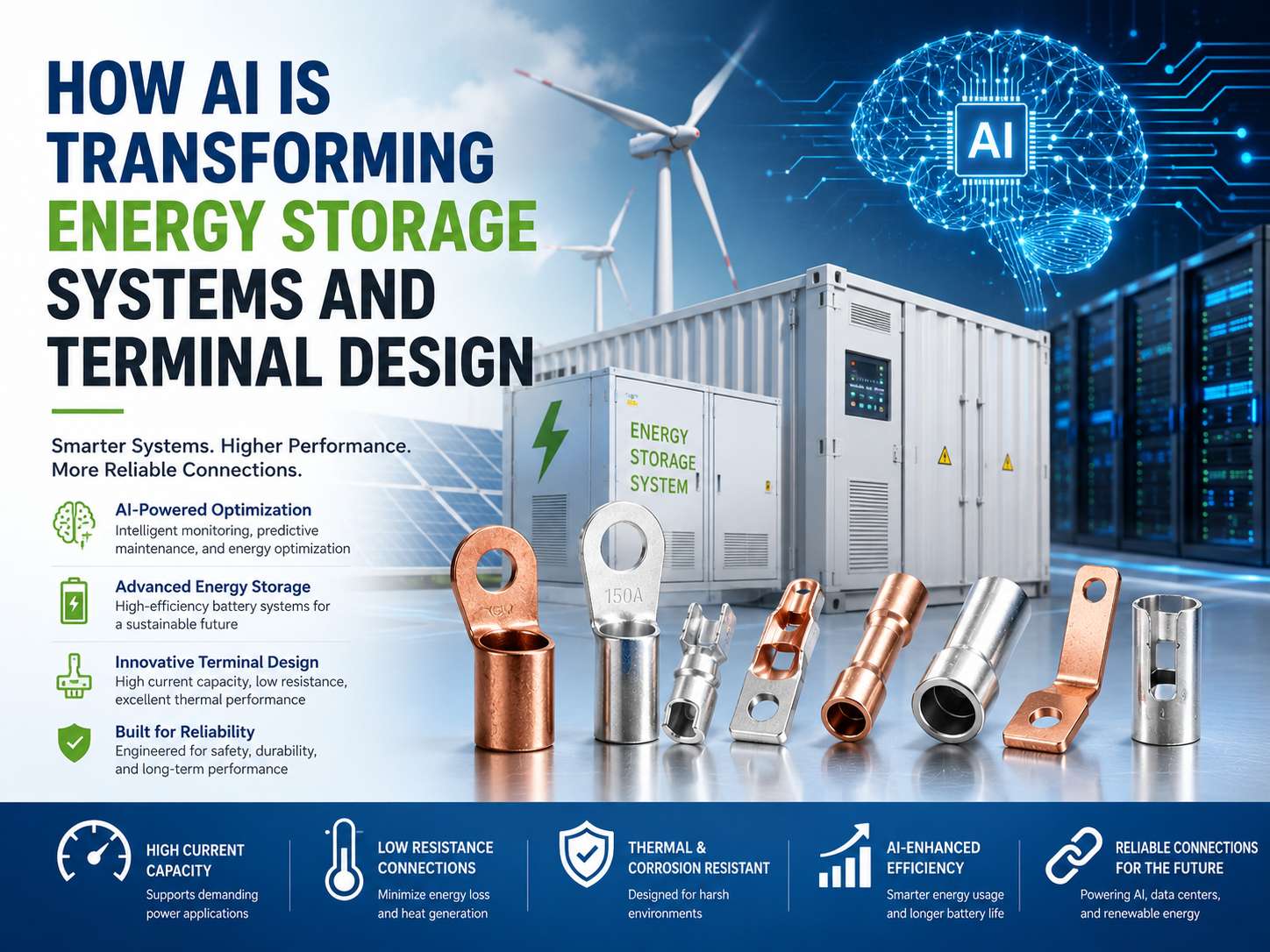
Artificial Intelligence (AI) is changing the world faster than almost any technology before it. From ChatGPT and autonomous vehicles to smart factories and data centers, AI applications are expanding rapidly across industries.
However, behind every AI model, every data center, and every intelligent system lies one critical requirement: electricity.
As AI computing power continues to grow, energy consumption is increasing at an unprecedented rate. According to industry forecasts, AI-driven data centers are expected to become one of the fastest-growing sources of electricity demand over the next decade. This growing demand is creating new challenges for power generation, distribution, and storage.
As a result, Energy Storage Systems (ESS) have become a key part of modern energy infrastructure. At the same time, the electrical components inside these systems—including electrical terminals—are facing new performance requirements.
In this article, we will explore how AI is reshaping energy storage systems and why it is driving the evolution of terminal design.
What Is an Energy Storage System?
An Energy Storage System (ESS) is a technology that stores electrical energy and releases it when needed.
Energy storage systems help balance electricity supply and demand by storing excess energy during low-demand periods and delivering power when demand increases.
Modern ESS solutions are widely used in:
- Solar power systems
- Wind farms
- Utility power grids
- EV charging stations
- Industrial facilities
- AI data centers
A typical energy storage system includes several major components:
- Battery modules
- Battery Management System (BMS)
- Power Conversion System (PCS)
- Busbars
- Connectors
- High-current terminals
- Monitoring and control systems
Among these components, terminals and connectors may seem small, but they play a critical role in ensuring safe and efficient power transmission.
Why AI Is Increasing the Need for Energy Storage
AI technologies require enormous computing resources.
Training large language models, operating AI servers, and supporting cloud-based AI services consume significantly more electricity than traditional computing workloads.
For example:
- A standard office computer may consume 100–300 watts.
- A high-performance AI GPU can consume 700 watts or more.
- AI server racks may require tens of kilowatts.
- Large AI data centers can consume hundreds of megawatts.
This surge in electricity demand creates several challenges:
Grid Stability
Power grids must handle sudden fluctuations in demand.
Renewable Energy Integration
Many companies want to power AI operations using renewable energy sources such as solar and wind.
However, renewable energy generation is intermittent.
The sun does not always shine.
The wind does not always blow.
Peak Demand Management
AI workloads often create peak electricity demand periods that utilities must support.
Energy storage systems help solve these problems by storing excess energy and releasing it when needed.
This is why ESS deployments are growing rapidly worldwide.
How AI Is Improving Energy Storage Systems
Interestingly, AI is not only creating demand for energy storage—it is also helping energy storage systems become smarter.
AI-Based Battery Monitoring
Traditional battery monitoring systems rely on predefined rules and thresholds.
AI systems can continuously analyze battery performance data and identify patterns that humans might miss.
Benefits include:
- Early fault detection
- Improved safety
- Better maintenance planning
- Reduced downtime
Instead of waiting for a battery failure, operators can identify potential issues before they become serious problems.
Predictive Maintenance
One of AI’s most valuable applications is predictive maintenance.
By analyzing:
- Temperature
- Voltage
- Current
- Charge cycles
- Historical performance
AI algorithms can predict when batteries or components are likely to fail.
This allows maintenance teams to replace parts proactively rather than reactively.
Smarter Energy Management
AI can also optimize how energy is stored and discharged.
Examples include:
- Peak shaving
- Load balancing
- Demand forecasting
- Energy arbitrage
By making intelligent decisions in real time, AI helps maximize system efficiency and reduce operating costs.
Extending Battery Lifespan
Battery replacement is one of the largest costs associated with energy storage systems.
AI can optimize charging and discharging strategies to reduce battery degradation.
Benefits include:
- Longer battery life
- Reduced replacement costs
- Improved return on investment
Why AI Is Changing Terminal Design Requirements
As energy storage systems become larger and more powerful, the terminals inside them must evolve as well.
The electrical terminal is the connection point where electrical current flows between cables, busbars, batteries, and electrical equipment.
Poor terminal design can lead to:
- Increased resistance
- Heat generation
- Energy loss
- Connection failure
- Safety hazards
The rise of AI is creating several new design challenges.
Higher Current Requirements
AI infrastructure consumes enormous amounts of power.
As a result, energy storage systems must handle increasingly higher current levels.
Modern battery storage systems often operate at hundreds or even thousands of amps.
This places significant demands on terminals.
Design requirements include:
- Low resistance
- High conductivity
- Strong mechanical connections
- Efficient heat dissipation
Even a small increase in resistance can generate significant heat when large currents are involved.
Greater Thermal Management Demands
Heat is one of the biggest enemies of electrical systems.
As power density increases, thermal performance becomes increasingly important.
Poor thermal management can cause:
- Efficiency losses
- Connector degradation
- Insulation damage
- Safety risks
Modern terminal designs must minimize heat generation while effectively dissipating thermal energy.
This is one reason why copper remains the preferred material for many high-current applications.
More Compact System Designs
Space is valuable in energy storage systems.
Manufacturers are constantly working to increase energy density while reducing overall system size.
This trend requires:
- Smaller terminals
- Higher current capacity
- Optimized geometries
- Compact connection solutions
Terminal manufacturers must balance size reduction with electrical performance.
Increased Reliability Expectations
AI data centers often operate 24 hours a day, 7 days a week.
Downtime can be extremely costly.
As a result, terminal reliability has become more important than ever.
Modern ESS terminals must withstand:
- Continuous operation
- Vibration
- Temperature cycling
- Humidity
- Corrosion
Long-term stability is no longer optional—it is essential.
Materials Used in Modern Energy Storage Terminals
Material selection directly affects terminal performance.
Electrolytic Copper
Electrolytic copper is one of the most widely used materials for high-current terminals.
Advantages include:
- Excellent conductivity
- Low resistance
- Superior thermal performance
- Long service life
For battery energy storage systems, copper terminals are often the preferred solution.
Copper Alloys
In some applications, pure copper may be supplemented with alloying elements.
Copper alloys can provide:
- Higher strength
- Better wear resistance
- Improved mechanical durability
These materials are commonly used where both conductivity and structural performance are required.
Aluminum Solutions
Aluminum terminals are sometimes used in large-scale power systems.
Advantages include:
- Lightweight
- Lower material cost
- Good conductivity-to-weight ratio
However, aluminum typically requires specialized connection designs to prevent galvanic corrosion.
The Importance of Surface Plating
Terminal performance is influenced not only by the base material but also by surface treatment.
Tin Plating
Tin plating remains the most common option.
Benefits include:
- Corrosion resistance
- Good conductivity
- Excellent solderability
- Cost-effectiveness
Silver Plating
Silver offers superior conductivity and is commonly used in high-current applications.
Benefits include:
- Extremely low contact resistance
- Excellent thermal performance
Nickel Plating
Nickel plating provides:
- Enhanced durability
- Corrosion protection
- High-temperature resistance
It is commonly used in demanding industrial environments.
How AI Is Transforming Terminal Manufacturing
AI is also changing the way terminals are manufactured.
Smart Production Systems
Modern factories increasingly use AI-driven production monitoring.
Benefits include:
- Improved process consistency
- Reduced defects
- Better efficiency
Automated Quality Inspection
Machine vision systems can inspect thousands of terminals per hour.
AI algorithms can identify:
- Surface defects
- Burrs
- Dimensional deviations
- Plating issues
This improves product quality while reducing labor requirements.
Predictive Tool Maintenance
Stamping dies are critical assets in terminal manufacturing.
AI systems can monitor:
- Tool wear
- Production data
- Equipment vibration
Maintenance can then be scheduled before failures occur.
This reduces downtime and improves productivity.
Testing Requirements for Energy Storage Terminals
Because energy storage systems operate under demanding conditions, rigorous testing is essential.
Contact Resistance Testing
Ensures efficient electrical conductivity.
Pull-Out Force Testing
Verifies mechanical retention strength.
Thermal Cycling Testing
Evaluates performance under repeated heating and cooling.
Vibration Testing
Simulates transportation and operational environments.
Salt Spray Testing
Measures corrosion resistance.
High Current Testing
Confirms performance under real-world electrical loads.
These tests help ensure long-term reliability and safety.
Future Trends in Energy Storage Terminal Technology
The evolution of AI is only beginning.
Future energy storage systems will require even more advanced connection technologies.
Ultra-High Current Terminals
As power requirements increase, terminals capable of carrying higher currents will become increasingly important.
Smart Terminals
Future terminals may include embedded sensors capable of monitoring:
- Temperature
- Current
- Connection integrity
Real-Time Condition Monitoring
Smart terminals could provide continuous performance data to AI monitoring systems.
Self-Diagnosing Connections
Future connection systems may automatically detect loose or degraded contacts before failures occur.
Why Choose Qianwei Precision for Energy Storage Terminal Manufacturing
As energy storage technologies continue to evolve, manufacturers need reliable terminal partners that can meet demanding technical requirements.
Qianwei specializes in precision-stamped terminals and custom connection solutions for modern electrical applications.
Our capabilities include:
- High-current terminal manufacturing
- Copper terminal production
- Custom terminal development
- OEM and ODM services
- Advanced tooling design
- Precision stamping technology
To ensure product reliability, Qianwei provides comprehensive testing services including:
- Contact resistance testing
- Pull-out force testing
- Thermal cycling testing
- Vibration testing
- Dimensional inspection
These capabilities help support the growing needs of energy storage systems, renewable energy projects, and AI-driven power infrastructure.
Conclusion
Artificial intelligence is transforming the global energy landscape.
As AI applications continue to expand, the demand for reliable, efficient, and scalable energy storage systems will grow alongside them.
While batteries, software, and control systems often receive the most attention, electrical terminals remain a critical part of the overall system. They directly influence power transmission efficiency, thermal performance, reliability, and safety.
The next generation of energy storage terminals must support higher currents, greater power density, improved thermal management, and smarter monitoring capabilities.
For manufacturers, engineers, and procurement teams, understanding these trends is essential for building future-ready energy storage solutions.
As AI continues to reshape the energy industry, advanced terminal technologies will play an increasingly important role in powering the world’s most demanding applications.
FAQs
How is AI used in energy storage systems?
AI helps energy storage systems monitor battery health, predict maintenance needs, optimize charging and discharging cycles, and improve overall energy efficiency. By analyzing large amounts of operational data, AI can make real-time decisions that enhance system performance and reliability.
Why are energy storage systems important for AI data centers?
AI data centers consume massive amounts of electricity and often experience fluctuating power demands. Energy storage systems help stabilize power supply, reduce peak demand charges, and improve the integration of renewable energy sources.
What role do electrical terminals play in energy storage systems?
Electrical terminals create secure electrical connections between batteries, cables, busbars, and power distribution equipment. Their performance directly affects conductivity, heat generation, system efficiency, and operational safety.
Why do AI-driven energy storage systems require advanced terminal designs?
As AI applications demand higher power levels, energy storage systems must handle greater current loads and power density. Advanced terminal designs help reduce resistance, improve thermal performance, and ensure long-term reliability.
What materials are commonly used for energy storage terminals?
The most common materials include:
- Electrolytic copper
- Copper alloys
- Aluminum alloys
Copper is generally preferred for high-current applications due to its excellent electrical conductivity and thermal performance.
Why is electrolytic copper widely used in high-current terminals?
Electrolytic copper offers low electrical resistance, high conductivity, and excellent heat dissipation. These properties make it ideal for battery energy storage systems, EV charging infrastructure, and power distribution equipment.
How does contact resistance affect energy storage system performance?
Higher contact resistance increases heat generation and energy loss. Even small increases in resistance can significantly impact efficiency and reliability in high-current energy storage applications.
What surface plating is best for energy storage terminals?
The choice depends on the application:
- Tin plating for cost-effective corrosion protection
- Silver plating for maximum conductivity
- Nickel plating for harsh environments and high temperatures
Tin plating remains the most widely used option in energy storage systems.
How does AI improve battery lifespan in energy storage systems?
AI analyzes battery usage patterns and operating conditions to optimize charging and discharging strategies. This reduces battery degradation and helps extend overall battery life.
What testing is required for energy storage terminals?
Common tests include:
- Contact resistance testing
- Pull-out force testing
- Thermal cycling testing
- Vibration testing
- Salt spray testing
- High-current endurance testing
These tests verify electrical performance, mechanical strength, and environmental durability.
What causes electrical terminal failures in energy storage systems?
Common causes include:
- Improper crimping
- Corrosion
- Loose connections
- Excessive current loads
- Thermal stress
- Vibration damage
Proper design and testing help minimize these risks.
Can energy storage terminals be customized?
Yes. Many manufacturers offer custom terminals designed for specific wire sizes, current ratings, installation methods, and environmental requirements. Custom solutions are common in battery energy storage systems and renewable energy projects.
What are smart terminals?
Smart terminals are next-generation electrical terminals that integrate sensors to monitor temperature, current flow, or connection status. They can provide real-time performance data to maintenance and energy management systems.
How are AI technologies changing terminal manufacturing?
AI is being used in terminal manufacturing for:
- Automated quality inspection
- Predictive maintenance
- Process optimization
- Dimensional measurement
- Defect detection
These technologies improve consistency and production efficiency.
What should buyers consider when sourcing energy storage terminals?
Key factors include:
- Current carrying capacity
- Material selection
- Surface plating
- Corrosion resistance
- Thermal performance
- Testing certifications
- Customization capabilities
- Manufacturer experience
Selecting the right terminal supplier helps improve system reliability and reduce long-term maintenance costs.

